Every digital nomad who has spent time in Spain has heard of the 183-day rule. Stay under 183 days, no Spanish tax residency. Simple, right?
Not even close. Spain's tax authorities have multiple ways to classify you as a tax resident, and counting calendar days is only one of them. If you're spending serious time in Spain (and who could blame you, the weather alone is worth it), you need to understand all three criteria the Hacienda uses, how the Beckham Law fits in, and what the digital nomad visa actually means for your taxes.
I learned most of this the hard way, through panicked emails to tax advisors and one very uncomfortable meeting at a gestoría in Barcelona. Here's what I wish someone had told me before I started splitting my year between Spain and the rest of Europe.
The Rule Everyone Knows (And Gets Wrong)
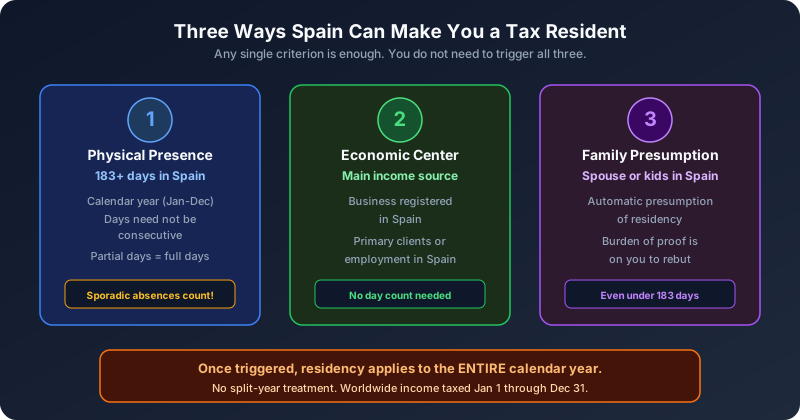
The 183-day rule is straightforward on paper. Under Article 9 of Spain's Personal Income Tax Law (IRPF), you become a tax resident if you spend more than 183 days in Spanish territory during a calendar year. That calendar year runs January 1 through December 31. The days do not need to be consecutive.
Here's where it starts getting tricky.
Partial days count as full days
Landed in Madrid at 11:45 PM on a connecting flight? That counts as a full day. Transit through Barcelona on your way to Lisbon? If you technically entered Spanish territory, that's a day. Spain counts any day where you have physical presence on Spanish soil, even for a few hours, as a complete day of stay.
The "presumed days" doctrine
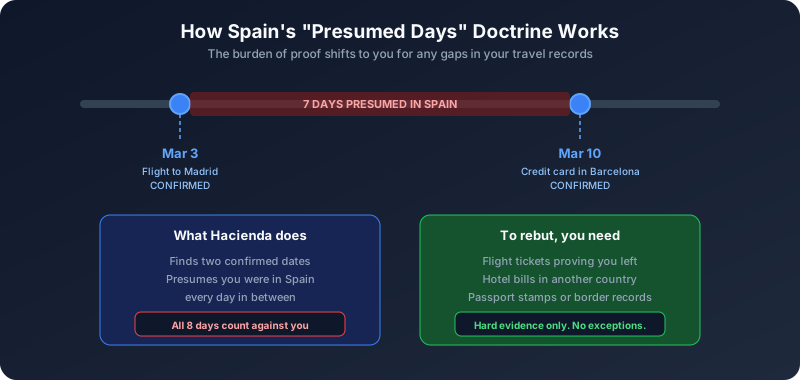
This is the one that catches people off guard. Spanish tax inspectors use a three-tier system when counting your days: certified presence (days they can prove you were in Spain through flight records, credit card transactions, phone data, or apartment contracts), presumed days (if they can prove you were in Spain on March 3rd and March 10th, they will presume you were there for every day in between), and sporadic absences.
That middle category is powerful. The burden of proof shifts to you. Unless you can demonstrate with hard evidence, think flight tickets, hotel bills, passport stamps, that you were physically in another country between those two certified dates, Spain counts those days as Spanish days.
Sporadic absences still count as Spain days
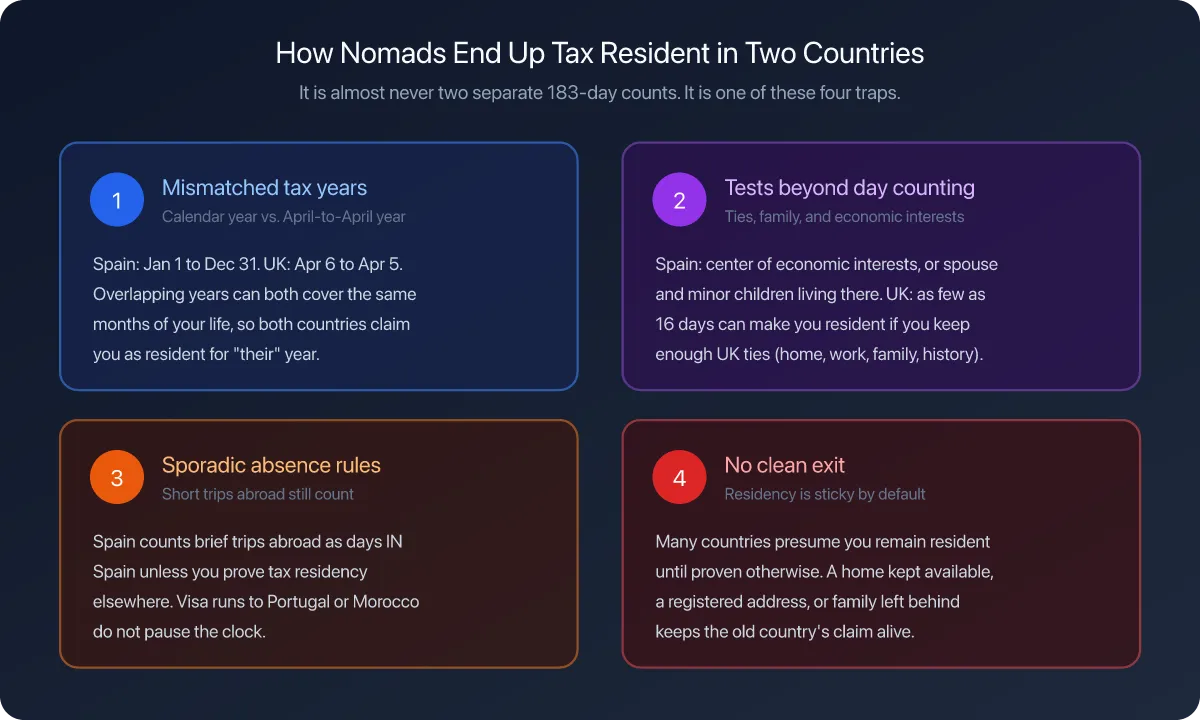
This is the rule that makes the 183-day calculation feel almost adversarial. If you pop out to Lisbon for a long weekend or fly to London for a meeting, those days abroad may still count as days in Spain for tax purposes. The Hacienda treats short trips out of the country as "sporadic absences" and adds them to your presence total, unless you can prove you are a tax resident of another country. That last clause is where a lot of nomads discover they are tax resident in two countries at once, because proving residency elsewhere means another country already has a claim on you.
Read that again. A weekend trip to Morocco doesn't subtract from your Spain count. It gets added to it.
The only reliable way to exclude days spent abroad from your Spanish total is to hold a certificate of tax residency from another country. Without that, Spain's default assumption is that you were present.
The Two Other Ways Spain Can Claim You
Most nomads fixate on the 183-day count and ignore the other two criteria entirely. That's a mistake, because either one of them can independently make you a tax resident, even if you never hit 183 days.
Criterion 2: Center of economic interests
If the "main nucleus" of your economic activities or interests is located in Spain, you are a tax resident. Full stop. No day count required.
What counts as a center of economic interests? Running a business registered in Spain. Having your primary clients in Spain. Earning most of your income from Spanish sources. Holding significant investments or property in Spain.
The tax authorities weigh active economic ties (a business, employment, regular clients) much more heavily than passive wealth (stocks, bank accounts). So having a large brokerage account in the US matters less than having a co-working membership and a handful of Spanish clients.
For digital nomads, this criterion usually isn't the primary risk. But if you've set up as an autónomo (self-employed) in Spain or registered a Spanish company, the economic center test becomes very relevant, very fast.
Criterion 3: The family presumption
If your spouse (not legally separated) or minor dependent children reside permanently in Spain, the tax authorities presume you are also a resident. This is a legal presumption, meaning it applies automatically unless you provide evidence to rebut it.
In practice, this means: if your partner moves to Spain with the kids while you travel for work, Spain assumes you live there too. You would need to prove, with documentation, that you are a tax resident of another specific country to override this.
No part-year residency
Here's one more detail that surprises people coming from countries like the UK or the US. Spain does not recognize split-year treatment. You are either a tax resident for the entire calendar year or you are not. There's no "I was resident from June to December" status. If you trigger residency by any of the three criteria at any point during the year, you owe taxes on your worldwide income for that full January-to-December period.
What Digital Nomad Visa Holders Need to Know
Spain's digital nomad visa (officially the International Telework Visa) is an immigration document, not a tax document. Holding the visa does not determine your tax status. What determines your tax status is how many days you spend in Spain and whether you meet either of the other two criteria. If you are still weighing Spain against other programs, we put the income thresholds and tax treatment side by side in our 2026 digital nomad visa comparison.
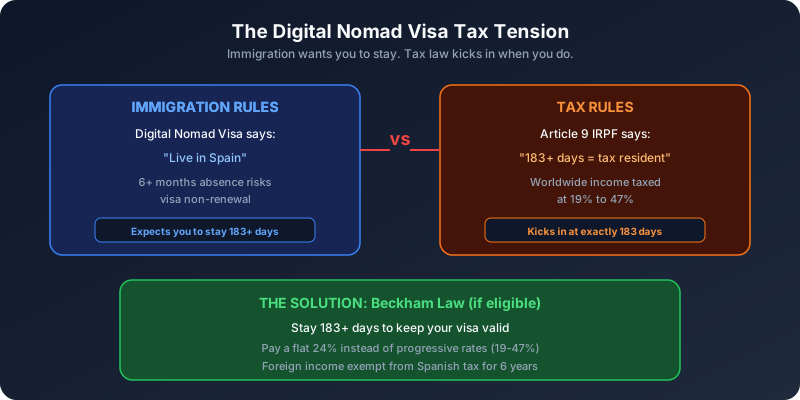
In practice, though, there's an inherent tension. To keep the visa valid and to renew it, immigration authorities expect you to actually live in Spain. Absences of more than six consecutive months can jeopardize your renewal. But living in Spain for more than 183 days in a calendar year makes you a tax resident.
For most digital nomad visa holders, becoming a Spanish tax resident is not an "if" but a "when."
Income requirements in 2026
The minimum income threshold for the digital nomad visa is 200% of Spain's Minimum Interprofessional Salary (SMI). In 2026, that works out to approximately €3,024 per month gross. If you're bringing dependents, the threshold increases by 75% for a spouse and 25% per child.
You also need to prove that at least 80% of your income comes from clients or employers outside Spain.
The self-employed trap
If you register as an autónomo in Spain to invoice clients, you enter the standard Spanish tax system. Progressive rates from 19% to 47% on worldwide income, plus mandatory social security contributions that start around €300 per month and increase based on your earnings. This is the default outcome for self-employed nomads who become tax residents.
There is no special tax treatment for being a freelancer on a digital nomad visa. The visa gets you in the door. Spanish tax law treats you like any other resident.
The Beckham Law: The Exception Worth Understanding
The one major exception to the standard tax treatment is the Beckham Law (formally, the Special Tax Regime for Impatriates, or Régimen Especial de Impatriados). Originally created in 2005 to attract high-profile talent (yes, named after the footballer), it was significantly expanded by the 2023 Startup Law.
How it works
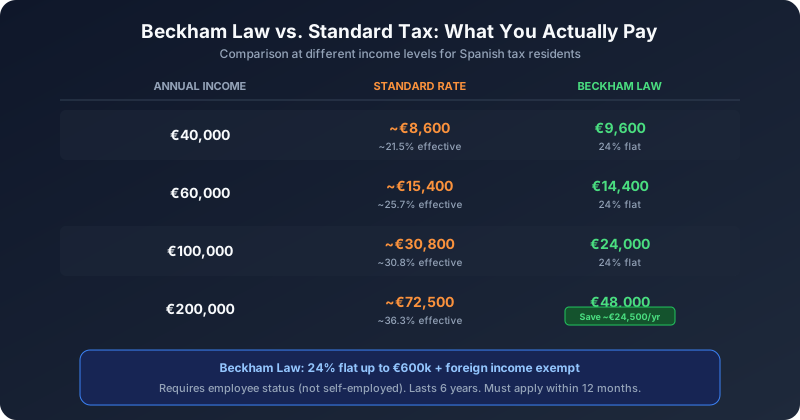
Instead of paying Spain's progressive income tax rates (19% to 47%), you pay a flat 24% on Spanish-source income up to €600,000 per year. Anything above €600,000 is taxed at 47%. Crucially, foreign-source income is exempt from Spanish taxation entirely.
The regime lasts for the year you arrive plus five more calendar years, giving you six years total.
Who qualifies in 2026
The rules changed meaningfully with the Startup Law. You now qualify if you have not been a Spanish tax resident in the previous five years (reduced from the old ten-year requirement). Employees relocating to Spain under a foreign employment contract are the clearest fit. Digital nomad visa holders who work as employees of non-Spanish companies can also qualify. Entrepreneurs, investors, and "highly qualified professionals" are now eligible too, provided they meet certain conditions.
There's one critical exclusion: if you register as an autónomo (self-employed), you generally lose eligibility for the Beckham Law. This is the single most important fork in the road for nomads considering Spain. How you structure your work, employee versus self-employed, determines which tax regime you land in.
Application timeline
You must apply within 12 months of registering with Spanish Social Security or starting qualifying employment activity in Spain. Miss this window and you're locked into the standard regime for the rest of your stay. Given bureaucratic processing times, starting the application early is non-negotiable.
Family benefits
Under the 2023 reforms, your spouse and children under 25 can also benefit from the 24% flat rate if they relocate with you. This is a significant addition that makes the Beckham Law considerably more attractive for nomads with families.
Real Scenarios: How This Plays Out
Scenario 1: The careful counter
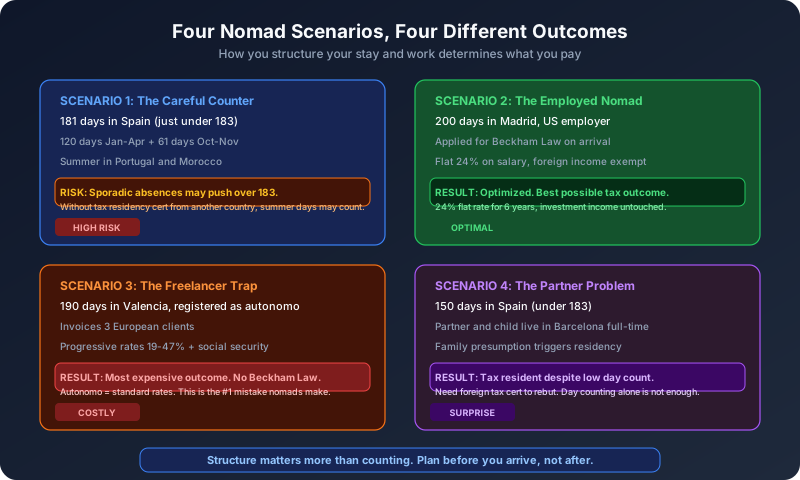
You spend January through April in Barcelona (120 days), then head to Portugal and Morocco for the summer, and return for October and November (61 days). Total: 181 days. You think you're safe. But if you don't hold a certificate of tax residency from Portugal or Morocco, Spain may count some of those summer days as sporadic absences, pushing you over 183. This is also the trap sitting underneath the idea of being a tax resident of nowhere: staying under the threshold is only half the work, being able to prove it is the other half.
Scenario 2: The employed nomad
You have a remote contract with a US company and get the digital nomad visa. You spend 200 days in Madrid. You apply for the Beckham Law within the first six months. Result: you pay 24% flat on your US salary (which is considered Spanish-source because you physically work in Spain), and any investment income from the US stays untaxed by Spain.
Scenario 3: The freelancer who didn't plan ahead
You arrive on the digital nomad visa and register as an autónomo to invoice your three European clients. You spend 190 days in Valencia. You are now a Spanish tax resident paying progressive rates up to 47% on your worldwide income, plus social security contributions. The Beckham Law is off the table because you registered as self-employed. This is the most common and most expensive mistake I see nomads make.
Scenario 4: The partner problem
You spend only 150 days in Spain, well under 183. But your partner and child live in Barcelona full-time. Spain presumes you are a tax resident. Without a certificate proving tax residency elsewhere, you owe Spanish taxes on your worldwide income for the entire year.
How to Protect Yourself
Keep meticulous records
The "presumed days" doctrine means that gaps in your documentation work against you. Save every flight confirmation, every hotel booking, every Airbnb receipt. If you cross a border by train or car, keep the ticket. Credit card statements showing purchases in other countries are useful evidence, but they're secondary to transportation records that prove physical presence elsewhere.
Get a certificate of tax residency
If you split time between Spain and another country, obtain a certificate of fiscal residency from whichever country you consider your tax home. This is the single strongest piece of evidence you can have when Spain's tax authority questions your status.
Structure your work carefully
Before you move to Spain, decide whether you will work as an employee or as self-employed. If you have the option to remain employed by a foreign company, this path gives you access to the Beckham Law and its 24% flat rate. If you must be self-employed, understand that you're signing up for the standard progressive rates.
Track your days automatically
Manual counting fails when you're crossing borders frequently. A weekend in Lisbon, a conference in Berlin, a visa run to Morocco: each of these affects your count and your evidence trail. The 183-day calculation is unforgiving, and Spain's "presumed days" approach means missing documentation can add days you didn't actually spend there.
This is exactly the kind of problem that Nomad Tracker was designed for. The app logs your location automatically, building a day-by-day record of which country you were in. When tax season arrives (or when an inspector asks questions), you have a complete, timestamped trail showing exactly where you were every single day. No spreadsheets, no guesswork, no scrambling through old emails for flight confirmations.
Consult a Spanish tax advisor early
This is not optional. Spanish tax law has enough nuance, from sporadic absences to the center-of-interests test, that general advice from the internet (including this article) only gets you so far. A qualified asesor fiscal who specializes in international clients can structure your arrival correctly from day one.
The Bottom Line
Spain's 183-day rule is real, but it's just one of three paths to tax residency. The presumed days doctrine, the center of economic interests test, and the family presumption each carry independent weight. And once you're a resident, it's for the entire calendar year with worldwide taxation.
The good news: if you plan ahead, Spain can actually be a very favorable place to base yourself. The Beckham Law's 24% flat rate is one of the most generous impatriate regimes in Europe, and the digital nomad visa gives you a legitimate path to long-term residency. The key is structuring everything correctly before you arrive, not after.
Spain is an incredible place to live and work. Just don't let the "183 days" number lull you into thinking the tax situation is straightforward. It isn't. But with the right planning, it's entirely manageable.
Know exactly how many days you've spent in Spain.
Nomad Tracker automatically logs your days per country, tracks fiscal residency thresholds, and alerts you before you hit critical limits. All on-device, all private.
Download on the App Store