Most nomads worry about becoming a tax resident somewhere by accident. Far fewer realize the uglier version of that problem: becoming a tax resident of two countries at the same time, with both of them claiming the right to tax your entire worldwide income.
This is not a rare edge case. Tax advisors who work with remote workers see it constantly, and the support inbox at Nomad Tracker regularly gets messages from users who discovered, usually a year too late, that two tax agencies both consider them "theirs." The good news is that the international tax system has a built-in mechanism for resolving it. The bad news is that the mechanism is slow, paperwork-heavy, and far easier to avoid than to invoke.
This guide explains how dual tax residency happens, walks through a realistic Spain-UK scenario, breaks down the treaty tie-breaker rules that decide which country wins, and shows you how to make sure you never need them.
What Dual Tax Residency Actually Means
Every country defines tax residency under its own domestic law. Spain has its rules, the UK has its rules, Germany has its rules, and none of them check with each other before applying them.
That independence is the whole problem. There is nothing in any country's domestic law that says "this person is already a tax resident somewhere else, so we will back off." If you meet Spain's residency tests and the UK's residency tests in the same year, then under domestic law you are simply a tax resident of both. Each country, on its own, expects a resident tax return declaring your worldwide income.
Without a fix, that means genuine double taxation: the same freelance income or salary taxed twice, once by each country. The fix exists in the network of bilateral double taxation agreements (DTAs), most of which follow the OECD Model Tax Convention. But the treaty only helps if you know it exists, claim it correctly, and can prove the facts it asks about.
The Four Ways Nomads Walk Into This Trap
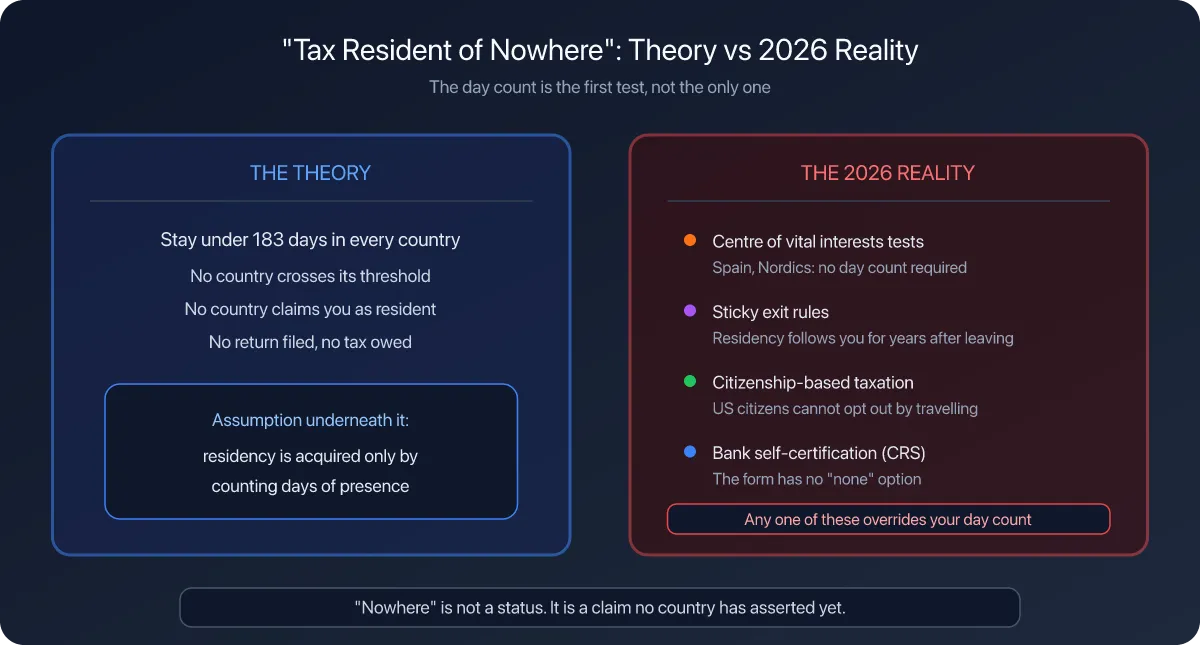
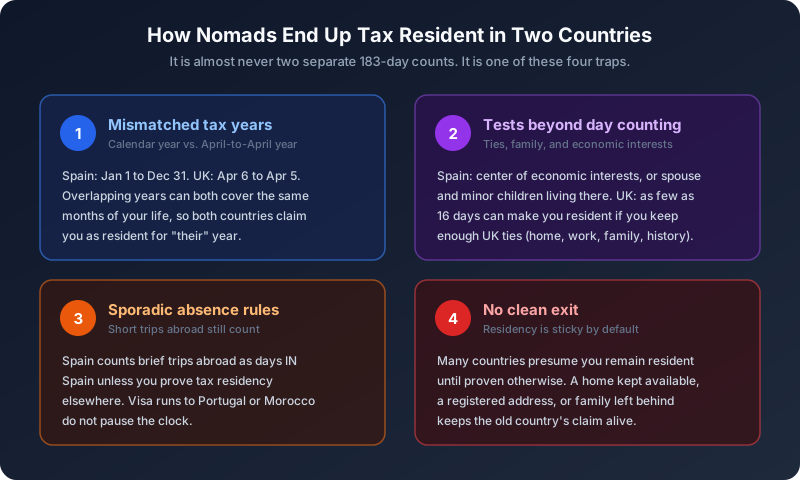
Dual residency almost never happens because someone spent 183 days in two different countries. That is mathematically impossible in a single calendar year. It happens through quieter mechanisms.
1. Mismatched tax years. Spain's tax year is the calendar year, January to December. The UK's runs from April 6 to April 5. Australia's runs July to June. When tax years overlap rather than align, you can be resident in one country for its tax year and resident in another country for its differently-shaped tax year, with both years covering the same months of your life.
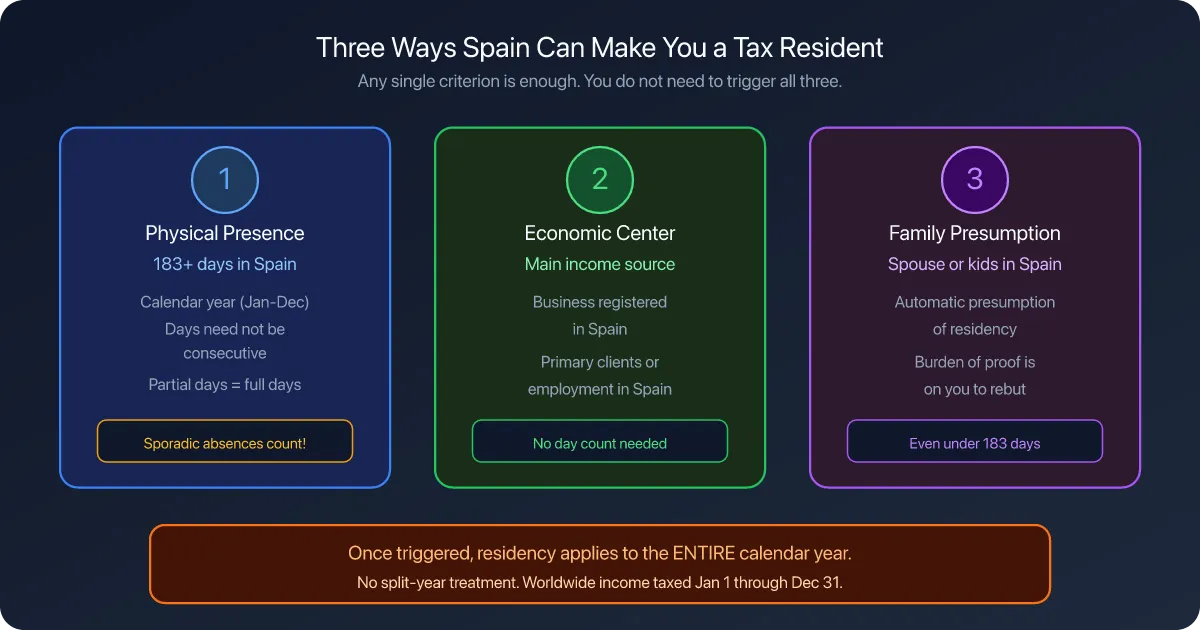
2. Residency tests that are not about day counting. Spain will treat you as a tax resident, regardless of your day count, if your "center of economic interests" is in Spain or if your non-separated spouse and dependent minor children habitually live there. The UK's Statutory Residence Test can make you UK resident with as few as 16 days of presence if you have enough UK ties: a home available to you, a resident family, substantive UK workdays, and recent UK residency history all count.
3. Sporadic absence rules. Spain counts short trips abroad as days in Spain unless you can prove you were tax resident somewhere else during that period. A nomad who uses Spain as a base and does visa runs to Portugal and Morocco may believe they stayed under 183 days while the Spanish tax agency, the AEAT, counts every one of those absences against them. We went through that doctrine, and the two other ways Spain can claim you, in our guide to the 183-day rule in Spain.
4. Failure to cleanly exit the old country. Tax residency is sticky. Many countries presume you remain resident until you demonstrate otherwise, and "I bought a one-way ticket" is not a demonstration. Keeping a home available, a registered address, local investments, or family in your previous country can keep its residency claim alive long after you stopped sleeping there.
A Worked Example: The Spain-UK Squeeze
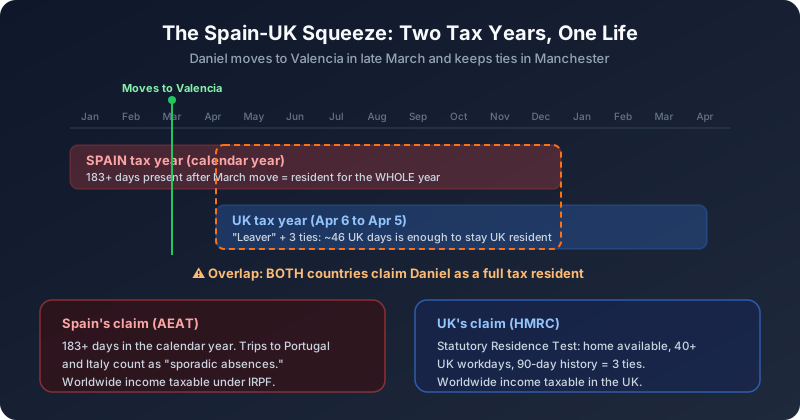
Consider a hypothetical but very typical case. Daniel is a British software contractor. In late March he moves to Valencia, rents an apartment on a 12-month lease, and starts the paperwork for Spain's digital nomad visa. He keeps his flat in Manchester "just in case," flies back regularly for client work, and spends scattered weeks in Portugal and Italy.
By December, here is what each country sees.
Spain's view: Daniel arrived in late March and was physically present well over 183 days during the calendar year. His short trips to Portugal and Italy count as sporadic absences because he cannot prove tax residency anywhere else during them. He is a Spanish tax resident for the entire calendar year, taxable on worldwide income.
The UK's view: Under the Statutory Residence Test, Daniel was UK resident in the previous three tax years, which puts him on the stricter "leaver" table. He kept accommodation available in Manchester, exceeded 40 UK workdays visiting clients, and spent more than 90 days in the UK during the prior tax year. With three ties, around 46 days of UK presence in the tax year is enough to keep him UK resident. His client trips add up well past that.
Result: for the overlapping months, both countries classify Daniel as a full tax resident. Spain wants IRPF on his worldwide income for the calendar year. HMRC wants UK tax on his worldwide income for the UK tax year. Neither claim is a mistake. Both are correct applications of domestic law.
The Tie-Breaker: How Treaties Decide Who Wins
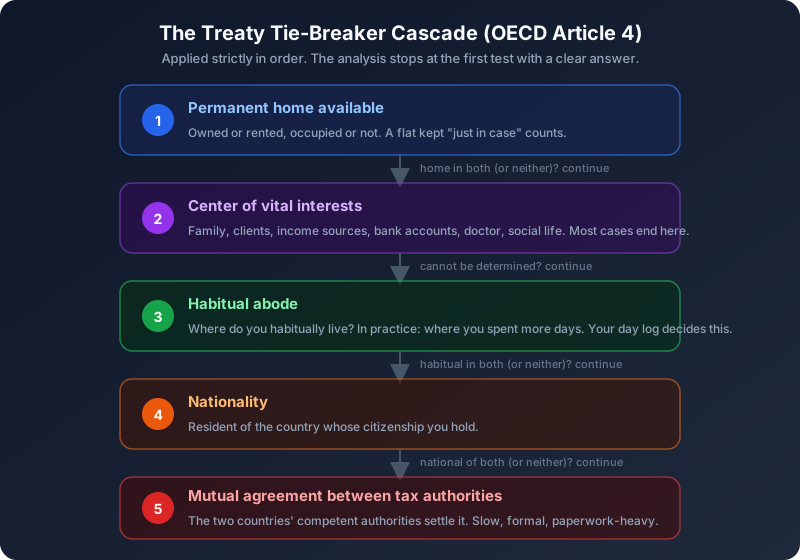
This is where the double taxation agreement steps in. Article 4(2) of the OECD Model Convention, which the Spain-UK treaty follows, contains a cascade of tie-breaker tests. They are applied strictly in order, and the analysis stops at the first test that produces a clear answer.
Test 1: Permanent home. You are resident where you have a permanent home available to you. "Available" is the key word: it does not need to be owned, and it does not need to be occupied. A rented apartment, or a flat kept empty "just in case," both count. If you have a permanent home in both countries, as Daniel does, this test ties and you move on.
Test 2: Center of vital interests. Where are your personal and economic relations closer? Tax authorities look at where your family lives, where your clients and income sources are, where your bank accounts and investments sit, your gym membership, your doctor, your social life. This is a facts-and-circumstances test, and it is where most dual residency cases are actually decided. For Daniel, it is genuinely contested: his lease and daily life point to Spain, while his clients, company, and financial accounts point to the UK.
Test 3: Habitual abode. If the center of vital interests cannot be determined, residency goes to the country where you habitually live, in practice a comparison of where you spent more time across the relevant period. Daniel's day count favors Spain.
Test 4: Nationality. Still tied? You are resident in the country of your citizenship. For Daniel that would be the UK, but in his case the cascade likely resolves at test 2 or 3.
Test 5: Mutual agreement. If you are a national of both countries or of neither, the two tax authorities must settle it between themselves.
One important caveat for American readers: US citizens generally cannot use tie-breakers to escape US taxation, because nearly every US treaty contains a "saving clause" letting the US tax its citizens regardless of where they reside. The tie-breaker still matters for the other country's claim, but the US side never fully lets go.
When the Tie Does Not Break Cleanly: The MAP Process
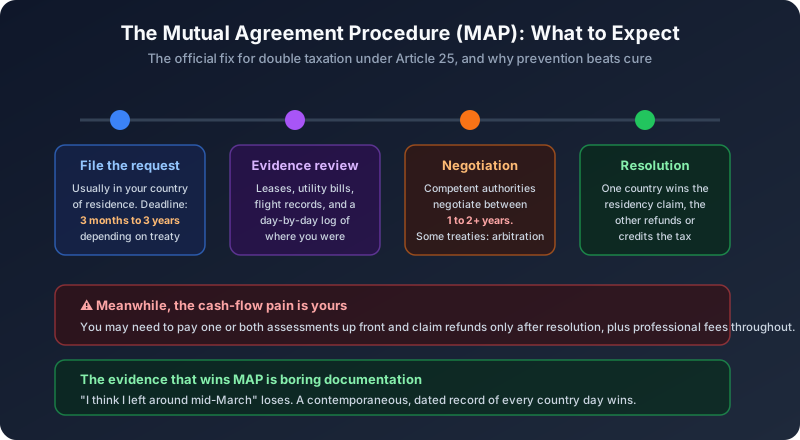
Winning the tie-breaker on paper does not mean the losing country simply sends a polite letter and disappears. If both tax agencies have already assessed you, or if the facts are contested, you may need the Mutual Agreement Procedure (MAP) under Article 25 of the treaty.
MAP is a formal negotiation between the two countries' "competent authorities," typically specialist units inside each tax agency. You file a request, usually in your country of residence, presenting the facts and the double taxation you face. Deadlines matter: depending on the treaty, you must file within a window that ranges from three months to three years of the first notification of the problematic assessment.
Then you wait. MAP cases routinely take one to two years, and complex ones take longer. Some modern treaties allow you to request binding arbitration if the authorities cannot agree within two years. During the process you may need to pay one or both assessments and claim refunds later, depending on each country's rules about suspending collection.
A practical reality: throughout MAP, the evidence that wins is boring documentation. Lease agreements, utility bills, flight records, and above all a credible, contemporaneous record of where you physically were on every disputed day. Tax authorities do not accept "I think I left around mid-March." They accept dated records.
Why You Cannot Just Ignore It: The CRS Factor
A decade ago, plenty of nomads resolved dual residency by simply not telling one of the countries. That option is gone.
Under the Common Reporting Standard, banks and brokers must report account information to every jurisdiction where the account holder has declared tax residency. They are explicitly not allowed to pick a "primary" country. If your bank knows you have a Spanish address and a UK address, both tax agencies receive your account data automatically, every year.
So when Spain's AEAT receives CRS data showing accounts linked to a person with a Valencia address who never filed a Spanish return, a letter follows. The same applies in reverse. Dual residency situations do not stay hidden anymore; they surface on their own schedule, usually with late-filing penalties and interest attached.
How to Avoid Dual Residency in the First Place
The entire mess above is preventable. The pattern in almost every dual residency case is the same: the person moved countries without managing the exit, and without an accurate record of their days. Here is what actually protects you.
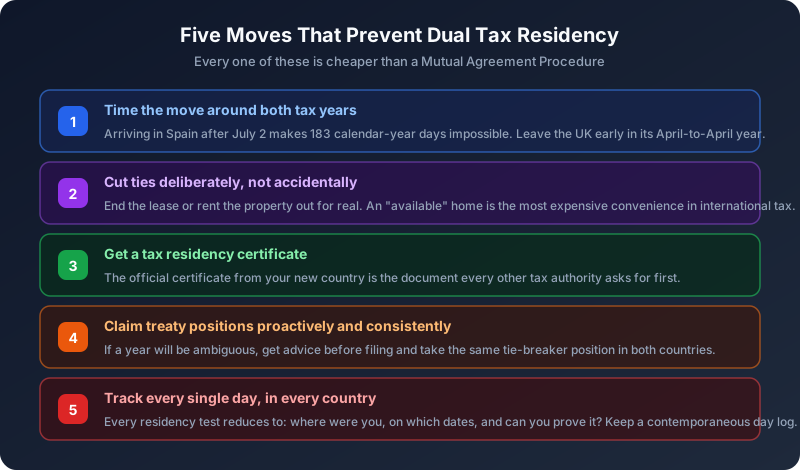
Plan the move date around both tax years. Moving to Spain in the second half of the year, after July 2, makes it arithmetically impossible to hit 183 Spanish days in that calendar year. Moving out of the UK early in its tax year, and keeping subsequent UK visits minimal, weakens the SRT claim fast.
Cut ties deliberately, not accidentally. A home that remains "available" to you is the single most expensive convenience in international tax. If you leave a country, end the lease, rent the property out on terms that genuinely remove your access, or sell. Review where your spouse and minor children live, because Spain and many other countries treat family location as a residency presumption.
Get a tax residency certificate. Once you are clearly resident in your new country, obtain the official certificate from its tax agency. It is the document every other tax authority asks for first, and it is what lets you rebut rules like Spain's sporadic absence counting.
Use the treaty proactively. If you know a year will be ambiguous, get advice before filing, claim the tie-breaker position consistently in both countries, and document the facts supporting your permanent home and center of vital interests.
Track every single day, in every country. Every test described in this article, Spain's 183 days, the UK's day-and-ties tables, habitual abode under the treaty, ultimately reduces to the same question: where were you, on which dates, and can you prove it? A contemporaneous day log is the difference between a five-minute answer and a two-year MAP case. That is the case we make at length in why we track every day in every country.
The Takeaway
Dual tax residency is not caused by bad luck. It is caused by two countries' rules quietly overlapping while nobody is keeping score. The treaty tie-breaker will usually rescue you eventually, but "eventually" can mean years of correspondence, professional fees, and cash-flow pain while two tax agencies sort out who you belong to.
The cheapest insurance is unglamorous: know the residency tests of every country you spend serious time in, manage your exits as carefully as your entries, and keep an airtight record of your days.
That last part is exactly what Nomad Tracker does. The app logs your country days automatically on-device, tracks your progress against each country's fiscal thresholds, and fires alerts well before you cross a line like 183 days in Spain. The Ghost Trips feature lets you simulate a planned move and see the residency consequences before you book the flight.
Never let two countries claim you at once.
Nomad Tracker monitors your days against every country's tax residency thresholds, with alerts before you hit 183 days -- all on-device, all private. Available on iOS.
Download on the App Store