"Move to Dubai. Pay 0% income tax." It is one of the most repeated lines in the digital nomad corner of the internet. Influencers post yacht photos. Tax consultants run ads. Discord groups argue about which free zone is best. The pitch is real, in the sense that the United Arab Emirates does not impose personal income tax on residents. But the pitch is also wildly incomplete.
By the time you factor in corporate tax obligations, the 183-day residency math, mandatory health insurance, Dubai's rental market, and the rules your home country still applies to you, the picture changes. Sometimes it still works. Often it does not. This guide walks through what the 2026 reality actually looks like, with numbers from current UAE regulations rather than vibes from a sponsored YouTube video.
What Dubai Actually Offers
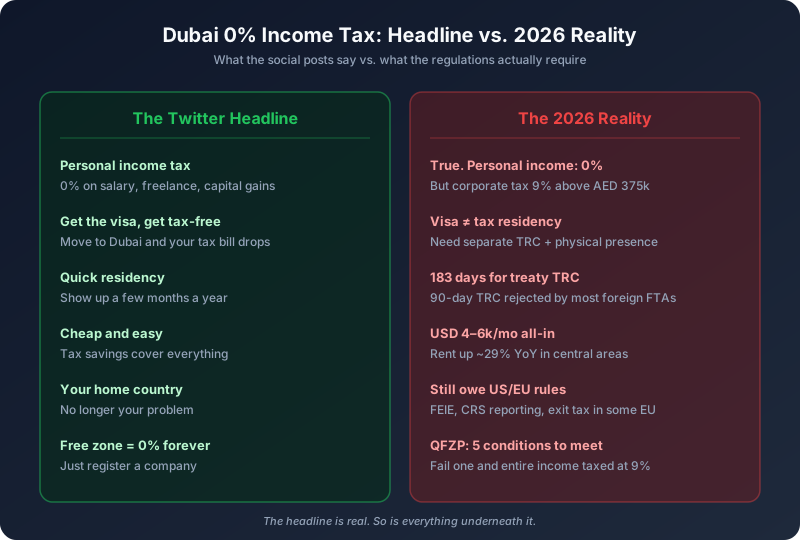
The UAE has no personal income tax. None. There is no tax on salary, no tax on freelance earnings, no tax on dividends, no tax on capital gains, no wealth tax, no inheritance tax, no gift tax. That part of the pitch is accurate, and it is genuinely unusual on a global scale.
There is also no state tax, no municipal income tax, and no payroll deduction equivalent to social security. VAT exists at 5%, which is low by international standards. Excise taxes apply to a narrow list of goods like tobacco and sugary drinks. For the typical remote worker, the day-to-day tax burden on personal income is structurally zero.
This is what generates the headline. It is also where most coverage stops.
The Corporate Tax Layer Most Posts Ignore
In June 2023 the UAE introduced a federal corporate tax. By 2026 it is fully active, and it changes the conversation for any nomad who runs a business through a UAE entity or operates as a freelancer above a certain revenue threshold.
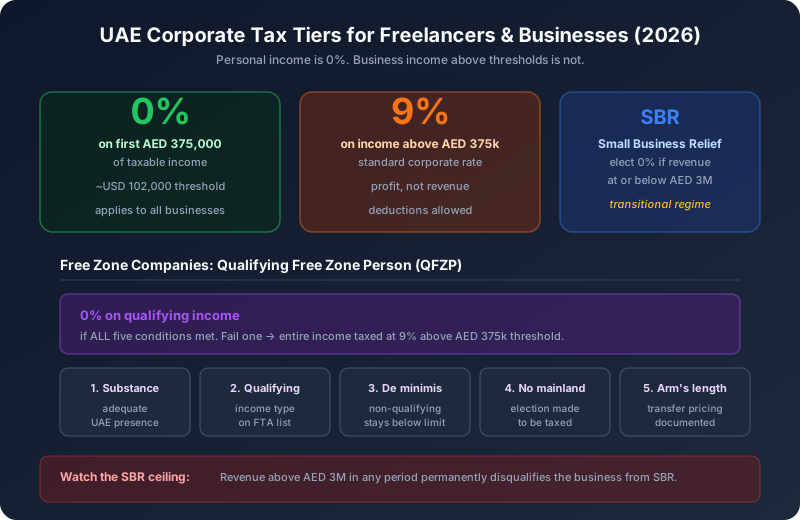
The headline rate is 9% on taxable income above AED 375,000 (roughly USD 102,000). Below that threshold, the rate is 0%. So a freelancer or business owner clearing AED 300,000 a year pays nothing. A freelancer clearing AED 600,000 pays 9% on the AED 225,000 of profit above the threshold.
There is also a transitional Small Business Relief regime. Businesses with total revenue at or below AED 3 million (about USD 817,000) can elect to treat their taxable income as zero for the period, effectively paying no corporate tax. The relief was originally available for tax periods ending on or before 31 December 2026, and the UAE Federal Tax Authority has extended it for qualifying taxpayers. Once your revenue exceeds AED 3 million in any tax period, you are permanently ineligible going forward, even if revenue drops back down later.
Free zone companies have their own track. A Qualifying Free Zone Person can pay 0% on qualifying income, but only if it meets all five conditions: adequate substance, qualifying income definitions, the de minimis test, no mainland election, and arm's length transfer pricing. Fail one condition and the entire income is taxed at 9% above the threshold.
The practical takeaway: most solo nomad freelancers will pay 0% in practice, either by staying under the threshold or qualifying for Small Business Relief. But the structure exists, the registration requirements exist, and the compliance cost exists. "0% tax" is true for personal income. It is conditionally true for business income, and only if you actually understand and meet the conditions.
The 183-Day Trap
Here is the part that catches a lot of people. Holding a UAE visa does not make you a tax resident of the UAE. Living in Dubai for two months does not make you a tax resident of the UAE. The UAE has specific tax residency rules, and meeting them matters whenever you need to claim tax treaty benefits against your home country.
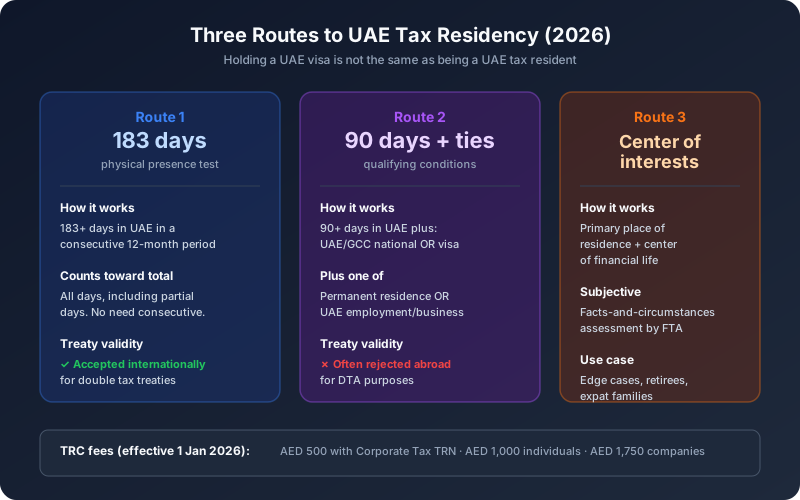
There are three routes to UAE tax residency for individuals in 2026.
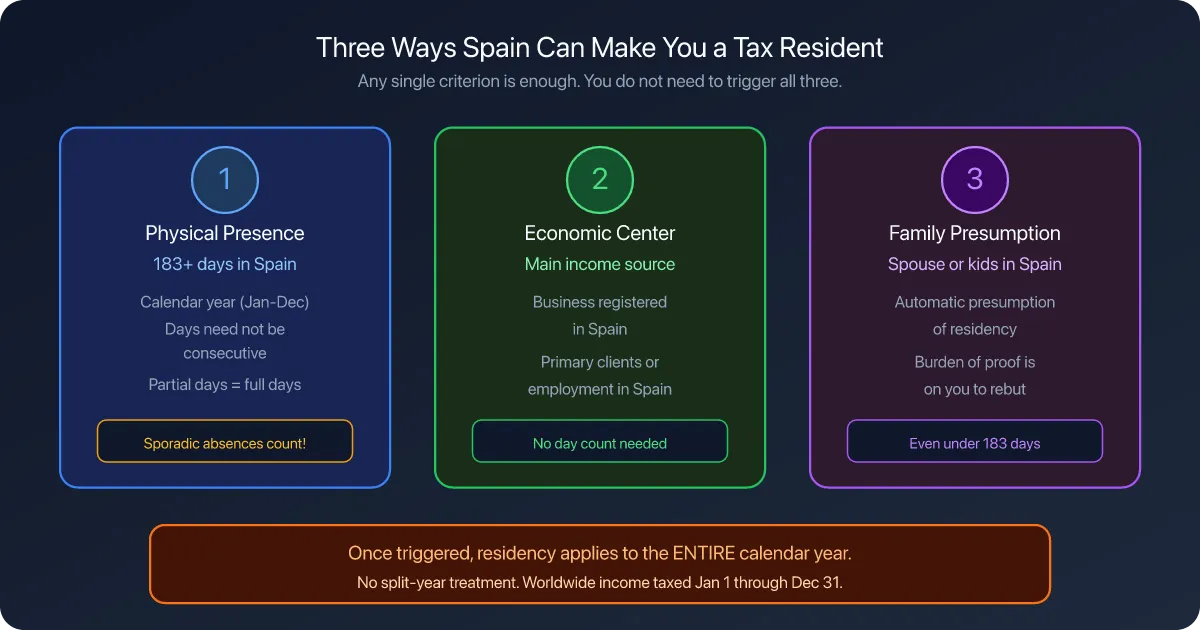
The 183-day physical presence test is the most straightforward. Spend 183 days or more inside the UAE in a 12-month period, and you qualify. All days count, including partial days and non-consecutive ones.
The 90-day test with ties is a faster path. You need to be physically present for 90 days or more in a consecutive 12-month period, be a UAE national, GCC citizen, or holder of a valid UAE residence permit, and either maintain a permanent place of residence in the UAE or carry on employment or business activity there.
The center of interests test is the catch-all. Your primary place of residence and the center of your financial and personal interests must be in the UAE.
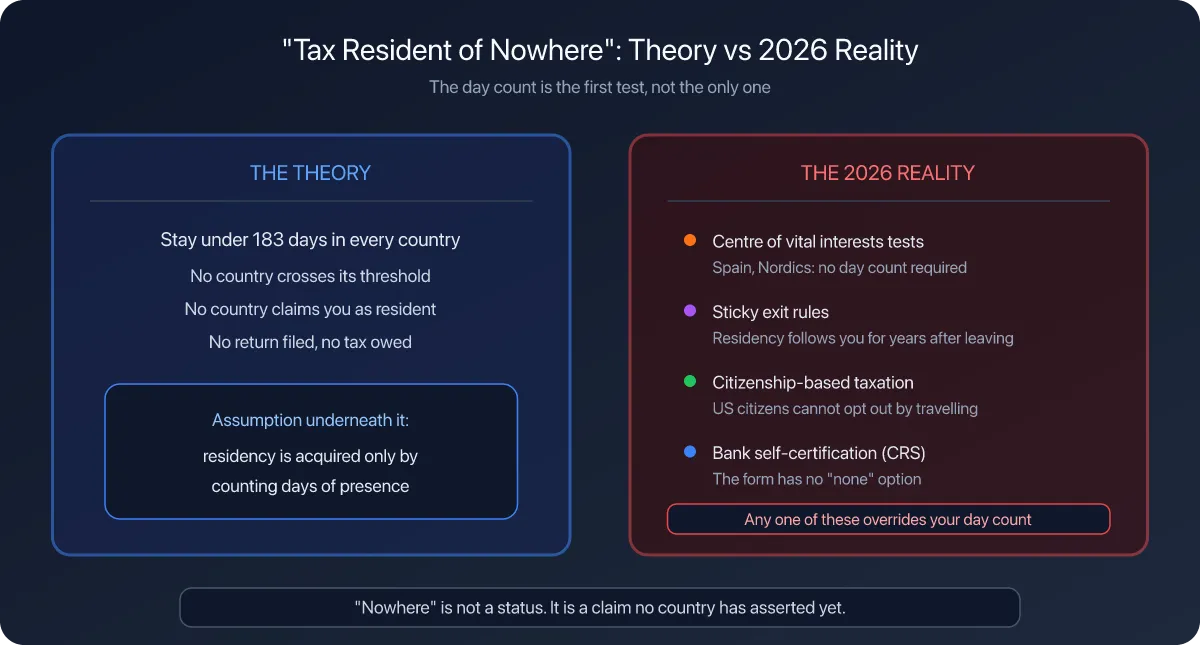
The trap: a Tax Residency Certificate based on the 90-day route is generally accepted for domestic UAE purposes, but most foreign tax authorities will not recognize a 90-day-based certificate for double tax treaty purposes. If you want to use a UAE certificate to claim treaty benefits against your home country, you almost always need the 183-day version. This is the same gap that sinks most attempts at being a tax resident of nowhere: a certificate nobody abroad accepts is not much of a shield.
This is the reality that breaks the "live in Bali half the year, claim Dubai tax residency" plans. Your home country tax authority will look at your actual physical presence, your family, your housing, and your economic ties. If you spent 90 days in Dubai and 200 days elsewhere, your home country will likely still consider you their resident, regardless of what your UAE paperwork says.
The Virtual Work Visa, By the Numbers
The UAE introduced the Virtual Working Programme (often called the Dubai Digital Nomad Visa) in 2021 and refined it in subsequent years. As of early 2026 the program looks like this.
The minimum income requirement is USD 3,500 per month, proven through six consecutive months of bank statements. The six-month rule replaced the previous three-month requirement on January 27, 2026. Applicants need valid international health insurance and proof of employment or business ownership outside the UAE for at least one year.
The visa itself costs around AED 1,535 in government fees, including the Emirates ID, plus AMER service center fees that bring the practical total closer to USD 600 to USD 800 depending on the provider. Initial approval takes five to seven working days. The full process, including medical test, biometrics, and Emirates ID issuance, runs three to four weeks.
The visa is valid for one year and renewable. It gives you legal residence, an Emirates ID, the ability to sponsor immediate family, and access to UAE banking. It does not, by itself, grant tax residency. That is a separate question governed by the residency rules above.
One detail worth highlighting: the visa is designed for people who keep their employer or business outside the UAE. If you start working for UAE clients or set up a UAE entity, you move into different regulatory territory, including potentially the corporate tax regime described earlier.
What Dubai Actually Costs in 2026
The tax savings are real. The cost of living offsets are also real, and they are not small.
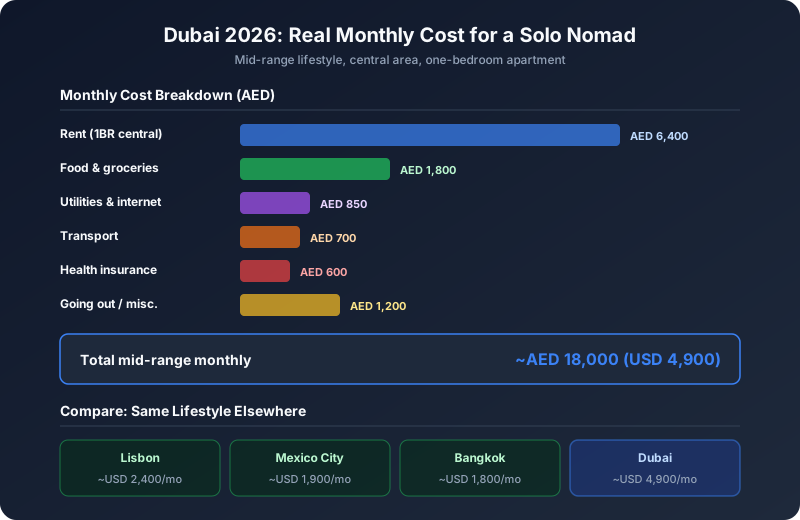
A one-bedroom apartment in central Dubai averages around AED 6,400 per month (about USD 1,742). In more peripheral areas the figure drops to roughly AED 4,040. In premium areas like Downtown Dubai, one-bedrooms regularly hit AED 12,500 per month. The rental market saw apartment rents climb roughly 29% year over year in 2025, and 2026 has continued the upward trend in central districts.
Outside of rent, a single expat in Dubai typically spends around AED 4,150 per month (about USD 1,130) on food, transport, utilities, and basic entertainment. Realistic all-in monthly costs for a mid-range lifestyle in a central area with a private one-bedroom land in the AED 15,000 to AED 20,000 range. That is roughly USD 4,100 to USD 5,450 per month before any travel, savings, or discretionary spending.
Then there is mandatory health insurance. As of 2026, all seven emirates enforce mandatory coverage, and no residency visa can be issued or renewed without proof of an active policy. The minimum Essential Benefits Plan starts at AED 500 to AED 800 per year, but these are bare-bones policies designed for low-income workers. Individual plans appropriate for a remote professional run AED 3,000 to AED 4,000 per year minimum. Comprehensive international coverage with reasonable deductibles and access to private hospitals runs USD 1,000 to USD 4,000 annually depending on age and coverage level.
For comparison, a nomad earning USD 80,000 a year and paying 25% effective tax in their home country saves USD 20,000 by moving to Dubai. Annual Dubai living costs at a mid-range level (rent, food, insurance, utilities, transport) easily reach USD 50,000 to USD 65,000. The same lifestyle in Lisbon, Mexico City, or Bangkok would run a fraction of that. Dubai's tax advantage only outpaces the cost differential at certain income levels, generally above USD 150,000 to USD 200,000 a year, and even then only when home country taxes are high.
The Home Country Question
This is the section most "move to Dubai" content skips entirely.
If you are a US citizen, you owe US tax on worldwide income regardless of where you live. The Foreign Earned Income Exclusion lets you exclude up to USD 130,000 of foreign earned income for tax year 2025 (filed in 2026) and USD 132,900 for tax year 2026. To qualify, you must either spend 330 full days abroad in any 12-month period (Physical Presence Test) or establish bona fide residence abroad for an uninterrupted period including at least one full tax year. FBAR reporting is also required for any non-US financial accounts exceeding USD 10,000 in aggregate. Self-employment tax on the first portion of net self-employment income still applies even when FEIE excludes the income tax piece.
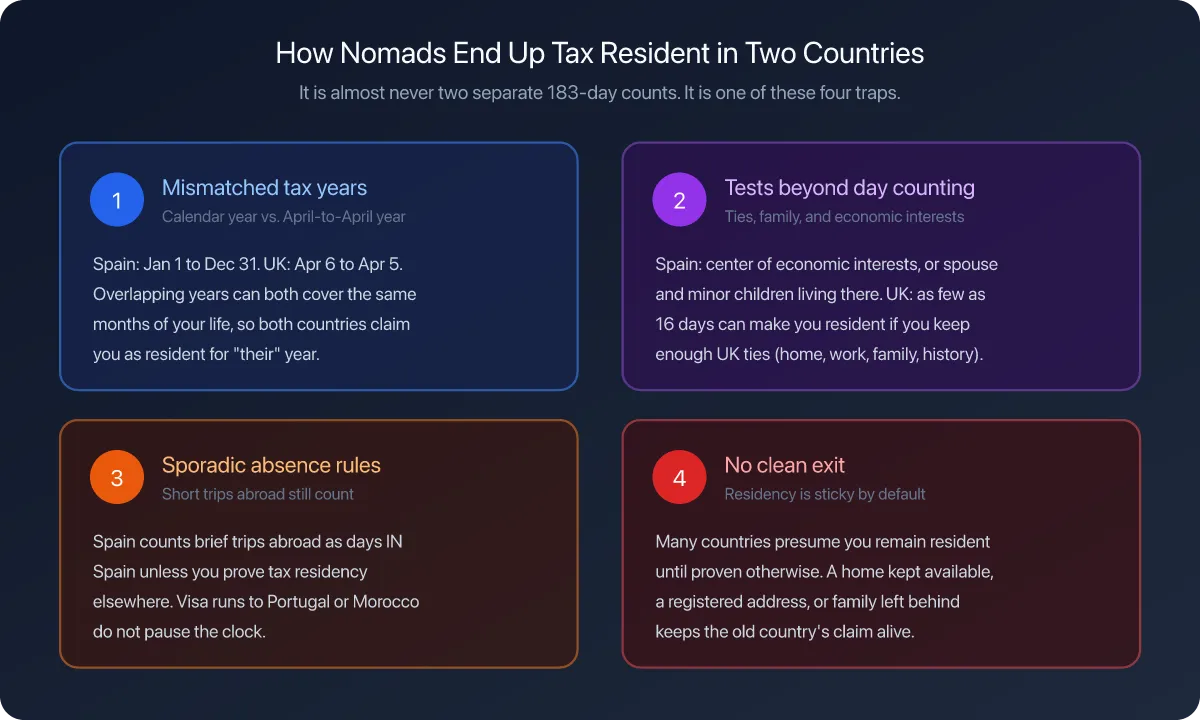
If you are a UK, Canadian, Australian, or EU citizen, your home country residency rules govern whether you remain a tax resident there. Most apply some version of a days-of-presence test, plus a center of vital interests or habitual abode test. Maintaining a home, a family, or significant economic ties in your home country can keep you tax resident there even when you spend most of the year in Dubai.
If you are leaving a high-tax European country, you generally need to break your tax residency cleanly. That often means deregistering from local social security, severing housing ties, and being able to demonstrate that Dubai is now your primary base. Some countries have exit tax regimes for unrealized capital gains on departure. Spain, France, and the Netherlands all have versions of this. Getting Dubai right starts with getting your home country exit right.
Common Reporting Standard (CRS) data exchange means your UAE bank accounts are reported back to your tax residency jurisdiction every year. If your home country still considers you their resident, those reports will flag the income that your UAE bank thinks is tax-free.
When Dubai Actually Makes Sense
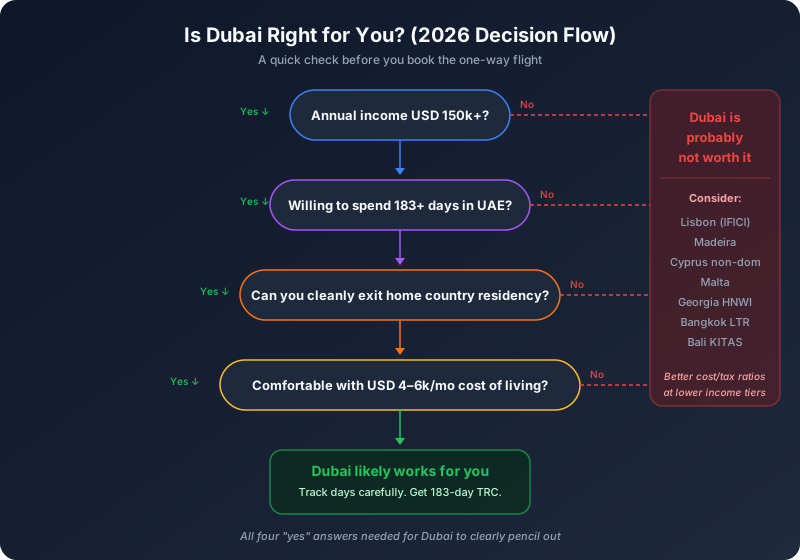
Dubai works well for a specific profile. High earners (typically USD 150,000+ annual income) who genuinely intend to base their life there, can credibly meet the 183-day physical presence requirement, are willing to absorb the cost of living, and either have no home country residual tax obligations (or accept the FEIE-based US filing situation) tend to come out ahead.
It works less well for nomads who travel constantly, earn under USD 100,000, want to maintain ties to a high-tax home country, or imagine that a Dubai visa alone shields them from their home tax authority. For that profile the math typically does not justify the move, and the Dubai-by-paperwork-only approach tends to unravel under audit.
It also works less well as a "tax flag" if you cannot commit to spending half the year on the ground. The 90-day route gives you a UAE certificate but not international treaty validity. Most home countries will reject thin residency claims.
What the Twitter Crowd Gets Right and Wrong
The 0% personal income tax claim is correct. The headline is not a lie.
What gets oversold: that the residency is easy to maintain, that the cost of living is manageable, that your home country will quietly accept your new status, that you can pop in for a few months and unlock tax-free life. None of those are reliably true in 2026.
What gets underdiscussed: the 9% corporate tax for higher-revenue businesses, the AED 3 million Small Business Relief ceiling, the genuine cost of mandatory health insurance, the 29% year-over-year rent increases in central districts, the difference between a 90-day TRC and a 183-day TRC for treaty purposes, and the absolute requirement to break home country tax residency cleanly if you want the headline benefits.
The right framing is not "Dubai is a scam" or "Dubai is a free pass." It is that Dubai is a legitimate but specific tax base for a specific kind of nomad, with real ongoing requirements. Much the same is true of the other headline regimes: Turkey's proposed 20-year exemption on foreign income also only pays off for someone willing to put the days on the ground. Going in with eyes open and a calendar that tracks where you actually are is the difference between this strategy working and falling apart at audit.
Track the Days, Not the Vibes
If you are seriously considering Dubai as a tax base, the single most important thing is accurate day counting. Not approximate. Not "I think I was there about six months." Actual, verifiable, day-by-day records of where you physically were across the year.
The UAE 183-day threshold is calculated to the day. Your home country exit test is calculated to the day, and a botched exit is how people end up tax resident in two countries at once. The FEIE 330-day rule is calculated to the day. A few miscounted days in either direction can flip your status, and there is no friendly border guard who will round in your favor.
This is exactly the gap Nomad Tracker was built to close. The app uses your phone's GPS to detect country changes automatically, builds a verifiable day log without requiring you to remember anything, and runs the residency math for any jurisdiction you configure, including the UAE's 183-day test. Everything stays on-device. No cloud sync, no third-party access to your location history. Just an honest, accurate count of where you actually are, ready for whichever tax authority asks.
Make Dubai math actually work.
Nomad Tracker automates day counting for the 183-day rule, fiscal residency, and visa limits. All on-device, all private. Available on iOS.
Download on the App Store