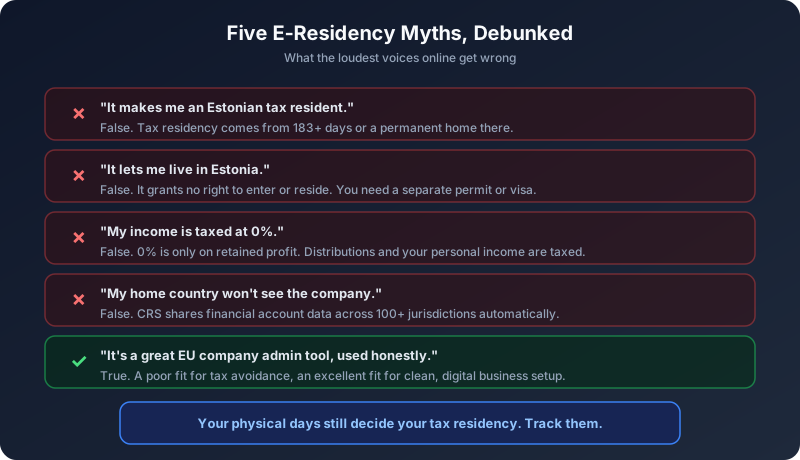
Every few weeks, someone in a nomad forum announces they have "moved their taxes to Estonia" by getting e-Residency. It is one of the most persistent misconceptions in the entire remote-work world, and it is completely wrong. E-Residency does not change where you pay tax. It does not make you a resident of Estonia. It does not even give you the right to set foot in the country.
More than 134,000 people from 185 countries now hold Estonian e-Residency, and they collectively own over 39,000 Estonian companies. That is a lot of people, and a meaningful share of them are operating on a flawed mental model of what the program does. Spanish founders are near the top of the list for new company formations, alongside Ukraine, Turkey, Germany, and France, so this confusion is spread widely across Europe and beyond. Let us clear it up properly.
What E-Residency Actually Is
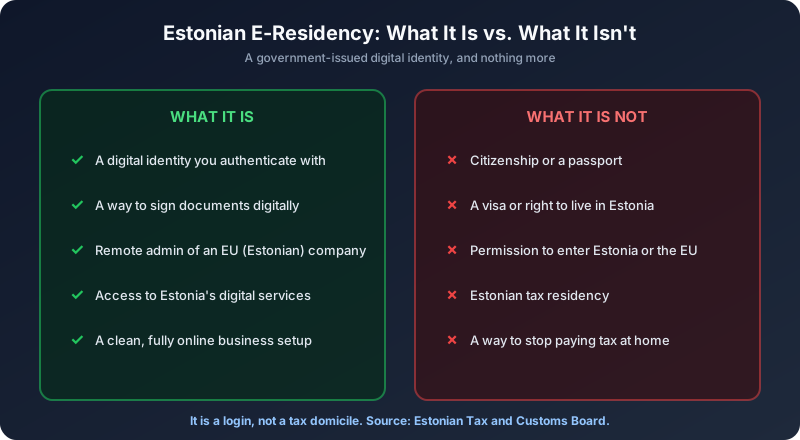
Estonian e-Residency is a government-issued digital identity. That is the entire pitch. It gives you a cryptographic ID that lets you authenticate online, sign documents digitally, and administer an Estonian company remotely from anywhere in the world. It was launched in 2014 as a way to let non-residents plug into Estonia's famously digital public services.
The Estonian Tax and Customs Board is explicit about the limits. A digital ID does not grant citizenship. It does not give you permission to live in Estonia. It does not give you the right to enter Estonia or the wider European Union. And critically, it does not make you a tax resident of Estonia. It is a login, not a passport, and definitely not a tax domicile.
Three Different Things People Constantly Confuse
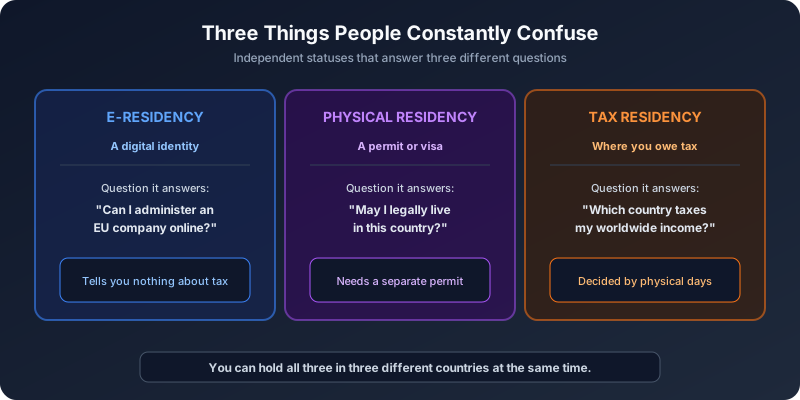
The root of nearly every e-Residency tax myth is that people collapse three separate concepts into one. They are not the same, and understanding the difference is the whole game.
E-Residency is a digital identity. It has nothing to do with where you physically are or where you owe tax.
Physical residency is the legal right to live in a country, usually granted through a residence permit or visa. E-Residency is not this. If you want to actually live in Estonia, you need a separate residence permit, and Estonia does offer a Digital Nomad Visa for that purpose. But the e-Residency card alone gives you zero right to be physically present.
Tax residency is the status that determines which country can tax your worldwide income. This is decided by physical presence and personal ties, not by which digital IDs you happen to hold.
You can be an e-resident of Estonia, a physical resident of Portugal, and a tax resident of Spain, all at the same time. These three statuses answer three different questions, and holding one tells you almost nothing about the others. Holding two of them badly is how people end up tax resident in two countries at once.
How You Actually Become a Tax Resident of Estonia
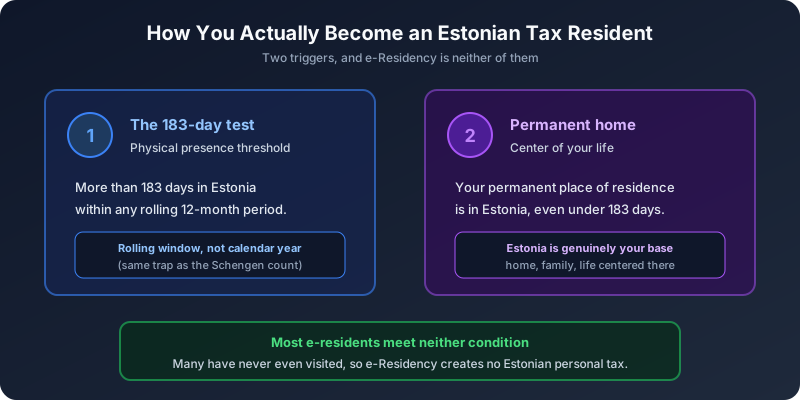
Since e-Residency does not do it, what does? Estonia's rules are conventional. You become an Estonian tax resident if you meet either of two conditions.
The first is the familiar 183-day test. If you spend more than 183 days in Estonia within any rolling 12-month period, you become a tax resident and your worldwide income becomes taxable there. Note that this is a rolling 12-month window, not a calendar year, which is a subtlety that trips people up in exactly the same way the Schengen rolling window does.
The second is having your permanent place of residence in Estonia. If Estonia is genuinely your home, where your life is centered, you can be a tax resident even without hitting 183 days.
For the overwhelming majority of e-residents, neither condition applies. They have never lived in Estonia and many have never visited. So they are not Estonian tax residents, which means e-Residency created no personal tax obligation for them in Estonia at all. That part of the myth, at least, works in the nomad's favor. The problem is what people conclude from it.
The Myth That Actually Costs People Money
Here is the dangerous leap. People reason: "E-Residency does not make me an Estonian tax resident, therefore my Estonian company lets me escape tax." That conclusion does not follow, and it is where nomads get into real trouble.
Two separate tax questions are in play, and the internet mashes them together.
The first is your personal tax residency. That is determined by where you physically live and spend your days, full stop. If you spend most of your year in Spain, you are probably a Spanish tax resident, and Spain taxes your worldwide income including whatever you draw from your Estonian company as salary or dividends. Owning an Estonian OÜ does not change your personal tax home by one inch.
The second is your company's tax position, and this is where the place of effective management concept bites.
The Corporate Tax Reality: 0% Is Not the Whole Story
The Estonian corporate model is genuinely attractive and genuinely misunderstood. An Estonian private limited company, the OÜ, pays 0% corporate income tax on retained and reinvested profits. Tax is only triggered when profit is distributed. When you pay out dividends, the company owes corporate income tax at the 22/78 rate, meaning roughly 22% of the pre-tax amount. Note that a planned increase to a 24/76 rate for 2026 was cancelled by the Estonian Parliament in December 2025, so the 22/78 rate holds for now.
So the "0% tax" headline refers only to money left inside the company. The moment it reaches your pocket, tax applies, both potentially at the company level in Estonia and at the personal level wherever you are a tax resident. There is also a defense-related tax layer that Estonia introduced for the 2025 to 2026 period, so it is worth checking current rates before assuming any figure.
Permanent Establishment: The Trap Nobody Reads About
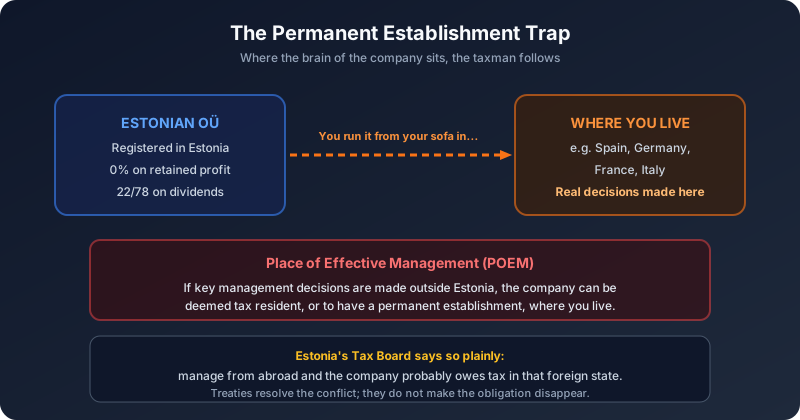
This is the part that turns a clever structure into a compliance nightmare. If you are the director of your Estonian company and you make all the real business decisions from, say, an apartment in Valencia, then under the concept of place of effective management, your Estonian company may be considered tax resident, or to have a permanent establishment, in Spain.
The Estonian Tax and Customs Board says this plainly: if an e-resident manages the company from outside Estonia, the company will probably have a permanent establishment abroad, and income tax must be paid on that company's profit in the foreign state. Many countries, including Germany, France, Italy, and Spain, apply the place of effective management principle drawn from the OECD Model Tax Convention. The logic is simple. Where the brain of the company sits, the taxman follows.
That means the Estonian company you set up to simplify your taxes can quietly create a taxable presence in the country where you actually live and work. Estonia has more than 60 double-taxation treaties to sort out who gets to tax what, but those treaties resolve conflicts, they do not make the obligation disappear. You still have to file, declare, and often pay where your management sits.
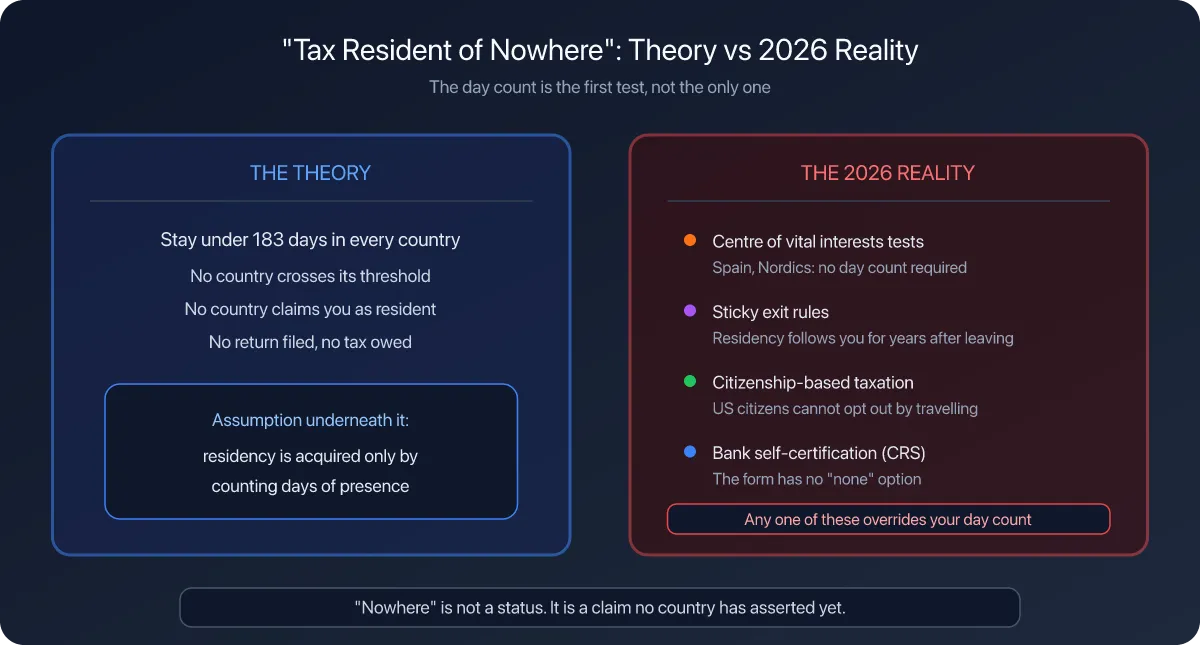
The honest summary: an Estonian OÜ works cleanly when the person running it is a genuine perpetual traveler with no strong tax home anywhere, a position that is harder to hold in 2026 than it sounds. It gets complicated fast the moment you settle somewhere with a real 183-day tax residency, because that country will look straight through the Estonian wrapper.
The Reporting Reality Most People Ignore
There is one more layer that the "just get e-Residency" crowd tends to skip: information reporting. Under the Common Reporting Standard, banks and financial institutions automatically share account information with tax authorities across more than 100 participating jurisdictions. Your Estonian business bank account, your fintech account, your company records: these are increasingly visible to the tax authority in your country of residence.
The days when an offshore-flavored structure quietly stayed offshore are over. If your home country's tax office wants to know whether you control a foreign company and draw income from it, the data is flowing to them automatically. Setting up the structure is the easy part. Reporting it correctly, in every country that has a claim, is the part that actually matters.
What E-Residency Is Genuinely Good For
None of this means e-Residency is a scam or a trap. It is an excellent tool used honestly. It is a strong fit if you are a location-independent freelancer or small software business without a fixed tax home, if you want a legitimate EU company with fully digital administration, if you bill EU clients and want a clean euro-denominated invoicing setup, or if you value being able to run everything remotely without paperwork trips.
It is a poor fit if you are hoping it will let you stop paying personal income tax in the country where you actually live. It will not. It is a company administration tool, not a tax-avoidance device, and treating it as the latter is how people end up with back taxes and penalties in their real country of residence.
The Common Thread: You Still Have to Count Days
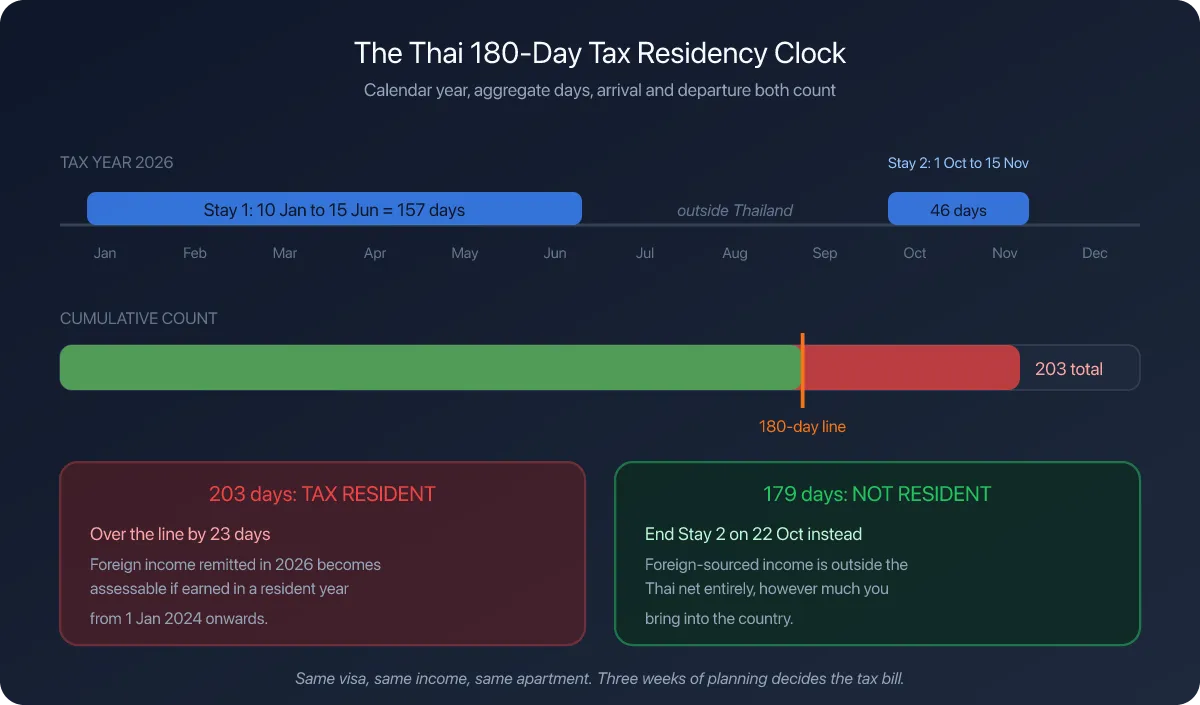
Notice what keeps deciding your actual tax exposure throughout all of this. Not your digital ID. Not your company registration. It is where you physically are and for how many days. The 183-day personal residency test, the place of effective management question, the treaty tie-breakers: every one of them turns on physical presence.
That is exactly why the nomads who get this right are the ones who track their days meticulously. If you know precisely how many days you spent in each country over any rolling 12-month period, you can see your tax residency risk coming months in advance. If you are guessing, you are exposed, e-Residency or not.
Estonia built one of the most genuinely useful digital-government tools on the planet. It just does not do the one thing the loudest people online claim it does. Use it for what it is, keep your personal tax residency clear-eyed and based on where you actually spend your days, and you will avoid the mess that catches so many nomads off guard.
Know exactly where you're a tax resident.
Nomad Tracker counts your days in every country automatically and warns you before you cross a 183-day tax residency line, so your company structure never gets a nasty surprise. All on-device, all private. Available on iOS.
Download on the App Store