For most of the last decade, the country of Georgia (the Caucasus republic, not the US state) sat near the top of every "best tax deal for nomads" list. The pitch was almost too good to write down without sounding like an offshore brochure: register as an Individual Entrepreneur, pay 1% tax on turnover up to 500,000 GEL, get 365 days visa-free as a citizen of 95+ countries, and skip social security entirely. Foreign-source income? Taxed at 0% under Georgia's territorial system, even once you crossed into tax residency.
In 2026 that pitch still mostly holds, but the picture has gotten more complicated. Tbilisi rents have climbed, the Special Labour Activity Permit went live on March 1, 2026, and freelancers face an enforcement deadline of May 1, 2026. The 1% regime survived all of it, but the path to using it legally now has more paperwork.
This is an honest breakdown of where Georgia stands as a tax base for solo nomads in 2026, who it still makes sense for, and where the math has shifted.
The Headline Numbers (Still Genuinely Good)
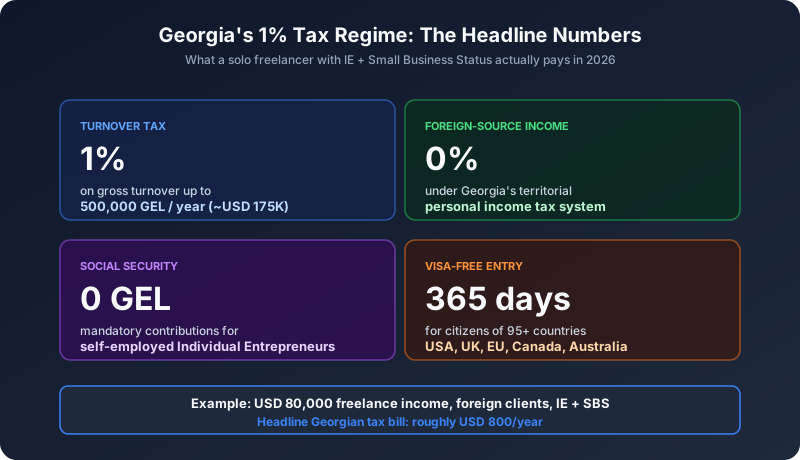
Before the caveats, the core offer is worth stating clearly. A solo freelancer with Individual Entrepreneur (IE) status and approved Small Business Status (SBS) pays:
- 1% tax on gross turnover up to 500,000 GEL per year (roughly USD 165,000 to USD 185,000 depending on the exchange rate)
- 3% on any turnover above that ceiling, until 500,000 GEL is exceeded and the status is lost for the next tax year
- 0% on foreign-source income that does not flow through the IE (Georgia uses territorial taxation for personal income)
- 0 GEL in mandatory social security contributions for the self-employed
On top of that, Georgia sits outside the Schengen zone and grants 365 days of visa-free stay to citizens of more than 95 countries, which is why so many European nomads use it as a long base while their 90/180 days age out. That pattern is one of the strategies in how to legally spend six months in Europe.
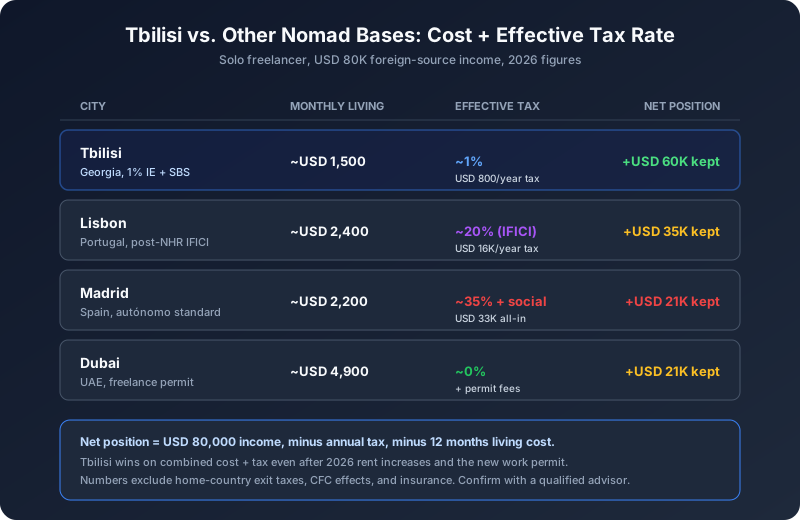
For someone earning USD 80,000 a year from non-Georgian clients and running everything through their Georgian IE, the headline tax bill is roughly USD 800. Compare that to a Spanish autónomo paying roughly 21% income tax on the same bracket plus around USD 5,000 a year in social security, or a US LLC owner who never escapes self-employment tax of 15.3%, and the gap is enormous.
How the 1% Regime Actually Works
The 1% rate is not a flat income tax. It is a turnover tax that replaces personal income tax for qualifying small businesses. That distinction matters because the base is gross revenue, not profit. If your business has high expenses, the effective rate is genuinely 1% of what you invoiced. If you have nearly zero expenses, it is still 1% of what you invoiced, which is the best deal in the system.
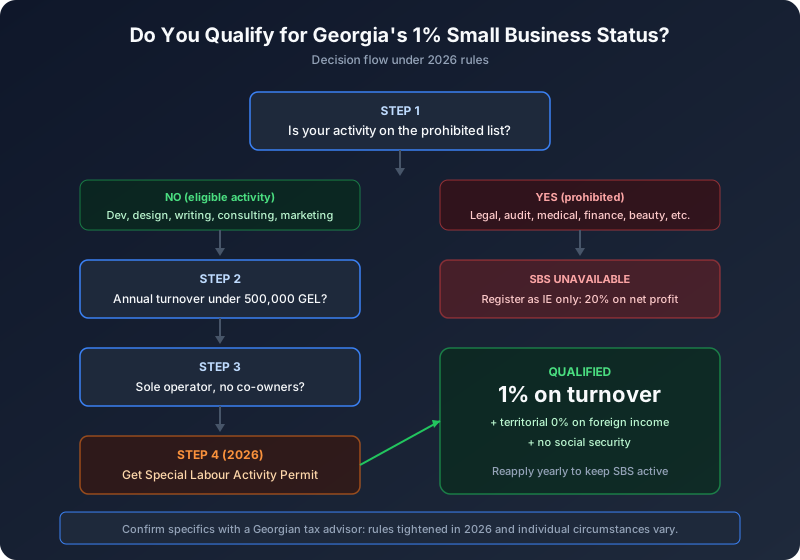
To get there you stack two separate statuses with the Georgian Revenue Service:
The first is Individual Entrepreneur (IE) status. This is the legal form. You register at a Public Service Hall, get a tax ID linked to your personal identification, and you are now a legally recognized self-employed business in Georgia. By default, an IE pays 20% personal income tax on net profit. Most of the registration can happen in a single day.
The second is Small Business Status (SBS). This is the preferential tax regime that drops the 20% to 1%. You apply separately at the Revenue Service after your IE is registered. Under the 2026 rules, SBS becomes effective on the date the request is submitted, not retroactively.
Crucially, you do not need to be a Georgian citizen or even a long-term resident to get either status. A foreign national on a tourist entry can register, open a Georgian bank account, and start invoicing under the 1% rate. That accessibility is what made Georgia famous in the nomad community.
The 500,000 GEL ceiling
Cross 500,000 GEL of annual turnover and the rate on the excess jumps to 3%. Cross it twice in two consecutive years and SBS is revoked entirely. After revocation, you cannot reapply until the tax year after the year in which the status was revoked. For a fast-growing solo consultancy, the ceiling is the planning horizon to watch. Many freelancers structure invoicing to stay just under the threshold, or accept the 3% bracket as still extremely cheap by international standards.
Prohibited activities
Not every business qualifies for SBS. The Revenue Service maintains an explicit prohibited list. Activities that cannot use the 1% regime include legal services, tax and legal consulting, audit, notary services, medical services, architectural services, financial services, foreign exchange, gambling, beauty centers, car repair, production of excise goods, and other licensed professions.
If your work falls on that list, you can still operate as an IE, you just pay 20% on net profit instead of 1% on gross. For most software developers, writers, designers, marketers, product managers, online coaches, and remote consultants in non-regulated fields, SBS is available.
The 2026 Work Permit: What Actually Changed
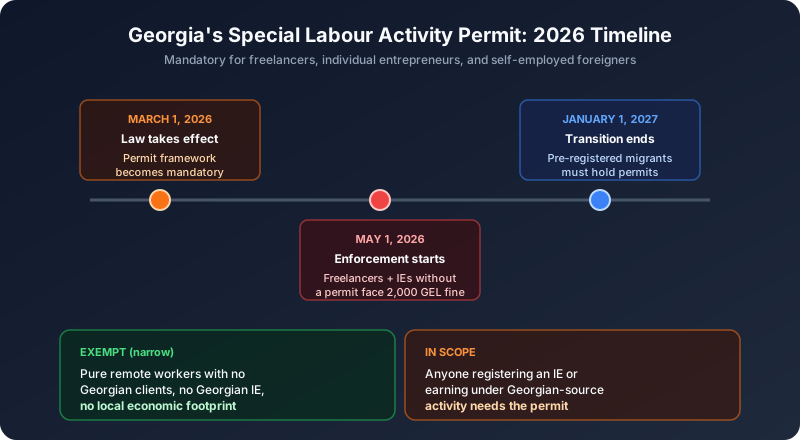
The biggest change in 2026 is the Special Labour Activity Permit, which became mandatory on March 1, 2026, and is being enforced against freelancers and self-employed individuals from May 1, 2026 onward. This is the most under-reported shift in the nomad tax world this year.
Here is what the new framework does. Any foreign national conducting economic activity inside Georgia, including freelancers, individual entrepreneurs, and independent contractors, must now hold a Special Labour Activity Permit before earning revenue that is treated as Georgian economic activity. The permit is issued by the Ministry of Labor and applied for through the labourmigration.moh.gov.ge portal. Penalties for working without it start at 2,000 GEL for the first offense, with higher fines for repeat violations.
There is a transition period: self-employed people who were already registered and active before March 1, 2026 are not fined for missing permits until May 1, 2026, and migrants already in the unified labor register get until January 1, 2027. After those dates, the framework applies in full.
Importantly, a narrow exemption remains for genuinely remote work. If you are physically in Georgia but all your clients, income, and economic footprint are outside the country, and you do not register an IE locally, you are arguably outside the scope of the work permit. The "Remotely from Georgia" route still exists for nomads who only want a long-term visa-free stay, not a Georgian business structure.
The trade-off is sharp. The moment you register an IE to access the 1% rate, you have created Georgian economic activity, and the permit obligation attaches. The very thing that unlocks the tax savings now also pulls you into the labor migration framework.
Tax Residency: The 183 Day Rule and the Territorial Twist
Georgia uses a standard 183-day rule for personal tax residency. If you spend 183 days or more inside Georgia within any continuous 12-month period ending in the current tax year, you become a Georgian tax resident. The rolling 12-month framing is slightly more aggressive than the strict calendar-year version used in some countries, and it matters for nomads who split time across multiple bases. It is the same structural problem as the Schengen rolling window, applied to tax instead of immigration.
Once you are a tax resident, Georgia's territorial system kicks in. The rule, in practical terms: Georgian tax residents owe Georgian tax only on Georgian-source income. Foreign-source income, including payments from non-Georgian clients to your personal accounts outside the IE, falls outside Georgian tax jurisdiction.
This is the point that surprises people. In most countries, becoming a tax resident means worldwide income reporting and worldwide taxation. In Georgia, becoming a tax resident does not, by itself, create a tax obligation on foreign earnings. It does, however, give you a Georgian tax residency certificate that other countries may accept as proof you are no longer their tax resident, which is often the more valuable outcome.
There are two important caveats to the territorial benefit. The first is that the moment foreign income flows through the IE (you invoice a foreign client through your registered Georgian business and bring the funds onshore as IE turnover), it is Georgian-source for the purposes of the 1% regime. That is usually fine and even desirable, but it is no longer "foreign income at 0%." The second is that the territorial concept applies to your personal income tax position. It does not override CFC rules, beneficial ownership rules, or your home country's reach if you have not properly cut tax ties there.
The HNWI alternative
For high-net-worth individuals who do not want to spend 183 days physically in Georgia, the country offers an alternative route to tax residency. The HNWI program lets qualifying applicants obtain Georgian tax resident status without the physical presence requirement, in exchange for evidence of substantial wealth or income meeting thresholds set by the Revenue Service. This is a niche tool, but it sometimes appears in cross-border tax planning when someone needs a clean tax residency certificate without committing to six months in Tbilisi.
The Cost of Living Reality in 2026
The 1% tax rate is only half the equation. The other half is what living there actually costs, and Tbilisi in 2026 is meaningfully more expensive than Tbilisi in 2021.
A solo nomad living in a furnished one-bedroom in popular nomad neighborhoods like Vera, Vake, or Saburtalo can expect to pay USD 400 to USD 700 a month in rent, with the upper end approaching USD 900 in the most central blocks. That is a real shift from the USD 250 to USD 400 range that was common before 2022. Rents in those neighborhoods have climbed roughly 20% to 30% since 2023, driven in part by a large inflow of Russian and Belarusian nationals after early 2022, plus the natural compounding of nomad demand on a small housing stock.
Outside rent, the rest of the budget still stretches well. Eating out is genuinely cheap if you avoid the Western-targeted restaurants. Groceries, transit, and domestic flights remain inexpensive. Coworking memberships sit in the USD 80 to USD 150 range. Health insurance for a healthy 30-something can be arranged for USD 40 to USD 80 a month locally.
A realistic monthly budget for a solo nomad in central Tbilisi in 2026 lands between USD 1,100 and USD 1,800 for a comfortable lifestyle. Batumi on the coast is similar, sometimes 10% to 20% cheaper outside the summer season. Kutaisi and the regional cities are noticeably cheaper but trade off the coworking and nightlife density.
Who Georgia Still Makes Sense For in 2026
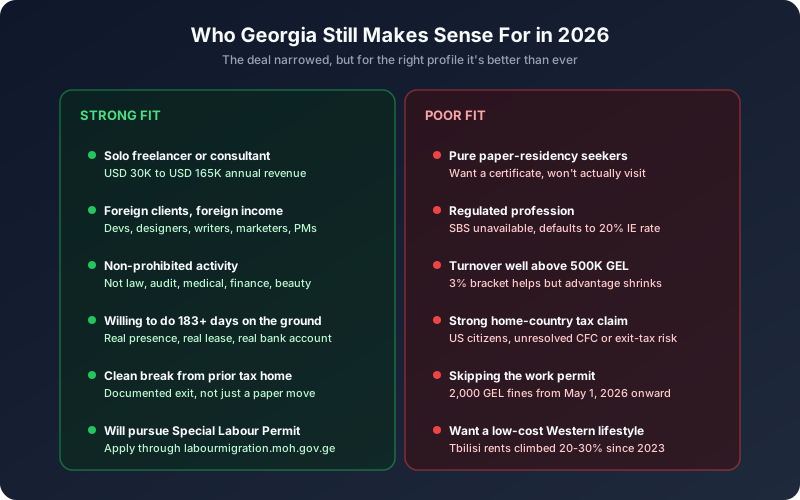
The answer is narrower than it used to be, but the people for whom Georgia works actually win bigger than ever.
Solo freelancers and consultants earning between USD 30,000 and USD 165,000 a year from foreign clients in non-prohibited activities continue to be the sweet spot. The 1% rate against the SBS turnover ceiling is most powerful in this band. Above that, the 3% bracket is still favorable, but the relative advantage versus other low-tax jurisdictions narrows.
Nomads willing to commit to genuine physical presence and the new work permit process will get the clean version of the deal. The 1% rate, the territorial system, and the Georgian tax residency certificate together create a coherent and defensible setup. Tax authorities elsewhere increasingly want to see real substance: a lease, a bank account, time on the ground, a work permit. Georgia in 2026 lets you build all of that, but it now requires actually building it.
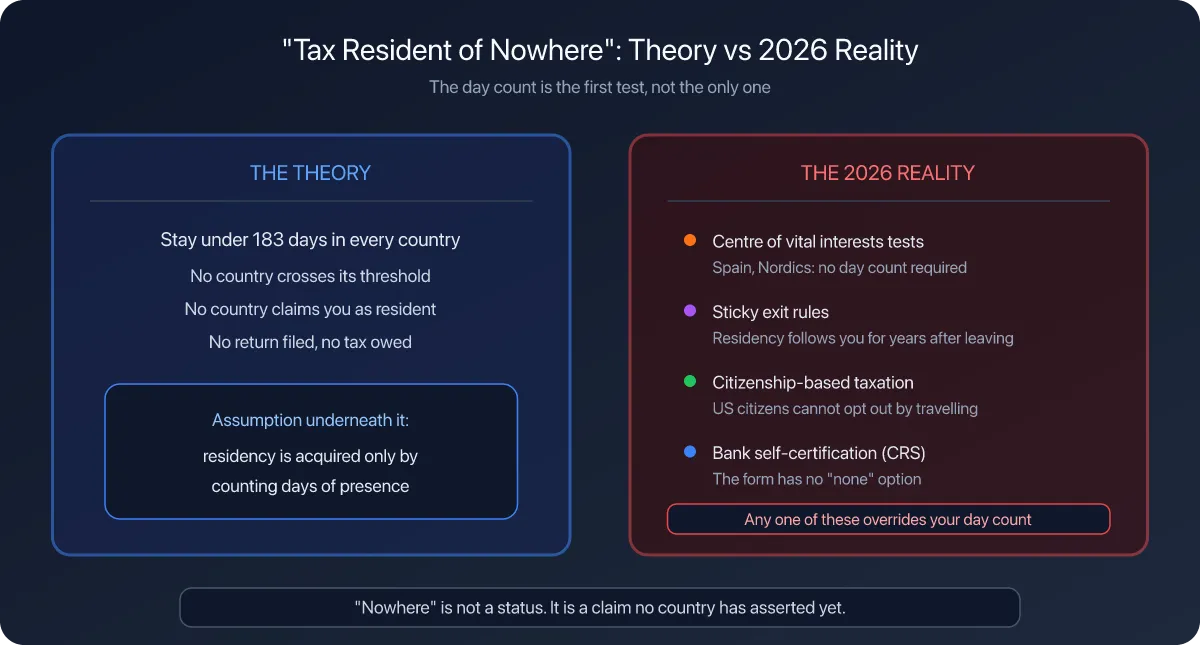
People who want to use Georgia as a passport-stamp tax haven without ever really being there will struggle more than they did three years ago. The combination of CRS reporting, tighter home-country exit rules, and Georgia's own move toward a more documented labor framework makes the "register an IE on a 10-day trip and never come back" play increasingly fragile.
Conversely, for someone whose home tax authority would tax their freelance income at 30% to 45% plus social security, who can structure to spend genuine time in Georgia, and whose activity is on the SBS-eligible list, the math is still excellent. Even after factoring in the work permit, accounting fees of USD 50 to USD 100 a month, and the higher rent, the net savings on USD 80,000 of freelance income often exceed USD 15,000 a year compared with staying tax resident in a Western European country.
Honest Risks and Open Questions
A few things worth thinking through before treating Georgia as a long-term base.
Geopolitical risk is real and underweighted in most nomad coverage. Georgia shares borders with Russia and has unresolved territorial disputes in South Ossetia and Abkhazia. The country has been stable and outside active conflict, but it sits in a neighborhood that is not stable, and that affects everything from flight reliability to insurance pricing.
Banking has gotten harder for foreign nationals over the past two years. Opening a personal account at TBC Bank or Bank of Georgia, once trivial, now often requires more documentation, proof of address, sometimes proof of business activity. Once open, the accounts work well. The friction is in onboarding.
Currency exposure cuts both ways. The GEL has been relatively stable against the USD, but the 500,000 GEL ceiling is denominated in lari, not dollars. A weakening lari quietly raises the dollar value of the cap, which helps. A strengthening lari lowers it, which can compress the SBS headroom.
Treaty-shopping risk is the underdiscussed long-term issue. If you originally come from a country with strong CFC and exit-tax rules (the US, the UK, Germany, Spain), simply registering in Georgia does not by itself extinguish your home tax obligations. Treaty tie-breakers, center-of-vital-interest tests, and CFC attribution can pull income back into the home jurisdiction even when you are technically a Georgian tax resident. The cleanest setups pair Georgia with a genuine and documented break from the prior tax home, not a paper-only one.
Tracking Days So Georgia Works As Planned
If the strategy is to become a Georgian tax resident, the 183-day count is the single most important number in the plan. Miss it and you do not get the residency certificate. Cross it accidentally somewhere else first and you may create a competing tax residency that overrides the Georgian one under treaty rules. How those tie-breakers actually resolve is worth reading before you commit to the plan.
For nomads using Georgia as the anchor of a multi-country setup, the discipline is the same as for any tax-residency-driven plan: count every day, in every country, in real time, with a system that does not depend on remembering border crossings.
Tracking your days is what makes the 1% rate actually work.
Nomad Tracker counts your days in Georgia and every other country automatically, alerts you before the 183 day line, and helps you simulate future trips without breaking the plan. All on-device, all private. Available on iOS.
Download on the App Store