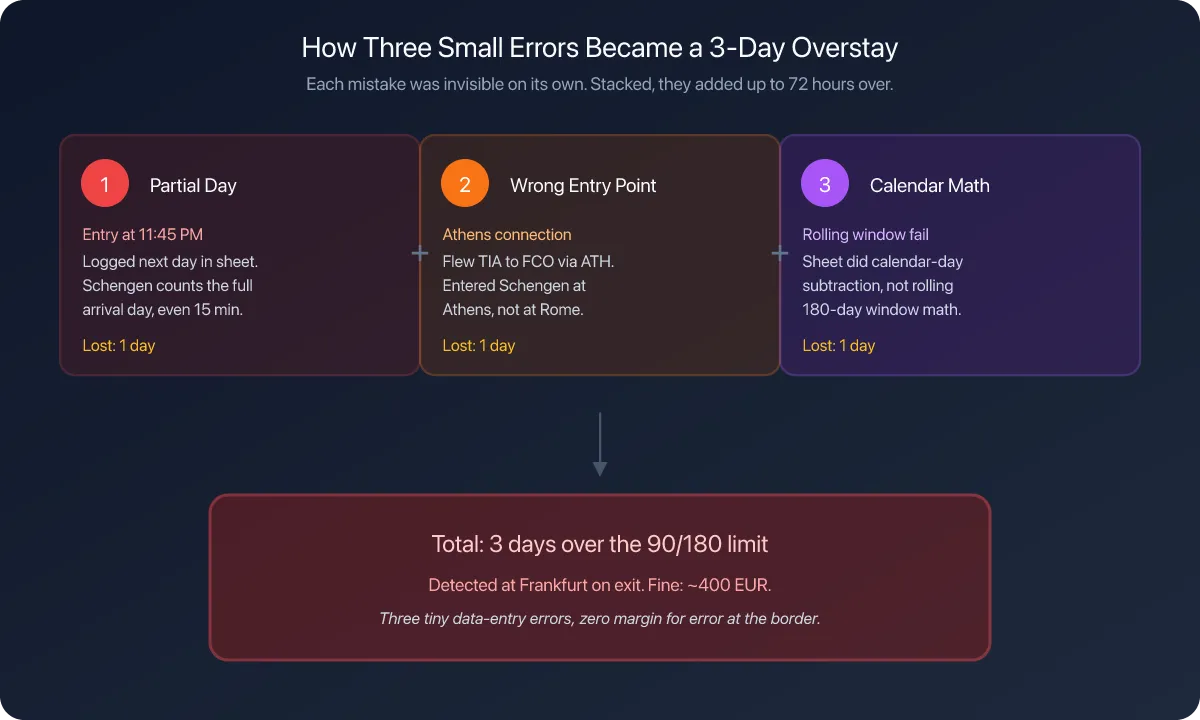
Here is the situation most nomads eventually face: you love Europe, you want to be there for more than three months, but the Schengen 90/180 rule says you cannot. Or at least, that is what most people think.
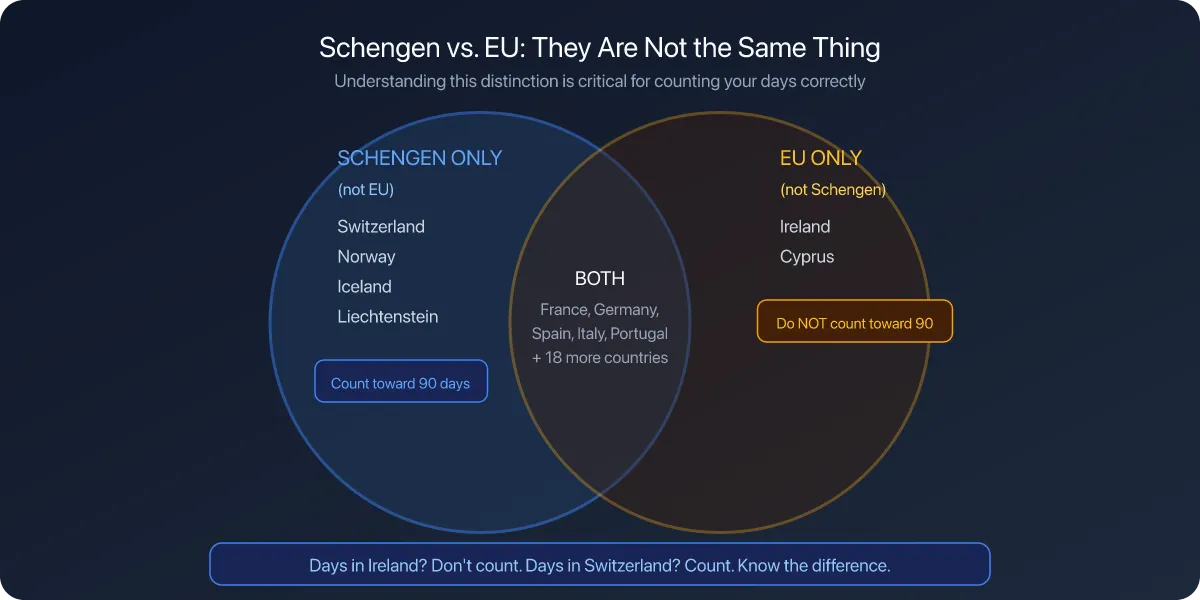
The truth is that "Europe" and "the Schengen Area" are not the same thing, and neither is the EU. Once you understand the difference, an entire world of legal strategies opens up. You can spend six, eight, even ten months on the continent without overstaying a single day.
This guide lays out every major approach. No gray areas, no "just hope they don't notice" advice. Everything here is legal, documented, and used by real nomads every day.
First: Understand What You Are Working With
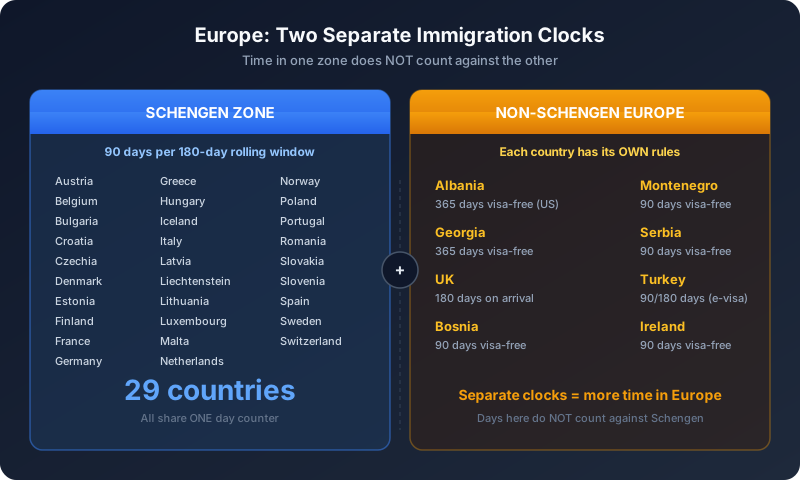
The Schengen Area covers 29 countries. As a visa-exempt traveler (US, Canadian, UK, Australian, and many other passports), you get 90 days within any rolling 180-day window across the entire zone. That means all your days in France, Germany, Spain, Portugal, Italy, and so on count toward the same 90-day pot. If you want the mechanics of that window in detail, start with our 90/180 rule guide.
But Europe has roughly 50 countries. Only 29 are in Schengen. The rest operate their own immigration systems with separate day counts.
This is the core insight: time spent in non-Schengen European countries does not touch your Schengen clock. And several of these countries offer generous visa-free stays on their own.
Strategy 1: The Schengen + Non-Schengen Rotation
This is the most popular approach, and the easiest to execute.
The idea: spend your 90 Schengen days, then move to a non-Schengen European country while your days regenerate. When enough Schengen days have "fallen off" the back of your 180-day window, you re-enter.
The classic pattern looks like this: 90 days in Schengen, 90 days outside, then another 90 in Schengen. That gives you 180 days in Europe over the course of a year, split between the two zones.
But you can get creative with the timing. You do not need to use all 90 days at once. Spending 45 days in Schengen, 45 outside, and repeating lets you stretch your European presence across a much longer period. The key is tracking your rolling window accurately so you always know your remaining Schengen days.
Where to spend your non-Schengen time
These are the most practical options for nomads in 2026:
Albania is the standout. US citizens can stay up to one full year without a visa or residence permit. That is 365 days, no questions asked, no application needed. The cost of living in Tirana is roughly a third of Lisbon, the food is incredible, and the coworking scene has grown a lot in the past two years. To restart the clock after a year, you need to leave for at least 90 days.
Montenegro allows visa-free stays of 90 days for most Western passport holders. It is beautiful, relatively affordable, and a short flight from most Schengen hubs. Kotor and Budva are the popular spots, but Podgorica is where the WiFi is more reliable and the rents are lower.
Georgia (the country, not the US state) offers a full year of visa-free stay to citizens of over 95 countries. Tbilisi has become one of the most popular nomad hubs on the planet, and for good reason: fast internet, cheap rent, a 1% small business tax for entrepreneurs, and a café culture that rivals any European capital. That 1% regime is more conditional than it looks since the 2026 permit changes, and we went through the honest math in our Georgia guide.
Serbia gives 90 days visa-free. Belgrade has a thriving nightlife and tech scene, and it is one of the most affordable capitals in Europe.
Bosnia and Herzegovina offers 90 days. Sarajevo is one of the most underrated cities on the continent for remote work.
Turkey is technically transcontinental, but Istanbul alone makes it worth mentioning. US citizens get an e-visa for 90 days within a 180-day period. The city is enormous, endlessly interesting, and the cost of living outside tourist areas is very reasonable.
The United Kingdom and Ireland both operate outside Schengen. UK gives most visa-exempt nationals six months on arrival. Ireland gives 90 days. These are more expensive bases, but they are options if your budget allows it.
Strategy 2: Digital Nomad Visas
If you want to settle in one European country for six months or more, a digital nomad visa is the cleanest legal path. These visas were specifically designed for people who work remotely and earn their income from abroad.
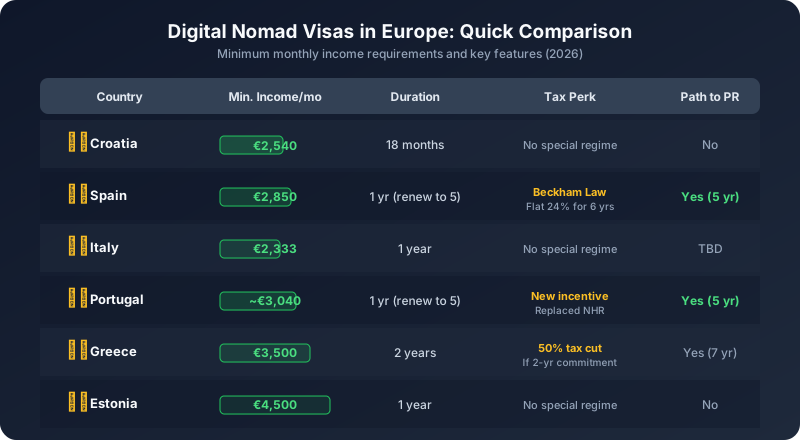
As of 2026, at least 15 European countries offer some form of digital nomad visa. Here are the most practical ones:
Spain
The Spanish digital nomad visa (under the Startup Act) is one of the most popular in Europe. You need to earn at least €2,850 per month from non-Spanish clients or employers, carry health insurance, and show that at least 80% of your income comes from outside Spain. The initial visa lasts one year, renewable up to five years total.
The real kicker: digital nomad visa holders qualify for the Beckham Law, which means you pay a flat 24% tax rate on Spanish income for up to six years instead of the progressive rates that go up to 47%. You need to apply within six months of arriving, and you cannot have been a Spanish tax resident in the previous five years.
Croatia
Croatia offers one of the most accessible nomad visas in the EU. The income threshold is around €2,540 per month, which is the lowest among EU member states. The visa lasts up to 18 months and can be renewed for another 18. Zagreb and Split both have solid nomad infrastructure, and the Adriatic coast is hard to beat during summer.
Portugal
The D8 visa (also called the Temporary Stay Visa) lets you live in Portugal while working remotely. Portugal is attractive because the visa can lead to permanent residency and eventually citizenship after five years. The NHR tax regime ended, and the program that replaced it is considerably narrower. The income requirements are lower than Spain's.
Greece
Greece requires a higher income threshold at €3,500 per month, but offers a compelling deal: if you commit to a two-year stay and become a Greek tax resident, you pay half the standard income tax rate. Athens and Thessaloniki are affordable by Western European standards, and the islands are there for the weekends.
Italy
Italy's nomad visa asks for about €28,000 per year in income. It lasts one year with renewal options. If your dream is writing code from a Tuscan village, this is your legal path.
Estonia
Estonia pioneered the digital nomad visa concept and remains a solid option, particularly for tech workers. The income requirement is higher at €4,500 per month, but the digital infrastructure is world-class, and the e-Residency program (separate from the nomad visa) lets you run an EU company from anywhere.
Strategy 3: Bilateral Visa Agreements
This one is less known and more complicated, but worth understanding.
Several Schengen countries signed bilateral visa-waiver agreements with the United States before they joined Schengen. In theory, these agreements allow US citizens to stay an additional 90 days in that specific country, separate from the Schengen 90/180 calculation.
Countries with such agreements include Denmark, Poland, Belgium, Italy, Spain, France, Hungary, Portugal, and Latvia.
Here is the catch: most of these agreements exist on paper but are not reliably honored at the border. The two countries where this strategy has actually worked in practice are Denmark and Poland. Even there, the experience is inconsistent. Some border agents are aware of the agreement. Others are not.
If you want to try this route, carry printed documentation of the bilateral agreement and be prepared to explain it calmly. But do not build your entire travel plan around it. Treat it as a bonus, not a foundation.
An important constraint: while using a bilateral agreement, you must stay exclusively in that country. You cannot bounce around Schengen during the extended period.
Strategy 4: National D-Visas (Long-Stay Visas)
Beyond digital nomad visas, many European countries offer national long-stay visas (D-visas) for various purposes: study, research, family reunification, or self-employment. These operate independently from the Schengen short-stay allowance.
A D-visa issued by France, for example, gives you the right to live in France for the duration stated on the visa. Your Schengen 90-day counter is irrelevant while you hold a valid D-visa in that country.
If you are considering this route, look into:
- Language study visas: France and Germany offer them for enrolled students.
- Self-employment visas: Germany's freelancer visa (Freiberufler) is well-established for consultants, writers, and designers.
- Research or academic visas: If you have any connection to a university or institution.
The application processes for D-visas are more involved than tourist entries or nomad visas. You typically need to apply at a consulate before traveling, provide financial proof, and sometimes attend an interview. But they unlock stays of 6 to 12 months in a single country.
Combining Strategies: A Sample 8-Month Plan
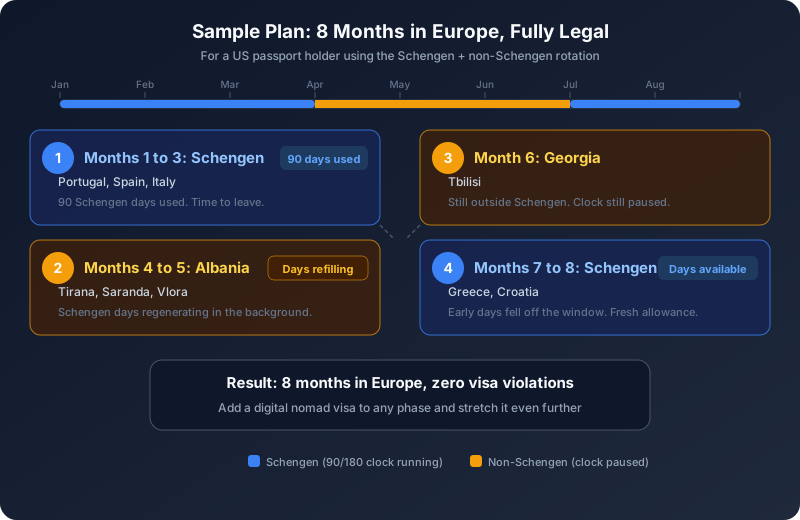
Here is what a practical eight-month European itinerary might look like for a US passport holder:
Months 1-3: Spend your 90 Schengen days across Portugal, Spain, and Italy. Work from Lisbon, then Barcelona, then somewhere on the Amalfi coast. Track your days carefully.
Months 3-5: Fly to Tirana, Albania. Your Schengen days are regenerating while you enjoy one of Europe's most affordable and underrated countries. Two months here barely dents your bank account.
Months 5-6: Head to Tbilisi, Georgia for a month. Different vibe, incredible food, very fast internet, and your Schengen days are still refilling.
Months 6-8: Return to Schengen. By now, your earliest days have "fallen off" the 180-day window. You have fresh Schengen days available. Spend them in Greece or Croatia.
That is eight months in Europe, fully legal, no visa applications required. If you add a digital nomad visa to the mix (say, Spain's for months 1-3), you could stretch this even further.
The Tax Side: Do Not Forget This
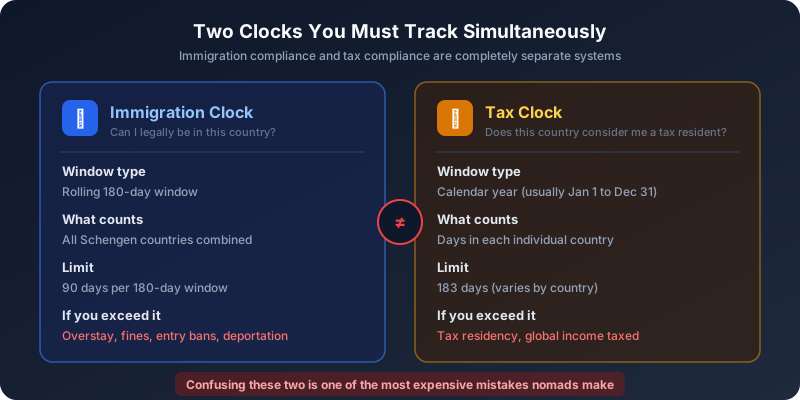
Here is the part that trips people up. Immigration law and tax law are two separate systems, and they do not care about each other.
You might be perfectly legal from an immigration standpoint, spending 89 days in Spain and moving on, but if Spain decides you have established your "center of vital interests" there (your apartment, your gym, your partner), they can still claim you as a tax resident.
The general rule across most European countries: spend more than 183 days in a single country within a tax year and you are almost certainly a tax resident there. But some countries look beyond just day counts. Spain, France, and Germany all have secondary tests based on economic ties, family connections, or property. Spain is the clearest case, with three independent routes to residency and no split-year treatment.
If you are using any of the strategies in this article, you need to track two things separately:
- Your Schengen-wide day count for immigration compliance (rolling 180-day window).
- Your per-country day count for tax compliance (usually calendar year).
These are fundamentally different calculations. Confusing them is one of the most common and expensive mistakes nomads make.
How ETIAS and EES Change Things in 2026
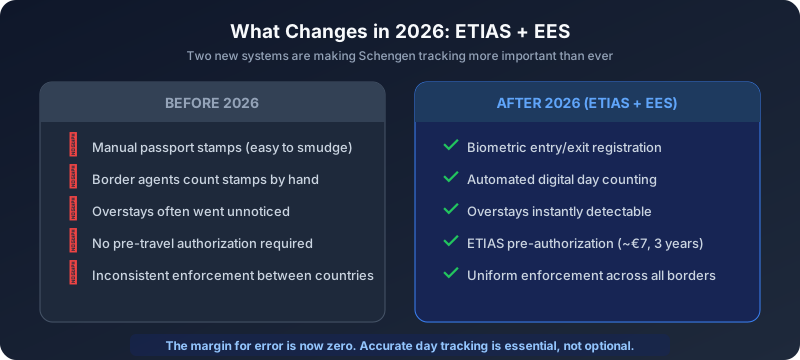
The European Travel Information and Authorisation System (ETIAS) and the Entry/Exit System (EES) are rolling out in 2026. Here is what they mean for the strategies above:
ETIAS is a pre-travel authorization for visa-exempt travelers. It costs about €7, lasts three years, and is required before boarding a flight to the Schengen zone. It does not change the 90/180 rule or any of the strategies described here. Think of it as a lightweight background check.
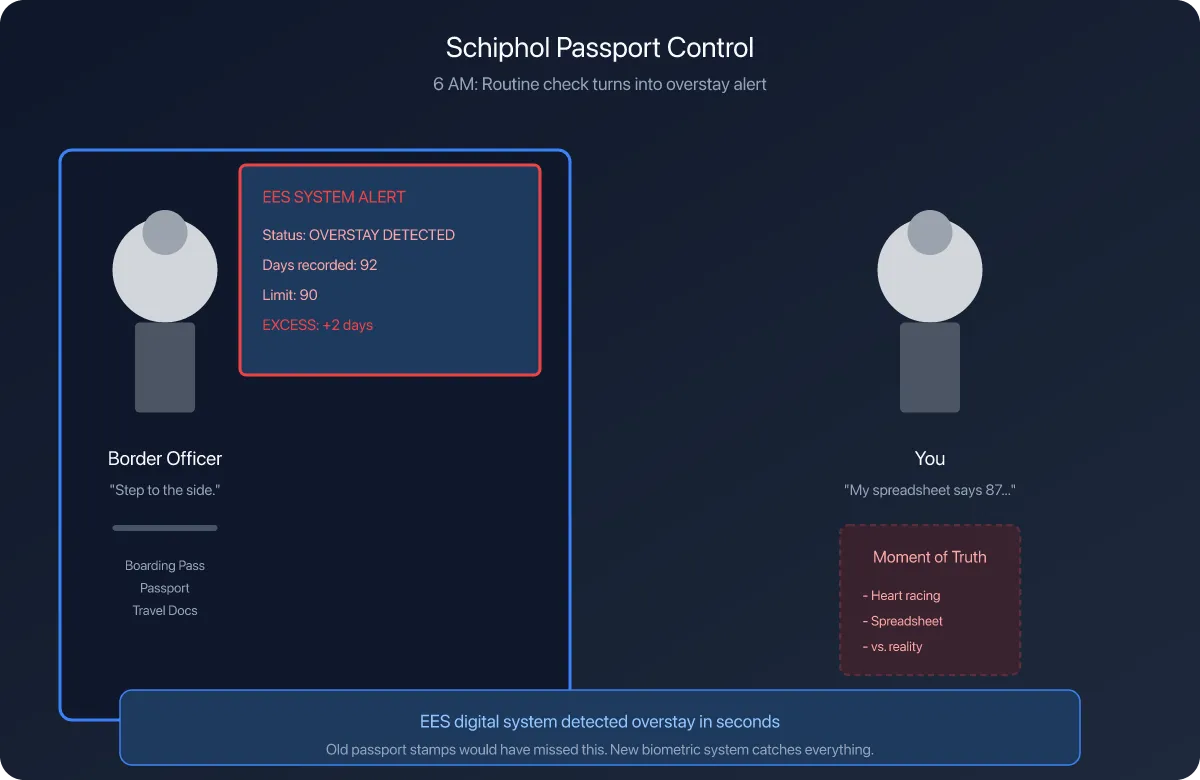
The EES is more significant. It replaces passport stamps with biometric entry/exit registration at Schengen borders. Every entry and every exit gets logged electronically. This means overstaying by even a single day becomes instantly detectable. Our full ETIAS and EES update covers the dates, the fees, and the exemptions.
For nomads who play by the rules, this is actually good news. No more ambiguous passport stamps. No more border agents squinting at faded ink trying to count your days. The system knows exactly where you stand, and so do you.
But it also means the margin for error is zero. Accurate day tracking is no longer just a good idea. It is essential.
Make It Automatic
If there is one takeaway from this article, it is this: the strategies exist. Legal paths to spending six, eight, even ten months in Europe are real and well-documented. The hard part is not finding them. The hard part is tracking your days accurately across multiple countries, visa regimes, and rolling windows simultaneously.
This is why we built Nomad Tracker. It uses your phone's GPS to automatically detect country changes and log them. The Schengen calculator runs the official rolling-window algorithm in real time. Per-country day counts update automatically. You can even use Ghost Trips to simulate future travel plans and see exactly when you would hit limits before you book anything.
No spreadsheets. No mental math. No unpleasant surprises at border control.
Stay in Europe longer. Stay legal.
Nomad Tracker automates Schengen day counting, per-country fiscal tracking, and visa limit monitoring. All on-device, all private, all automatic.
Download on the App Store