For years, Portugal's Non-Habitual Resident program was the golden ticket. Move to Lisbon or Porto, register as a tax resident, and enjoy a flat 20% rate on Portuguese income plus near-total exemption on foreign earnings for a full decade. It was, frankly, one of the best tax deals anywhere in the world for location-independent workers.
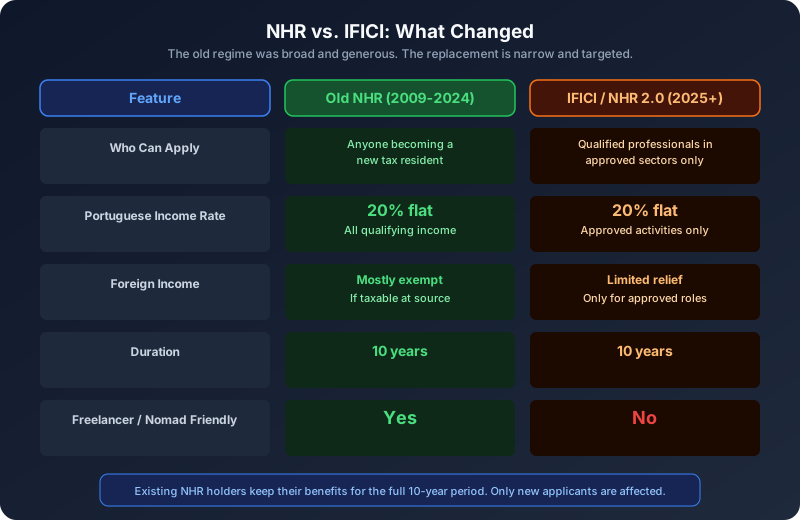
That deal is gone. As of January 1, 2025, the NHR regime is officially closed to new applicants. Portugal replaced it with something called IFICI, sometimes marketed as "NHR 2.0," but calling it that is generous. The new program is narrower, more restrictive, and designed for a completely different audience.
If you have been eyeing Portugal as your next base, you need to understand what changed, what IFICI actually offers, and whether the math still works in your favor. Let's break it all down.
What the Original NHR Was (and Why Everyone Loved It)
The Non-Habitual Resident regime launched in 2009 as a deliberate play to attract foreign capital, retirees, and skilled workers to Portugal. The pitch was compelling: become a Portuguese tax resident, and for 10 years you would pay a flat 20% tax on qualifying Portuguese-source income. Foreign-source income, including pensions, dividends, interest, capital gains, and rental income, was largely exempt from Portuguese taxation as long as it could be taxed in the source country under an applicable double taxation treaty.
For digital nomads, this was extraordinary. If you were a freelancer working remotely for clients outside Portugal, your income could effectively be taxed at 20% or, in many cases, even less. Retirees with foreign pensions could pay as little as 10% (after a 2020 amendment). Compared to Portugal's standard progressive rates that climb to 48%, the NHR was a massive advantage.
The result? Portugal became the hottest destination in Europe for tax-conscious expats. Lisbon's real estate prices soared. Co-working spaces multiplied. The nomad community in places like Ericeira, Lagos, and Madeira exploded.
Why Portugal Killed the NHR
The NHR did not die quietly. It was politically controversial for years before the axe finally fell.
The core problem was domestic backlash. Portuguese citizens, especially younger workers priced out of Lisbon and Porto's housing markets, grew resentful of a system that gave foreigners dramatically lower tax rates while locals paid the full progressive scale. The optics were terrible: a Portuguese software developer earning €40,000 could be paying an effective rate above 25%, while a newly arrived British retiree next door paid 10% on a pension three times that size.
The housing crisis accelerated the political pressure. Between 2015 and 2023, Lisbon rents roughly doubled. The NHR was widely seen as a contributor, attracting wealthy foreigners who bid up property prices without creating proportional economic benefit for local communities.
Prime Minister Antonio Costa's government announced the end of the NHR in the 2024 State Budget, effective January 1, 2024, for new applicants. A transitional period allowed those already in the pipeline to still register through early 2025. But by April 1, 2025, the door was firmly shut.
Enter IFICI: What "NHR 2.0" Actually Looks Like
Portugal did not simply cancel its tax incentive program. It replaced the NHR with the IFICI, which stands for "Incentivo Fiscal a Investigacao Cientifica e Inovacao" (Tax Incentive for Scientific Research and Innovation). The name alone tells you a lot about how different this is.
Where the NHR was broadly accessible to anyone willing to establish tax residency in Portugal, IFICI is targeted. It is designed to attract a specific kind of professional: highly qualified workers in innovation-driven sectors that Portugal's government considers strategically important.
The tax benefit
The headline rate is the same: a 20% flat tax on qualifying Portuguese-source employment or self-employment income, available for 10 consecutive years. Foreign-source income from employment in certain approved activities can also receive favorable treatment.
Who qualifies
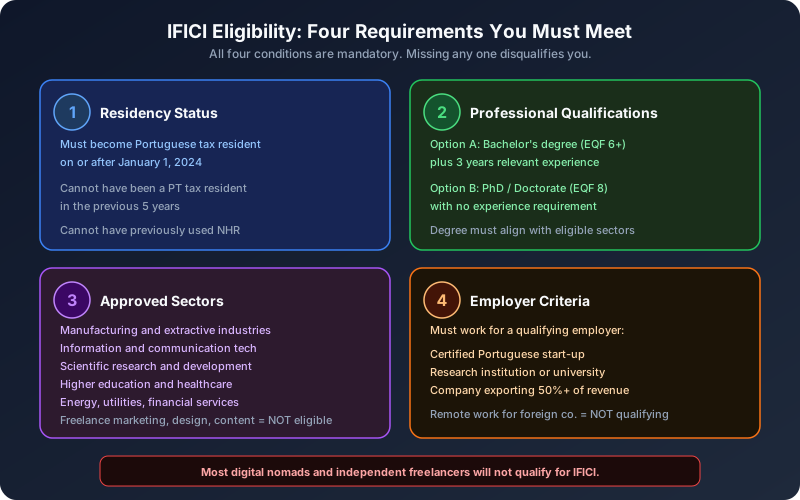
This is where things get restrictive. To be eligible for IFICI, you must meet all of the following conditions:
You must become a Portuguese tax resident on or after January 1, 2024. You cannot have been a Portuguese tax resident in the previous five years. You cannot have previously benefited from the NHR or any other special Portuguese tax regime.
Beyond that, you must work in a qualifying profession within eligible sectors. These sectors include extractive and manufacturing industries, information and communication technologies, scientific research and development, higher education, healthcare, and certain financial and consulting services. Critically, you need to hold at least a Level 6 European Qualifications Framework degree (a bachelor's degree) plus three years of relevant professional experience, or a doctoral-level qualification.
If you are employed, your employer must meet additional criteria. The company typically needs to be a certified Portuguese start-up, a research institution, or a company that exports at least 50% of its turnover.
The Honest Assessment: Does IFICI Work for Digital Nomads?
Let's be direct. For the typical digital nomad, IFICI is not a realistic option.
If you are a freelance web designer, a remote marketing consultant, a content creator, or a solo developer building your own SaaS, you almost certainly do not qualify. The regime requires employment in specific sectors with specific types of employers. Self-employed freelancers working for foreign clients, the exact profile that made the old NHR so popular, fall outside the IFICI's scope in most cases.
Even tech workers who might theoretically qualify face hurdles. You would need a Portuguese employer that meets the export or start-up certification criteria. Simply working remotely for a foreign company while living in Lisbon does not count.
There are exceptions. If you are a researcher recruited by a Portuguese university, an engineer hired by a Portuguese tech company that exports most of its revenue, or a doctor moving to work in the Portuguese healthcare system, IFICI could be excellent. But these are traditional expat roles, not the typical digital nomad setup.
What this means for your tax bill
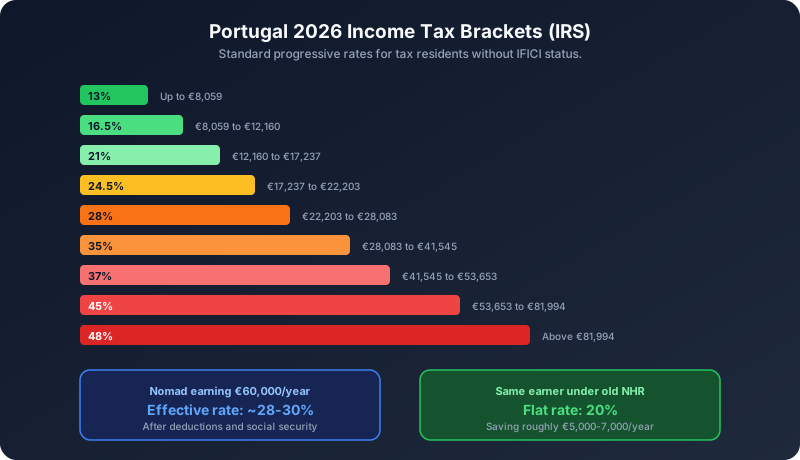
Without IFICI, you are on Portugal's standard progressive income tax scale. For 2026, those brackets look like this:
The first €8,059 is taxed at 13%. Income between €8,059 and €12,160 hits 16.5%. The next band, up to €17,237, is taxed at 21%. It continues climbing: 24.5% up to €22,203, 28% up to €28,083, 35% up to €41,545, 37% up to €53,653, and 45% up to €81,994. Above that, you reach the top rate of 48%, plus a solidarity surcharge of 2.5% to 5% for income above €80,000.
For a nomad earning €50,000 per year, the effective tax rate under the standard system lands somewhere around 27-30% after deductions. Compare that to the flat 20% under the old NHR, and the difference is significant. At €80,000, the gap widens further.
The D8 Digital Nomad Visa: Still a Solid Entry Path
Even without favorable tax treatment, Portugal remains attractive for many nomads. The quality of life, climate, safety, English proficiency, and food scene are hard to beat. If you decide Portugal is where you want to be regardless of the tax picture, the D8 visa is your entry point, and it holds up well against the other European programs on the residency path if not on tax.
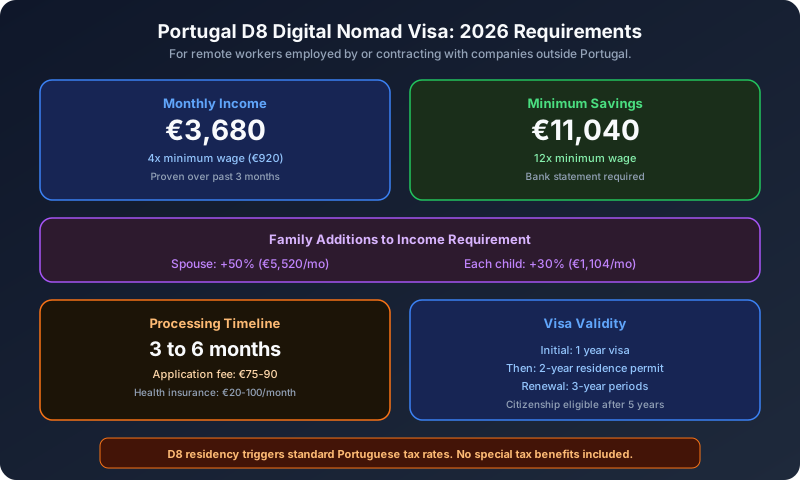
The D8 (digital nomad visa) is designed for remote workers employed by or contracting with companies outside Portugal. For 2026, the key requirements are:
You need to prove a minimum monthly income of €3,680, which equals four times Portugal's minimum wage of €920. You also need savings equivalent to at least 12 months of minimum wage, or €11,040. If you are bringing a spouse, add 50% to the income requirement. Each dependent child adds another 30%.
The visa itself is initially valid for one year, with a residence permit extension to two years. After that, you can renew for three-year periods. The application fee runs €75 to €90, though you should budget for health insurance (€20 to €100 per month), legal assistance, and the general bureaucratic adventure that is Portuguese immigration processing. Expect processing times of three to six months.
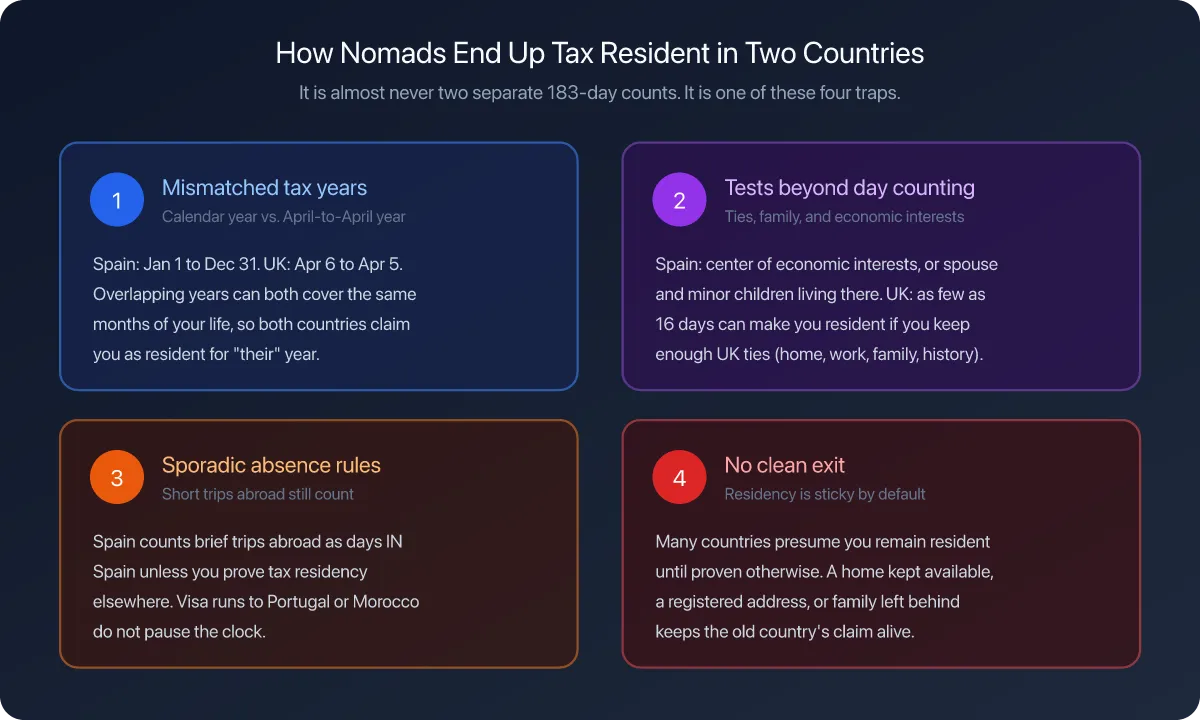
One important note: holding a D8 visa and spending enough time in Portugal to maintain it will almost certainly make you a Portuguese tax resident. The residence permit requires at least 16 months of physical presence during the initial two-year period. That easily crosses the 183-day threshold that triggers tax residency. Worth planning around if you still have ties elsewhere, since that is exactly how people end up tax resident in two countries at once.
So while the D8 gets you legal residency and the right to live and work in Portugal, it also puts you squarely on the standard tax scale. No special rates. No exemptions.
Running the Numbers: Portugal vs. the Alternatives
Let's put some real math to this. Say you earn €60,000 per year as a remote freelancer.
Under the old NHR, your tax bill in Portugal would have been roughly €12,000 (20% flat), and depending on your setup, potentially less on foreign income. Under the standard 2026 system, you are looking at approximately €17,000 to €19,000 after deductions and social security contributions.
That extra €5,000 to €7,000 per year adds up. Over five years, the difference could fund a year of living in a cheaper country.
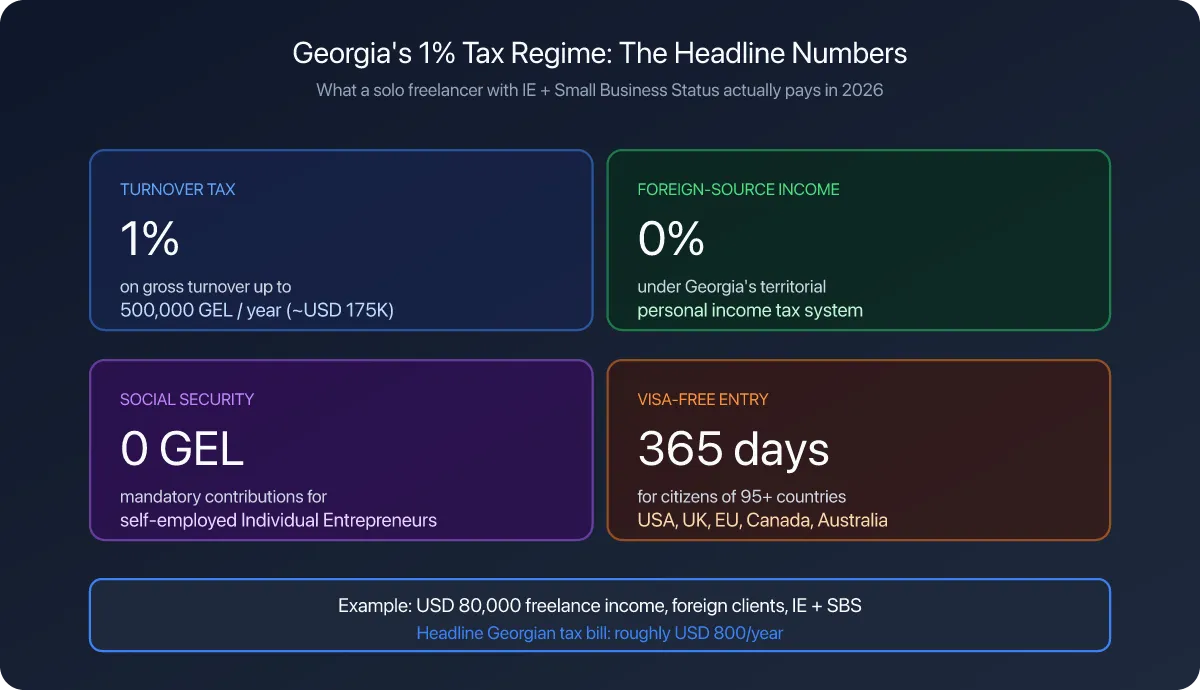
Meanwhile, other European destinations still offer competitive tax deals. Georgia's small business status allows individual entrepreneurs to pay just 1% on revenue up to roughly $155,000, though the living experience is very different from Lisbon, and the 2026 work permit rules added conditions the old pitch never mentioned. Croatia's digital nomad visa comes with a one-year income tax exemption. Greece offers a 50% income tax reduction for qualified workers who move there and commit to a two-year stay. Romania and Bulgaria maintain flat tax rates of 10% and similar.
Portugal's appeal was never purely about tax. It was the combination of low taxes plus exceptional lifestyle. Without the tax piece, the value proposition shifts. Portugal is still wonderful to live in. But you need to make that choice with open eyes about what it costs.
Existing NHR Holders: You're Safe (For Now)
If you registered for the NHR before the cutoff, you keep your benefits for the full 10-year period. Nothing changes for you. Your flat 20% rate and foreign income exemptions remain intact until your decade expires.
This means there is a two-tier reality in Portugal right now. Nomads who arrived before 2024 are still enjoying the old deal. New arrivals in 2025 and 2026 face the standard tax system or need to qualify for the much narrower IFICI.
If you are an existing NHR holder, the main thing to watch is whether future Portuguese governments attempt to retroactively modify the terms. So far, this has not happened, and legal consensus suggests it would face serious constitutional challenges. But it is worth monitoring.
So, Should You Still Move to Portugal?
The answer depends on what you are optimizing for.
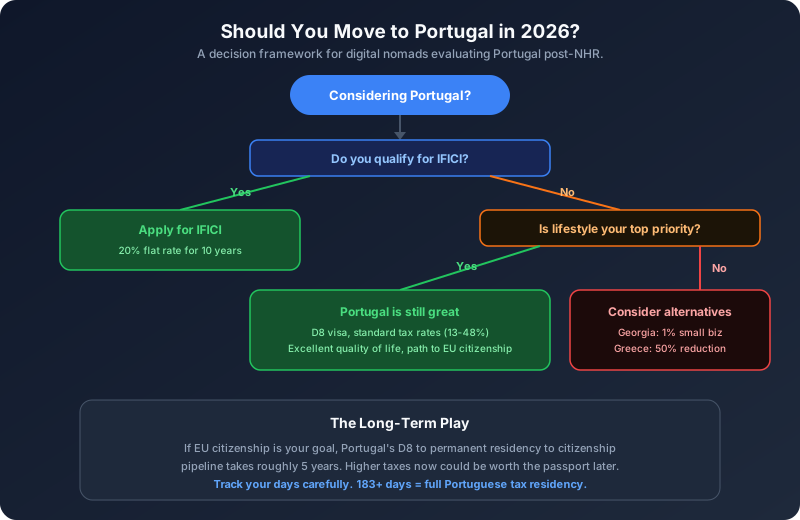
If your primary motivation was tax savings, Portugal is no longer the slam dunk it once was. The IFICI only works if you happen to fit its narrow professional criteria. For most independent remote workers, the standard tax system will take a bigger bite than destinations like Georgia, Romania, or the UAE.
If you value quality of life above all else, Portugal remains exceptional. The climate in the Algarve and Lisbon coast is among Europe's best. Healthcare quality is high. Safety is excellent. The nomad community, particularly in Lisbon, Madeira, and the Algarve, is mature and well-established. English is widely spoken. The food alone might justify a higher tax bill.
If you are playing the long game, Portugal still offers a path to permanent residency and EU citizenship after five years. For nomads who want an EU passport eventually, the D8 visa into residency into citizenship pipeline is one of the more accessible routes.
The bottom line: Portugal went from being the obvious choice to being a deliberate one. It still works, but you need to go in understanding exactly what the tax situation looks like and deciding that the lifestyle justifies the cost.
Track Your Days, Wherever You Land
Whether Portugal stays on your radar or you pivot to another European base, tracking your days matters. Tax residency thresholds are unforgiving. Spending 184 days instead of 182 in any country can trigger a full year of tax obligations you did not plan for.
Nomad Tracker was built specifically for this problem. It automatically logs which country you are in each day, monitors your approach to critical thresholds like the 183-day mark, and lets you simulate future travel plans with Ghost Trips before committing to anything. All of it runs locally on your device with zero data leaving your phone.
Don't let day counting surprise you.
Nomad Tracker monitors your fiscal residency across every country you visit, alerts you before you hit tax thresholds, and runs entirely on-device. No spreadsheets, no guesswork.
Download on the App Store