If you spend any amount of time hopping between European countries, the Schengen 90/180 rule is the single most important number you need to understand. Get it wrong and you risk overstaying, entry denials, fines, or even future visa complications. Get it right and you unlock a remarkably generous travel allowance across 29 countries.
This guide breaks down exactly how the rule works, where most nomads trip up, and what you can do to stay on the right side of it in 2026.
What is the Schengen Area?
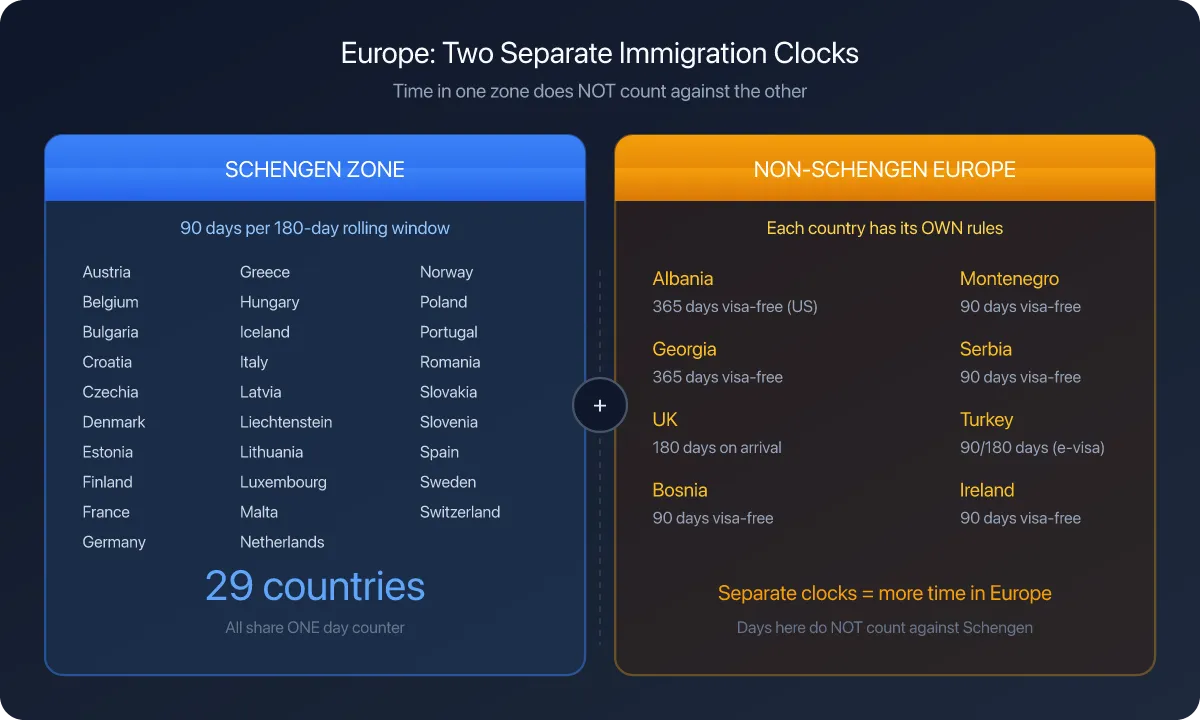
The Schengen Area is a zone of 29 European countries that have abolished internal border controls. Once you enter through any member state, you can move freely between them without showing your passport again.
As of 2026 the Schengen members are: Austria, Belgium, Bulgaria, Croatia, Czechia, Denmark, Estonia, Finland, France, Germany, Greece, Hungary, Iceland, Italy, Latvia, Liechtenstein, Lithuania, Luxembourg, Malta, Netherlands, Norway, Poland, Portugal, Romania, Slovakia, Slovenia, Spain, Sweden, and Switzerland.
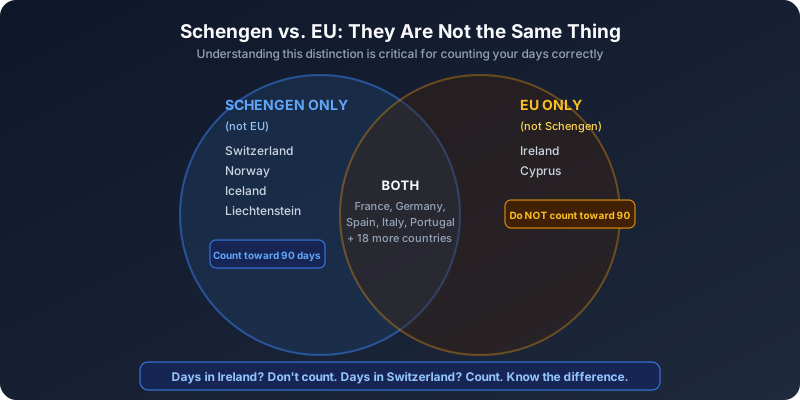
Important distinction: the Schengen Area is not the same as the EU. Norway, Iceland, Switzerland, and Liechtenstein are Schengen members but not EU members. Ireland is in the EU but not in Schengen. Our breakdown of Schengen, the EU, and the EEA goes through every overlap, because getting this wrong is what breaks people's arithmetic.
The 90/180 Rule, Explained
The rule is simple to state: you may stay up to 90 days within any 180-day rolling window in the Schengen Area as a whole. Not per country -- for the entire zone combined.
Here is where most people go wrong. The 180-day window is not a fixed calendar period. It is a rolling window that moves with every day. On any given day, border authorities look back exactly 180 days and count how many of those days you spent inside the Schengen zone.
Think of it like a sliding ruler. Every single day, the ruler shifts forward by one. Days that fall off the far end of the 180-day window are no longer counted. Days you just spent get added to the total.
A practical example
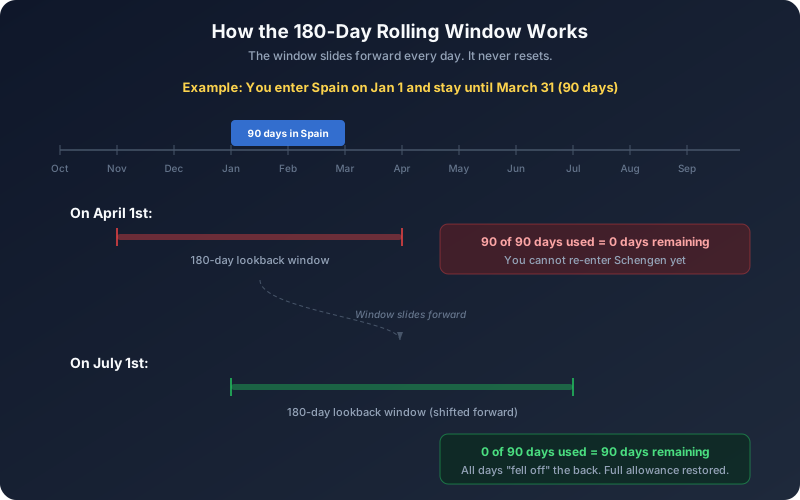
Say you enter Spain on January 1st and stay through March 31st. That is 90 days used. You must leave. But you cannot simply re-enter the next day -- you have already used your full 90 days in the current 180-day lookback.
If you look at it from April 1st: the 180-day window stretches back to October 4th of the previous year. Every day from January 1 through March 31 falls inside that window, which equals 90 days counted.
Now fast forward. By July 1st, the 180-day window looks back to January 3rd. Your January days have started to "fall off" the back end of the window. Each new day that passes frees up one more day of allowance. By roughly July 1st you will have regained all 90 days.
Common Mistakes Nomads Make
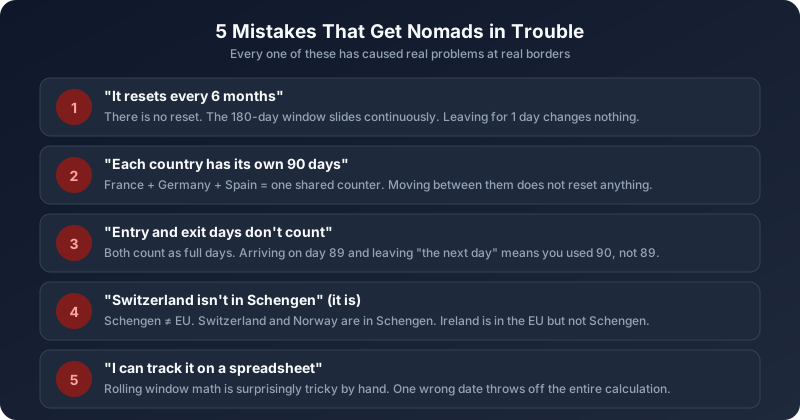
Mistake 1: Thinking it resets every 6 months
This is the most dangerous misconception. There is no "reset date." The window slides continuously. You cannot simply leave for a day and come back with a fresh 90 days.
Mistake 2: Counting per country
Days in France, Germany, and Portugal all count toward the same 90-day total. Moving between Schengen countries does not reset or pause your count.
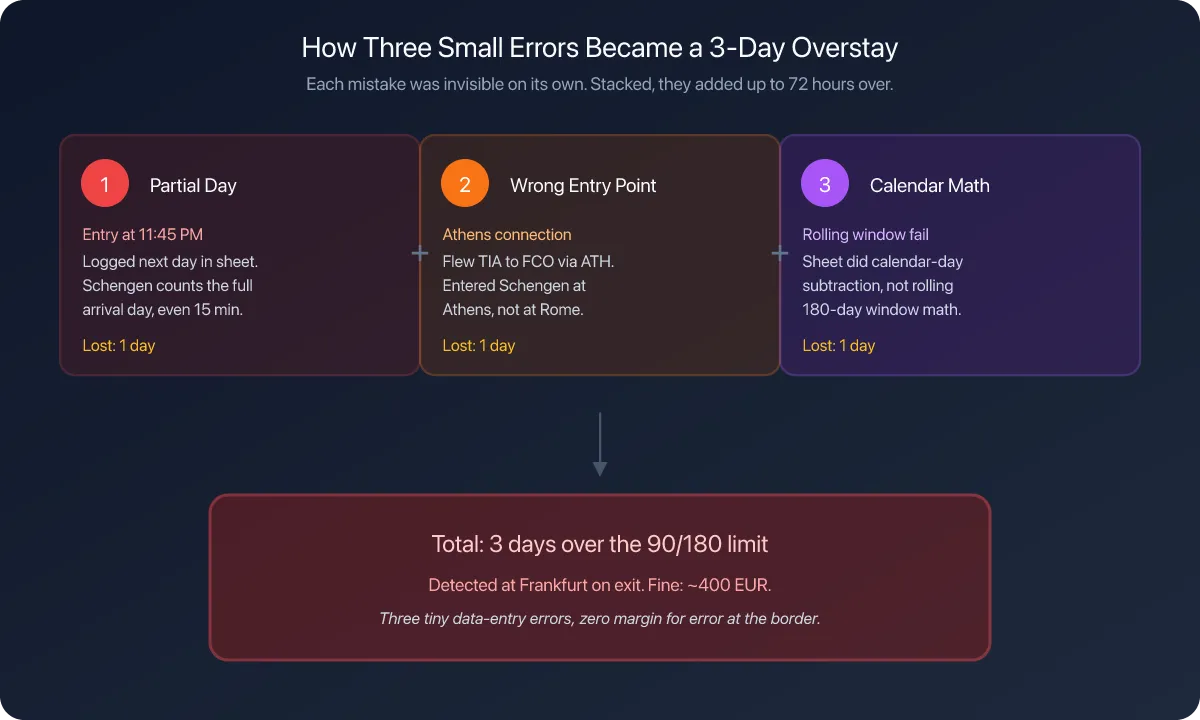
Mistake 3: Not counting entry and exit days
Both the day you arrive and the day you depart count as full days in the Schengen zone. A common trap: arriving late on day 89 and thinking you have two more days when you actually have one.
Mistake 4: Confusing Schengen with EU
Spending time in Ireland (EU but non-Schengen) does not count against your Schengen days. Spending time in Switzerland (Schengen but non-EU) does count.
Mistake 5: Relying on manual spreadsheets
A rolling 180-day calculation is genuinely tricky to do by hand. One wrong date and your entire count is off. This is exactly why automated calculators exist.
How to Calculate Your Remaining Days
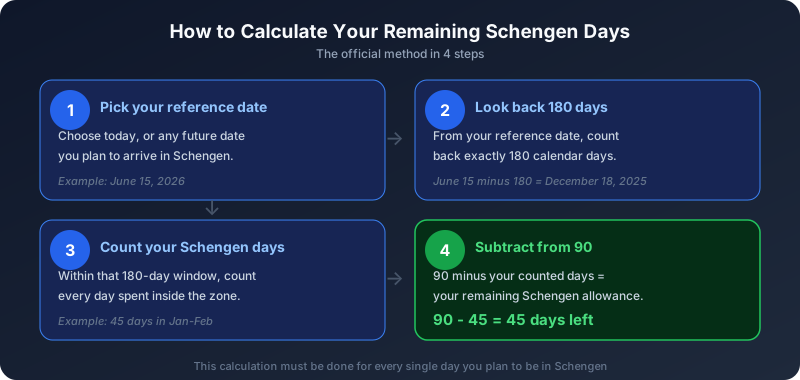
The official calculation method works like this:
- Pick a reference date (today, or any future date you plan to arrive).
- Look back exactly 180 days from that date.
- Count every day within that window that you spent inside the Schengen zone.
- Subtract from 90. That is how many days you have left.
The European Commission provides a short-stay visa calculator, but it requires you to manually enter every trip. If you have been nomading for a while, that gets tedious fast.
We built a free Schengen Calculator that lets you input your trips and instantly see your remaining days, plus a visual breakdown of your rolling window. Give it a try -- it runs entirely in your browser, no data sent anywhere.
Strategies for Maximizing Your Time in Europe
The 90-out-90-in pattern
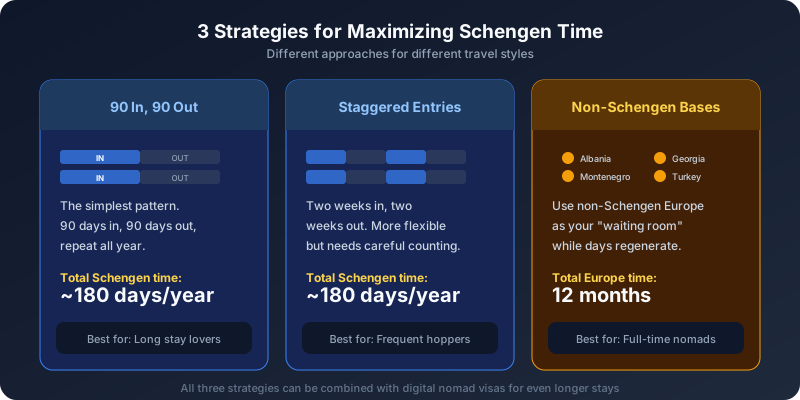
The simplest approach: spend 90 days in Schengen, leave for 90 days, repeat. This gives you the maximum possible Schengen time in a year -- roughly 180 days total.
Non-Schengen European bases
Countries like Albania, Montenegro, Turkey, Georgia, the UK, and Ireland are popular "waiting rooms" for nomads using up their Schengen days. They offer excellent quality of life and are a short flight from most Schengen hubs. Be careful about what leaving actually buys you, though: a short hop out pauses your count, it does not reset it, and that distinction catches people out constantly. Strung together properly, these stays are the backbone of spending six months a year in Europe legally.
Staggered entries
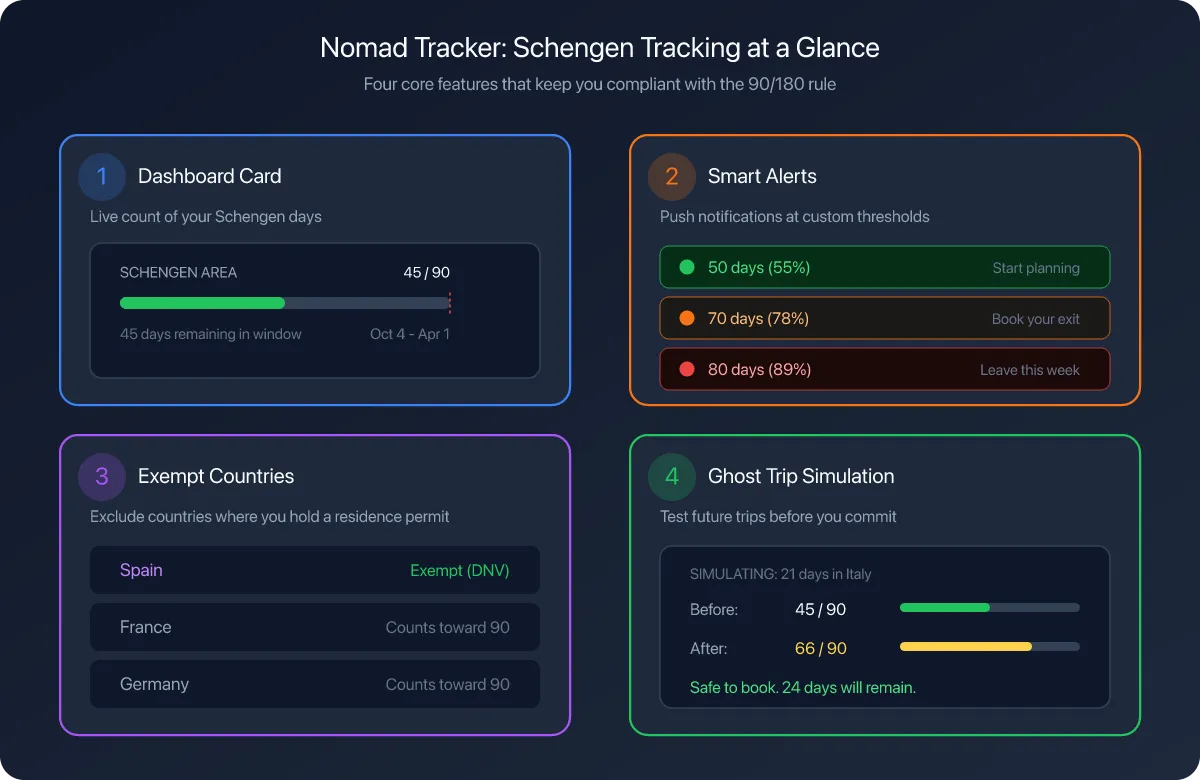
Instead of burning all 90 days at once, spread them out. Two weeks in, two weeks out. This gives you more flexibility and a longer overall presence in Europe throughout the year, though it requires more careful counting. If you use Nomad Tracker for that, here is how to set the Schengen counter up, exempt countries included.
Long-stay visas and residency permits
If you plan to be in Europe long-term, consider a D-visa (national long-stay visa) or residency permit. Countries like Portugal, Spain, and Estonia offer specific digital nomad visas that let you stay well beyond the 90-day Schengen limit. Our 2026 comparison covers the income thresholds, costs, and tax treatment of the main programs.
ETIAS in 2026: What Changes?
The European Travel Information and Authorisation System (ETIAS) is expected to become operational for visa-exempt travelers (US, Canadian, UK, Australian citizens, etc.). Here is what to know:
- ETIAS is a pre-travel authorization, not a visa. It does not change the 90/180 rule itself.
- You will need to apply online before traveling. The authorization is valid for 3 years.
- The fee is around 7 EUR.
- ETIAS will make it easier for border authorities to track your entries and exits electronically. The days of vague passport stamp counting are ending.
Combined with the Entry/Exit System (EES) that registers all border crossings biometrically, overstaying even by a day will become trivially detectable. Our ETIAS and EES update goes through the timelines and what each system actually checks. Accurate day counting is no longer optional -- it is essential.
Tax Implications of Schengen Stays
The 90/180 rule governs your immigration status, but spending significant time in any one country can also trigger tax residency. Most European countries apply some version of the 183-day rule: spend more than 183 days in a tax year and you may become a tax resident there.
For nomads, this creates a double constraint: you need to track both your Schengen-wide total (for immigration) and your per-country totals (for tax). These are separate calculations with different window types.
The 183-day tax rule typically uses a calendar year or fiscal year, not a rolling window. Confusing the two frameworks is a common and costly mistake, and Spain is the country where it goes wrong most often.
Why Automated Tracking Matters
If you are serious about the nomad lifestyle, manual day counting stops working past two or three trips. The rolling window math is non-trivial. Timezone differences mean you might not be sure which date you actually crossed a border. Multiple Schengen entries and exits create overlapping periods that are nearly impossible to verify by hand.
This is exactly the problem Nomad Tracker was built to solve. It uses your phone's GPS to automatically detect country changes and logs them for you. The Schengen calculator runs in real-time using the official rolling-window algorithm, so you always know exactly how many days you have left.
No spreadsheets. No guesswork. Just accurate, automatic tracking that runs entirely on your device with zero data leaving your phone.
Stop counting days manually.
Nomad Tracker automates Schengen day counting, fiscal residency monitoring, and visa tracking -- all on-device, all private. Available on iOS.
Download on the App Store