Walk into any digital nomad group chat on a Friday night and you will eventually see some version of this question: "My Schengen is almost up, if I pop over to Tirana for the weekend does that reset my 90 days?"
The short answer is no. The long answer is that the question itself shows a deep misunderstanding of how the 90/180 rule works, and that misunderstanding is now far more dangerous than it was two years ago. Since the EU Entry/Exit System (EES) went live at all Schengen external borders on 10 April 2026, the old strategy of hoping a border guard will not count too carefully is effectively over. Every entry and exit is biometrically recorded. The math is done in real time. And the system simply does not care how many weekends you spent in the Balkans.
This article breaks down exactly what a quick trip outside Schengen does, what it does not do, and why the border-hopping myth keeps refusing to die.
The Myth in One Sentence
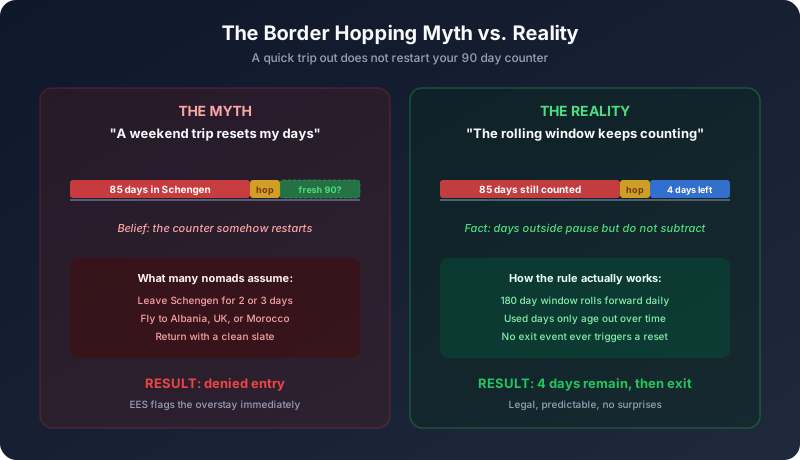
The myth: "If I leave the Schengen Area, even for a short time, my 90-day counter restarts from zero."
That belief takes several forms in the wild. Some nomads think a flight to Morocco or Turkey buys them a fresh 90 days. Others think a long weekend in London or Dublin quietly erases the days they have already burned. A few genuinely believe that the 180-day window is a fixed calendar block that resets at a specific date, and that a quick exit accelerates that reset.
None of these are true. Every single one of them has been used in real visa denial cases at European borders, and every single one results in the same outcome: you have used more days than you realized, and now you need to leave.
What the Rule Actually Says
The Schengen 90/180 rule is written into Article 6 of the Schengen Borders Code. The wording that matters: a third-country national may stay in the Schengen Area for up to 90 days within any 180-day period. Our full guide to the rule unpacks each clause, but three details do all the work here.
Two features of that sentence do the work:
"Any 180-day period." Not a calendar half-year. Not a fiscal year. Any. On any given day you pass a Schengen border, the system takes today as day zero and looks back 180 calendar days. That is your window. Tomorrow, that window has shifted forward by one day. The day before yesterday, it was shifted back by one. The window never stops moving and it never resets.
"Up to 90 days." Inside that rolling window, the total number of days you have been physically present in the Schengen zone must be 90 or less. Entry day counts. Exit day counts. Transit days count. Days at Frankfurt airport waiting for a connection, counted. Days on a train through France to get to Spain, counted.
What is deliberately missing from the rule is any concept of a reset trigger. There is no event, short of time itself, that removes used days from your window. You cannot accelerate the process by leaving. You cannot reset it by applying for a different visa. You cannot start fresh by entering through a different airport. The only thing that removes used days from your count is days falling off the back end of the 180-day window, which happens at a strict rate of one day per day.
Why "Leaving" Feels Like It Should Reset Something
The confusion is understandable. For most visa regimes in the world, a counter really does restart when you leave and come back. A US B1/B2 tourist gets a new clock on each entry. The same is true for many Asian tourist visas. If your only experience of international travel is the pattern of "enter, get 30 days, leave, next time you enter you get 30 more," the rolling-window concept feels almost adversarial.
There is a second source of the myth: old passport-stamp enforcement was genuinely inconsistent. Before EES, a border guard in Lisbon might glance at your stamps, fail to do the arithmetic, and wave you through even though your math was off. Once or twice is not a pattern of policy, but it is absolutely a pattern of social media storytelling. The "I did a border run to Albania and they let me back in" threads multiplied, and many readers drew the wrong conclusion: the trip reset the counter. What actually happened was that the reader simply had days available, or the guard did not catch the discrepancy. Neither of those things is the rule changing.
What a Trip Outside Schengen Actually Does
A short trip outside Schengen does exactly one thing for your count: it pauses the accumulation of new days. That is it. The days you were outside are not counted toward your total, because they were not spent inside Schengen. The days you already burned remain in your rolling window until they naturally age out of it.
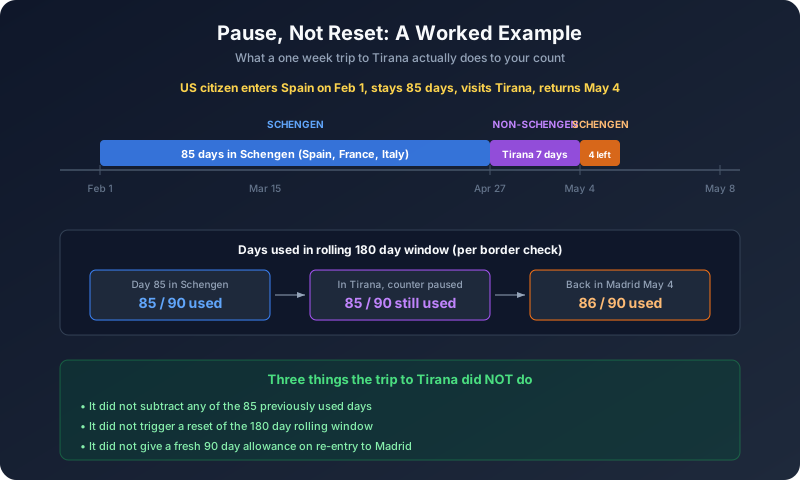
Consider a worked example. Imagine a US citizen who enters Spain on 1 February and spends 85 straight days traveling through Spain, France, and Italy. On 27 April she has 85 of 90 days used. She then flies to Tirana for a week, returning to Madrid on 4 May.
When she lands in Madrid, a border officer (or, from 10 April 2026 onward, the EES self-service kiosk) looks back 180 days from 4 May. That window covers roughly 6 November of the previous year through 4 May. Inside that window she has 85 Schengen days from her earlier trip plus the new entry day of 4 May. Her total used stands at 86. She has 4 days of allowance left. The trip to Tirana added zero fresh days. It simply froze her count at 85 for the week she was away.
If she had tried to re-enter expecting 90 new days, she would have been caught immediately. The kiosk would show 86 used and refuse entry past 8 May.
Three Classic Failed Border Hops
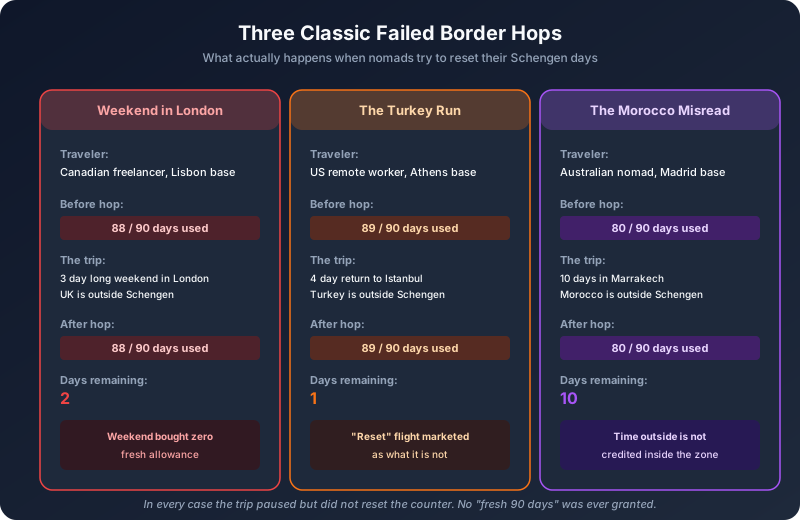
The same failure patterns keep showing up in support tickets from Nomad Tracker users and in publicly documented cases on expat forums. A few deserve special attention.
The Weekend in London
A Canadian freelancer based in Lisbon has used 88 Schengen days and decides a long weekend in London will "top him up." The UK is not in Schengen, so the weekend does not add days to his count. But it also does not subtract any. When he flies back into Lisbon on Monday he still has 88 days used. He now has two days of legal stay left before he must exit Schengen entirely. Most people in this situation are shocked to learn that their "reset" bought them nothing.
The Turkey Run
A popular flight route out of Athens or Milan is a cheap return trip to Istanbul. It is often marketed in nomad groups as a "Schengen reset." It is not. Turkey is not in Schengen and your counter pauses for the days you are there. But if you re-enter at Athens with 89 days already used, you get one more day of legal stay. The Turkey trip only helps if your goal is to wait out old days, and waiting out 90 days requires, well, 90 days. Not a long weekend.
The Morocco Misread
Tangier and Marrakech fill up every summer with European-based nomads attempting the same move. Once again the trip pauses rather than resets. The failure mode here has a unique twist: many travelers arrive back at a Spanish port of entry with a mental model where Moroccan days were somehow subtracted from their Schengen total. That is not how any border authority, anywhere, has ever counted days. Time outside the zone is not credited inside the zone. It is simply time not spent in the zone.
EES Ended the "Maybe They Will Not Notice" Era
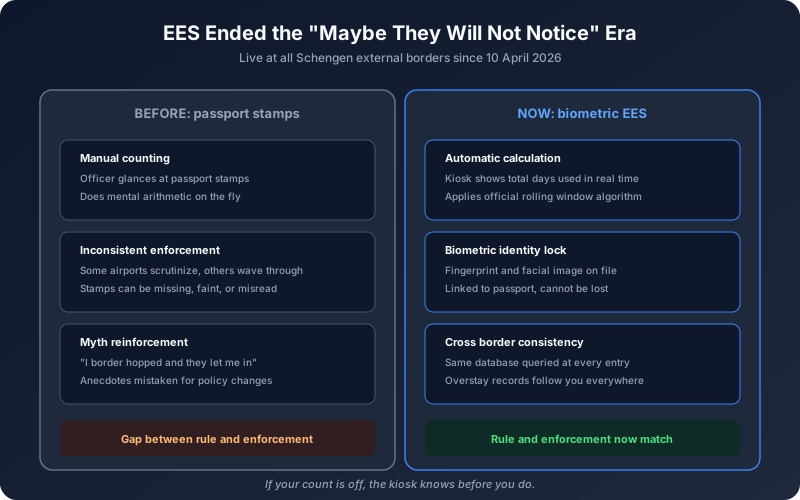
Until April 2026, the practical layer on top of the legal rule was human. A border officer might miscount, a passport might be missing a stamp, a transit through a smaller airport might not get scrutinized. Some nomads built entire travel patterns on the gap between the rule and its enforcement.
That gap has closed. The Entry/Exit System records every crossing at every external Schengen border biometrically. It stores fingerprints and a facial image linked to your passport. On entry it shows the officer your total used days within the rolling window. On exit it records the exit timestamp. There is no passport stamp to smudge, lose, or misread. If you used 85 days in the past 180, the kiosk knows before you do.
Two consequences follow. First, the old argument "I did it last year and it worked" is even less reliable as a data point than before. A looser enforcement environment is gone. Second, overstays are now effectively self-documenting. Any future entry into Schengen, any visa application for a Schengen country, any ETIAS renewal, all query the same database. Overstay records do not quietly fade away.
None of that is scary if your counting is correct. It is only scary if you were counting on the gap.
What Actually Works: Genuine Non-Schengen Time
The fact that border hopping does not reset your days does not mean non-Schengen countries are useless. Used properly, they are essential to a sustainable European nomad life. The key is understanding what you are actually buying when you leave the zone: time for old days to age out of your rolling window.
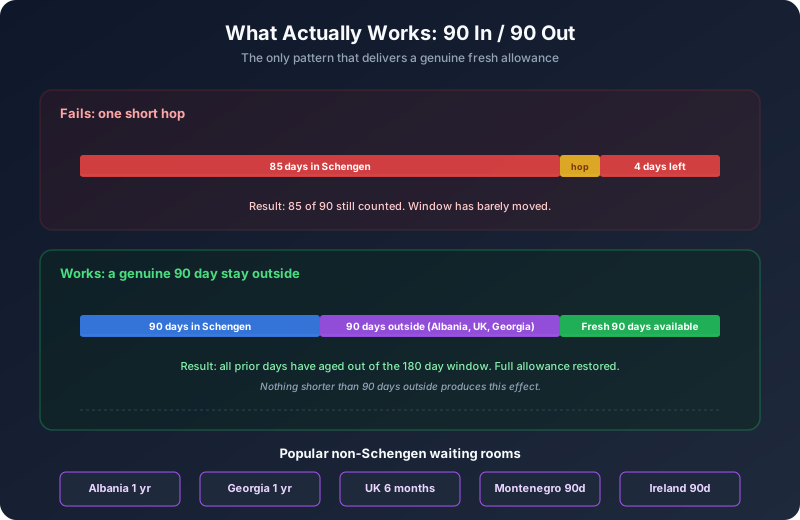
The clean pattern is the 90-in / 90-out cycle. Spend up to 90 days inside Schengen. Then spend a genuine 90 days somewhere else. By the time you re-enter, all 90 of your previous days have fallen off the back of the rolling 180-day window and you start fresh. This is the only pattern that actually delivers what the border hopping myth promises, and it requires something the myth conveniently skips: the full 90 days on the outside. Built out across a year, this is what makes six or more months a year in Europe legal rather than wishful.
The Western Balkans have become the default waiting room for this pattern and for good reason. Albania grants many nationalities (including US passport holders) up to one year visa-free. Montenegro, Serbia, North Macedonia, and Bosnia generally allow 90 days. Costs are low, budget airline connections to Schengen are good, and life in Tirana, Belgrade, or Kotor is pleasant enough that 90 days outside does not feel like exile.
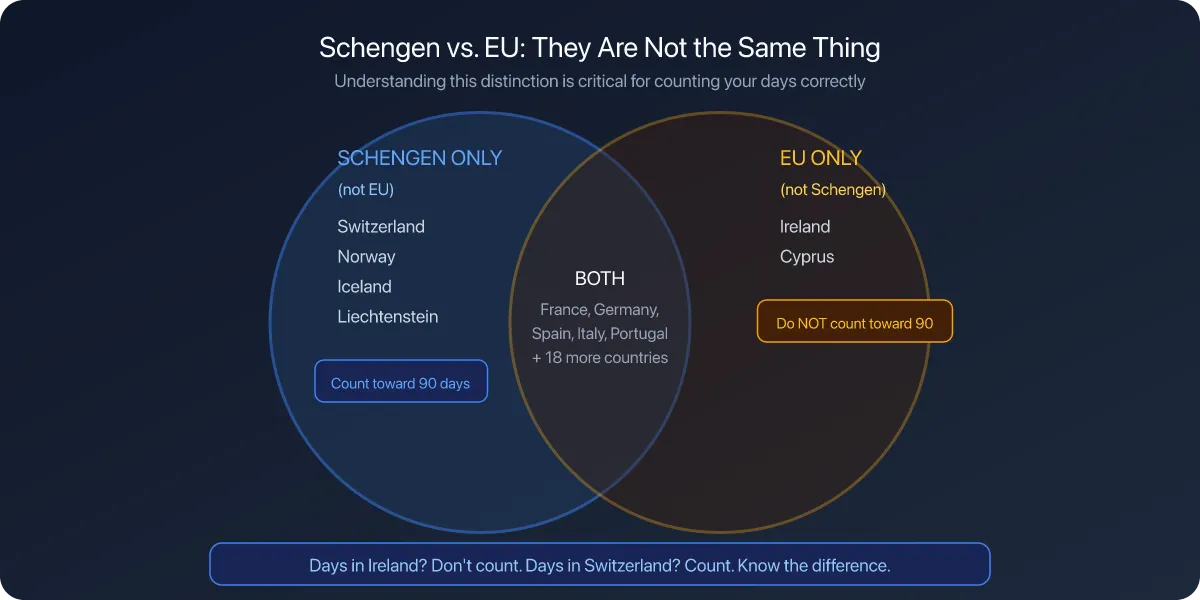
Two European countries deserve their own mention. The UK offers visa-free stays of up to 6 months on a Standard Visitor category for many nationalities. Ireland offers up to 90 days. Both are outside Schengen entirely. Both are useful for nomads who want to stay in Europe without burning Schengen days, though both have their own immigration rules, their own work restrictions, and their own enforcement apparatus. They are separate systems, not extensions of Schengen.
Georgia, technically in the Caucasus rather than Europe, offers one of the most generous visa-free stays in the world: one year for many nationalities. For nomads who need a long non-Schengen base to wait out their counter, Tbilisi has become a popular home, helped along by a 1% tax regime for small entrepreneurs that survived the 2026 permit reforms.
The strategy only works if your time outside is genuine. Five short trips to Albania totaling 30 days does not produce a clean re-entry. It produces five pause points in a counter that is still close to 90.
The Uncomfortable Math
One reason the border hopping myth survives is that doing the rolling-window calculation by hand is genuinely unpleasant. It requires sorting every trip in order, identifying the current 180-day window, tagging each day inside that window as Schengen or non-Schengen, summing the Schengen ones, and then repeating the whole exercise for every future date you care about.
Most nomads skip that work because it is tedious. The result is a mental model built on vibes. That mental model is where the "weekend trip resets everything" idea feels plausible. It does not feel plausible to anyone who has actually done the arithmetic.
This is exactly the gap we built Nomad Tracker to close. The app uses on-device GPS to detect country changes automatically, applies the official rolling-window algorithm in real time, and shows your current Schengen day total alongside projections for any future travel. The free Schengen Calculator on the website does the same calculation from manually entered trips if you prefer a browser tool.
The Ghost Trips feature is particularly useful for testing hypotheses like "what if I spend 10 days in Albania in May?" You can model the trip, see the projected day count on your return, and instantly verify whether the plan works before booking flights. No myth. No guesswork. Just the actual math.
Stop testing myths at border control.
Nomad Tracker counts your Schengen days automatically, simulates future trips with Ghost Trips, and alerts you before you hit 80 days. On-device, private, and accurate to the same algorithm the EES uses.
Download on the App Store