For years, one of the most-asked questions in nomad forums has been some version of: "If I land in Spain instead of Germany, will the officer actually count my 90 days?" The implicit hope is that if you pick the right airport, a tired officer with a manual stamp will wave you through and your overstay becomes someone else's problem.
That mental model is on its last legs. As of April 10, 2026, the Entry/Exit System (EES) is fully operational at every external Schengen border. Day counting is no longer a discretionary call by an officer leafing through your passport. It is a database query. But the cultural differences between member states still matter, especially during this transition period and for what happens after the system flags you.
Here is an honest country-by-country read on Schengen border enforcement in 2026, what changed when EES went live, and why the "soft border" strategy is officially dead.
How Enforcement Actually Worked Before EES
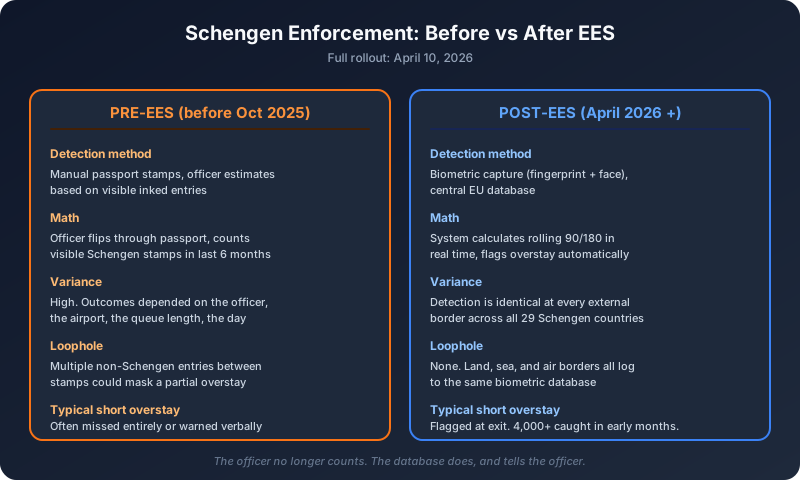
Pre-EES, the 90/180 rule was technically a uniform Schengen regulation, but enforcement was wildly uneven across the 29 member states. Officers would flip through your passport, look at the most recent stamps, do quick mental arithmetic, and make a judgment call. If you had a busy passport with a lot of non-Schengen entries mixed in, the math was effectively impossible to do at the booth in under 30 seconds.
This created a well-known reputation gradient. Some countries had a culture of close inspection and strict enforcement. Others tended to wave through anyone who did not raise a red flag. Reader-submitted stories on forums like Rick Steves Travel Forum, Reddit's r/digitalnomad, and r/expats consistently mapped the same hierarchy.
The historically strict tier
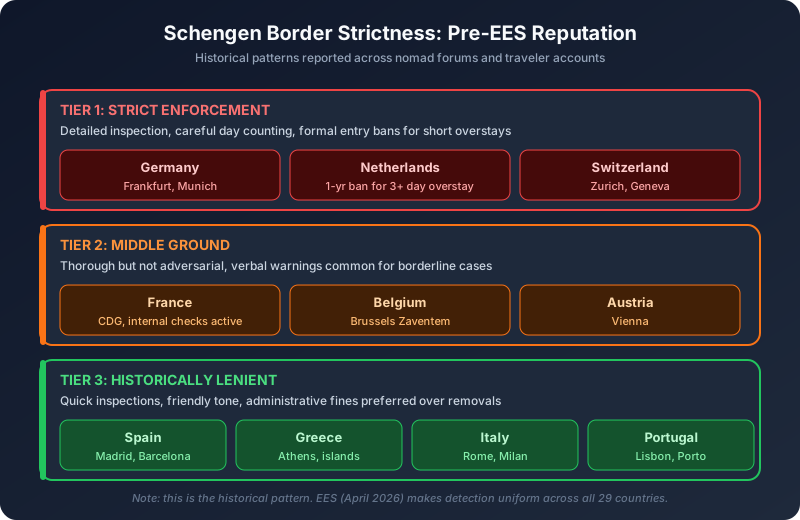
Germany, the Netherlands, and Switzerland built reputations as the toughest Schengen entry points. Officers at Frankfurt, Schiphol, and Zurich were known for asking detailed follow-up questions, calculating days carefully, and issuing entry bans for overstays as short as a single day. The Netherlands in particular has a published policy that imposes a one-year entry ban for overstays of more than three days and up to 90 days, escalating to a two-year ban for overstays beyond 90 days.
Anecdotal accounts from third-party travel forums describe officers at these airports counting backwards on a calendar, asking for proof of accommodation in the next country, and refusing entry to travelers who could not show a clear exit plan.
The middle tier
France, Belgium, and Austria typically fell in the middle. Charles de Gaulle and Brussels Zaventem had a reputation for being thorough but not adversarial. Officers would check, but a borderline case would often get a verbal warning rather than a fine. France in particular has used internal border controls aggressively in recent years, but its external air border posture was historically moderate.
The traditionally lenient tier
Spain, Greece, Italy, and Portugal sat at the lenient end of the spectrum. Reader cases from Madrid Barajas, Athens, Rome Fiumicino, and Lisbon described officers who barely glanced at stamps, asked one or two friendly questions, and stamped travelers through. Southern European countries also tended to apply administrative fines rather than removals when overstays were caught.
This reputation drove a specific nomad behavior: enter through Madrid, exit through Lisbon, and hope nobody at the exit point cared enough to do the math. It worked often enough that it became conventional wisdom.
Why the EES Changes Everything
The Entry/Exit System replaces passport stamps with biometric records, fingerprints and facial scans, stored in a central EU database. Every entry and every exit, at every Schengen external border, is logged automatically. The system does the 90/180 calculation in real time and flags overstays the moment they happen.
This is not a future change. It is the current state of the world. The phased rollout began on October 12, 2025, and the system became fully operational on April 10, 2026. According to the European Commission, the system flagged more than 4,000 overstayers within its first months of operation.
The implications are straightforward. The "lenient officer" loophole no longer exists, because the officer is no longer the one doing the math. The database does it before the officer even looks up. If your record shows 91 days in the rolling 180-day window, the system tells the officer, and the officer follows the country's enforcement protocol.
What Still Varies Between Countries Post-EES
The detection is now uniform. The consequences are not. Each Schengen country sets its own administrative penalties for overstayers. This is where the country-by-country differences still matter, and where the historical strictness reputation still informs what happens after a flag.
Penalty structures by country
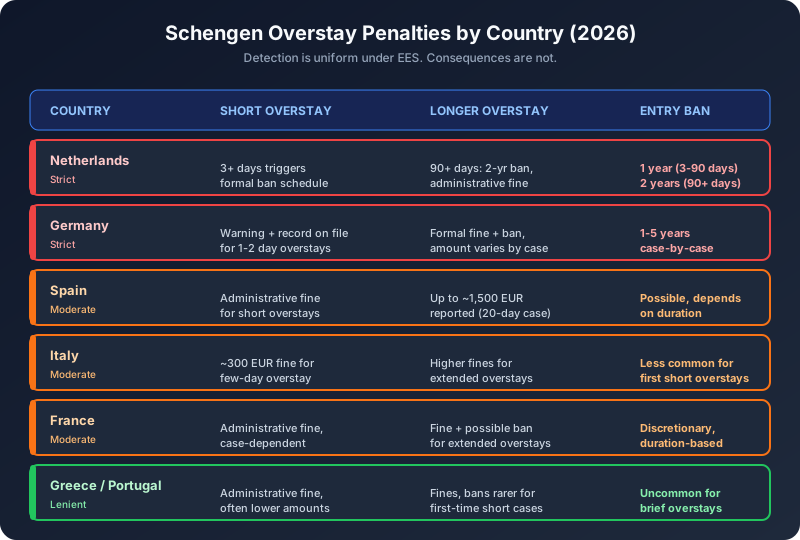
Italy has issued recent overstay fines around 300 EUR for short overstays of a few days, with larger penalties for longer violations. Spain has been observed issuing fines as high as 1,500 EUR for overstays in the 20-day range, despite its historical reputation for leniency at the booth. The Netherlands runs a published entry-ban schedule: overstays of more than three days but less than 90 days trigger a one-year Schengen-wide entry ban, and longer overstays trigger two years. For what this looks like from the traveler's side, one reader wrote up a three-day overstay in Frankfurt, fine, record and all.
Germany generally combines administrative fines with formal entry-ban records. The amounts vary based on length of overstay, prior violations, and whether the traveler was attempting to leave or was caught while still in-country. A first-time overstay of a day or two during exit will typically result in a warning and a record, while longer overstays move into the formal fine and ban territory.
France, Greece, and Portugal still tend toward administrative fines for short overstays, especially during voluntary exits. Discretion at the exit point may be reduced now that EES has flagged the violation, but the size of the fine and whether an entry ban is added remains a country-specific decision.
The takeaway: the country where you exit (or where you are caught) still determines how painful the consequences are. But the question of whether you get caught is no longer up for debate.
The Internal Border Check Layer
There is a second layer of enforcement that often gets overlooked in 90/180 conversations: temporary internal border controls. Several Schengen countries have invoked Article 25 of the Schengen Borders Code to reintroduce ID checks at internal borders, citing migration pressure and security concerns.
As of mid-2026, this list includes France, Germany, Norway, Poland, Sweden, Austria, Denmark, Italy, the Netherlands, and Slovenia. Germany alone has extended its land border controls with nine neighbors through September 15, 2026, covering the borders with France, Luxembourg, Belgium, the Netherlands, Denmark, Austria, Switzerland, Czechia, and Poland. Poland has extended its controls with Germany and Lithuania through October 1, 2026.
These are not external Schengen borders, so they do not appear in EES records. But they do involve random ID checks, and an officer can still ask to see your passport. If you are pulled over on a train from Frankfurt to Strasbourg or driving from Berlin to Warsaw, you can be asked to prove your status. For a non-EU citizen on an active 90-day window, this is a non-issue if your math is clean. For someone who has lost track, an internal check can become a quiet but real exposure point.
What This Means in Practice for Non-EU Nomads
Several practical conclusions follow from the new landscape.
Your entry airport choice matters less, but is not irrelevant
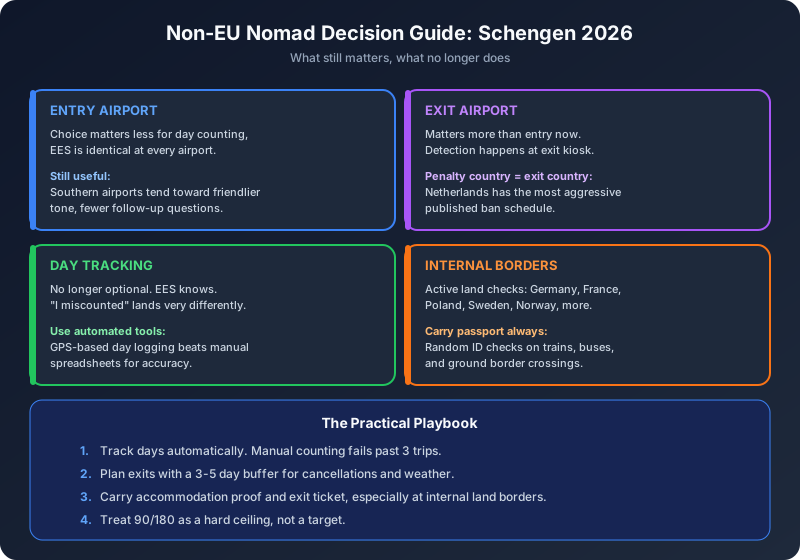
The biometric record is identical regardless of which Schengen country you enter through. Madrid is no softer than Frankfurt for day counting. But there is still a useful difference for ambiguous travelers, those whose calculations are tight and who want to minimize secondary inspection. Travelers report that officers at southern airports continue to be friendlier in tone, ask fewer follow-up questions, and have more flexibility in handling administrative edge cases.
The flip side: if you are clearly overstaying, no airport will save you. The system will flag you at the exit kiosk regardless of where you booked your flight.
Exit airport choice matters more than entry choice
If your overstay is detected, it will be detected at exit. The exit country handles the penalty. Travelers planning a deliberate or borderline-acceptable late departure should think carefully about which country they want to be processed by. The Netherlands has the most aggressive ban policy in the published guidance. Spain and Italy historically have lower fine ceilings and rarely impose multi-year bans for first-time short overstays. None of this is a license to overstay, but it is relevant context for travelers managing weather delays, sick days, or genuine emergencies.
The grace period is over for "I didn't realize"
Before EES, a borderline overstay could often be explained away with a confused look and a polite apology. Officers had discretion. The system itself did not know exactly how many days you had used.
Now, the system knows. It tells the officer. The "I miscounted" explanation lands very differently when it follows a printed-out tally that the officer is holding in their hand. Border professionals have a cognitive shift: an EES flag is, by default, treated as a confirmed violation rather than a question to investigate.
Internal land borders are a separate exposure surface
Even nomads who carefully manage their external entry and exit can still be checked at internal Schengen land borders. This matters most for ground travel through Germany, France, Poland, and the Nordic countries. Carrying your passport (or a clear digital copy) and knowing your current day count are no longer optional.
Common Misconceptions Still Circulating
Several pieces of nomad folklore deserve to be put down explicitly.
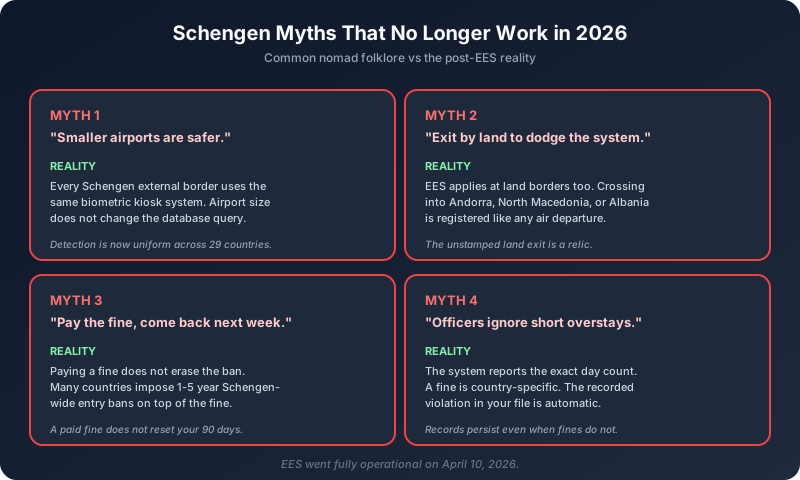
"Smaller airports are safer." Pre-EES, this had a kernel of truth at very small regional airports. Post-EES, every Schengen external border has the same biometric kiosk system. The size of the airport does not change the database query.
"Exit by land to dodge the system." EES applies at land borders too. Crossing from Spain to Andorra and back, or from Greece to North Macedonia, is registered. The myth that overland exits are not logged is a relic of the passport-stamp era.
"If I pay the fine, I can come back next week." Paying a fine does not erase the entry-ban record. Many countries impose entry bans of one to five years across the entire Schengen Area, in addition to the fine. A paid overstay fine does not reset your 90-day allowance, and it does not remove the ban.
"Officers do not really check for short overstays." Pre-EES, this was sometimes true for one or two days. Post-EES, the system reports the exact number of days used. Whether the officer cares enough to issue a fine is country-specific. Whether the violation is recorded in your file is not optional, it is automatic.
What Travelers Should Actually Do
The practical playbook for non-EU nomads in 2026 is simple and unglamorous.
Track your days accurately, ideally with an automated tool that uses your phone's location rather than a hand-kept spreadsheet. Plan exits with a buffer of three to five days, both because flights get cancelled and because the EES system runs in real time and does not care about your good intentions. Carry documentation of your accommodation and your exit ticket, especially when entering through countries with active internal border controls. Treat the rolling 180-day window as a hard ceiling, not a target.
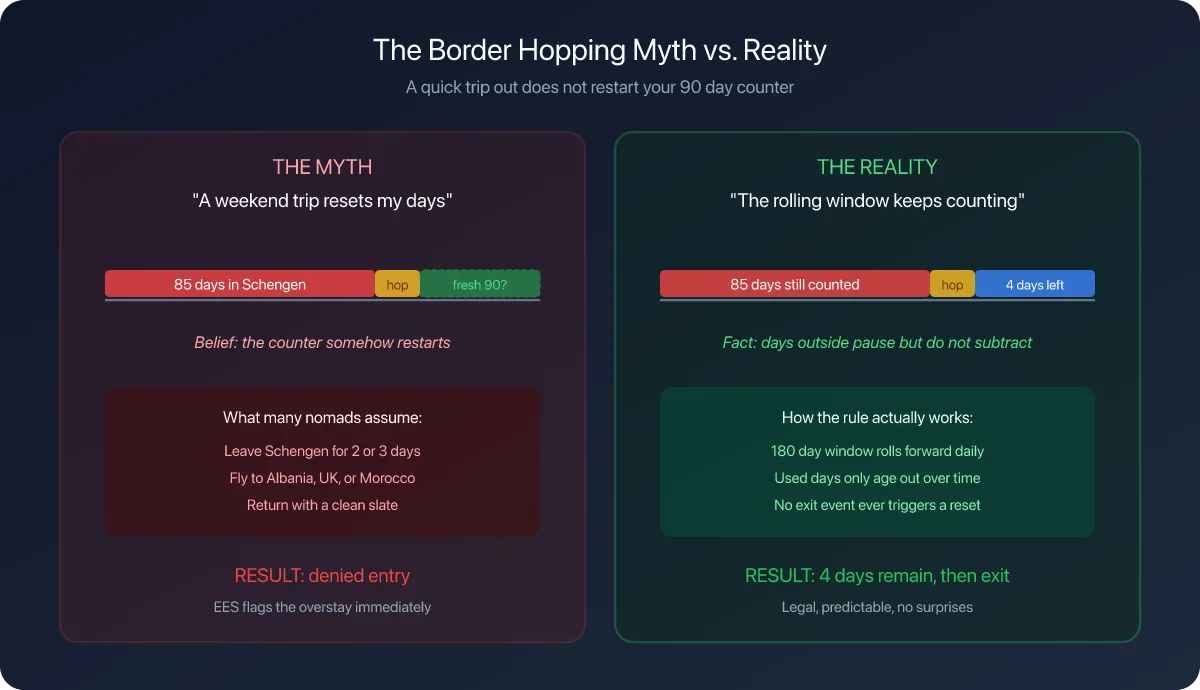
For travelers who want more legal time in Europe, the right answer is no longer "find a lenient airport." It is to combine Schengen visa-free time with non-Schengen European stays in countries like Albania, Montenegro, Georgia, the UK, and Ireland, or to apply for a digital nomad visa or long-stay residency permit in a Schengen country that offers one.
The era of border-control roulette is over. The math is the same everywhere now, and the math runs automatically.
Don't let the EES be the first to count your days.
Nomad Tracker uses on-device GPS to automatically log every Schengen entry and exit, calculates the rolling 180-day window in real time, and warns you before you hit 80 days. All processing happens on your phone, with zero data sent to any server.
Download on the App Store