Ask ten digital nomads to define "Europe" and you will get ten different answers. Most of them will be wrong, and some of those wrong answers will cost real money in fines, missed flights, or accidental tax residency.
The confusion is understandable. Europe is layered with three overlapping memberships: the Schengen Area, the European Union (EU), and the European Economic Area (EEA). They look like the same thing on a casual map. They are not. Each one governs a different aspect of your right to be in a given country, and most of the bad visa advice circulating in nomad forums comes from people who never bothered to learn the difference.
This guide pulls those three memberships apart, shows exactly which countries belong to which, and explains what each membership actually means when you are counting days, planning a visa run, or trying to figure out whether your time in Dublin counts against your Schengen allowance. It does not.
The Three Memberships in One Paragraph
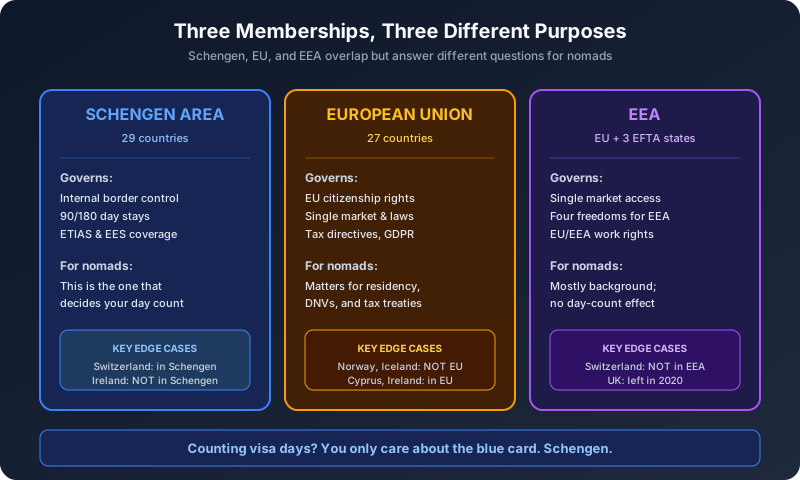
Before going deep, here is the cheat sheet. The Schengen Area is a 29-country zone with no internal border checks. The European Union is a 27-country political and economic union with shared laws, a parliament, and a single market. The European Economic Area extends the EU single market to three non-EU countries (Iceland, Norway, Liechtenstein) so they get free movement of goods, services, capital, and people without being EU members. Switzerland is in Schengen and EFTA but not in the EU and not in the EEA. Instead, it has a stack of bilateral agreements with the EU that achieve roughly similar effects. Ireland and Cyprus are in the EU but not in Schengen (as of May 2026).
If your eyes already crossed, that is the point. The lines do not match up neatly, and that is why nomads keep getting it wrong.
What the Schengen Area Actually Is
The Schengen Area is the one nomads care about most because it directly governs how long you can stay before getting in trouble. It was created by the Schengen Agreement of 1985 and the implementing convention of 1990, both originally signed in the Luxembourg village of Schengen.
The defining feature is the abolition of internal border controls. Once you legally enter through any external Schengen border (think landing at Madrid, Paris, or Frankfurt), you can move freely across the other 28 member countries with no passport check. Internal flights, trains, and road crossings are treated essentially as domestic travel.
For non-EU visitors from visa-exempt countries (US, Canada, UK, Australia, and roughly 60 others), the trade-off for that freedom is the 90/180 rule: you can spend up to 90 days within any rolling 180-day window across the entire zone combined. Not per country. The whole zone. Our complete guide to the rule covers how that window is calculated.
The 29 Schengen members in 2026
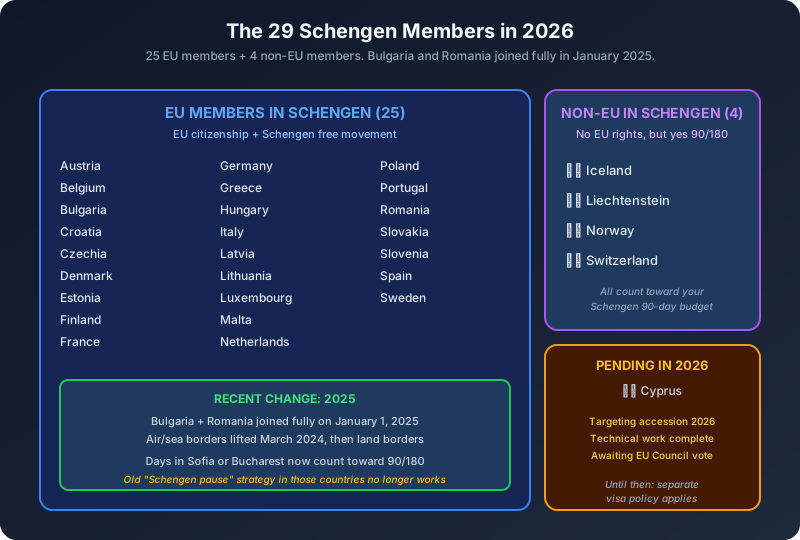
As of May 2026, the Schengen Area has 29 members. This number changed recently. Bulgaria and Romania were granted full Schengen membership on January 1, 2025, after their air and sea borders had already been lifted in March 2024. That brings the count to:
Austria, Belgium, Bulgaria, Croatia, Czechia, Denmark, Estonia, Finland, France, Germany, Greece, Hungary, Iceland, Italy, Latvia, Liechtenstein, Lithuania, Luxembourg, Malta, Netherlands, Norway, Poland, Portugal, Romania, Slovakia, Slovenia, Spain, Sweden, and Switzerland.
Of these, 25 are EU member states and 4 are not (Iceland, Norway, Switzerland, Liechtenstein). Cyprus is the only EU member still working through the Schengen accession process. Cypriot officials have publicly targeted 2026 for full entry, but technical readiness and political approval are separate hurdles, and as of this writing the country is not yet a Schengen member.
What Schengen membership means for your day count
Every day you spend in any Schengen country counts toward the same 90/180 budget. A weekend in Vienna plus two weeks in Lisbon plus a month in Croatia is one combined total. Crossing from France into Germany does not reset anything. Crossing from Germany into Switzerland does not reset anything either, because Switzerland is in Schengen.
This is the single most important takeaway. If you are tracking your days, the question to ask about any country is not "is this Europe?" or "is this the EU?" The only question that matters is: is this country in the Schengen Area?
What the European Union Actually Is
The EU is a political and economic union, not a travel zone. It has 27 member countries, a parliament, a court, a central bank for the eurozone subset, and a body of binding law (the acquis communautaire) that all members must adopt.
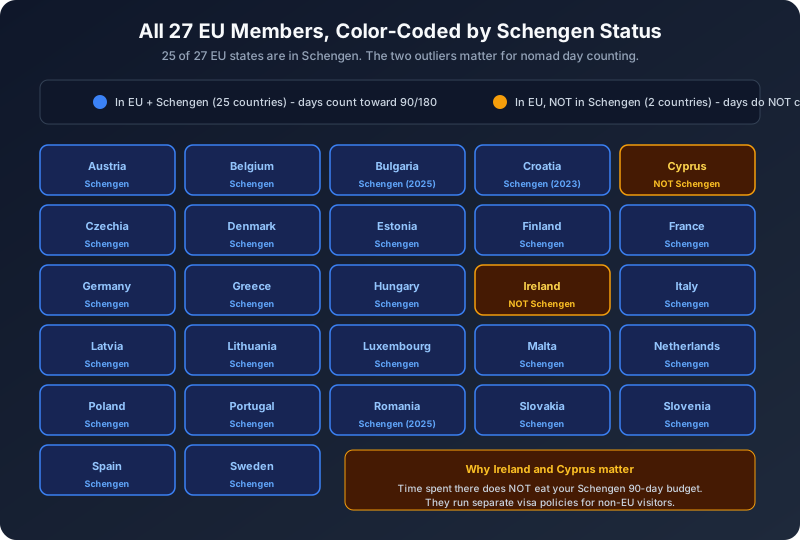
The 27 EU members are: Austria, Belgium, Bulgaria, Croatia, Cyprus, Czechia, Denmark, Estonia, Finland, France, Germany, Greece, Hungary, Ireland, Italy, Latvia, Lithuania, Luxembourg, Malta, Netherlands, Poland, Portugal, Romania, Slovakia, Slovenia, Spain, and Sweden.
Notice what is not on that list: Iceland, Norway, Switzerland, Liechtenstein, and the United Kingdom. Norway and Iceland have applied in the past but ultimately rejected membership. Switzerland walked away from accession in 1992. The UK left in 2020.
What EU membership means for nomads
For non-EU passport holders, EU membership matters less than Schengen membership for short stays. The 90/180 rule is a Schengen rule, not an EU rule. If you are a US citizen visiting Ireland for 60 days, those days do not count against your Schengen budget, because Ireland is in the EU but not in Schengen.
EU membership becomes relevant when you start dealing with longer-term things: digital nomad visas, residency permits, tax treaties, GDPR, banking rules, the European Health Insurance Card, and the upcoming ETIAS pre-travel authorization (which is an EU-wide regulation that applies to all 29 Schengen states regardless of EU membership).
For EU citizens themselves, of course, EU membership is the whole game: the right to live, work, study, and retire in any other EU country without a visa or permit.
What the European Economic Area Actually Is
The EEA is the least famous of the three but the one that quietly answers "why does Norway feel so European if it is not in the EU?"
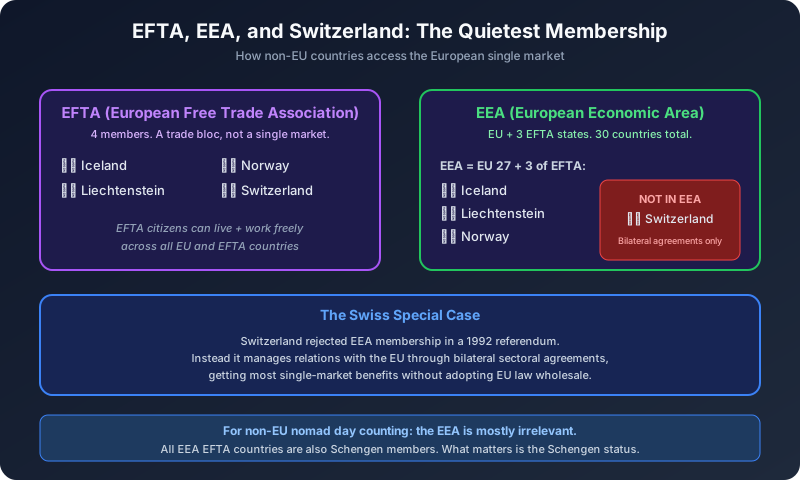
The EEA Agreement, in force since 1994, extends the EU's internal market (the "four freedoms" of goods, services, capital, and people) to three non-EU countries: Iceland, Norway, and Liechtenstein. They get to participate in the single market without joining the political union, but they have to adopt most EU single-market legislation in exchange.
The EEA is therefore the EU plus those three EFTA countries: 30 countries total. Switzerland is the odd one out. It is an EFTA member but rejected EEA membership in a 1992 referendum and instead manages its relationship with the EU through a series of bilateral sectoral agreements that produce roughly similar effects without the legal obligation to adopt EU law wholesale.
The relationship to EFTA
The European Free Trade Association (EFTA) is a separate trade bloc with four members: Iceland, Norway, Liechtenstein, and Switzerland. EFTA itself is not a single market. The EEA is the bridge that lets three of those four EFTA countries participate in the EU single market.
EFTA citizens can live and work in any EU country, and EU citizens can live and work in any EFTA country. This is a free movement right that flows from the EEA agreement (and, in Switzerland's case, from the bilateral free movement agreement).
Why the EEA is mostly irrelevant to non-EU nomads
For a US, Canadian, UK, or Australian nomad, the EEA distinction usually does not affect day counting. What matters is whether the country is in Schengen. Iceland, Norway, and Liechtenstein are all in both EEA and Schengen, so days there count toward your 90.
The EEA matters more if you are an EU citizen weighing where to base yourself, or if you hold a passport from one of the three EEA EFTA countries and want to know your rights elsewhere in Europe. For a typical visa-exempt nomad, the EEA is a useful piece of background context but not a daily operational concern.
The Edge Cases That Trip Nomads Up
Most of the bad advice in nomad forums comes from people who do not realize these edge cases exist. Here are the ones to internalize.
Ireland: EU but not Schengen
Ireland is in the EU but maintains a Schengen opt-out to preserve the Common Travel Area with the United Kingdom. Practically, this means Ireland runs its own visa policy and operates its own border checks even with EU and Schengen passport holders.
For nomads, Ireland is a useful "Schengen pause" base. A US citizen who has burned all 90 Schengen days can still legally spend up to 90 days in Ireland on a separate visa-free entry, with no impact on the Schengen counter. Many nomads use Dublin as a working pause between Schengen sprints.
Cyprus: EU but not yet Schengen
Cyprus has been working toward Schengen accession for years. As of May 2026, the country is committed to joining and has reportedly completed its technical readiness, but the EU Council has not yet given the final political approval. Until that happens, Cyprus operates its own border policy. Days spent in Cyprus do not currently count toward Schengen, though that will change once accession is finalized.
If you are planning travel into 2026 and beyond, watch this carefully. The day Cyprus joins Schengen, time spent there will start counting against your 90/180 budget.
Switzerland: Schengen but not EU and not EEA
Switzerland is in Schengen, so days there count. Switzerland is also in EFTA, so it has free movement with EU and EEA citizens. But Switzerland is not in the EU, not in the EEA, not in the EU customs union, and operates its own VAT system. For shopping or shipping, Switzerland feels like a separate country, because it is. For visa day counting, treat it as Schengen.
Bulgaria and Romania: now fully Schengen
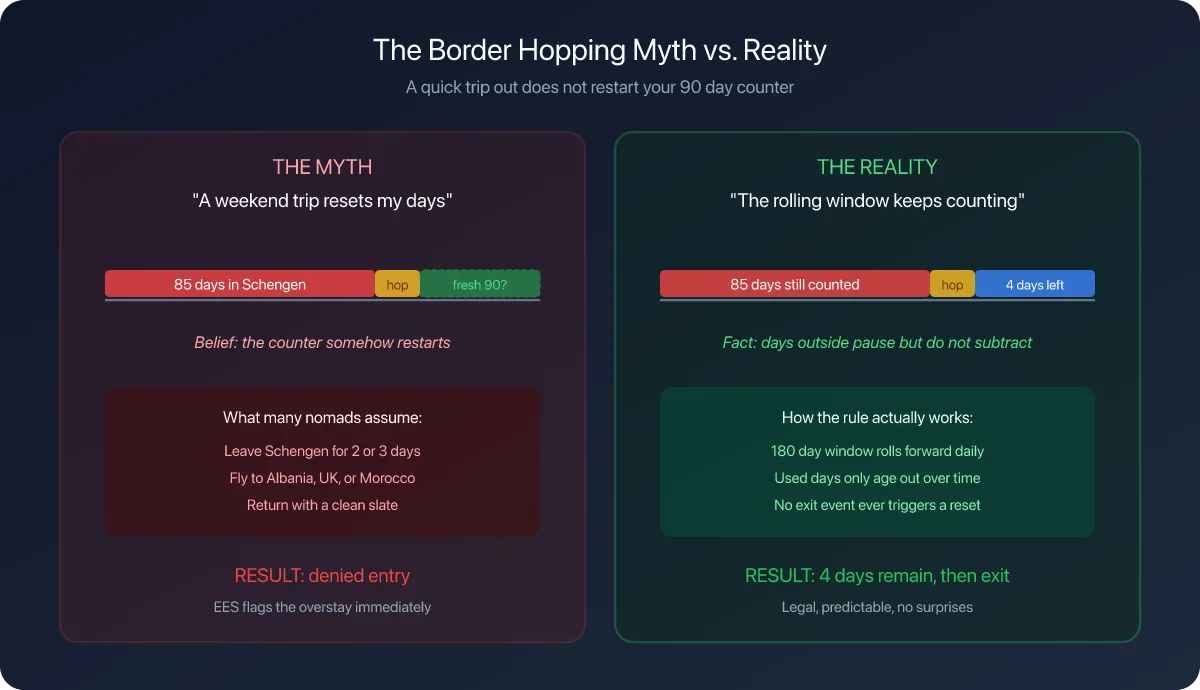
Until early 2025, Bulgaria and Romania were EU members outside Schengen. As of January 1, 2025, they are full Schengen members. Days spent there now count against your 90/180 budget. If you used Bulgaria or Romania as a Schengen pause in the past, that strategy no longer works. More broadly, stepping outside the zone never reset your counter anyway; it only pauses it.
There is one technical wrinkle: when full membership took effect, EU member states agreed to allow temporary land-border checks between Hungary, Romania, and Bulgaria for at least six months as a public-policy safeguard. These can be extended further. The day counting status is unchanged: it is Schengen, full stop. The border check theatrics are a separate issue.
Croatia: in everything
Croatia joined the EU in 2013, the eurozone in January 2023, and Schengen in January 2023. Days there count toward Schengen. As recently as 2022 this was different, and you may still find old articles claiming Croatia is a "Schengen pause" country. They are out of date.
The United Kingdom: in nothing
Post-Brexit, the UK is in none of these three groupings. It runs its own border policy (visa-exempt for most, with a separate ETA pre-authorization). UK time does not count against Schengen and is not affected by ETIAS or EES. UK citizens visiting Schengen are now subject to the 90/180 rule themselves.
Why This Matters for Your Day Counting
Here is the practical translation. If you are tracking your time in Europe, your spreadsheet (or hopefully your tracking app) needs to know which countries to count.
Counts toward Schengen 90/180: all 29 Schengen members. As of 2026 that includes Bulgaria, Romania, Croatia, and all four non-EU Schengen members (Iceland, Norway, Switzerland, Liechtenstein).
Does NOT count toward Schengen 90/180: Ireland, Cyprus, the United Kingdom, and the rest of non-Schengen Europe (Albania, Montenegro, Serbia, Bosnia, North Macedonia, Kosovo, Moldova, Ukraine, Andorra, Monaco, Vatican are technically governed by their own arrangements, plus Turkey, Georgia, Armenia, Azerbaijan).
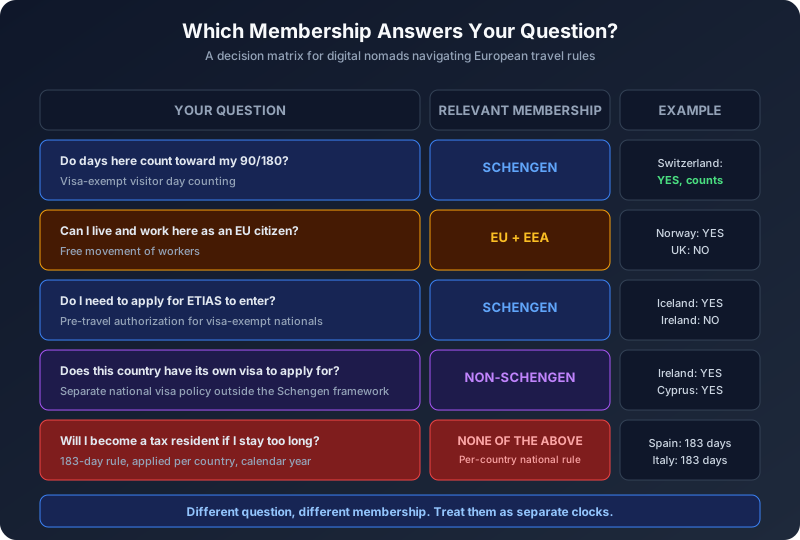
Tax residency is a separate count. Most European countries apply some version of a 183-day test for tax residency, calculated per country, usually on a calendar-year basis. The Schengen total has nothing to do with this. You can spend exactly 90 Schengen days legally and still trigger Spanish tax residency if those days happened to all fall in Spain on top of other Spanish presence. The two clocks run independently and need to be tracked independently.
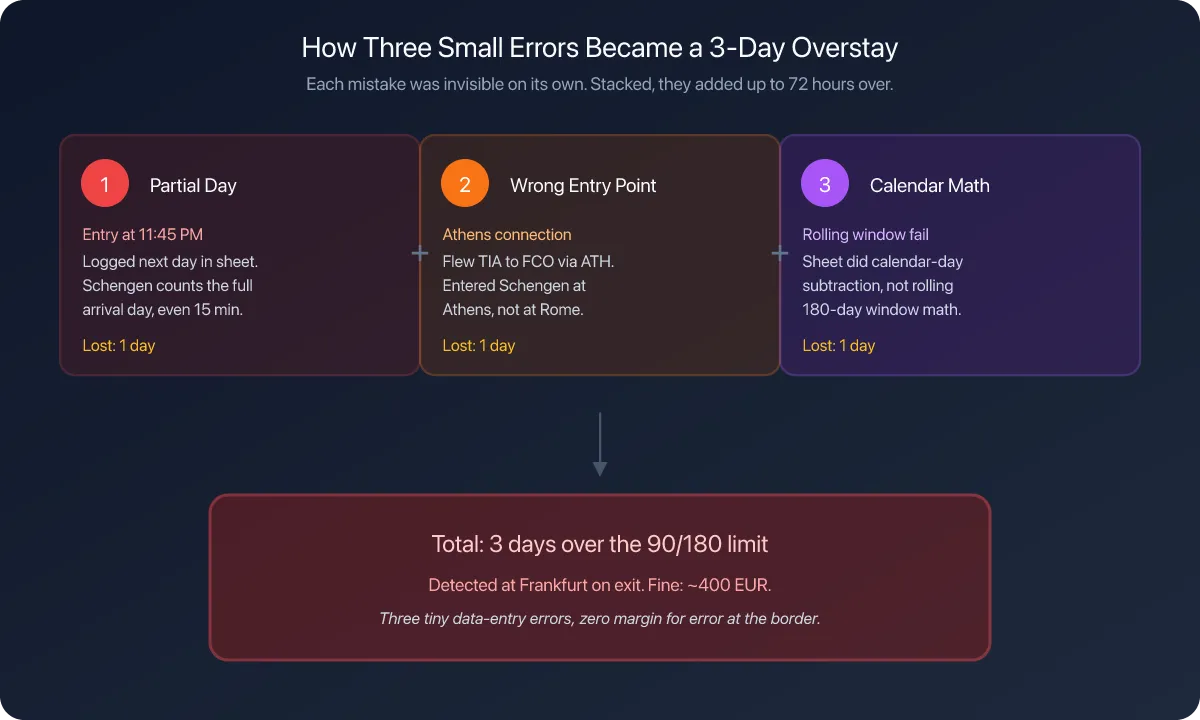
This is exactly the gap manual spreadsheets struggle to handle. A nomad doing two weeks in France, three weeks in Ireland, three weeks in Portugal, and a week in Switzerland needs to know that France, Portugal, and Switzerland count toward 90/180 but Ireland does not, and separately needs per-country totals for any country where they might cross the 183-day threshold.
ETIAS, EES, and Why the Distinctions Are About to Get Stricter
Two big systems are reshaping how Europe enforces these rules.
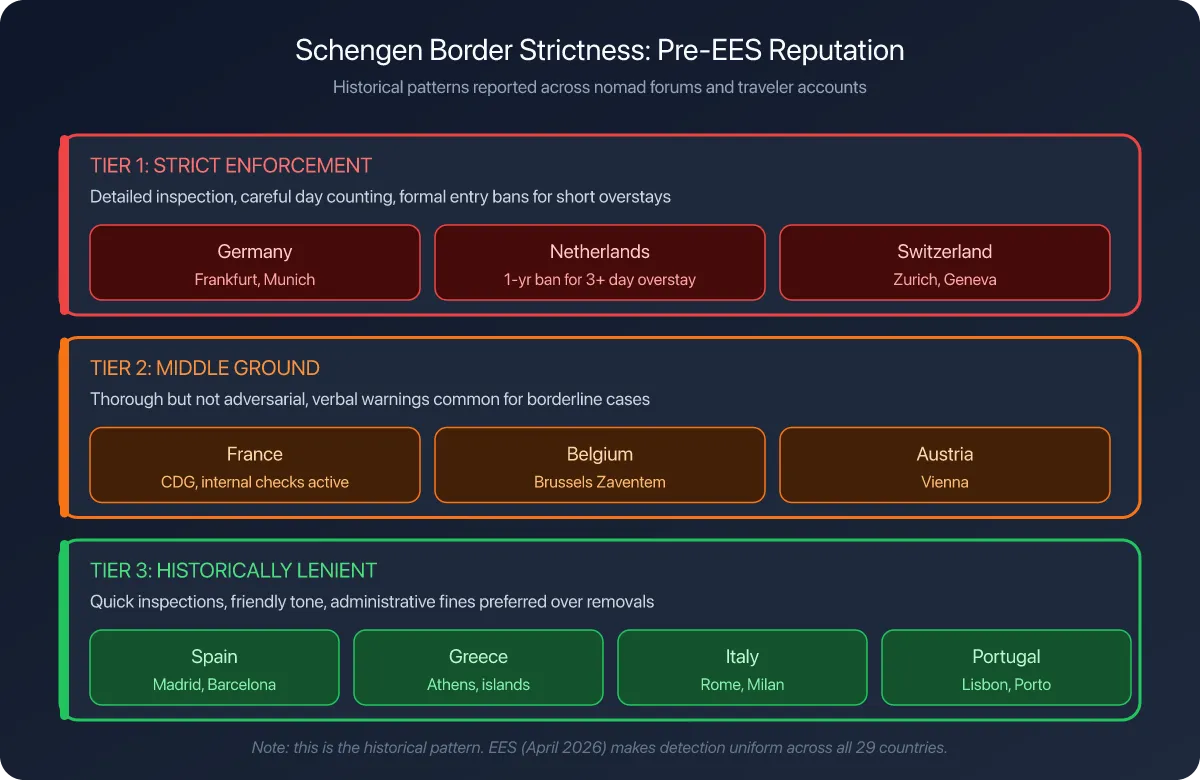
The Entry/Exit System (EES) went live in late 2024 and replaces passport stamping with biometric entry and exit logs across all Schengen borders. Every entry and exit is timestamped in a central database. Manual day counting on the basis of vague stamps is over. The system applies to all 29 Schengen states, including Bulgaria and Romania. Our ETIAS and EES update has the current rollout dates and the exemptions.
ETIAS (European Travel Information and Authorisation System) is the pre-travel authorization for visa-exempt non-EU nationals. It is expected to become fully required in 2026 for travelers entering the Schengen zone. Crucially, ETIAS is a Schengen-area system: it does not apply to Ireland or Cyprus, even though those are EU countries. It does apply to Switzerland, Iceland, Norway, and Liechtenstein, because those are Schengen.
These systems make the Schengen vs EU distinction more important than ever. EES will know to the minute when you entered Sweden and when you left Italy. It will not be confused by an unstamped land crossing into Switzerland. If you have been doing rough mental math based on a vague sense of "I was in Europe for a while," that approach is now obsolete.
How to Stop Getting This Wrong
The single best thing a nomad can do is to internalize one rule and one rule only:
For day counting, the only membership that matters is Schengen.
Memorize the Schengen list (or use a tool that does). Know that the four common edge cases are Ireland (EU, not Schengen), Cyprus (EU, not Schengen as of May 2026), Switzerland (Schengen, not EU), and the UK (none of the above). Treat tax residency as a completely separate accounting problem with its own per-country clocks.
If you are juggling multiple Schengen entries, multiple non-Schengen "pause" countries, and per-country tax thresholds at the same time, manual tracking starts breaking down quickly. This is exactly the kind of overlapping-rule problem we built Nomad Tracker to solve. The app knows which countries are Schengen members in 2026 (including the recent Bulgaria and Romania additions), tracks your 90/180 rolling window automatically, and runs separate per-country clocks for tax residency. All on-device, no spreadsheets, no edge-case mistakes.
If you only take one thing away: stop using "Europe" as a category. Use the right one for the right question.
Get the Schengen list right, automatically.
Nomad Tracker tracks your 90/180 days using the official Schengen member list (updated for 2026), runs separate per-country tax residency clocks, and never sends your location data anywhere. Available on iOS.
Download on the App Store