Thailand's Long-Term Resident (LTR) visa gets pitched online as a golden ticket: ten years of residency, a "tax-free" life in Bangkok or Chiang Mai, and an escape from the 90-day visa runs that define ordinary nomad life in Thailand. Some of that is true. A lot of it is oversimplified to the point of being misleading.
The LTR visa does offer a real, meaningful tax benefit for some nomads and retirees. It does nothing for others. And it interacts with a set of Thai tax rules that have changed twice since 2023 and may change again before this article is a year old. Here is what the visa actually does, category by category, and where the "tax-free" framing falls apart.
What the LTR Visa Actually Is
The LTR is a 10-year renewable residency permit run by Thailand's Board of Investment (BOI), designed to attract wealthy individuals, remote workers, and skilled professionals. It replaces the annual visa extension grind with a single long-term status, cuts immigration reporting from every 90 days to once a year, and comes with a digital work permit that exempts holders from the standard rule requiring Thai companies to employ four local staff for every foreign hire.
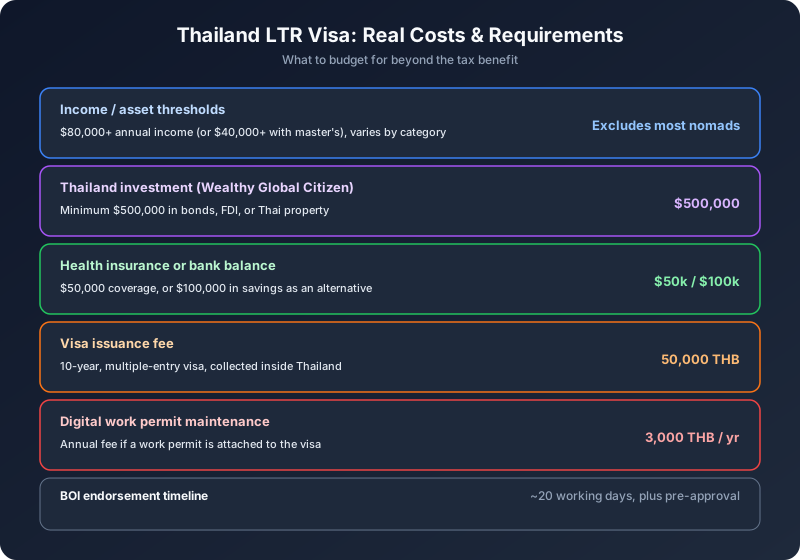
Applications go through the BOI's LTR portal with processing handled via VFS Global. BOI endorsement typically takes about 20 working days, followed by a shorter pre-approval step before the visa itself is issued. The visa issuance fee is 50,000 Thai baht per person for the full 10-year, multiple-entry visa when collected inside Thailand (fees run higher when collected at an embassy or consulate abroad). If a digital work permit is attached, there's an additional 3,000 baht per year to maintain it.
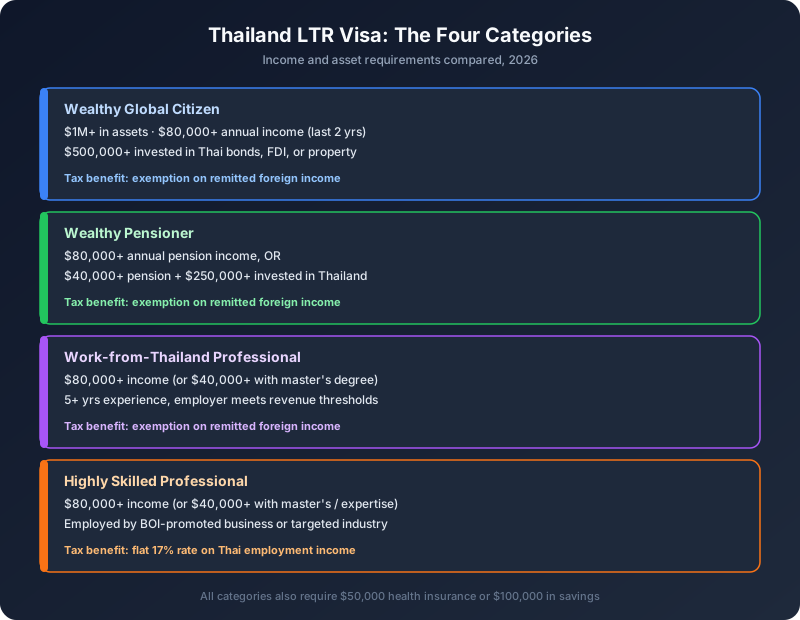
There are four LTR categories, and the tax treatment differs meaningfully between them.
The four categories
Wealthy Global Citizen: requires at least $1 million in assets, $80,000 or more in annual income over the past two years, and a minimum of $500,000 invested in Thai government bonds, foreign direct investment, or Thai property.
Wealthy Pensioner: requires $80,000 or more in annual pension income, or $40,000 in pension income combined with at least $250,000 invested in Thailand.
Work-from-Thailand Professional: for remote employees of an established foreign company, requiring $80,000 or more in annual income (or $40,000 with a relevant master's degree), plus at least five years of work experience and the employer meeting minimum revenue thresholds.
Highly Skilled Professional: for those working in Thailand for a BOI-promoted business or a targeted industry (things like advanced manufacturing, digital, medical, or biotech), requiring $80,000 or more in income, or $40,000 with a master's degree or specialized expertise.
All four categories also require health insurance coverage of at least $50,000, or proof of at least $100,000 sitting in a savings or investment account as financial security instead.
The Tax Benefit, In Plain Language
This is where most explainers get sloppy, because the benefit is not the same across categories.
For the Wealthy Global Citizen, Wealthy Pensioner, and Work-from-Thailand Professional categories, the core tax benefit is an exemption on foreign-sourced income remitted into Thailand. That covers overseas employment income, business income, dividends, and returns on foreign investments, as long as the money originates outside Thailand.
For the Highly Skilled Professional category, the benefit works differently: instead of an exemption, holders get a flat 17% personal income tax rate on employment income earned from work in Thailand for a BOI-promoted business, replacing Thailand's standard progressive rate that climbs to 35% at the top bracket.
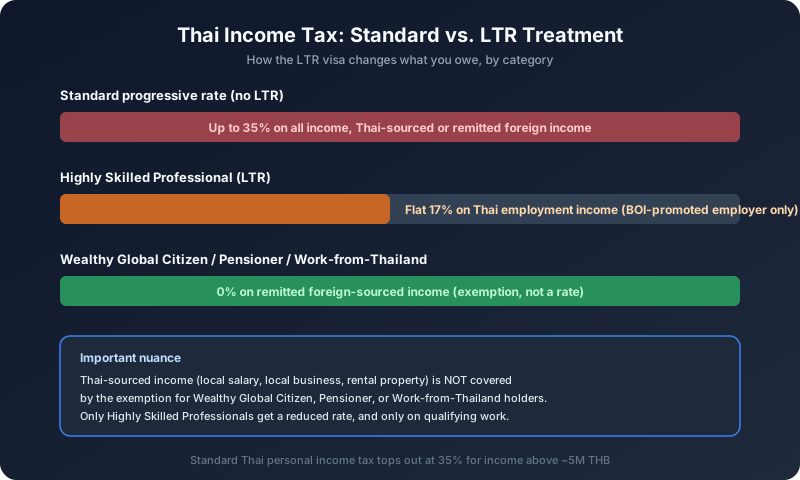
In practice, this means the exemption categories benefit most if a large share of your income comes from outside Thailand (a US salary, a UK pension, dividends from a European brokerage account) and you plan to bring that money into the country to live on. If your income is generated inside Thailand, the exemption does nothing for you. Only the Highly Skilled category addresses locally-earned income, and only if that income comes from a BOI-promoted employer.
Why This Matters More After the 2024 Rule Change
To understand why the LTR's foreign-income exemption is actually valuable, you need the backstory on how Thailand taxes everyone else's foreign income.
Before 2024, Thailand ran on a de facto loophole: foreign-sourced income was only taxable if it was remitted into Thailand in the same calendar year it was earned. Wait a year to transfer the money, and it arrived tax-free. Plenty of long-term expats built their entire financial planning around that one-year lag.
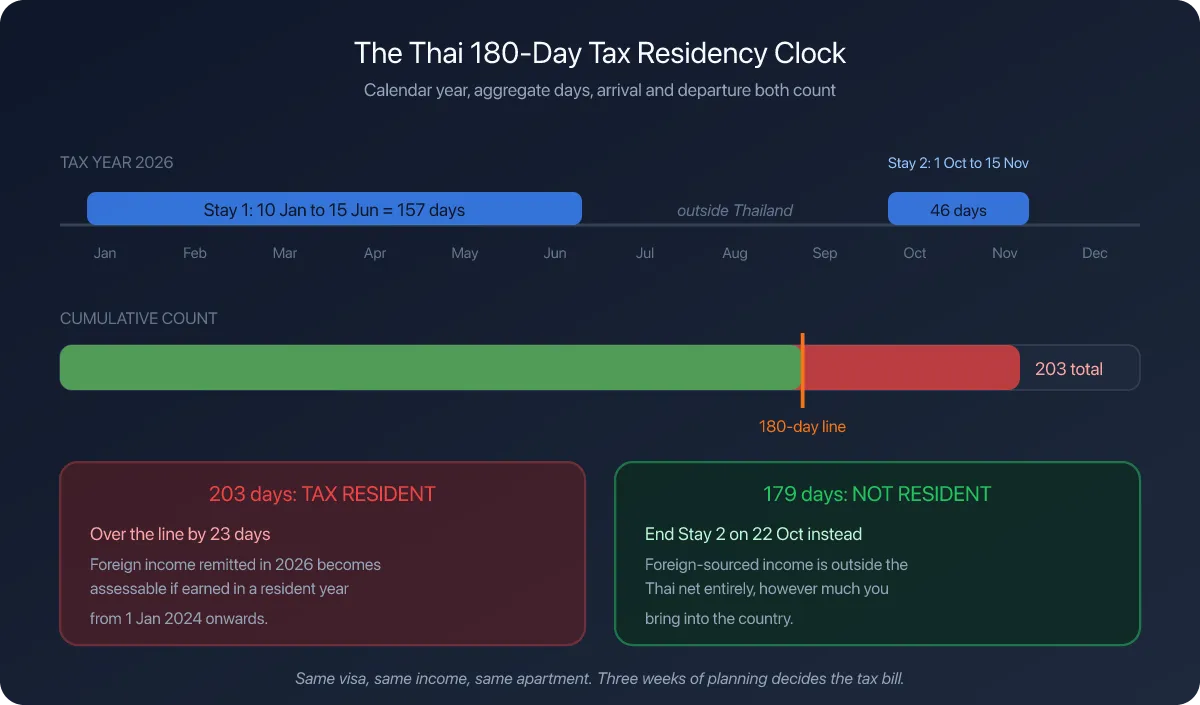
The Revenue Department closed that loophole through Departmental Instructions Por. 161/2566 and Por. 162/2566, effective January 1, 2024. Under the new rule, any foreign-sourced income remitted into Thailand by a tax resident is potentially taxable, regardless of which year it was originally earned. A Thai tax resident (defined as anyone who spends 180 days or more in Thailand in a calendar year) who transfers savings, salary, or investment gains into a Thai bank account can now trigger a Thai tax liability on money earned years earlier.
In mid-2025, the Revenue Department proposed a partial rollback: a Royal Decree that would exempt foreign-sourced income earned from 2024 onward if it's remitted within the year it was earned or the year after. That proposal is still pending formal enactment as of this writing and would apply from the 2026 tax year if it goes through. Separately, there is an ongoing and unresolved debate in Thai policy circles about moving to a full worldwide income tax model, taxing residents on global income whether or not it's ever remitted at all. Nothing on that front has been enacted, but it's the direction some officials have floated.
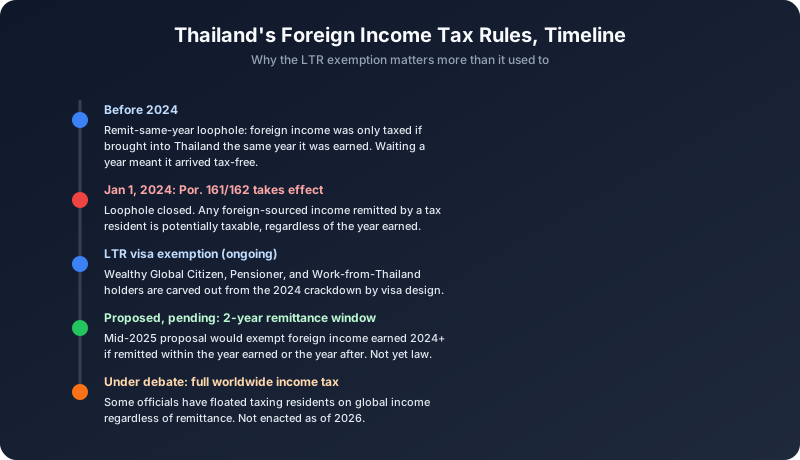
Against that backdrop, the LTR's foreign-income exemption is genuinely useful. It's a specific, written-into-the-visa carve-out that protects LTR holders in the Wealthy Global Citizen, Wealthy Pensioner, and Work-from-Thailand categories from the 2024 crackdown that now applies to every other long-term resident bringing foreign money into the country.
What the LTR Does NOT Exempt You From
This is the part that gets left out of the "tax-free Thailand" pitch.
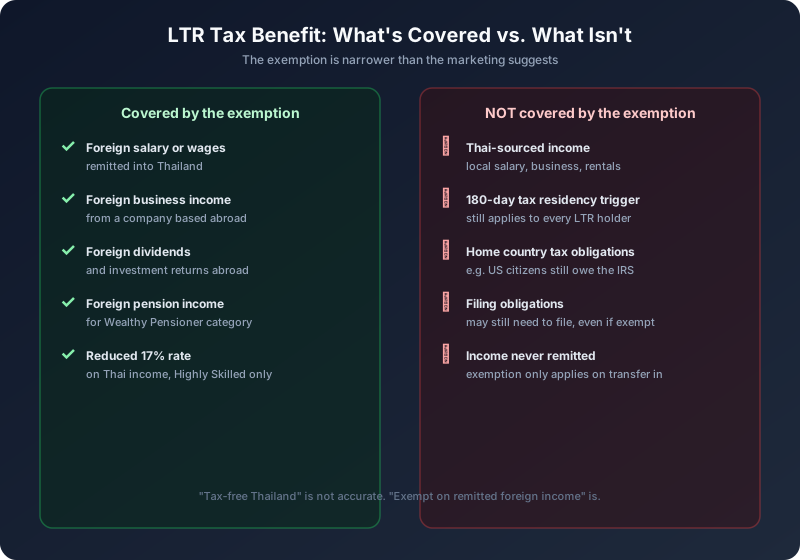
Thai-sourced income is still taxed normally. If you earn money working for a Thai company, running a Thai business, or renting out Thai property, that income follows the standard progressive tax schedule for everyone except Highly Skilled Professionals working for a BOI-promoted employer, who get the flat 17% rate on that specific income only.
You still need to track your 180-day tax residency status. The LTR visa lets you stay in Thailand indefinitely on the immigration side, but Thai tax residency is still triggered the same way it is for anyone else: spend 180 days or more in a calendar year in the country and you're a tax resident, LTR or not. The visa changes what happens once you're a resident, not whether you become one, and the remittance rules that follow are where the real money is decided.
The exemption applies to remittance, not to earning the income. If you never bring foreign income into Thailand, none of this matters either way, remitted or not, resident or not. The LTR exemption specifically addresses what happens when a Thai tax resident under the qualifying categories transfers foreign income into the country.
You may still need to file a Thai tax return. Depending on your income sources and how the Revenue Department treats your specific situation, LTR holders can still have filing obligations even when the underlying income ends up exempt. Several tax advisories recommend LTR holders keep clear documentation showing which remittances are foreign-sourced income and confirming the funds meet the exemption criteria.
None of this touches your home country's tax obligations. A US citizen with the LTR visa is still a US taxpayer on worldwide income regardless of Thai residency status. The LTR is a Thai tax instrument, not an escape hatch from citizenship-based taxation elsewhere.
The Real Costs and Requirements
The LTR is not a budget option, and it's worth being upfront about that before anyone starts the application.
The asset and income thresholds alone rule out most digital nomads: $80,000 in annual income is well above what the typical remote freelancer or early-stage founder earns, and the Wealthy Global Citizen category's $500,000 Thailand investment requirement puts it firmly in the high-net-worth bracket. The Work-from-Thailand and Highly Skilled categories are the most accessible for people without significant assets, since they hinge on income and employment rather than a large upfront investment, but the $80,000 (or $40,000 with a master's degree) income bar still excludes a large share of nomads.
On top of the qualifying thresholds, budget for the 50,000 baht visa issuance fee, the $50,000 health insurance requirement (or the $100,000 bank balance alternative), and, if applicable, the 3,000 baht annual work permit maintenance fee. Many applicants also use an immigration law firm or visa agent to manage documentation, which adds a separate service fee on top of the government charges.
Who It Actually Makes Sense For
The LTR visa is a strong fit for a fairly narrow group: retirees with a substantial foreign pension who plan to live in Thailand long-term and remit that pension income regularly, remote employees earning well above $80,000 for an established foreign employer who want to base themselves in Thailand for years rather than months, and high-net-worth individuals who were already planning to invest in Thailand and want the residency stability that comes with it.
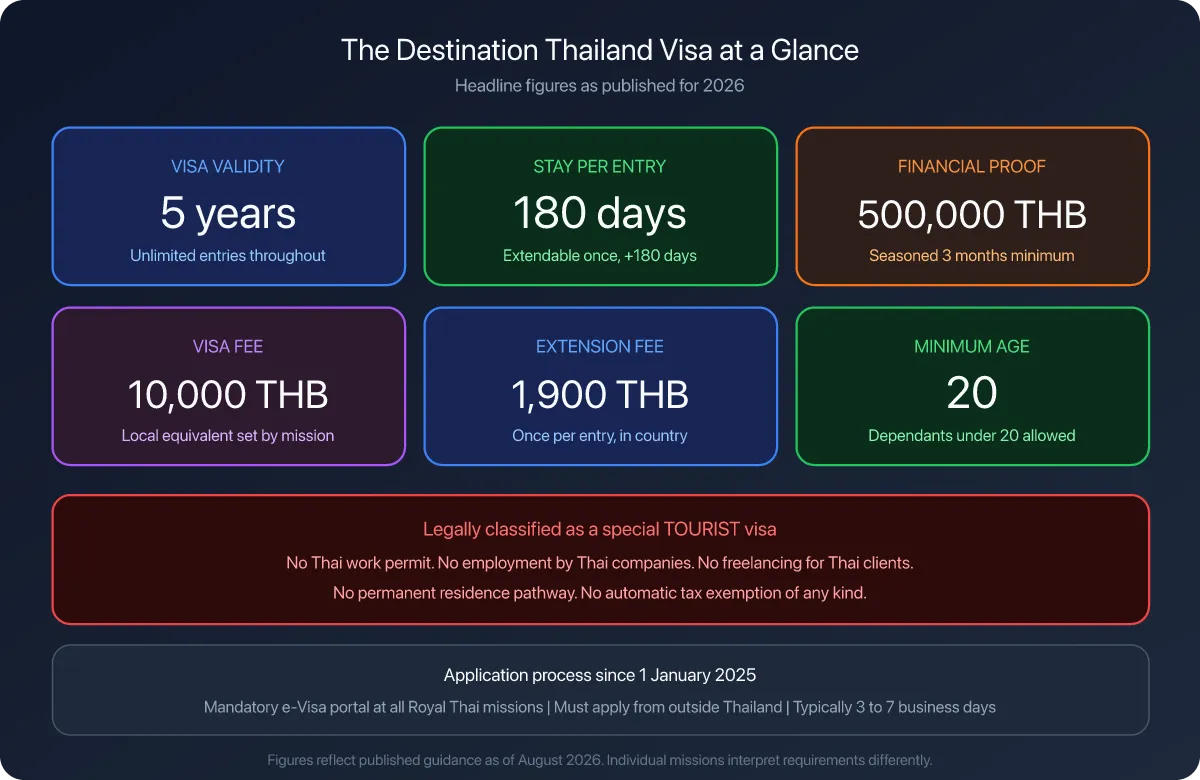
For nomads earning under the income thresholds, running a small freelance or consulting business with irregular income, or planning to stay in Thailand for a year or two rather than a decade, the standard Destination Thailand Visa (DTV) or ordinary tourist and non-immigrant visa routes typically make more practical sense, without the asset requirements or the multi-week BOI approval process.
Whatever route you take, the tax residency clock is the same for everyone: cross 180 days in Thailand in a calendar year and you become a Thai tax resident, LTR or not. That's a number worth tracking precisely, since Thailand's foreign income rules have already changed once since 2024 and are actively being debated again.
Track your days in Thailand and everywhere else, automatically.
Nomad Tracker monitors your day counts across every country you visit, flags when you're approaching the 180-day tax residency threshold, and keeps your Schengen and visa limits straight too, all on-device and private. Available on iOS.
Download on the App Store