On April 24, 2026, Turkish President Recep Tayyip Erdogan announced a fiscal package that, if it passes parliament, would do something no other large economy in the region currently offers: a 20-year exemption on foreign-source income and capital gains for individuals who relocate to Turkey, plus a flat 1 percent rate on inheritance and gift tax for those same residents. Twenty years. Zero Turkish tax on income earned outside the country. The number is large enough that it has dominated relocation chatter all week.
Before anyone packs a suitcase for Istanbul, the proposal deserves a careful read. The structure has real teeth, but it also has gaps, eligibility traps, and a few unanswered questions that matter a lot more than the headline rate. This guide walks through what was actually announced, who qualifies, how it stacks against Italy, Greece, and Portugal, and the risks that should temper the optimism.
What the proposal actually says
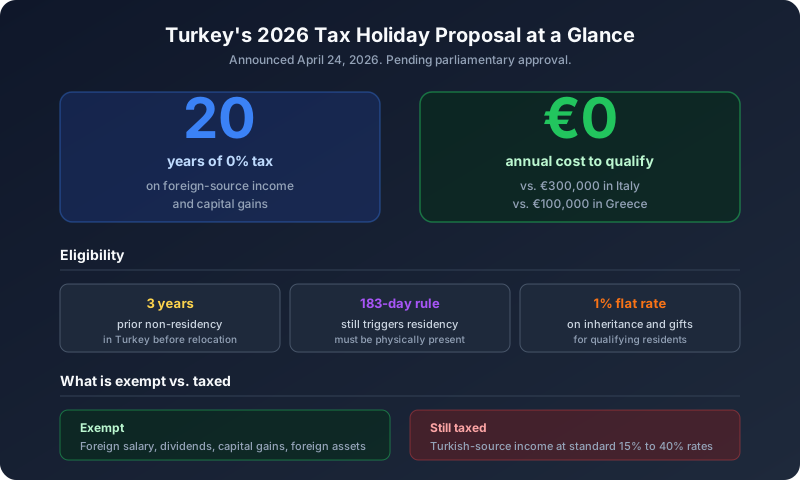
The headline measure is straightforward in concept. An individual who has not been a Turkish tax resident for at least three years prior to relocation can move to Turkey and pay no Turkish tax on their foreign-source income for 20 years. Capital gains earned outside Turkey are included in the exemption. Only domestically earned income, meaning income generated inside Turkey, would fall within the Turkish tax net.
A few specifics from the announcement and from the legal commentary that has followed:
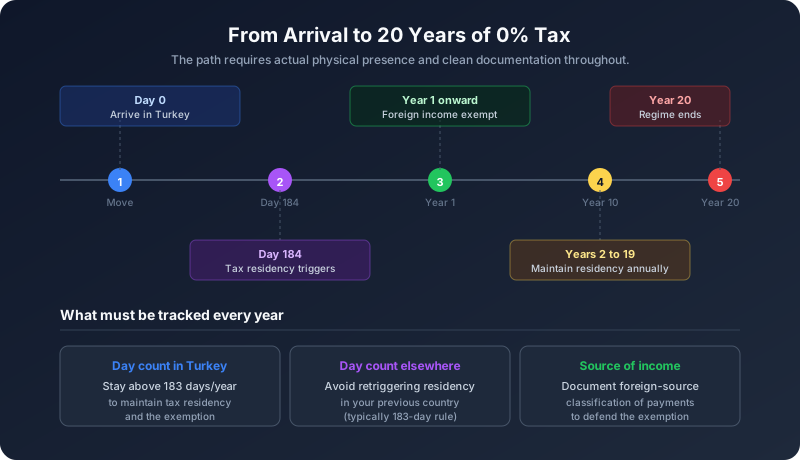
- Duration: 20 years from the date of becoming a Turkish tax resident under the new regime.
- Eligibility filter: at least three years of non-residency in Turkey immediately before the move.
- Scope of exemption: foreign-source income, including capital gains. Local Turkish income remains taxable under the standard progressive rates (15 to 40 percent in 2026).
- Inheritance and gift tax: a flat 1 percent for qualifying residents, well below the standard rates.
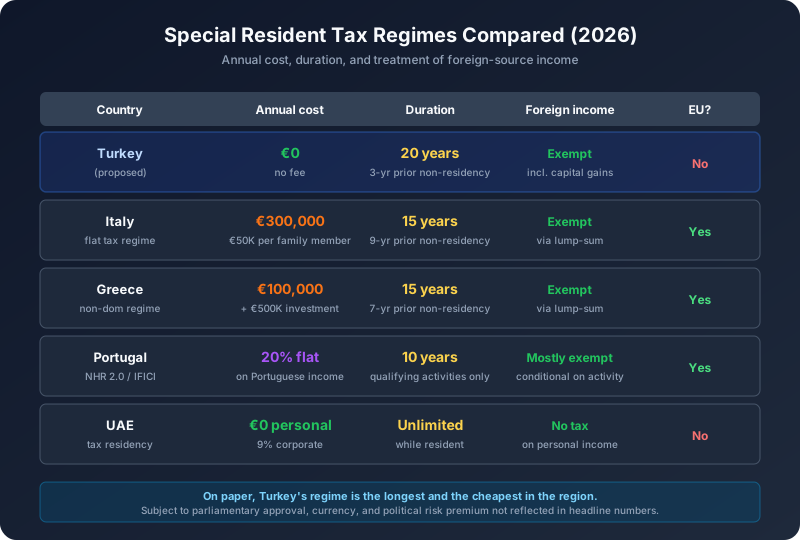
This is a textbook territorial-style exemption regime, similar in shape to non-domiciled programs in Europe, but with a duration and a price tag (zero) that nothing else in the EU neighborhood currently matches. The closest comparison is the Italian flat-tax regime, which lasts 15 years but costs €300,000 a year as of January 2026. Turkey's proposed version, by contrast, charges nothing.
The companion package nobody is talking about
The 20-year individual holiday is the headline, but it sits inside a wider investment-attraction package that reshapes corporate taxation as well. The other measures matter because they signal intent: this is not a one-off carve-out, it is part of a strategic push to position Turkey as a regional financial and trading hub, particularly through the Istanbul Finance Centre (IFC).
Key corporate measures in the package:
- Manufacturing exporters: corporate tax rate cut from the standard 25 percent down to 9 percent.
- Other exporters: corporate tax rate of 14 percent.
- Transit trade inside the IFC: the existing 50 percent income deduction on profits from cross-border trading intermediation rises to 100 percent, effectively zero corporate tax on those flows.
- Transit trade outside the IFC: 95 percent exemption.
- Regional headquarters relocating to the IFC: a 20-year corporate tax exemption, mirroring the individual regime.
The combination is unusual. Most non-dom programs target individuals only. Turkey is bundling a personal regime, a corporate regime, and a financial-centre incentive into a single package. For a remote worker structuring through a personal company or a holding entity, the corporate side may matter as much as the individual exemption.
Who actually qualifies, and what the 3-year rule means
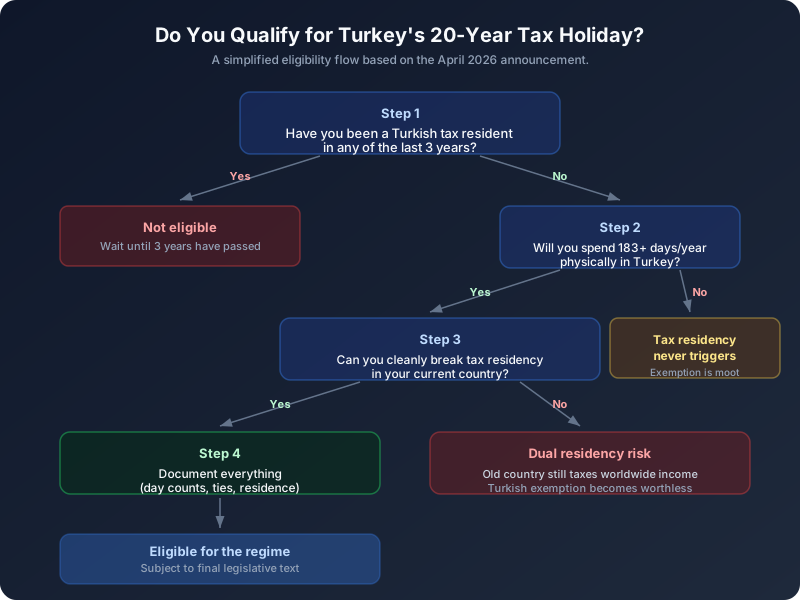
The eligibility filter is the three-year non-residency rule: an applicant must not have been a Turkish tax resident at any point during the three years immediately before relocating. This is meant to prevent locals from "round-tripping" out of and back into Turkey to claim the exemption on income that was always Turkish in character.
Under existing Turkish tax law, residency is triggered by either of two conditions:
- Physical presence in Turkey for 183 days or more in a calendar year, continuous or cumulative.
- Maintaining a "permanent place of residence" in Turkey, even with fewer days.
Once an individual qualifies under the new regime, the same 183-day residency mechanics presumably continue to apply, although the legislative text will need to clarify whether the 20-year clock pauses if the person leaves and returns, and how spousal or family-member treatment is handled. None of that detail was in the April 24 announcement.
Two practical implications for nomads considering the move:
- A nomad who has been touching Turkey for short stays (well under 183 days a year) over the past three years should still qualify, because tourist visits do not normally trigger Turkish tax residency.
- A nomad who held a Turkish residence permit during the past three years and was treated as a tax resident will likely be excluded, even if their income was almost entirely foreign-source.
How the regime compares to Italy, Greece, Portugal, and Dubai
The Turkey proposal does not exist in a vacuum. Several jurisdictions in the broader region have offered non-dom or special-resident regimes for years, and the field has shifted hard in the last 18 months. The headline numbers below are useful only as a starting point: each program has very different access conditions and a very different risk profile.
Turkey (proposed)
Annual cost: zero. Duration: 20 years. Foreign-source income, including capital gains, fully exempt from Turkish tax. Eligibility hinges on three years of prior non-residency in Turkey. Inheritance and gift tax drops to a flat 1 percent for qualifying residents. The catch: still pending parliamentary approval, no published draft text, and Turkey is outside the EU.
Italy flat tax regime
Annual cost: a flat €300,000 lump sum, raised from €200,000 in the December 2025 budget law. Family members can be added at €50,000 per person. Duration: 15 years. Foreign-source income is fully exempt in exchange for the lump-sum payment. Eligibility requires nine years of prior non-residency, the strictest filter on the list. Italy offers full EU residency and access to the European banking system.
Greece non-dom regime
Annual cost: €100,000 lump sum, plus an upfront €500,000 investment in Greek assets (real estate, businesses, or government bonds). Duration: 15 years. Foreign-source income exempt via the lump-sum mechanism. Eligibility requires seven years of prior non-residency. Family members can be included at €20,000 per person.
Portugal NHR 2.0 (IFICI)
This is not a true exemption regime. Qualifying newcomers pay a flat 20 percent on Portuguese-source income from highly skilled, scientific, or innovation-related activities, while most foreign-source income is exempt. Duration: 10 years. There is no annual fee, but eligibility is narrow: only specific qualifying professions and roles in research, R&D, startups, and certified innovation activities. The original NHR program ended on March 31, 2025, and IFICI is the more restrictive successor.
UAE (Dubai)
Annual cost: zero personal income tax, indefinitely. There is no special non-dom regime because the UAE does not levy personal income tax in the first place. Companies pay a 9 percent corporate tax introduced in recent years, with thresholds and free-zone exemptions. Tax residency requires 183 days of physical presence to access treaty benefits. The UAE is outside the EU and the Schengen Area. The full Dubai picture, including corporate tax and the real cost of living, is a separate conversation from the headline rate.
Bottom line on the comparison
On paper, Turkey's proposal is the longest-duration, lowest-cost individual regime currently on offer in the Mediterranean basin. It outlasts Italy by five years, costs nothing versus Italy's €300,000 annual fee, and unlike the Greece program does not require a €500,000 investment. The main catch is jurisdictional and macroeconomic: Turkey is not in the EU, the lira has experienced significant volatility, and the political and regulatory environment carries a structural risk premium that the alternatives do not.
The catches nobody is mentioning
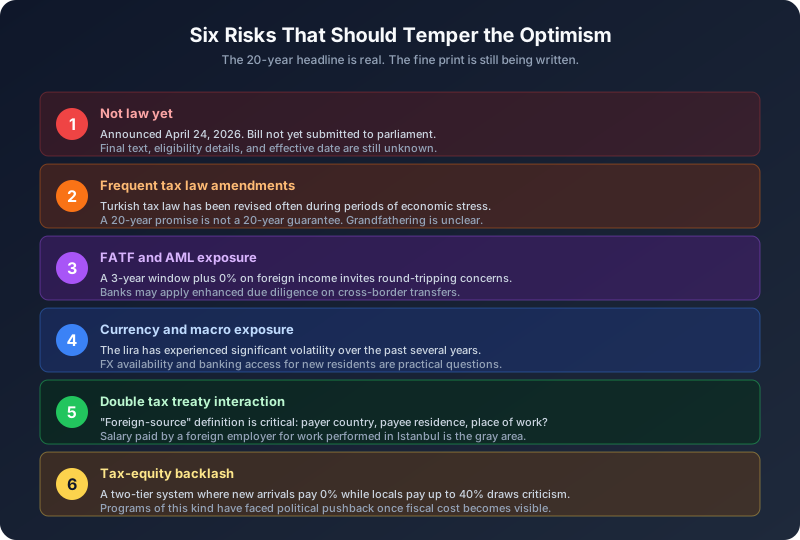
The headline number is striking, but several issues should weigh on any decision built around the proposal.
1. It is not law yet
The package was announced. It has not been submitted to parliament, no exact submission date was given, and the final text has not been published. Until a draft bill is tabled and debated, every detail above is provisional. Tax-planning decisions made on the basis of an announcement are decisions made on incomplete information.
2. Turkey amends tax law often
Turkish tax law has been frequently revised during periods of economic stress, sometimes within months of major changes. A 20-year promise made in 2026 is not the same as a 20-year guarantee. New residents would be relying on a future parliament not to alter the regime substantially over the next two decades. Several legal commentators have flagged retroactivity and grandfathering as the open questions that will determine whether the program is genuinely durable or politically contingent.
3. FATF and AML risk
Multiple analysts have noted that an exemption this broad, combined with a three-year non-residency filter, creates a structural vulnerability to "round-tripping," where domestic funds are routed offshore, parked, and reintroduced as foreign-source income. Turkey's standing with the Financial Action Task Force (FATF) has been a recurring concern, and a regime that is attractive to large flows of opaque capital could complicate that picture further. Banks, payment providers, and counterparties may apply enhanced due diligence on residents claiming the exemption, particularly for cross-border transfers above reporting thresholds.
4. Currency and macro exposure
The lira has experienced significant volatility over the past several years. A foreign-income exemption is meaningful only if the holder can preserve and access the underlying assets in their original currency. Practical questions about banking, custody, and FX availability for new residents are not addressed by the tax regime itself.
5. Double taxation treaty interaction
Foreign income is foreign income only by reference to a country of source. For a remote worker physically present in Turkey and performing services from Turkey, some types of income may be re-characterized as Turkish-source under existing double tax treaty principles. Salary paid by a foreign employer to an individual physically working from Istanbul is the classic gray-area example. The legislative text will need to clarify whether "foreign-source" is defined by the payer's country, the payee's residence, or the place where the work is performed.
6. Tax-equity backlash
Some Turkish economists have publicly criticized the proposal for creating a two-tier tax system where new arrivals pay nothing on foreign income while local taxpayers continue under the progressive 15-to-40 percent regime. Programs of this kind have historically faced political pushback once their fiscal cost becomes visible in budget data, even in countries with stable institutional environments.
Hypothetical scenarios for nomads
To make the regime concrete, here are three reader-style cases that illustrate how the proposal could play out. None of these are real individuals, they are illustrative composites based on common nomad profiles.
Case 1: A US-passport remote worker earning $180K/year from a US tech employer, no prior connection to Turkey.
She qualifies on the three-year non-residency test. If she relocates and her US salary is treated as foreign-source under the final legislation, she could legally hold tax residency in Turkey while paying zero Turkish tax on the salary. US tax obligations remain (US citizens are taxed on worldwide income regardless of residency), so the actual benefit depends on the US-Turkey double tax treaty and whether the Foreign Earned Income Exclusion applies. Net result: potentially significant savings on the US state-tax side and full elimination of any Turkish tax on the salary.
Case 2: A UK-passport solo SaaS founder running a UK Ltd company, $400K/year retained earnings.
She qualifies on the three-year test if she has not been a Turkish resident. Dividends from her UK Ltd to her personally would be foreign-source, and under the proposal, exempt in Turkey. Capital gains on a future exit would also be exempt. The UK side requires careful planning around statutory residence tests, the UK ties rule, and treaty tie-breakers, but the Turkish leg of the structure looks favorable on paper.
Case 3: A Spanish citizen working as a freelancer for European clients, currently splitting time between Madrid and Barcelona.
This case is the most cautious. Spain's Beckham Law and standard residency rules already create a dense tax footprint in Spain, and a relocation to Turkey would need to break Spanish tax residency under the 183-day rule and the center-of-vital-interests test. If the relocation is genuine and Spanish residency cleanly ends, the Turkey regime applies as normal. If Spanish residency is not properly broken, Spain will continue to tax worldwide income and the Turkish exemption becomes meaningless. The exit from a high-tax EU country is almost always the harder problem than the entry into a low-tax destination.
The pattern across all three cases is the same: the Turkish exemption is real, but it only delivers value if the nomad cleanly leaves their previous tax residency. Pretending to leave while keeping a permanent home, family ties, or significant economic activity in the previous country is a well-trodden path to dual-residency disputes.
Tax residency in Turkey still works the old way
A point worth repeating: the proposal does not change how Turkish tax residency is triggered, it changes what is taxed once residency is established. The 183-day rule and the permanent-residence rule remain in force. To benefit from the 20-year exemption, an individual must first be a Turkish tax resident, and that means crossing the 183-day line in a calendar year or maintaining a permanent home in Turkey.
For a nomad currently rotating across multiple countries, this is a fundamental shift. The classic perpetual-traveler profile (under 183 days everywhere) does not benefit from the regime. The 20-year holiday is meaningful for someone who is willing to commit Turkey as their actual base, with the days on the ground to back it up.
This also creates a tracking obligation. Once Turkish residency is established, foreign tax authorities, particularly home-country tax authorities, may scrutinize the move and require evidence of physical presence in Turkey above the 183-day threshold. A clear, reliable day-count is the difference between a clean relocation and an expensive dual-residency dispute.
What to watch in the coming months
A few signals will determine whether the announcement becomes a genuine option or remains a press cycle.
The legislative text will reveal the technical details: definition of foreign-source income, treatment of mixed-source income, family-member coverage, exit provisions, anti-abuse rules, interaction with Turkey's existing double tax treaty network, and whether the 1 percent inheritance and gift rate is conditional on continued residency. None of these are knowable from the announcement.
The parliamentary timeline will indicate political momentum. A bill submitted within weeks suggests the package is a top priority. A delay of months suggests internal negotiation and possible scope reduction.
The FATF response and the EU reaction will signal whether the regime faces external pressure. EU member states have grown increasingly assertive about non-dom programs in neighboring jurisdictions, and Turkey's accession-adjacent status complicates the diplomatic picture.
For now, the right posture is interest plus patience. The proposal is real enough to take seriously and incomplete enough to refuse to plan around.
How Nomad Tracker fits in
The Turkey proposal, like every non-dom regime, lives or dies on physical presence. The 20-year exemption is only available to actual Turkish tax residents, and Turkish tax residency depends on a 183-day count plus the permanent-residence test. Anyone considering the move needs accurate, defensible day counts in Turkey and in every previous residence country, both to claim the new regime and to defend the exit from the old one.
That is the problem Nomad Tracker was built to solve. The app uses on-device GPS to log country changes automatically, calculates rolling and calendar-year day totals for any jurisdiction, and produces audit-ready exports for tax filings. For a relocation as significant as the one the Turkey proposal would enable, manual spreadsheets are not enough. Documentation needs to be rigorous, dated, and exportable.
Track your days in every country, automatically.
Whether you are planning a move to Turkey, defending an exit from Spain or the UK, or simply staying compliant with Schengen, Nomad Tracker gives you accurate day counts, fiscal residency alerts, and exportable records. All on-device, all private. Available on iOS.
Download on the App Store