There is a recurring pattern in nomad forums that confuses almost everyone who runs into it. Two people with near-identical circumstances, similar income, similar savings, similar work, submit DTV applications in the same month. One is approved in four days. The other is refused with a single line of boilerplate and loses the 10,000 THB fee.
The instinct is to call this arbitrary. It mostly is not. The Destination Thailand Visa has one published rule set, issued by the Royal Thai Ministry of Foreign Affairs, but it is adjudicated by dozens of separate missions, each applying its own reading of "sufficient evidence" and its own document formatting preferences. The rules are national. The judgement is local. That gap is where almost every rejection lives.
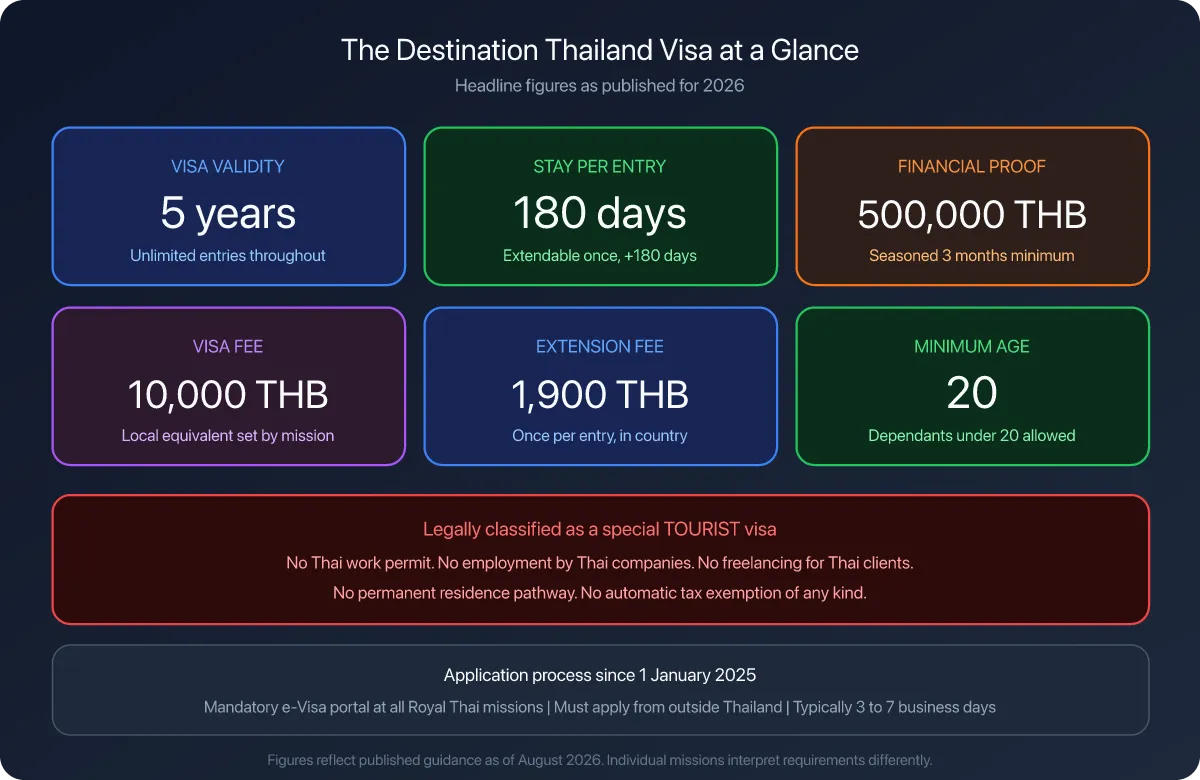
This article covers what that gap actually looks like in 2026, the specific failure modes that produce refusals, and what a rejected applicant can realistically do next. If you are still deciding whether the DTV suits you at all, our complete DTV guide covers the visa itself: validity, tracks, costs and limits.
The Consulate Lottery Is Not Actually a Lottery
Thai missions abroad work from the same MFA checklist. What they do not share is a common standard for how much evidence clears the bar.
Take the financial requirement. The official checklist says a bank statement for the last three months with an ending balance of no less than 500,000 THB. That is one sentence, and it leaves at least four things to local discretion:
- Whether the balance must be maintained across all three months or only present at the end
- Whether three months is the floor or whether six months of history is expected
- How recently the statement must have been issued, which ranges from roughly a week to a month depending on the mission
- Whether an app-generated PDF is acceptable or a bank-stamped original is required
Community trackers and visa agencies reporting through 2025 and 2026 describe a consistent spread: some missions accept a clean three-month statement, while others, Vientiane being the most frequently cited example, look for six months of unbroken history and scrutinise inflows in detail. None of those missions are breaking the rule. They are reading the same sentence with different levels of suspicion.
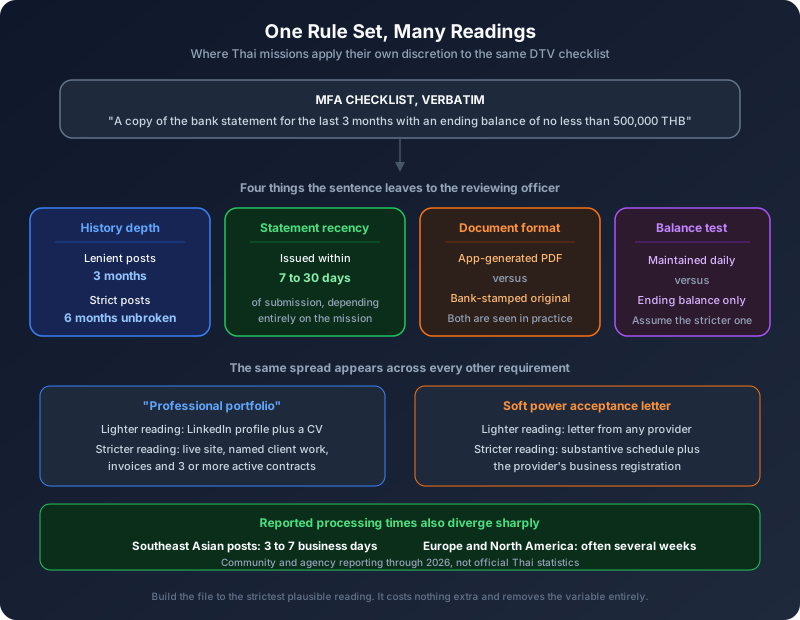
The same variation applies to the Workation track. The MFA checklist asks for an employment contract or employment certificate, salary evidence for six months, and a professional portfolio. A mission that reads "portfolio" as a live website with named client work is applying a very different standard from one that accepts a LinkedIn profile and a CV. Reports through 2026 consistently indicate the stricter reading is now the norm rather than the exception.
One structural point worth understanding: the DTV is adjudicated by a mission, not by Thai Immigration. The officer reviewing your file has no obligation to explain a refusal beyond a standard phrase, and there is no published appeal standard equivalent to what exists in most European visa systems. That asymmetry is precisely why the preparation matters more than the appeal.
The Failure Modes That Produce Most Refusals
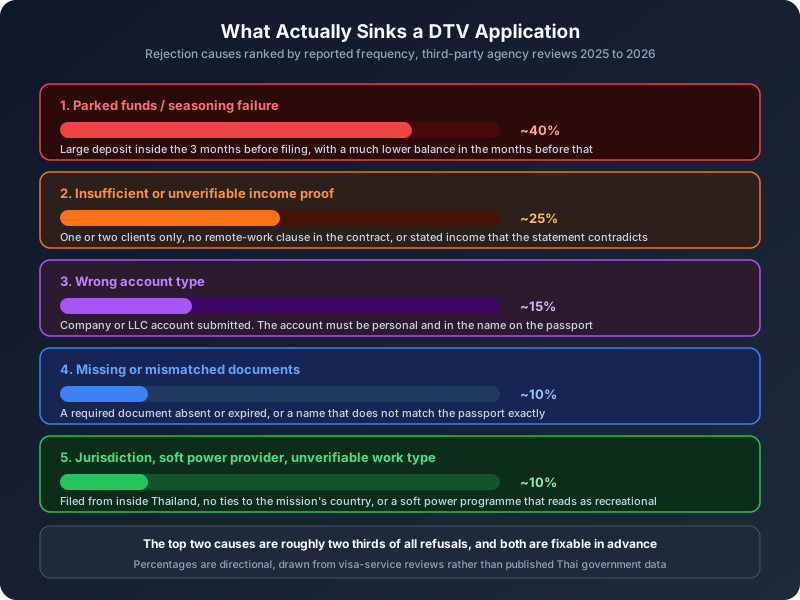
Independent visa services and community rejection trackers reporting through 2025 and 2026 converge on a similar ranking. The percentages below come from third-party agency reviews rather than official Thai statistics, so treat them as directional rather than precise, but the ordering is consistent across sources.
1. Seasoning failure, the single largest cause
Agencies reviewing self-filed applications report that somewhere between 30 and 50 percent fail first review on the financial documentation alone, and the specific pattern is almost always the same: a large deposit landing in the account within three months of the application date, with a materially lower balance in the months before it.
The mission is not testing whether you have 500,000 THB today. It is testing whether that money is yours in an ongoing sense or whether it was borrowed to pass a screenshot test. A statement showing a balance that jumps from 40,000 THB to 520,000 THB six weeks before submission answers that question in the wrong direction.
The fix is unglamorous and slow. The balance needs to sit there, at or above the threshold, without dipping, for at least three months and preferably six. This is the one rejection cause that cannot be repaired in a hurry, which is exactly why it should be the first thing you start and the last thing you improvise.
2. Income documentation that does not establish sustainable remote work
The second cluster is evidentiary rather than financial. The applicant has the money but has not convincingly shown where it comes from or that the work is genuinely remote and genuinely foreign.
Common versions reported by agencies:
- A freelancer with one or two clients, which reads to an officer as disguised employment rather than an independent practice
- An employment letter that confirms a job but says nothing about remote work being permitted
- A vague job title with no portfolio, no invoices and no verifiable output
- Stated income that does not reconcile with the deposits visible on the bank statement
That last one is underrated. Missions do compare the two documents. If you claim 4,500 USD a month and the statement shows irregular deposits averaging 1,800, the file contains its own contradiction.
3. The wrong account entirely
A steady share of refusals trace back to applicants submitting a business or company account statement. If you run a limited company and the 500,000 THB sits in the company's name, it is not your money in the eyes of the reviewing officer, however true that may be commercially.
The requirement is a personal savings or current account in the applicant's own name, matching the passport exactly. Business owners who hit this wall usually need three to four months of paying themselves a regular draw into a personal account before reapplying, which is a slower fix than most people expect.
4. Soft power evidence that reads like a hobby
The Soft Power track was the most flexible route into the DTV in 2024. It has been narrowed considerably since.
Two changes matter. First, Thai language schools were removed from the qualifying soft power list, with applicants who want to study Thai now directed to the Non-Immigrant ED visa instead. Second, missions have started assessing whether the stated programme constitutes serious cultural study or a token enrolment. Reports through 2026 indicate that acceptance letters showing one or two sessions a month are increasingly flagged as recreational rather than qualifying.
If you are applying on Muay Thai, Thai culinary training or medical treatment, the acceptance letter needs to come from an established provider, show a substantive schedule, and ideally be accompanied by the provider's business registration. The gyms and schools that process these routinely know this. The ones that will sell you a letter for 3,000 THB and no attendance are the ones producing refusals.
5. Jurisdiction, ties, and applying from the wrong place
Two related problems close out the list. Applications submitted from inside Thailand are refused, and the e-Visa system cross-checks against entry records, so this is not a rule people successfully route around. Separately, applying from a country where you have no residence permit, no visa of meaningful duration and no evident connection invites the question of why you are there, and some missions require proof of legal residence in their jurisdiction as a precondition.
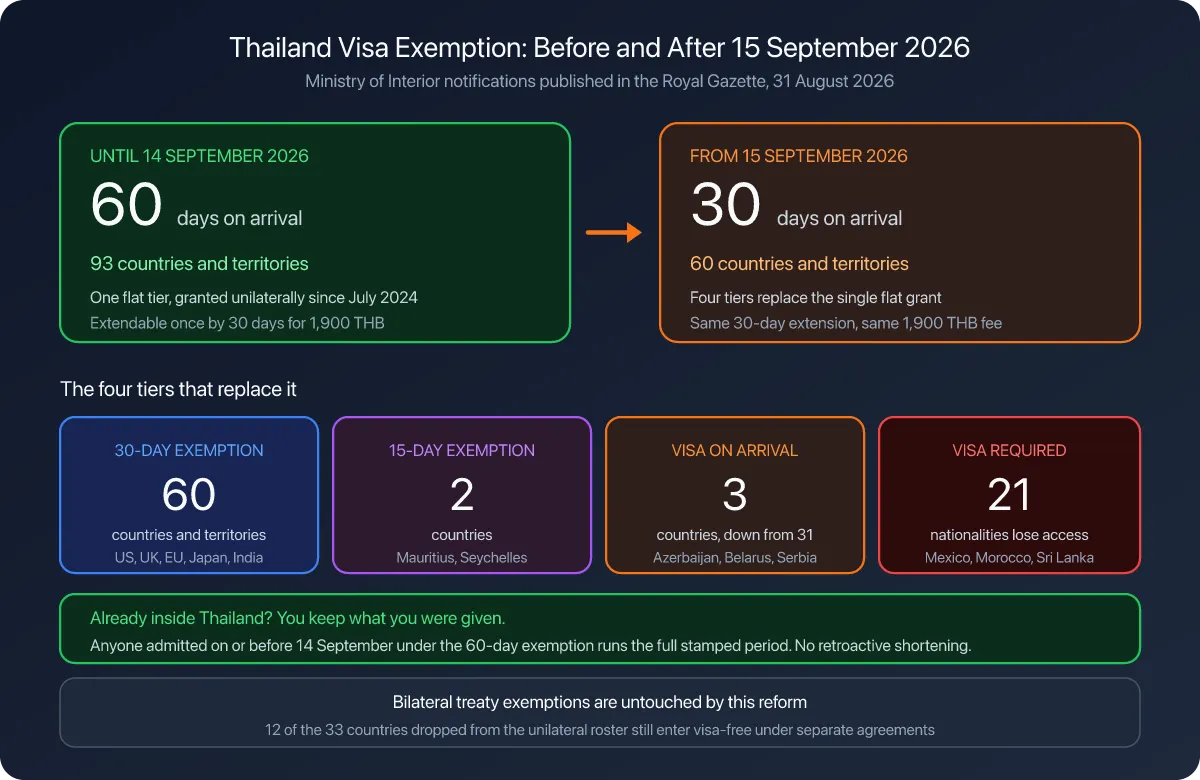
There is also a pattern-level factor that catches people by surprise. Reviewing officers can see your Thai entry history. A file preceded by a long run of visa-exempt entries and short border hops signals a person already living in Thailand on tourist status, which is not a neutral fact when the question in front of the officer is whether your stated purpose is genuine. That history got easier to accumulate, and more conspicuous, once the visa exemption dropped to 30 days and each stay started requiring more entries.
What the Official Checklist Actually Requires
It is worth reading the MFA's own document list rather than an agency's summary, because the official version contains requirements that get quietly dropped in blog rewrites. The published DTV checklist covers three categories.
Workation requires the passport valid six months beyond travel, a recent photograph, the completed application form, a biodata page copy, proof of prolonged residence in Thailand for at least six months such as a condominium or lease agreement, a three-month bank statement ending at no less than 500,000 THB, salary or monthly income evidence for the last six months, a foreign employment contract or employment certificate authenticated by the embassy of the company's country, a copy of the company's registration or business licence similarly authenticated, and a professional portfolio evidencing remote worker or freelancer status.
Soft Power applicants replace the last three items with a letter of acceptance from the institute or company organising the activity, or a letter of appointment from the hospital or medical centre.
Dependants, meaning spouses and children under 20 of a DTV holder, submit the same core documents plus the principal holder's six months of income evidence and their DTV approval.
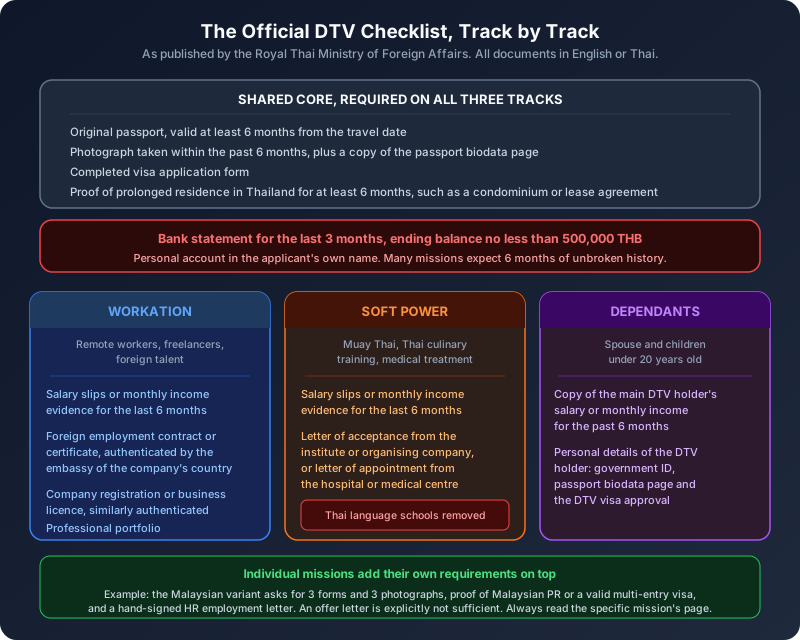
Two items on that list deserve attention because they surprise people. The authentication requirement on the employment contract and company registration is real and is enforced at some missions, and legalisation through a foreign ministry or embassy takes weeks, not days. And the proof of prolonged residence in Thailand line asks for a lease or accommodation arrangement, which many applicants read as optional and some missions do not.
Note also that the checklist adds mission-specific items for certain countries. The Malaysian variant, for example, requires three completed forms with three photographs, proof of Malaysian permanent residence or a valid multiple-entry Malaysian visa with at least a year of validity, and a hand-signed employment letter from HR confirming position, status and salary, with an explicit note that a job offer letter is not sufficient. Always open the specific mission's page, not a generic one.
How the e-Visa Process Actually Runs
Applications now go through Thailand's official e-Visa portal, and in-person filing has largely disappeared. The flow is straightforward, with two places where things commonly go wrong.
You register an account, select Destination Thailand Visa and your category, complete the form, upload your documents as PDFs or images, and pay the 10,000 THB fee or its local-currency equivalent by card. Upload size limits apply per file, commonly around 3 MB, which is the first failure point: applicants compress a bank statement until it is unreadable and the officer cannot verify it.
The second failure point is that some missions call applicants in for an interview, and if you are called you are expected to bring originals of everything you uploaded. A file built from documents you cannot produce in physical form is a problem waiting to happen.
Processing times vary widely by mission. Southeast Asian posts are consistently reported as the fastest, with approvals commonly arriving inside three to seven business days, while posts in Europe and North America frequently run into several weeks depending on backlog.
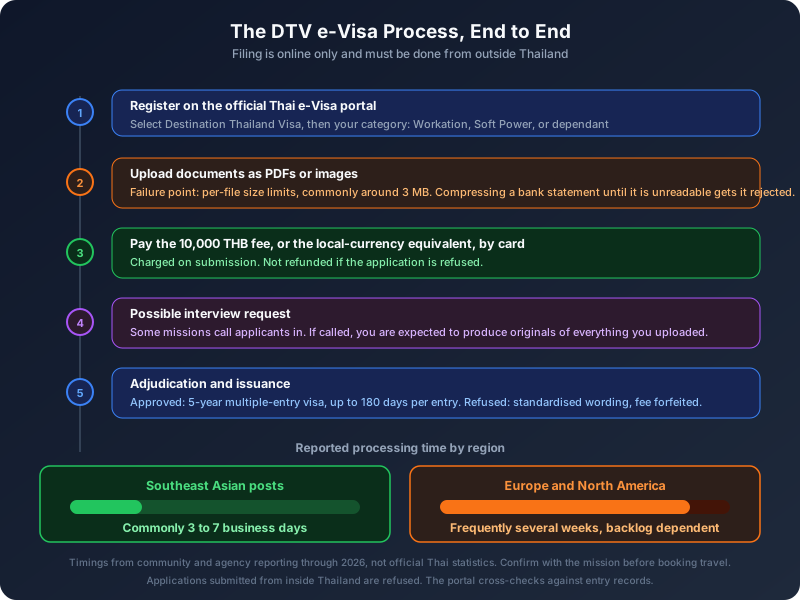
The fee is charged on submission and is not refunded if the application is refused. That is the practical reason a rushed application is expensive: a refusal costs you the 10,000 THB, a recorded rejection, and the months you then need to spend fixing the underlying issue.
After a Refusal: The Sequence That Works
The most commonly reported mistake after a rejection is resubmitting the same file at a different mission within days. Missions can see the prior refusal, the underlying deficiency is unchanged, and a second refusal makes the third attempt harder.
A better sequence:
Read the refusal as a diagnosis. The language is standardised and vague, but each phrase maps to a category. "Insufficient proof of financial means" generally points at parked funds or a balance below threshold. "Unable to verify employment or income" points at the evidence bundle, not the money. "Incomplete application" points at a specific missing or expired document. "Application does not meet requirements" usually means a mission-specific rule such as jurisdiction or account type.
Match the fix to a realistic timeline. A missing or mismatched document can be corrected in days. Income evidence takes one to three months to assemble properly, including additional client contracts, a tax return and a portfolio. An account-type problem takes three to four months of regular personal-account deposits. A seasoning failure takes three to six months and cannot be accelerated by any means that will survive review.
Decide between appeal and reapplication honestly. An appeal is worth attempting when the refusal rests on an administrative error you can document, such as a submitted file the mission did not log or a data entry mistake. When the refusal was substantively correct given what you submitted, an appeal adds weeks and changes nothing.
Then choose the mission deliberately. If you were refused at a post with a reputation for heavy financial scrutiny, moving to a post with a lighter reading is rational, but only in combination with an actually stronger file. Changing venue without changing substance is the version of this that fails twice.
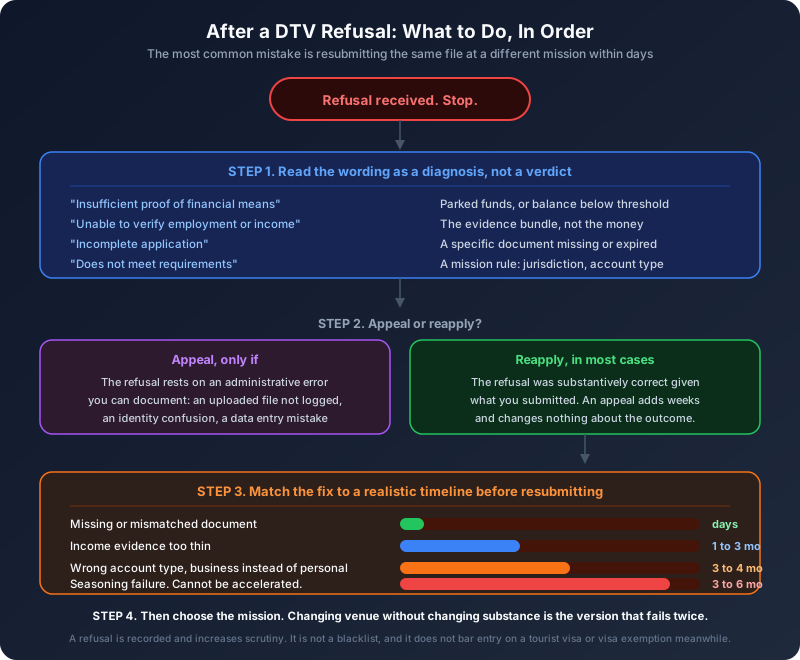
One reassurance worth stating plainly: a DTV refusal is not a blacklist and does not bar you from Thailand. It is recorded, it increases scrutiny on the next application, and it does not prevent you entering on a tourist visa or visa exemption in the meantime. Nothing about a refusal is permanent except the lost fee.
The Clock That Starts the Day You Are Approved
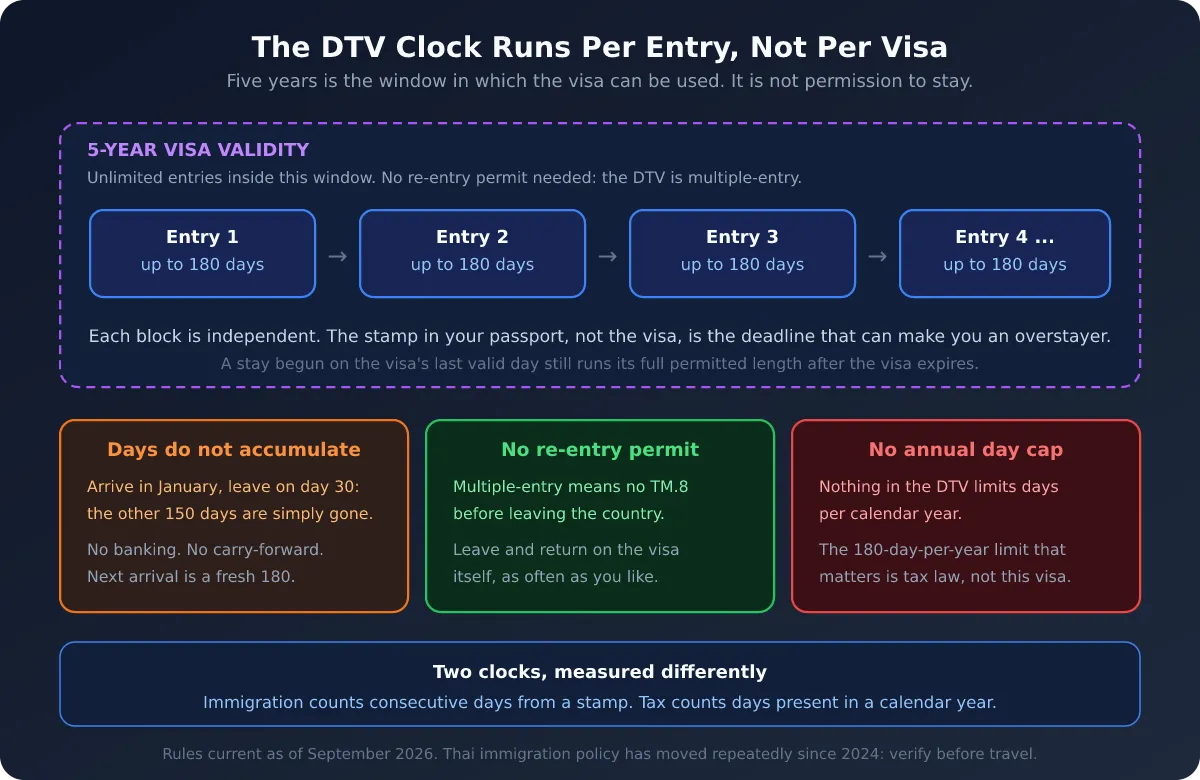
Approval is the end of the application problem and the beginning of a different one. The DTV grants up to 180 days per entry, and 180 is also, not coincidentally, the number that matters for Thai tax residency. Spend more than 180 days in Thailand in a calendar year and you become a Thai tax resident, which brings the remittance rules into play. Those two 180s are measured on completely different clocks: the visa one runs from your entry stamp, the tax one runs from 1 January.
Our breakdown of Thai tax residency and the remittance rules goes through how that works, why the calendar-year count is the one with financial consequences, and what remitting money into Thailand actually triggers.
Track the Clock That Starts After Approval
We built day tracking into Nomad Tracker for exactly this problem: your visa clock and your tax clock are separate, and a DTV holder needs both.
Nomad Tracker detects country changes automatically, runs a per-country calendar-year count alongside your visa windows, and fires fiscal residency alerts at 150, 170 and 180 days so the Thai threshold never arrives unannounced. Ghost Trips let you model a planned 180-day DTV entry before you book the flight, so you can see in advance whether it lands inside one tax year or straddles two.
Know your day count before Thai immigration does.
Nomad Tracker automates visa day counting, fiscal residency monitoring, and trip planning -- all on-device, all private. Available on iOS.
Download on the App StoreThis article is informational and reflects publicly available guidance as of August 2026. Rejection-rate and processing-time figures are drawn from third-party visa services and community reporting, not official Thai statistics, and individual missions change their practice without notice. Confirm current requirements directly with the Royal Thai mission where you intend to apply.