Most nomads who move to Thailand understand two things about Thai tax: something changed in 2024, and there is a 180-day line somewhere. Beyond that, the picture gets murky fast, and the murk is expensive. Thailand does not tax you on what you earn. It taxes you on what you bring in, and only when you crossed a specific day count in both the year you earned the money and the year you moved it. Those conditions interact in ways that make identical incomes produce wildly different tax bills.
This is the single most consequential piece of admin for anyone spending serious time in Thailand, whether on a DTV, an ED visa, a marriage extension, or a stack of tourist entries. Here is how the system actually works, what the Revenue Department has and has not changed, and what legal planning looks like as of August 2026.
A necessary caveat before anything else: this is informational, not tax advice. Thai rules have moved three times since 2023 and a fourth change is drafted but unpassed. Anything with real money attached should be run past a Thai tax adviser who can look at your specific facts.
The 180-Day Rule: How Thailand Decides You Are a Tax Resident
Section 41 of the Thai Revenue Code is short and unforgiving. Any person staying in Thailand for a period or periods aggregating 180 days or more in any tax year is deemed a resident of Thailand for tax purposes.
Four details in that sentence do most of the damage:
Aggregating. The days do not need to be consecutive. Three separate two-month stays add up exactly the same as one six-month stay. There is no reset from leaving the country, no matter how many times you fly to Vietnam and back.
Any tax year. The Thai tax year is the calendar year, 1 January to 31 December. The counter resets to zero every 1 January and each year is assessed independently. This is different from the rolling 180-day window used for immigration purposes on visas like the DTV, and confusing the two is one of the most common mistakes nomads make.
180, not 183. Thailand uses a lower threshold than the 183 days that most of the world defaults to. If you have internalised 183 from reading about Spain or Portugal, you are working with the wrong number and you will cross the line three days before you expect to.
Any part of a day counts. Arrival day and departure day each count as a full day of presence. Landing at 23:50 on 1 October costs you a day. Leaving at 00:20 on 15 November costs you another.
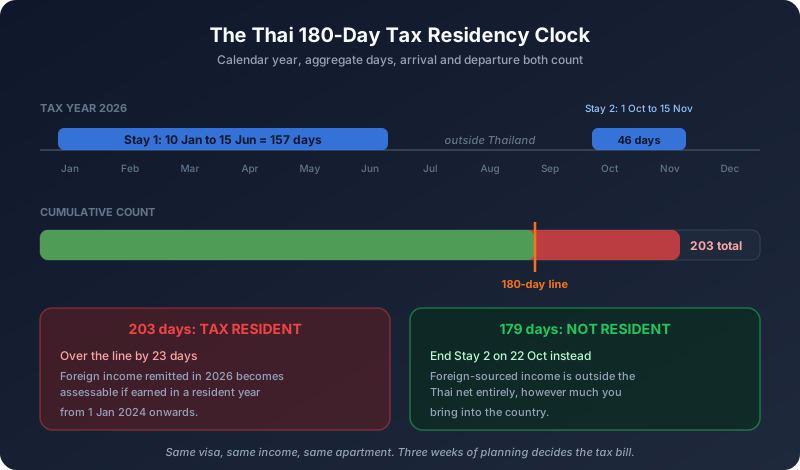
A worked day count
Take a nomad on a DTV who arrives on 10 January 2026 and leaves on 15 June. That is 157 days. She spends the summer elsewhere, then comes back on 1 October and stays until 15 November, another 46 days. Total presence: 203 days. She is a Thai tax resident for the 2026 tax year, by 23 days, and probably never sat down to do the arithmetic.
Shorten that second trip so it ends on 22 October instead, and the total is 179 days. Not a tax resident. Same visa, same income, same apartment, entirely different tax position, decided by three weeks of travel planning.
This is why the count matters more than almost anything else in Thai tax planning. Every other decision below sits downstream of whether you crossed 180.
The Remittance System: Thailand Taxes Money That Arrives, Not Money That Is Earned
Thailand does not tax residents on worldwide income the way the US, Spain or Germany do. It operates a remittance basis. Foreign-sourced income becomes assessable when it is brought into Thailand, not when it is earned abroad.
If you earn 200,000 USD in a Singapore bank account and never move a satang of it into Thailand, that income sits outside the Thai net. If you move 30,000 USD of it into a Bangkok account to pay rent and living costs, that 30,000 is what enters the calculation.
What changed on 1 January 2024
For decades, there was a widely used timing escape. Foreign income remitted in a calendar year later than the year it was earned was not taxable. Nomads and expats simply parked income for twelve months and brought it in tax free the following January.
Departmental Instruction No. Por. 161/2566, issued on 15 September 2023, killed that. The Revenue Department reinterpreted Section 41 so that foreign-sourced income earned by a Thai tax resident is assessable whenever it is remitted, regardless of the year. Income earned in 2024 and remitted in 2034 is still assessable. The instruction applies to income brought into Thailand from 1 January 2024 onwards.
Departmental Instruction No. Por. 162/2566, issued on 20 November 2023, added the transitional protection that makes the whole system survivable: the new interpretation does not apply to foreign-sourced income earned before 1 January 2024. Pre-2024 savings and capital can be remitted to Thailand tax free, whenever you like.
The three conditions, stated plainly
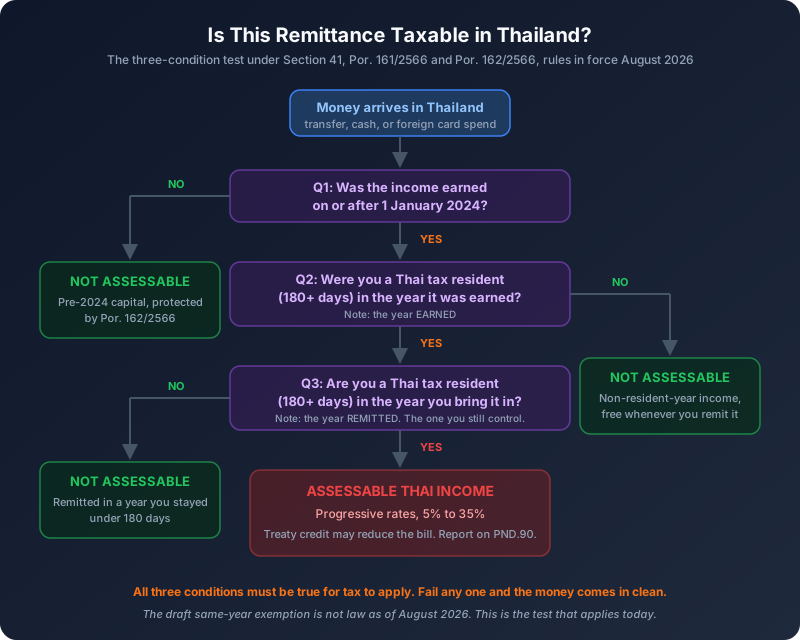
Under the rules in force in August 2026, a remittance is assessable Thai income only when all three are true:
- You were a Thai tax resident (180+ days) in the calendar year the income was earned,
- The income was earned on or after 1 January 2024, and
- You are a Thai tax resident in the calendar year you actually bring the money in.
Fail any one of the three and the remittance is not assessable. That is the entire architecture, and almost all legitimate planning consists of managing which bucket your money comes from and which year it lands in.
The third condition is the one most often left out of summaries, and it is the one with the most planning value. Section 41 taxes remitted foreign income in the hands of a resident, so a transfer made in a year you stay under 180 days is outside the Thai net no matter when the money was earned or how exposed the source year was. Conditions 1 and 2 are historical facts you cannot change after the event. Condition 3 is a decision you get to make every single year.
What counts as a remittance
Bank transfers are obvious. The grey areas are not.
Foreign credit and debit card spending inside Thailand is the big open question. Multiple Thai advisory firms take the position that card transactions drawing on an overseas account can be treated as remittance, because foreign funds are being applied to Thai expenditure. The Revenue Department has not published final rules that settle it, and its published FAQ did not confirm the treatment either way. Practically, small day-to-day card use has not been an enforcement focus, but a nomad paying a year of condo rent by foreign card is doing something the department has explicitly said it is watching. Treat it as unsettled and document your funding sources.
Cash brought in physically, foreign currency converted inside Thailand, and transfers to a Thai account in someone else's name that fund your living costs all sit in the same conversation. The underlying principle the department applies is substance: foreign money being put to use in Thailand.
The Rule Everyone Is Waiting For (And Should Not Plan Around Yet)
Since mid-2025 the Thai advisory world has been talking about a proposed relaxation. The Revenue Department drafted a measure that would exempt foreign-sourced income remitted to Thailand in the calendar year it is earned or in the immediately following year. Income earned in 2025 and brought in by the end of 2026 would come in tax free. Money held offshore longer would stay taxable on remittance.
It is a real proposal, and it would meaningfully change planning for a lot of nomads. It is also, as of August 2026, still a draft. It requires Cabinet approval, Council of State review, and publication in the Royal Gazette. None of that has happened.
Note what is not on that list: Parliament. The measure is expected to arrive as a royal decree, an executive instrument, so it does not need a sitting House to pass. That matters, because the delay is often explained as parliamentary paralysis and that explanation no longer holds. The House was dissolved in December 2025, the general election was held in February 2026, and a new government has been in place since March 2026. Five months on, the exemption still has not moved. Read the hold-up as a question of political priority and revenue appetite rather than procedure, which is a considerably weaker basis for predicting when it lands.
Two practical consequences. First, remittances made in 2026 are governed by the rules in force today, not the draft. If you brought 2025 income into Thailand this year assuming the exemption exists, that remittance is assessable under current law and belongs on your return. Second, drafts change during review. The covered income years, the definition of remittance, and the effective date are all still movable. Treating enactment as a trigger event rather than an assumption is the only defensible posture.
The Numbers: Rates, Bands and Allowances
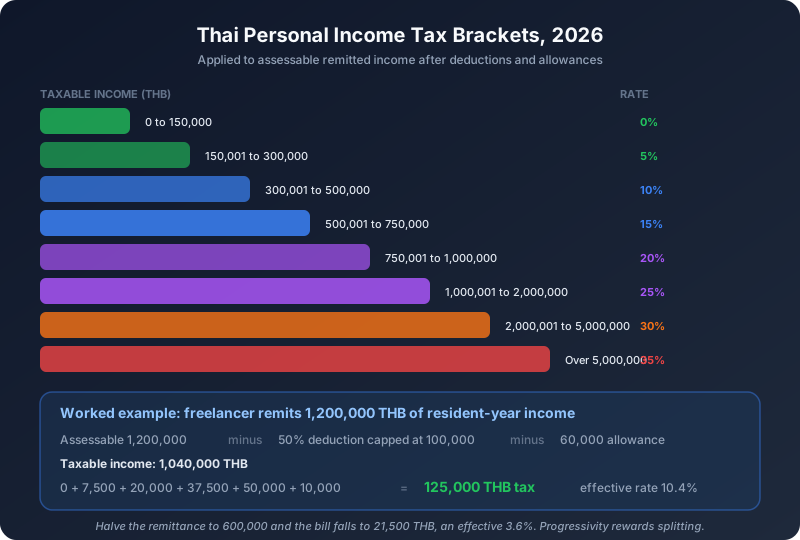
Once a remittance is assessable, it drops into Thailand's ordinary progressive personal income tax scale. Rates for 2026 are unchanged from prior years:
| Taxable income (THB) | Rate |
|---|---|
| 0 to 150,000 | 0% |
| 150,001 to 300,000 | 5% |
| 300,001 to 500,000 | 10% |
| 500,001 to 750,000 | 15% |
| 750,001 to 1,000,000 | 20% |
| 1,000,001 to 2,000,000 | 25% |
| 2,000,001 to 5,000,000 | 30% |
| Over 5,000,000 | 35% |
The first 150,000 THB of taxable income is exempt. That band alone means a nomad remitting modest amounts may owe nothing at all.
Before you reach taxable income you subtract deductions and allowances. The main ones:
- Employment and contract-for-work income (Sections 40(1) and 40(2)): a standard deduction of 50%, capped at 100,000 THB across both categories combined. Section 40(2) covers fees, commissions and service income earned under a contract for work, which is where most freelance and consulting billing sits.
- Other business and professional income (Sections 40(6) to 40(8)): a standard deduction ranging from 10% to 60% depending on the nature of the activity, or actual documented expenses. Regulated professions, contracting with materials supplied, and general trade each have their own percentage.
- Personal allowance: 60,000 THB, plus 60,000 for a non-filing spouse.
- Children: 30,000 THB each, with an extra 30,000 for the second child onwards born in or after 2018.
- Parental care: 30,000 THB per qualifying parent.
- Life insurance: up to 100,000 THB with a Thai insurer on a policy of at least ten years. Health insurance premiums up to 25,000 THB count inside that same 100,000 ceiling.
- Retirement mutual funds: up to 30% of assessable income, maximum 500,000 THB, inside a combined 500,000 THB retirement cap.
- Thai ESG funds: up to 30% of assessable income with a temporary maximum of 300,000 THB and a five-year holding period for investments made between 1 January 2024 and 31 December 2026, reverting to 100,000 THB and eight years from 2027.
A worked tax calculation
Consider a hypothetical freelancer, tax resident in Thailand for 2026, who remits 1,200,000 THB of 2026 freelance income (roughly 33,000 USD at recent rates).
One classification decision has to be made before any arithmetic, and it is worth stating rather than assuming. We are treating her billing as Section 40(2) income, fees for services performed under a contract for work, which is where independent contractors and consultants normally fall and which carries the 50% deduction capped at 100,000 THB. If her activity is instead run as a trade or a regulated profession under Sections 40(6) to 40(8), the percentage deduction of 10% to 60% or actual documented expenses applies and every number below changes. Which category you are in is a question of substance, not preference, and it is the first thing a Thai adviser will pin down.
Start with 1,200,000 assessable. Apply the 50% standard deduction capped at 100,000, leaving 1,100,000. Apply the 60,000 personal allowance, leaving 1,040,000 of taxable income.
Run it through the brackets: nothing on the first 150,000; 7,500 on the next 150,000; 20,000 on the next 200,000; 37,500 on the next 250,000; 50,000 on the next 250,000; and 10,000 on the final 40,000 at 25%. Total Thai tax: 125,000 THB, an effective rate of about 10.4% on the amount remitted.
Now halve the remittance to 600,000 THB and repeat. After the same deductions, taxable income is 440,000, and the tax is 21,500 THB, an effective rate of about 3.6%. Thailand's progressivity means the marginal cost of each additional baht remitted rises sharply. That single fact drives most of the planning below.
And if the same 1,200,000 THB came out of a pre-2024 savings account instead? Zero.
How to Legally Pay Less
There is a bright line between planning and evasion. Planning means choosing which money you move, when you move it, and how many days you spend in the country, and then reporting all of it accurately. Evasion means moving assessable money and not declaring it. The first is legitimate and is what Thai advisers do for clients every day. The second carries a 1.5% monthly surcharge on unpaid tax, a fine of up to 2,000 THB for late filing, and penalties of one or two times the tax due where the department issues a summons and finds a shortfall.
With that said, here is what legitimate structuring looks like.
1. Segregate pre-2024 capital, and prove it
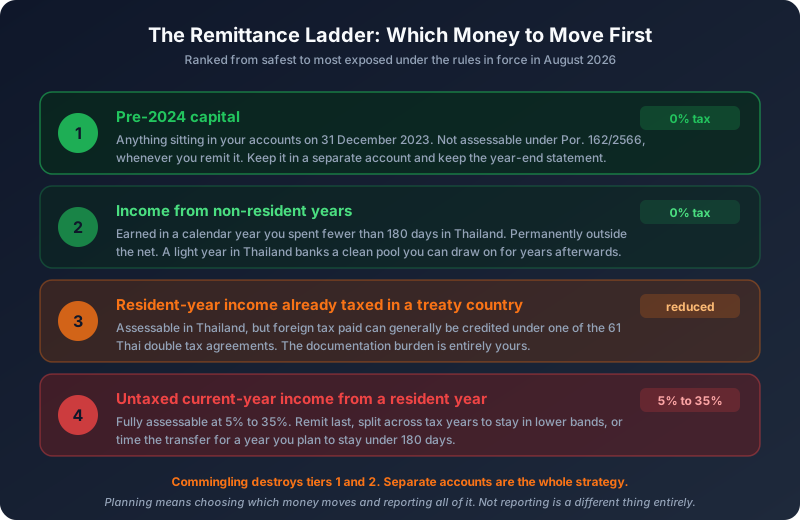
The single most valuable tax document a long-term resident of Thailand can own is a bank statement dated 31 December 2023. Everything in an account on that date is pre-2024 capital and can be remitted free of Thai tax under Por. 162/2566.
The practical failure is commingling. If post-2024 salary has been landing in the same account as your 2023 balance for two years, you have a mixed pool and no clean way to demonstrate which baht crossed the border. The fix is structural and boring: keep a separate account holding only pre-2024 funds, remit from that one, and retain year-end statements, account histories, and records separating principal from subsequent gains. Note that interest and investment gains earned on that capital after 1 January 2024 are new income, not old capital.
2. Remit savings, not current-year earnings
Even after pre-2024 capital runs out, not all money is equally exposed. Income earned in a year when you were not a Thai tax resident is outside the net permanently, whenever you remit it. A nomad who spent 2025 mostly in Georgia and Vietnam, staying only 120 days in Thailand, banked non-assessable income for life. If she becomes resident in 2026 and needs money, the 2025 pool is the one to draw on.
This produces a natural remittance ladder: pre-2024 capital first, then non-resident-year income, then, only if necessary, current or recent resident-year income.
3. Manage the day count deliberately
Staying under 180 days is the cleanest option available, and it is entirely legal. A non-resident is not taxed on foreign-sourced income at all, no matter how much of it arrives in Thailand.
The catch is that this has to be decided in advance, not discovered in December. The count is cumulative across the whole year, so a nomad who has already burned 150 days by August has 29 left before the line, and every subsequent trip has to be planned around that number. This is precisely the problem automated day tracking solves: knowing in March that your current pace lands you at 210 days is actionable, whereas finding out on 31 December is not.
It also has to be reconciled against your immigration position. The DTV grants 180 days per entry on a rolling basis, which is not the same window as the calendar-year tax test. It is entirely possible to be compliant on the visa and over the tax line simultaneously, and many DTV holders end up exactly there. Our complete DTV guide covers how the 180-day-per-entry clock works.
4. Time remittances across tax years
If you are going to be resident anyway, the timing and size of transfers still matters because the brackets are progressive. Remitting 2,000,000 THB in one year pushes the top slice into the 25% band. Splitting it across two years keeps more of it in the 10% and 15% bands. The saving is real and requires nothing more than a calendar.
The same logic applies across a residency change, and this is the third condition doing the work. Money remitted in a year you are non-resident is not assessable regardless of source, and regardless of how exposed the year it was earned in happened to be. A nomad sitting on a large pool of post-2024 resident-year income has exactly one clean exit from it: schedule a year under 180 days, and move the money in that year.
5. Use your treaty
Thailand has double taxation agreements with 61 countries. Where income has already been taxed at source in a treaty country, the tax paid can generally be credited against the Thai liability, so the same income is not taxed twice at full rates. A Spanish, German or Australian nomad with taxed employment income at home is often in a much better position than the headline Thai rate suggests.
Two caveats. The credit is not automatic, and the documentation burden is entirely yours: you need proof of foreign tax paid, and you need to claim it correctly on the Thai return. And a credit reduces Thai tax to the extent of foreign tax paid; it does not create a refund if the foreign rate was higher.
6. Know when the LTR beats all of this
For nomads and retirees who qualify, Thailand's Long-Term Resident visa carries a statutory foreign-income exemption for several categories that is already in force by Royal Decree, not waiting in a drafting queue. That is a materially different position from managing remittance timing under rules that keep moving.
We have covered the LTR tax treatment in depth, including where the "tax-free" framing falls apart, in Thailand's LTR Visa Tax Benefits: A Brutally Honest Breakdown for 2026. If your income is above the LTR thresholds, read that before you build an elaborate remittance structure.
7. Do not build a plan on foreign cards
Using a foreign card for everything and declaring no remittance is the most commonly repeated "strategy" in Thai nomad forums, and it is the weakest. Thai advisers broadly read card spending on overseas funds as remittance, the department has signalled it is scrutinising indirect methods, and the guidance is unsettled rather than favourable. Building a tax position on an unresolved ambiguity, at a moment when the Revenue Department is actively tightening, is not planning. It is a bet.
Compliance: TIN, Filing, Deadlines
If you are a Thai tax resident with assessable remitted income, you are inside the filing system.
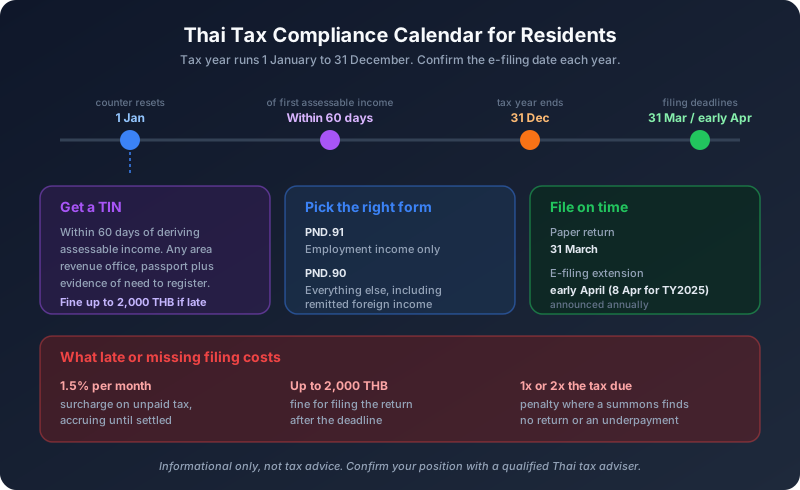
Tax identification number. You must obtain a Thai TIN within 60 days of deriving assessable income. Applications go to any area revenue office regardless of where you live, with your passport and evidence of the need to register. Failure to obtain one carries a fine of up to 2,000 THB. In practice, some revenue offices have been inconsistent about issuing TINs to foreigners without Thai-source income, and nomads have reported very different experiences office to office.
Forms. PND.91 is for individuals with employment income only. PND.90 covers everything else, which is most nomads: freelance income, business income, rental, dividends, and remitted foreign income.
Deadlines. The tax year runs to 31 December. Paper returns are due by 31 March of the following year. E-filing through the Revenue Department's portal receives an extension, reported as 8 April for the 2025 tax year filed in 2026. Confirm the exact e-filing date each year, as the department announces it annually.
Late filing. A surcharge of 1.5% per month accrues on unpaid tax, plus a fine of up to 2,000 THB for the late return. Where the department issues a summons and finds no return filed or tax underpaid, an additional penalty of one or two times the tax due can apply on top of the surcharge.
The Direction of Travel
It is worth being blunt about where this is heading. Thailand spent decades with a remittance system that was easy to work around and rarely enforced against foreigners. Since 2023 the department has closed the timing loophole, issued repeated guidance on what counts as remittance, expanded automatic exchange of financial account information with treaty partners, and floated a move toward taxing worldwide income rather than remittances at all.
The draft same-year exemption is a relaxation, and it may still pass in some form. But it has now survived an entire election cycle without being signed, and the broader trajectory is towards more visibility and more enforcement, not less. Structures that depend on the department not knowing about an offshore account are aging badly.
The practical takeaway for a nomad in Thailand in 2026 is unglamorous. Know your day count in real time rather than in hindsight. Keep pre-2024 capital in a separate, documented account. Understand which of your income years were resident years and which were not. Remit from the safest pool first. File on the law as it is, not as it might become. And when the numbers get large, pay a Thai adviser to look at your specific facts, because the difference between the right and wrong remittance sequence on a seven-figure baht transfer dwarfs the fee.
Track the Line Before You Cross It
Nearly all of this depends on one number: how many days you have actually spent in Thailand this calendar year. Almost nobody knows it accurately from memory, and by the time you sit down to reconstruct it from boarding passes and passport stamps, the decisions it would have informed have already been made.
Nomad Tracker was built for exactly this. It detects country changes automatically from your phone, keeps a per-country day count on a calendar-year basis for tax purposes and a rolling basis for visa purposes, and sends fiscal residency alerts at 150, 170 and 180 days so the 180-day line arrives as a warning rather than a surprise. Ghost Trips let you model a planned itinerary and see whether it tips you over before you book anything. Everything runs on-device.
Know your Thai day count before December.
Nomad Tracker automates per-country day counting, fiscal residency alerts at 150/170/180 days, and visa tracking, all on-device and all private. Available on iOS.
Download on the App StoreThis article is informational and reflects the Thai rules in force as of August 2026. It is not tax advice. Thai regulations in this area have changed repeatedly since 2023 and a further amendment is drafted but not enacted. Confirm your position with a qualified Thai tax adviser before acting.