The Destination Thailand Visa launched in July 2024 and quickly became the most talked-about long-stay option in Southeast Asia. Five years of validity, unlimited entries, 180 days per entry, and a financial bar low enough that most working freelancers clear it. On paper it is the closest thing the region has to a proper digital nomad visa.
Two years in, the picture is more textured. The headline rules have not changed, but enforcement has tightened noticeably through 2025 and into 2026, and a lot of what circulates in nomad forums is either outdated or was never accurate to begin with. This guide covers what the DTV actually is as of August 2026, who qualifies, what it costs, and the specific things it does not let you do.
What the DTV Actually Is
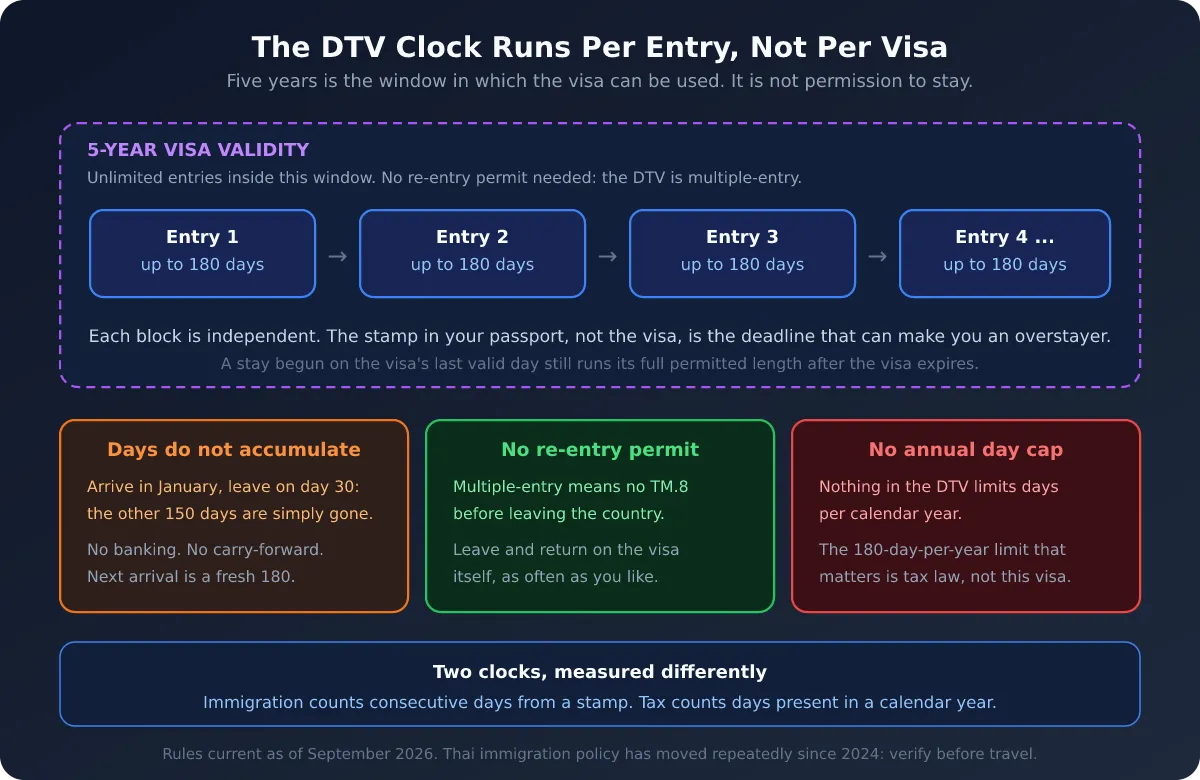
The DTV is a five-year, multiple-entry visa. That five-year number is the source of most of the confusion online, so it is worth being precise: the visa is valid for five years, but it does not grant you five years of residence in Thailand.
What it grants is the right to enter Thailand as many times as you like across those five years, receiving a stay permission of up to 180 days on each entry. Each entry starts a fresh 180-day clock. When that clock runs out you either extend once at a local immigration office or you leave and come back.
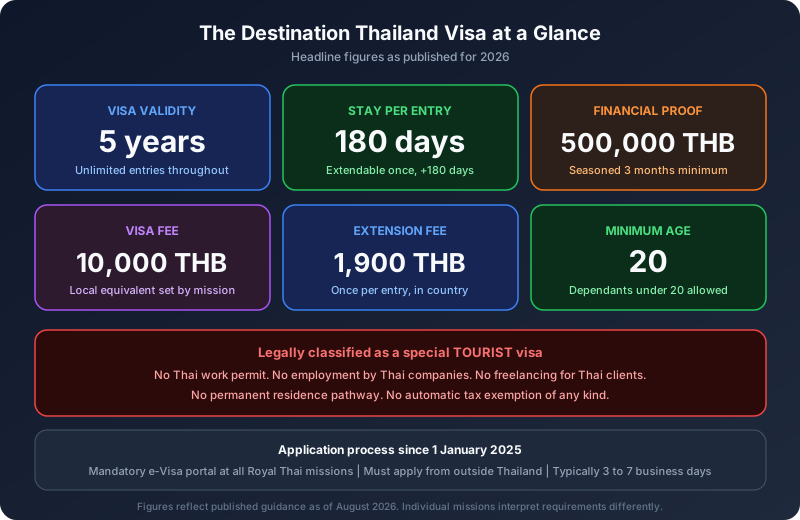
Legally, the DTV sits in the tourist visa family. Thai authorities classify it as a special category of tourist visa, not a work or residence visa. That classification matters enormously for what you can and cannot do once you are inside the country, and we will come back to it.
The key headline figures, as published by the Royal Thai Ministry of Foreign Affairs and confirmed across embassy guidance in 2026:
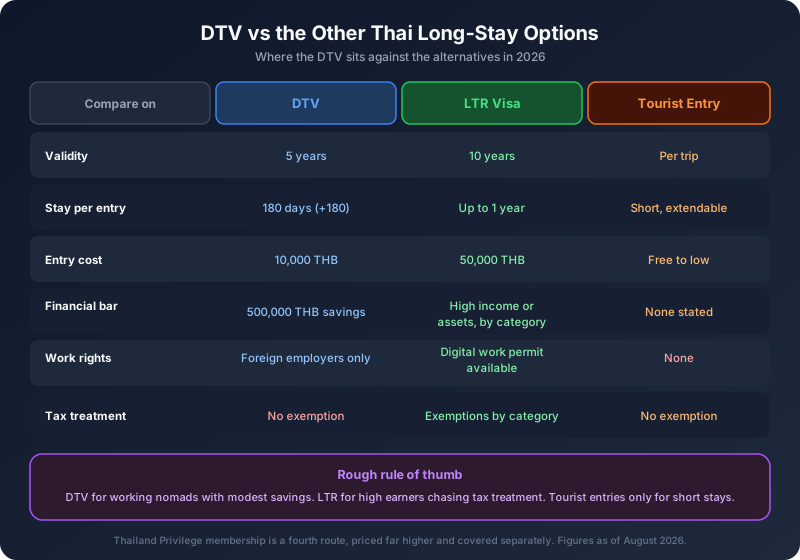
- Validity: 5 years from issue
- Entries: unlimited
- Stay per entry: up to 180 days
- Extension: once per entry, for a further 180 days, at a Thai immigration office
- Extension fee: 1,900 THB, the standard Thai extension-of-stay fee
- Visa fee: 10,000 THB, or the local-currency equivalent set by the issuing mission
- Minimum age: 20
- Financial requirement: 500,000 THB or equivalent, seasoned in a savings account
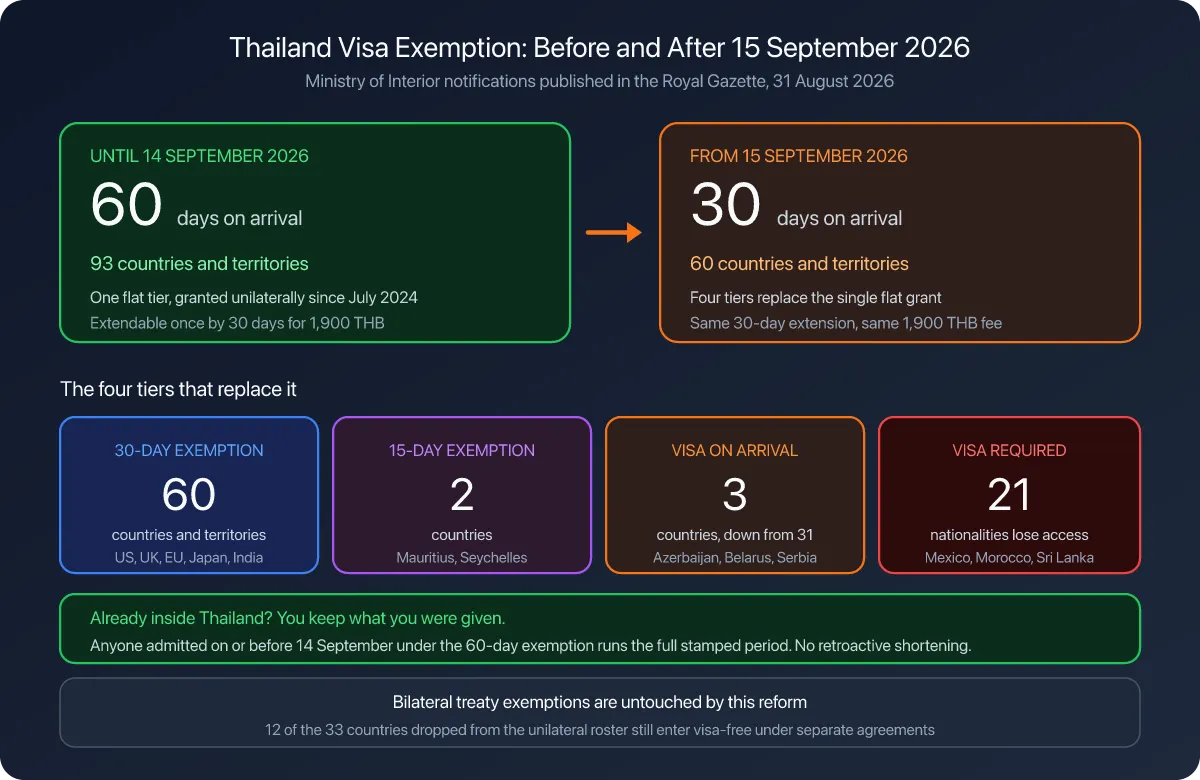
That 180-day allowance matters more than it used to. Since 15 September 2026 the visa exemption grants 30 days instead of 60, which is what pushed many long-stay nomads toward the DTV in the first place.
The Two Qualifying Tracks (Plus Dependants)
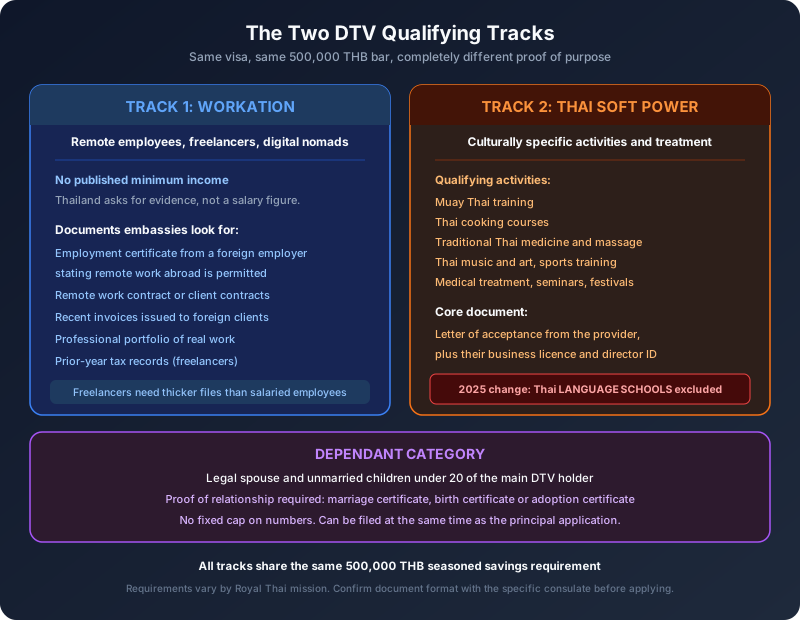
The DTV is not a single visa with a single set of requirements. It has two substantive qualifying tracks and a third dependant category that rides on the first two.
Track 1: Workation
This is the remote-work track, and it is what most people mean when they say "DTV." It covers digital nomads, remote employees of foreign companies, and freelancers with foreign clients.
There is no published minimum income requirement for this track, which surprises people coming from European nomad visas that demand 2,500 EUR a month or more. What Thailand asks for instead is credible evidence that remote income exists and that it comes from outside Thailand. In practice, embassies look for some combination of:
- An employment certificate from a foreign employer explicitly stating that remote work from abroad is permitted, often required to be notarised
- A remote work contract or client contracts
- Recent invoices issued to foreign clients
- A professional portfolio demonstrating a real freelance practice
- Prior-year tax records showing self-employment income
Freelancers have a harder time here than salaried remote employees, because there is no single letter that proves the arrangement. The successful freelance files tend to be thick: contracts plus invoices plus tax returns plus a written explanation of the business.
Track 2: Thai Soft Power Activities
The second track exists to bring people to Thailand for culturally specific activities. The qualifying list is narrower than most applicants assume, and it got narrower still in 2025.
Activities that qualify include Muay Thai training, Thai cooking courses, traditional Thai medicine and massage training, Thai music and art, sports training, medical treatment at a Thai hospital, seminars, and music festivals.
The critical 2025 change: general Thai language schools were excluded from the soft power category under Ministry of Foreign Affairs guidance. A lot of older blog posts still list "Thai language study" as a DTV route. It is not one. Language study remains the domain of the ED visa, which is the subject of a later article in this series.
For soft power applicants the core document is a letter of acceptance from the gym, school, hospital or organisation. Practitioners report that embassies increasingly want the provider's business licence and a copy of the director's ID attached, and that acceptance letters covering a longer programme (six to twelve months rather than one month) fare better.
Dependants
Spouses and unmarried children under 20 can apply as dependants of the main DTV holder. There is no fixed cap on the number of dependants provided each relationship is properly documented with a marriage certificate, birth certificate or adoption certificate.
Two useful details that come up repeatedly in community reports. Dependants can apply at the same time as the principal applicant rather than waiting for the principal visa to be issued. And in many missions the dependant does not need to be physically present alongside the principal at the appointment. Both of these vary by consulate, so confirm before booking anything.
The 500,000 THB Requirement, and Why Seasoning Is the New Battleground
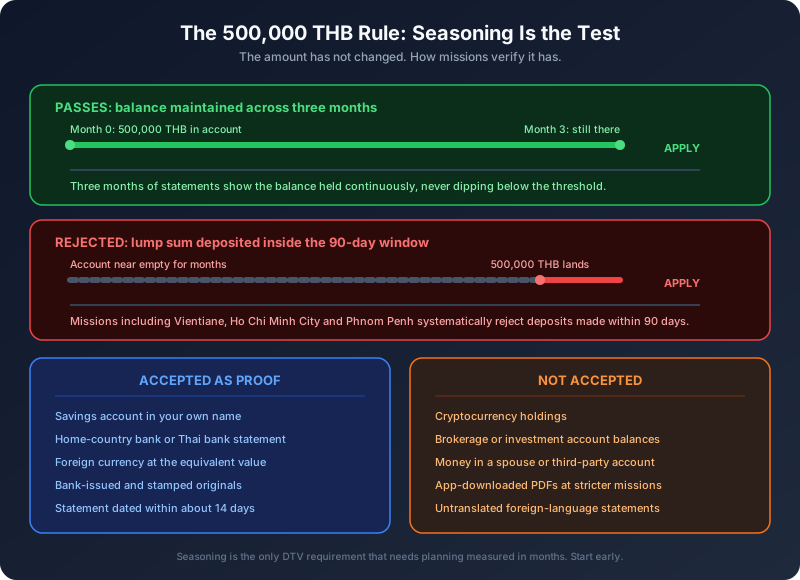
The financial requirement is 500,000 THB or the equivalent in another currency, held in a savings account. At current rates that is roughly 14,000 to 15,000 USD, though you should check the rate on the day since the requirement is denominated in baht.
The requirement itself has not changed. How it is verified has changed a great deal.
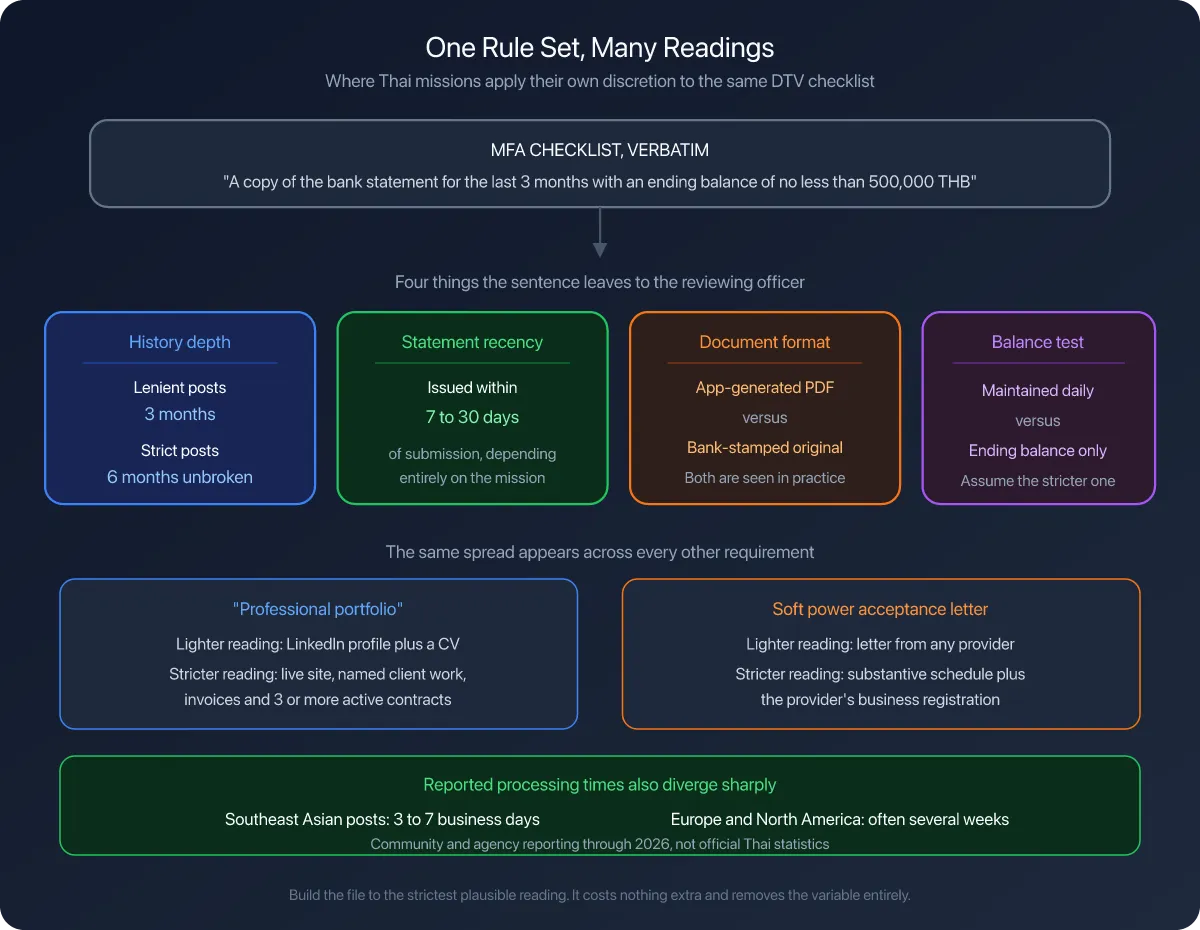
Through 2025 and into 2026, Ministry of Foreign Affairs guidance and Cabinet-level decisions re-emphasised seasoning: the money must have been sitting in the account, not just be sitting there now. Most missions, including the popular regional consulates in Vientiane, Ho Chi Minh City and Phnom Penh, now require at least three months of statements showing the balance maintained throughout. Embassies are systematically rejecting files where a lump sum landed in the account within 90 days of the application.
What does not count:
- Cryptocurrency holdings
- Brokerage or investment account statements
- Money in someone else's account, including a spouse's, unless you are applying as their dependant
- A balance that appeared last week
What tends to cause avoidable problems even when the money is genuinely there:
- PDF statements downloaded from a banking app. Stricter missions want an original statement issued and stamped by the bank. Some accept app downloads. Check with the specific mission.
- Statements older than about 14 days at the time of submission
- Foreign-language statements without a certified English or Thai translation
Cost and Process
The official fee is 10,000 THB per issuance, collected in local currency by the issuing mission. The Royal Thai Embassy in Washington DC, for example, charges 400 USD. Because each mission sets its own local-currency figure, the effective cost varies by a few tens of dollars depending on where you apply.
Since 1 January 2025 all Royal Thai missions process the DTV through the mandatory e-Visa portal. There is no paper application at the counter any more. You create an account, upload your documents, pay, and wait for a decision that arrives by email as a PDF e-Visa. There is no sticker in your passport.
Processing times reported by applicants cluster around three to seven business days, with heavy variance by mission. Some approvals land in under a day. Some files sit for several weeks, particularly at consulates handling high volumes of DTV applications.
One more 2026 change worth flagging: location verification was added to prevent applications submitted from inside Thailand. The DTV must be applied for from outside the country. Applicants are also generally expected to show a connection to the country they are applying from, which is why "consulate shopping" from a country where you have no residence or long-stay basis has become a common rejection ground. We covered that failure mode, and the others, in our guide to DTV rejections and embassy practice.
What the DTV Does Not Allow
This is the section that matters most, because the DTV's tourist-visa classification carries real consequences that marketing copy tends to skip.
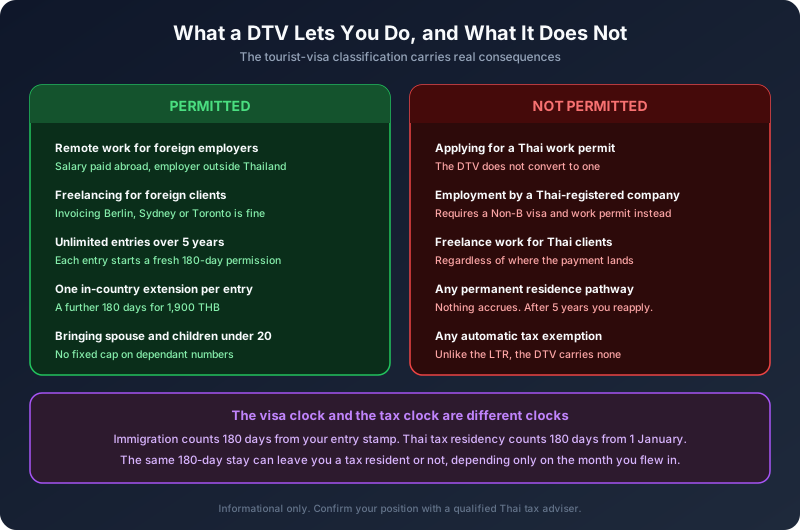
No Thai work permit. DTV holders cannot apply for one. The visa does not convert, and there is no pathway from DTV to work permit while holding the DTV.
No work for Thai-registered companies. Employment by a company registered in Thailand is not permitted on a DTV, full stop.
No freelance work for Thai clients. This one catches people. A freelance designer on a DTV can invoice clients in Berlin, Sydney and Toronto without issue. Invoicing a client in Bangkok is outside what the visa permits, regardless of where the money lands.
No permanent residence pathway. The DTV does not accrue toward permanent residency or citizenship. After five years it simply expires and you reapply.
No automatic tax exemption. The DTV is an immigration document. It says nothing about tax. Spend 180 days or more in Thailand in a calendar year and you become a Thai tax resident, at which point Thailand's remittance-basis rules apply to foreign income you bring into the country. The LTR visa carries specific tax exemptions for some categories. The DTV carries none.
Who the DTV Is Actually For
Strip away the hype and the DTV suits a fairly specific profile.
It works well for a remote employee or freelancer with foreign clients who wants Thailand as a base for six to twelve months a year without the visa-run treadmill, and who has 500,000 THB they can leave untouched in savings for a quarter.
It works well for someone doing a serious Muay Thai, cooking or traditional medicine programme, where the acceptance letter is genuine and the training is the actual reason for the trip.
It works well for families, because dependants are cheap to add relative to almost any comparable programme.
It works poorly for anyone who wants to work with Thai clients or a Thai employer, who needs a residency pathway, who is chasing a tax outcome, or who wants continuous multi-year residence without leaving. For higher earners the LTR visa, which does carry tax benefits and does permit work for Thai employers under the Work-from-Thailand Professional category, is usually the better fit despite its far higher thresholds. Our breakdown of the LTR visa's tax treatment goes through where that visa's "tax-free" reputation holds and where it does not.
The Number You Have to Watch
Here is the tension at the heart of the DTV, and it is arithmetic rather than legal.
The visa gives you 180 days per entry. Thai tax residency triggers at 180 days in a calendar year. Those two numbers are identical and it is not a coincidence, but they are measured differently. The immigration clock runs from your entry stamp. The tax clock runs from 1 January.
Consider a hypothetical. Someone enters Thailand on 1 October 2026 on a DTV and stays through the end of March 2027. That is roughly 92 days in the 2026 tax year and roughly 90 in 2027. They have used a single 180-day entry and are a tax resident in neither year. Now shift the same trip to start on 1 February. Same 180 days, but all of them fall in one calendar year, and on day 180 they become a Thai tax resident with everything that follows.
Same visa. Same number of days. Completely different tax position, decided by which month you flew in.
That interaction is important enough that it gets its own article in this series, covering the 180-day threshold, Thailand's remittance-basis system, and the changes that took effect from 1 January 2024 onward.
Practical Takeaways
If you are considering the DTV in 2026:
- Start seasoning the 500,000 THB now. Three months minimum, maintained continuously, in your own savings account. This is the single most common rejection cause and the only one that requires advance planning measured in months.
- Pick your track honestly. Do not file a soft power application for a gym you have no intention of attending. Providers are increasingly asked for their business licence, and immigration takes an interest in whether the stated purpose matches reality.
- Check the specific mission's document format. Original stamped statements versus app PDFs, translation and notarisation requirements, and appointment booking rules all vary by consulate.
- Apply from outside Thailand, from a country where you have a real connection.
- Count your calendar-year days from the start, not from the entry stamp. The two clocks are different and only one of them has tax consequences.
The DTV remains, in 2026, the best-value long-stay option in Southeast Asia for remote workers who fit its profile. It is also a document that rewards planning and punishes improvisation, both at the application stage and once you are counting days on the ground.
Track Both Clocks Automatically
The reason we built day tracking into Nomad Tracker is exactly the problem in the section above: your visa clock and your tax clock are different clocks, and almost nobody tracks both.
Nomad Tracker detects country changes automatically and runs a per-country calendar-year count alongside your visa windows, with fiscal residency alerts at 150, 170 and 180 days so the Thai tax threshold never arrives as a surprise. Ghost Trips let you model a planned DTV entry before you book it, so you can see whether that 180-day stay lands inside one tax year or straddles two.
Know your day count before Thai immigration does.
Nomad Tracker automates visa day counting, fiscal residency monitoring, and trip planning -- all on-device, all private. Available on iOS.
Download on the App StoreThis article is informational and reflects publicly available guidance as of August 2026. Thai immigration and tax rules have changed repeatedly since the DTV launched and individual missions interpret requirements differently. Confirm current requirements with the Royal Thai mission where you intend to apply, and consult a qualified Thai adviser for anything touching tax.