The Destination Thailand Visa is sold on one number: five years. That number is the least useful thing about it. What actually governs your life in Thailand on a DTV is a stack of smaller clocks that all run at different speeds and reset on different triggers: a 180-day permitted stay, a discretionary 180-day extension, a 90-day address report, a 24-hour landlord filing, and a 180-day tax residency threshold that has nothing to do with immigration at all.
Most DTV holders learn these one at a time, usually by getting one wrong. This guide lays out all of them together, with the arithmetic, so you can plan a year in Thailand instead of reacting to it.
The Unit of the DTV Is the Entry, Not the Visa
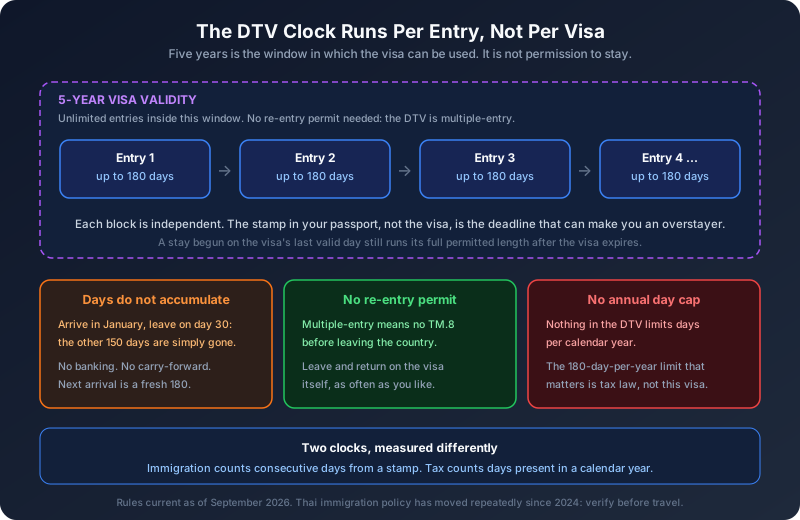
The DTV is a five-year multiple-entry visa. The five years are the window in which the visa can be used. They are not a permission to stay.
What you get on arrival is a permitted stay of up to 180 days, stamped at the border. That stamp is the only thing that matters to an immigration officer checking whether you are legal. Your visa can be valid for another four years and you can still be an overstayer if the stamp has expired.
Three consequences follow, and they trip people up in this order:
Entries do not accumulate. Each entry stands alone. If you arrive in January, stay 30 days, and fly to Vietnam, the other 150 days are gone. They do not bank, they do not carry forward, and there is no annual allowance being drawn down. You simply get a fresh 180 on your next arrival.
No re-entry permit is required. Because the DTV is multiple-entry, you do not need the TM.8 re-entry permit that single-entry visa and extension holders need before leaving. You can leave and come back on the visa itself as many times as you like inside the five years.
The clock is per entry, not per year. Nothing in the DTV limits how many days per calendar year you spend in Thailand. That limit, where it exists, comes from tax law, which is a completely separate system covered further down.
The 1,900 THB Extension: One Per Entry, and Discretionary
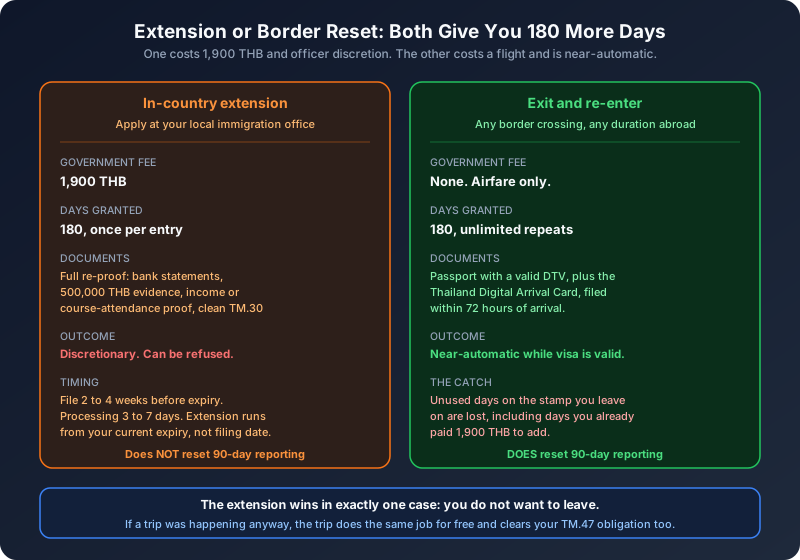
Inside Thailand you can apply once per entry to extend that 180-day stamp by a further 180 days. The government fee is 1,900 THB, which is the standard fee for almost every in-country extension of stay in Thailand.
Four things about this extension are worth being precise about, because the word "extension" does a lot of misleading work.
It is an application, not an entitlement. Immigration offices grant it at officer discretion. In practice most well-documented applications are approved, but reporting through 2026 from immigration-facing law firms and agencies in Chiang Mai and Bangkok consistently describes it as discretionary. Nobody is entitled to it.
You are re-proving your case. Expect to produce updated versions of what got you the visa: current bank statements, evidence you still meet the 500,000 THB financial requirement, proof of your remote employment or freelance clients, and for Soft Power track holders, evidence you are still enrolled in and attending the activity. Community reports through 2026 describe officers asking Muay Thai and Thai language DTV holders for specific course dates and attendance hours, not just a receipt.
Your address paperwork has to be clean first. The pattern reported most often in 2026 rejections is not a financial failure, it is an administrative one: an unfiled or mismatched TM.30 address notification, or an arrival not properly registered through the Thailand Digital Arrival Card. Those get the file turned away before the substance is even discussed.
Timing is tighter than it sounds. You must apply before the current permitted stay expires, and offices vary in how early they will accept a file. Guidance ranges from roughly two weeks to four weeks ahead, and applicants have reported being told to come back when arriving with only ten days left. Processing commonly runs three to seven days. The extension runs from the expiry of your current stay, not from the date you file, so applying early costs you nothing.
The Border Reset: Cheaper, Faster, and Usually Better
Here is the part that makes the extension optional for many people. Because each arrival grants a fresh 180 days, leaving Thailand and coming back gives you a new 180-day stamp for the price of a flight. No documents, no immigration office, no discretion, no 1,900 THB.
Weigh the two honestly:
| In-country extension | Exit and re-enter | |
|---|---|---|
| Cost | 1,900 THB plus your time | Airfare, typically 3,000 to 12,000 THB return |
| Days granted | 180 | 180 |
| Documents | Full re-proof of eligibility | Passport and the arrival card |
| Outcome | Discretionary | Near-automatic while the visa is valid |
| Repeatable | Once per entry | Unlimited inside the five years |
| Downside | Can be refused | You lose any unused days on the stamp you leave on |
The extension wins in exactly one situation: you do not want to leave. If you have a lease, a gym block, a family arrangement or a reason to stay put, 1,900 THB is a bargain. If you were going to take a trip anyway, the trip does the same job for free.
One trap to avoid: if you have already extended and then leave the country, the remainder of that extended stay is gone. The DTV is multiple-entry, so you re-enter fine, but you re-enter on a fresh 180-day stamp and the extension you paid for is spent. Extend at the end of a stay you intend to complete, not at the start of one you might cut short.
Getting to 360 Days, and Why That Is the Wrong Target
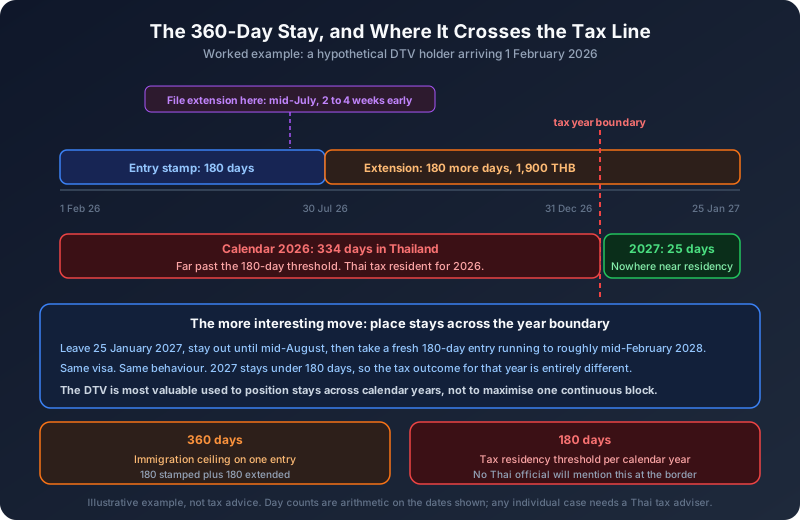
The advertised maximum on a single entry is 360 days: 180 stamped on arrival, 180 added by extension. Combine that with a border reset and the theoretical ceiling becomes continuous residence, one 360-day block after another, for five years.
Nothing in Thai immigration law stops that. Something else does.
Two separate things break the 360-day fantasy, and they are worth naming clearly because they are the two most expensive mistakes DTV holders make.
The tax line. Spend 180 days or more in Thailand in a calendar year and you become a Thai tax resident. A 360-day stay crosses that threshold twice over. This is not an immigration penalty and immigration will never mention it to you. It is a Revenue Department consequence with filing obligations attached. Our full breakdown of Thai tax residency and the remittance rules covers what changes once you are over that line, and it is the article to read before you plan a long stay, not after.
Entry scrutiny. The border reset is procedurally easy, not legally guaranteed. Entry is always at officer discretion, and a passport showing a long series of short exits and immediate returns invites questions. The DTV is a better position here than tourist status, because you hold a visa that is explicitly designed for repeated long entries. But if you are asked whether you still meet the conditions of the visa, you want to be able to answer with documents rather than confidence.
Worked example: the 360-day plan
Consider a hypothetical DTV holder who arrives on 1 February 2026.
- 1 February: enters, permitted to stay until 30 July 2026 (180 days).
- Mid-July: applies at immigration with two weeks to spare, pays 1,900 THB, extended to 25 January 2027 (a further 180 days).
- Total continuous stay: 360 days.
- Days in calendar 2026: 1 February to 31 December is 334 days. Thai tax resident for 2026, comfortably.
- Days in calendar 2027 on this stay: 1 to 25 January is 25 days. On its own, nowhere near residency for 2027.
The interesting move is what happens next. Leaving on 25 January 2027 and staying out until, say, mid-August gives a fresh 180-day entry that runs to roughly mid-February 2028 while keeping 2027 days under 180. Same visa, same behaviour, entirely different tax year. The DTV's flexibility is most valuable when you use it to place your stays across calendar-year boundaries rather than to maximise a single block.
The Reporting Obligations Nobody Reads About Until They Cost Money
Long stays in Thailand come with two filings that have nothing to do with your visa and everything to do with whether immigration knows where you sleep.
TM.47: the 90-day address report
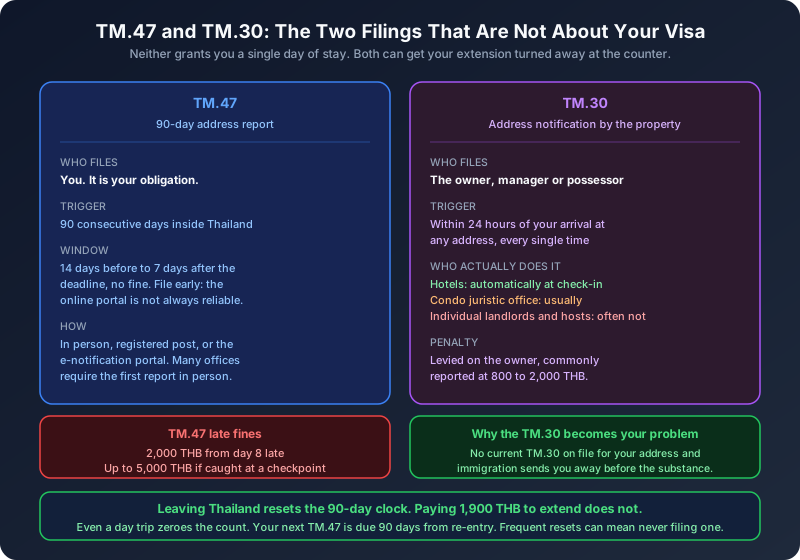
If you remain in Thailand for 90 consecutive days, you must notify immigration of your current address. This is the TM.47, and it is purely an address notification. It grants no days, extends nothing, and is not a check on your visa.
The mechanics:
- The window opens 14 days before the deadline and closes 7 days after it, with no fine inside that window.
- From day 8 late, there is a 2,000 THB fine.
- Getting caught at a checkpoint without having reported can run to 5,000 THB.
- You can file in person, by registered post, or online at the immigration e-notification portal. Many offices require the first report in person, with subsequent ones online.
- Online filing is best attempted early in the window. The portal is not famously reliable, and leaving it to the last day is how people end up fined.
The single most useful fact about the TM.47: leaving Thailand resets it. Any departure, even a day trip, zeroes the count. Your next report is due 90 days from your re-entry date. A DTV holder who takes a weekend in Penang every couple of months may never file a TM.47 at all. Someone who sits still in Chiang Mai for 360 days will file three or four.
Note that this reset is independent of the extension. Paying 1,900 THB to extend your stay does not reset the 90-day report. Only crossing a border does.
TM.30: the landlord filing that is your problem anyway
The TM.30 is the notification that a foreigner is staying at an address. The legal duty sits with the property owner, manager or possessor, not with you, and it must be filed within 24 hours of your arrival at the address. Hotels do it automatically as part of check-in. Condo juristic offices usually handle it. Individual landlords and short-term hosts frequently do not.
Penalties are levied on the owner and reported in the range of 800 to 2,000 THB, with higher figures cited for repeated or aggravated cases. That sounds like someone else's problem until you turn up at immigration for your extension, or for your 90-day report, and the officer cannot find a current TM.30 for the address on your form. Then it becomes your problem: you get sent away to have it filed first.
Practical handling: confirm in writing that your landlord has filed it, keep the receipt, and re-check after every re-entry into Thailand and every change of address, including a hotel stay in between leases. Each new arrival at an address is a new filing.
Arrival Admin: The Digital Arrival Card
Since 2025 every foreigner entering Thailand by air, land or sea has been required to submit the Thailand Digital Arrival Card. It replaces the paper TM.6 and is free on the official immigration portal.
The rule that catches people is the submission window: no earlier than 72 hours before arrival. You cannot file it a week out along with the rest of your trip admin. Self-service kiosks exist at the major airports for travellers who miss it, but queues in high season make that an unattractive fallback.
For DTV holders running border resets, this is a per-crossing obligation, not a one-time registration. Every re-entry needs a fresh submission. Since a reset trip is often a same-week affair, the 72-hour window is usually not a constraint in practice, but it does mean adding one more step to every bounce. Beware of the paid lookalike sites; the official card costs nothing.
The Five-Year Wall
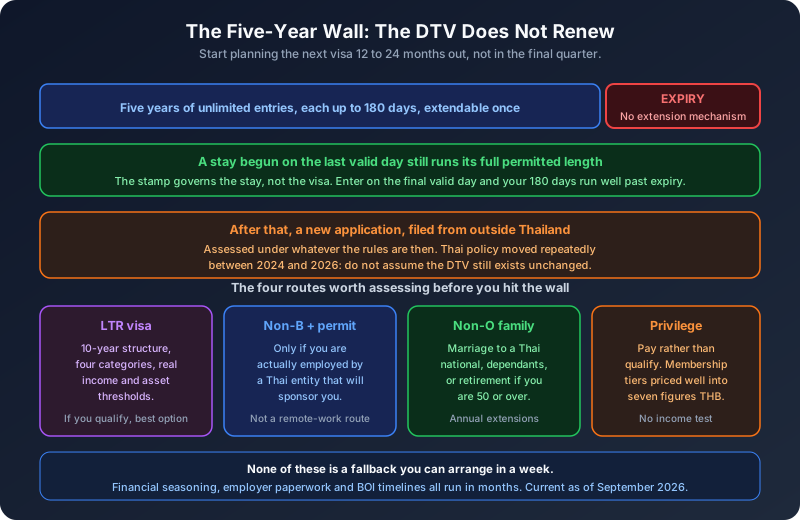
The DTV does not renew. At the end of the five years it simply expires, and there is no mechanism to extend the visa itself.
What that means concretely:
- You can keep entering and starting fresh 180-day stays right up to the visa's expiry date. A stay begun on the last valid day still runs its full permitted length after the visa has expired, because the stamp governs the stay.
- After expiry, continuing to live in Thailand requires a new application, from outside Thailand, assessed under whatever the rules are at that time. Given how much Thai immigration policy moved between 2024 and 2026, assuming the DTV will exist in its current form in 2029 or 2030 would be optimistic.
- The sensible planning horizon is 12 to 24 months before expiry. That is when to look seriously at whether you qualify for something more durable: the LTR visa if your income or assets reach its thresholds, a Non-B with a work permit if you are actually employed by a Thai entity, a Non-O if you have family grounds, or the Thailand Privilege programme if you would rather pay than qualify.
What Actually Matters, In Order
- Your permitted-stay stamp is the only immigration deadline that can make you an overstayer. Know its date, not your visa's date.
- Days do not accumulate. Each entry is a fresh 180, and unused days are lost on departure.
- The 1,900 THB extension is one per entry, discretionary, and worth it only if you did not want to leave anyway.
- A border reset does the same job for free, and also resets your 90-day reporting obligation.
- TM.47 at 90 consecutive days, TM.30 within 24 hours of arriving at any address. Both are cheap to do and annoying to fix.
- The Digital Arrival Card is required on every entry and can only be filed inside 72 hours of arrival.
- 180 days in a calendar year makes you a Thai tax resident. The immigration ceiling of 360 days and the tax threshold of 180 days are not the same number, and no Thai official will point out the difference to you.
That last point is the one worth sitting with. On a DTV you are running two clocks at once, and they are measured differently: the immigration clock counts consecutive days from a stamp, the tax clock counts days present in a calendar year regardless of how many times you crossed a border. It is entirely possible to be perfectly legal on one and to have quietly acquired obligations on the other. Anything in this article about tax is a description of how the rules work, not advice on your situation, and the specifics for any individual case need a Thai tax adviser to confirm.
Track Both Clocks, Automatically
We built Nomad Tracker because these two clocks are exactly the kind of arithmetic humans get wrong. It logs country changes from your phone's location, counts your consecutive permitted-stay days against your current entry, and separately tracks your calendar-year day count per country with fiscal residency alerts at 150, 170 and 180 days, so the tax threshold arrives as a notification rather than a surprise.
Ghost Trips let you model a border reset before you book it: drop a hypothetical exit and re-entry onto the calendar and see immediately what it does to both your 180-day stay and your calendar-year total. If you are also moving through Europe between Thai entries, the Schengen calculator runs the rolling 90/180 window in parallel. Everything stays on the device.
Stop counting days manually.
Nomad Tracker automates Schengen day counting, fiscal residency monitoring, and visa tracking -- all on-device, all private. Available on iOS.
Download on the App Store