Almost every "digital nomad packing list" online is a wall of affiliate links dressed up as advice. It tells you to buy nine cubes, four cables, and a bag big enough to hide a body, then sends you to checkout. The result is a setup that looks great in a flat-lay photo and feels miserable at the top of a fourth-floor walk-up in Lisbon with no elevator.
A real one-bag system starts from a different question. Not "what could I bring," but "what survives crossing a border every few weeks without becoming a liability." Forty liters is the number that keeps coming up in the nomad community, and there is a reason for it. It is the largest bag you can plausibly keep on your back through a budget airline gate, and it is small enough that it forces the discipline that makes long-term travel sustainable. This guide walks through a 40L setup built around that logic, updated for the rules that actually apply in 2026.
Why 40 Liters Is the Ceiling, Not the Goal
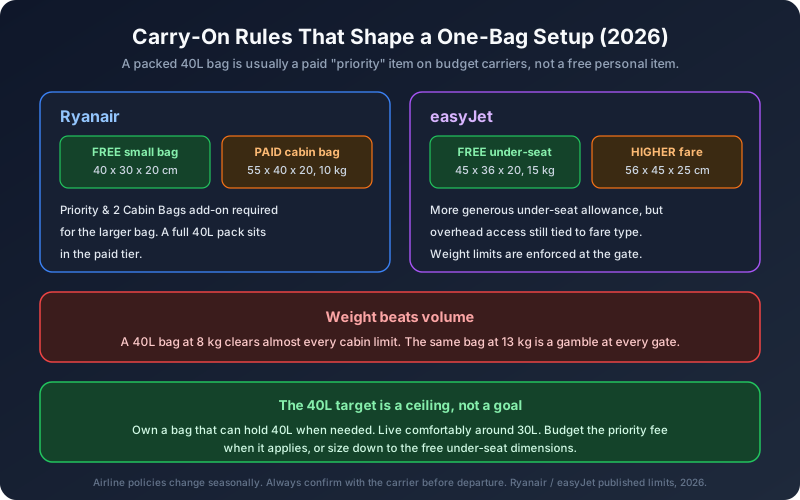
The instinct is to treat 40L as a target to fill. It is better understood as a wall you try never to hit. The reason is airline math, and the math got stricter in 2026.
A true 40L travel backpack sits right at the edge of European budget carrier limits, and often just past them. On Ryanair, the only bag you carry for free is the small under-seat item at 40 by 30 by 20 centimeters. Anything larger, including the standard 55 by 40 by 20 cabin bag capped at 10 kilograms, requires the Priority add-on. easyJet is more generous, allowing an under-seat bag up to 45 by 36 by 20 centimeters and 15 kilograms, with a larger 56 by 45 by 25 cabin bag on higher fares. The practical takeaway: a packed 40L bag is usually a "priority" or "large cabin bag" item on European low-cost airlines, not a free personal item. Budget for that fee, or size down.
This is exactly why weight matters more than volume. A 40L bag that weighs 8 kilograms packed clears almost every cabin limit in the world. The same bag at 13 kilograms turns every gate into a gamble. The goal is not to use all 40 liters. It is to own a bag that can hold 40 when you need it, while living comfortably around 30.
The Bag Itself
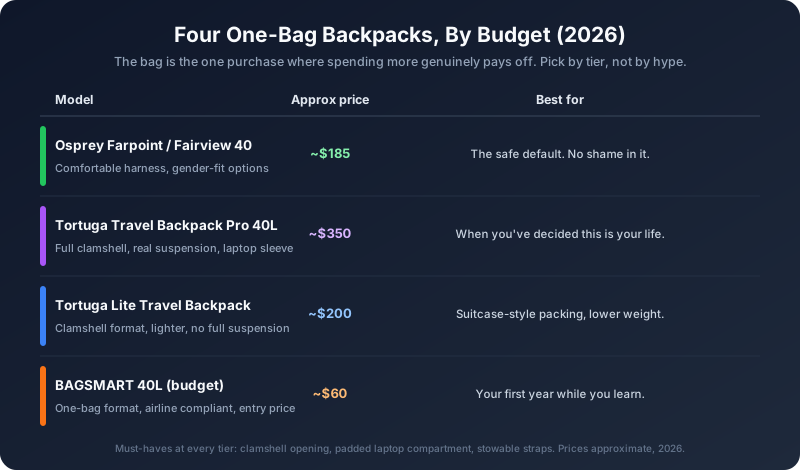
The bag is the one purchase where spending more genuinely pays off, because it is the single item you touch every day and the one thing that cannot be replaced cheaply on the road. A few models come up again and again in serious one-bag circles, and they split cleanly by budget.
The perennial community favorite is the Osprey Farpoint 40, or the Fairview 40 in its women's-fit version. It is carry-on compliant in most regions, has a genuinely comfortable harness with a real hip belt, and is priced well below the premium tier. It is the safe default, and there is no shame in the safe default.
At the higher end, the Tortuga Travel Backpack Pro 40L is the bag people upgrade to when they have decided this is their life. It opens like a suitcase in a full clamshell, carries a heavy load better than almost anything its size thanks to a proper suspension system, and protects a laptop in a dedicated sleeve. The catch is the price, which lands around 350 US dollars. Tortuga also makes a lighter, cheaper Lite version for people who want the clamshell format without the full suspension.
On a budget, bags like the BAGSMART 40L deliver the one-bag format and airline compliance for a fraction of the cost. They will not last a decade, but they will get you through your first year while you learn what you actually value in a bag. That knowledge is worth more than the marketing copy on a premium model.
Whichever tier you choose, three features are non-negotiable for nomad use: a clamshell or near-clamshell opening so you pack like a suitcase rather than digging like a hiker, a dedicated padded laptop compartment, and a stowable or low-profile harness so the straps do not get shredded on baggage belts when you are forced to check it.
The Tech Kit Is Where One-Bag Lives or Dies
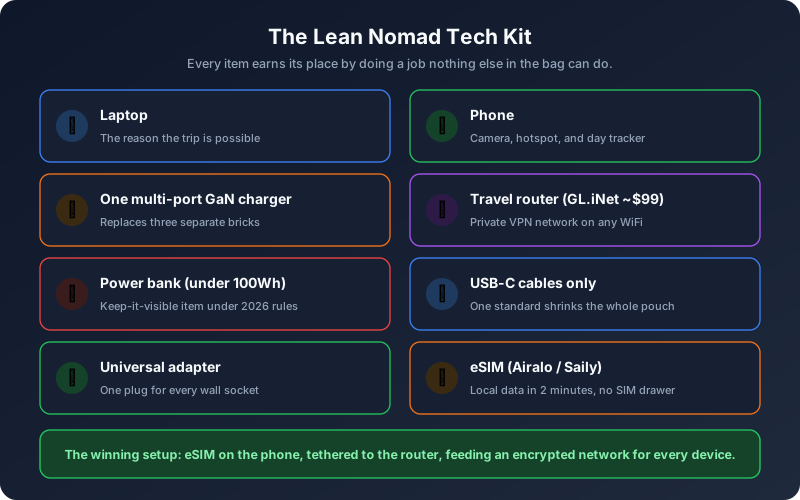
For a location-independent worker, the tech kit is not an accessory. It is the reason the trip is possible at all, and it is where a disciplined setup separates itself from a cluttered one. The principle is ruthless: every item earns its place by doing a job nothing else in the bag can do, and cables get consolidated to a single standard wherever possible.
The core is obvious: a laptop, and a phone that doubles as camera, hotspot, and increasingly your primary tool for the admin side of nomad life. Around that core, a small number of items punch far above their weight.
A single high-wattage GaN charger with multiple USB-C ports replaces the pile of separate bricks most people carry. One charger that can run a laptop and top up a phone and a power bank at once eliminates three chargers and the tangle that comes with them. Standardizing on USB-C across every device you own is the quiet upgrade that shrinks a tech pouch more than any packing cube ever will.
The item that surprises people is a compact travel router. A model like the GL.iNet Beryl AX costs around 99 US dollars and solves several problems at once. You connect your phone to it by USB and it rebroadcasts that cellular data as a private, VPN-protected network for all your devices, so a café's open WiFi never touches your laptop directly. It also lets a whole room of devices share one connection, and it gives you a stable private network name that follows you from country to country. For anyone doing real work over untrusted networks, it is one of the highest-value items in the bag.
Connectivity itself has quietly become a solved problem, and it no longer requires a drawer of physical SIM cards. eSIM providers like Airalo and Saily let you activate a local data plan from your phone in a couple of minutes, usually before you have even cleared the airport. The common setup among nomads now is to run an eSIM on the phone and tether it to the travel router, which shares that single connection across the laptop, a tablet, and anything else. One plan, activated digitally at each border, feeding an encrypted network for everything you own.
The 2026 Power Bank Rules Actually Changed Things
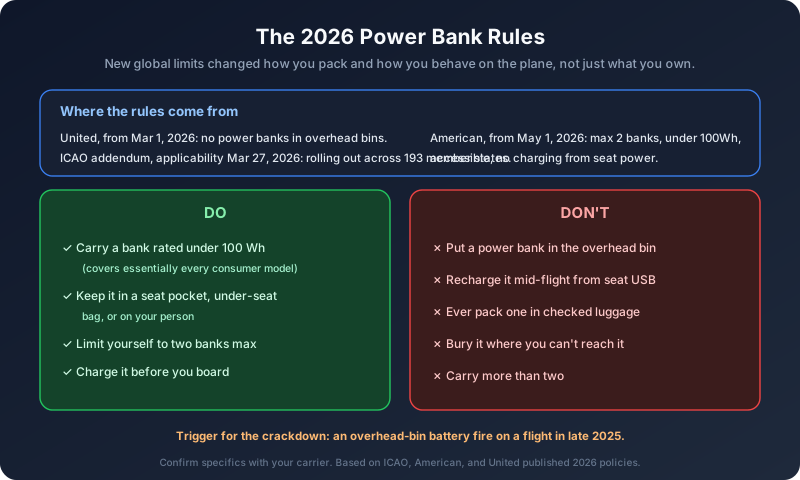
If you last reviewed your gear a couple of years ago, one part of your kit now carries rules it did not before. Power banks are under new global restrictions in 2026, and they affect how you pack and how you behave on the plane, not just what you own.
The International Civil Aviation Organization approved an addendum to its dangerous-goods instructions with an applicability date of March 27, 2026, being rolled out across all 193 member states. It limits each passenger to two power banks, prohibits recharging them during a flight, and requires them to stay accessible rather than buried in a bag. Individual carriers layered their own versions on top. American Airlines, effective May 1, 2026, caps passengers at two power banks each rated under 100 watt-hours, requires them in carry-on and within reach, and forbids charging them from the aircraft's USB or seat power. United, effective March 1, 2026, no longer permits power banks in overhead bins at all. The trigger for the crackdown was an overhead-bin battery fire on a flight in late 2025.
For a one-bag traveler, the practical rules are simple to internalize. Carry one power bank rated under 100 watt-hours, which covers essentially every standard consumer model. Keep it in a seat pocket, an under-seat bag, or on your person during the flight, never in the overhead bin. Do not try to recharge it mid-flight from the seat's USB port. And never, under any circumstances, put a power bank in checked luggage, which has been the rule for years and is now enforced more aggressively than ever. A power bank is a "keep it visible" item now, and packing it where you can grab it is no longer optional.
Clothes: The Capsule That Refuses to Grow
Clothing is where one-bag setups fail, because clothing is where fear lives. Every "just in case" item is a small vote against the whole system, and those votes add up until the bag stops closing.
The working principle in the one-bag community is a capsule wardrobe built around a single muted color palette, so everything pairs with everything and nothing is dead weight waiting for a specific outfit. A realistic full-time count lands somewhere around seven tops, two or three bottoms, one layer for warmth, one shell for rain, a week of underwear and socks, and a single pair of versatile shoes with sandals if the climate calls for it. That is roughly a week of clothing, and a week is the correct amount regardless of trip length, because past a week you are no longer packing, you are doing laundry.
The mental shift that makes this work is accepting that laundry is a feature, not a failure. A nomad life is a sequence of places with washing machines, not a single expedition into the wilderness. Packing for two weeks is packing for a laundromat you will never visit. Merino wool earns its premium here, because it resists odor and can be worn several times between washes, which quietly reduces how much you need to carry in the first place.
Climate is the only real variable, and the honest answer is that you do not solve winter and summer in the same 40 liters. The people who make it look effortless are chasing a season, keeping to roughly 15 to 25 degree destinations, and buying a cheap coat locally on the rare occasion they land somewhere cold, then donating it when they leave. Trying to pack for every possible climate is how a 40L bag becomes a 60L bag becomes a checked bag becomes the exact suitcase you were trying to escape.
The Admin Layer Most Packing Lists Skip
Here is the part no gear review covers, because you cannot buy it and there is no affiliate link for it. The most important thing a border-crossing nomad carries is not in the bag at all. It is the record of where they have been.
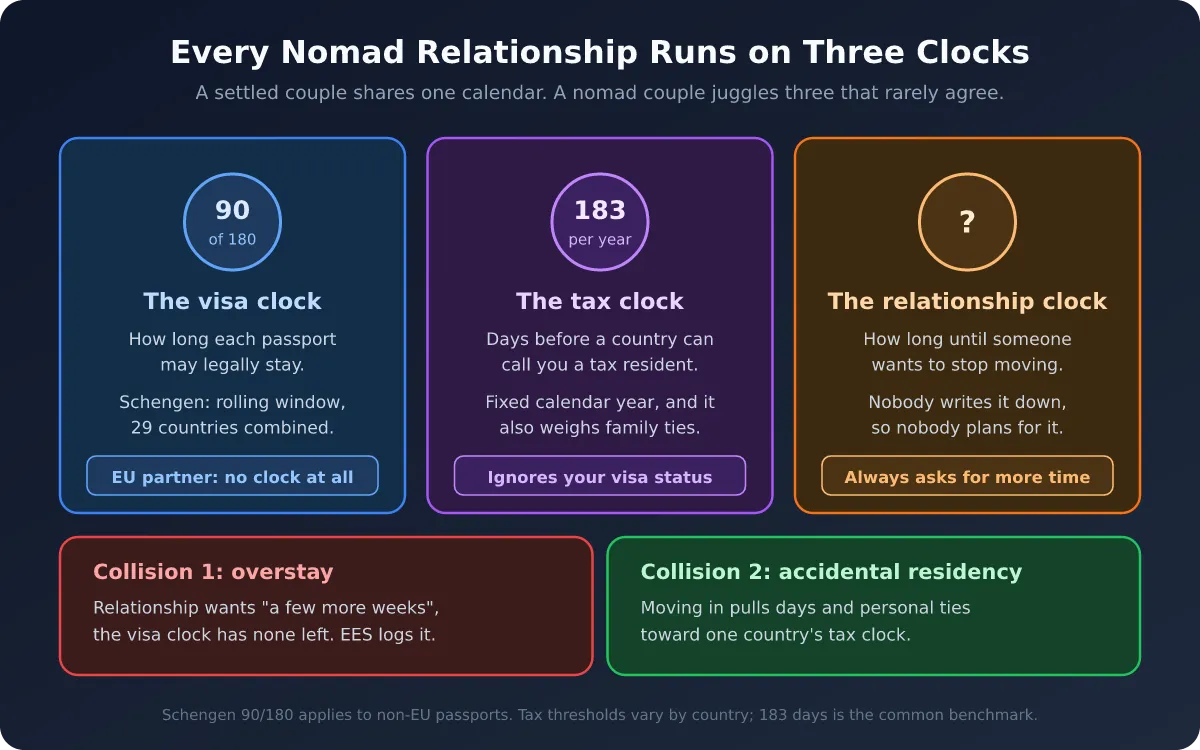
Every packing list obsesses over passports, a document pouch, and backup copies of your ID in the cloud, and those matter. But the document that actually keeps you out of trouble is your day count. A full-time nomad is constantly accumulating time against two separate ceilings that no amount of good gear protects you from. The first is immigration: the Schengen Area alone caps most non-EU visitors at 90 days inside any rolling 180-day window, and other regions have their own limits. The second is tax: most countries treat 183 days of presence in a year as the line where you may become a tax resident, with all the filing obligations that follow. Two counters, two calendars, and nothing on a gear list helps with either, which is why we count every day in every country.
These two numbers are the real luggage of the lifestyle, and they are the two most people never weigh until they are overweight. A miscounted Schengen day does not care how nice your bag is. It shows up as a problem at a border desk or, worse, months later in a letter from a tax authority. The one-bag philosophy of ruthless subtraction applies here too: the goal is to carry the fewest open questions about your own status, and the way you do that is by keeping the count accurate and automatic rather than trusting your memory or a stale spreadsheet.
This is the layer where a phone stops being a camera and becomes the most important tool in the kit. The lightest possible way to carry your compliance is to let it track itself in the background, so the two numbers that can actually derail your travel are always current, and you find out you are approaching a limit weeks before a border officer does.
Putting It Together
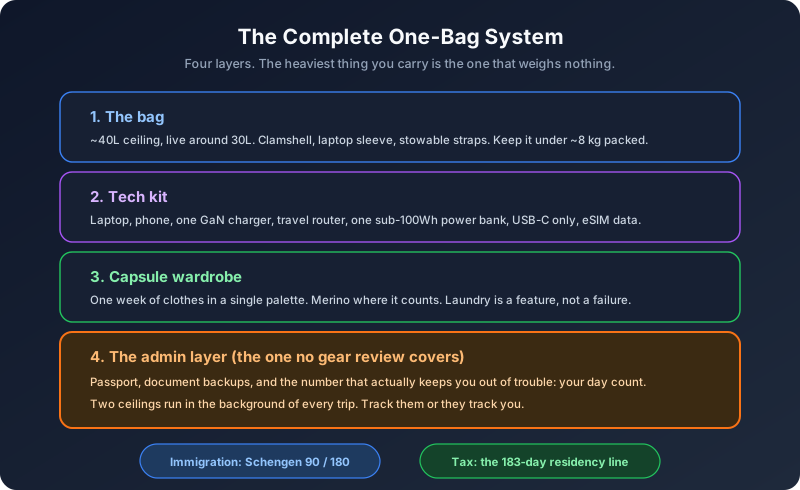
A good one-bag setup is not a shopping list, it is a set of decisions you make once and then defend against your own instinct to add. Buy a bag around 40 liters and then refuse to fill it. Standardize your tech on a single cable format and let a small router and an eSIM handle connectivity everywhere. Respect the new 2026 power bank rules, because the gate agent will. Pack a week of clothes in one palette and let laundry do the rest. And treat the invisible admin layer, your visa and tax day counts, as the most important thing you carry, because it is.
The nomads who last are rarely the ones with the most impressive gear. They are the ones whose setup is so light and so settled that they stop thinking about it, which frees them to think about the work and the places instead. The bag is a means to that. So is knowing, at any moment and without doing math, exactly how many days you have left.
Pack light. Track lighter.
Nomad Tracker logs your days in every country automatically and runs your Schengen and tax residency counts in real time, entirely on-device. The one part of your setup that weighs nothing and matters most. Available on iOS.
Download on the App Store