There is a particular kind of city that never trends. No infinity pool content, no sunset rooftop, no "I quit my job and moved here" video with 400,000 views. Rent is cheap because nobody is fighting you for the apartment. The coworking space has eleven desks and six of them are free. The most exciting thing that happens on a Tuesday is that the good bakery has sourdough again.
These cities are where a lot of serious remote work actually gets done.
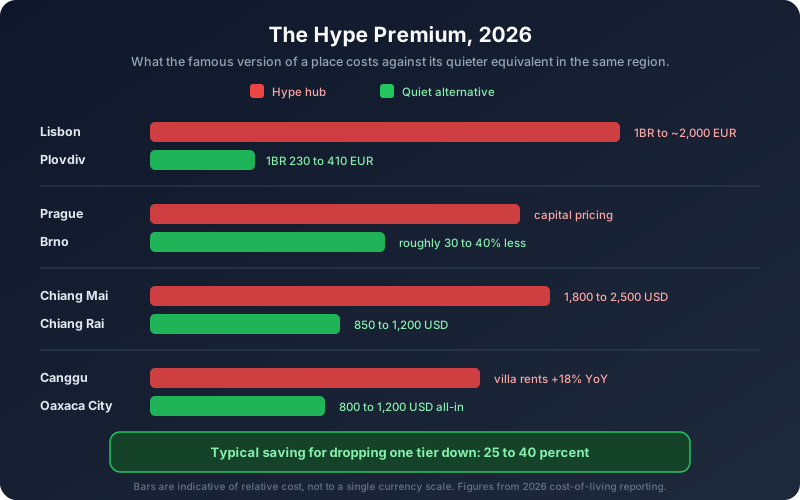
The hype circuit has a well documented problem in 2026. Lisbon rents are up roughly 38 percent year on year and around 40 percent since 2019, with central one-bedroom apartments reaching 2,000 EUR. In Canggu, asking rents for a one-bedroom villa with a pool hit 12 to 18 million rupiah in 2026, up from 10 to 15 million a year earlier, an 18 percent jump, and landlords started demanding two-month deposits instead of one. Chiang Mai rents rose an estimated 4 to 6 percent into early 2026. The arbitrage that made those places famous has been steadily arbitraged away by the people who came for it.
Meanwhile a second tier of cities keeps quietly delivering the thing nomads claim to want: a desk, fast internet, low fixed costs, and enough boredom that you open your laptop instead of your calendar.
What "Boring" Actually Means Here
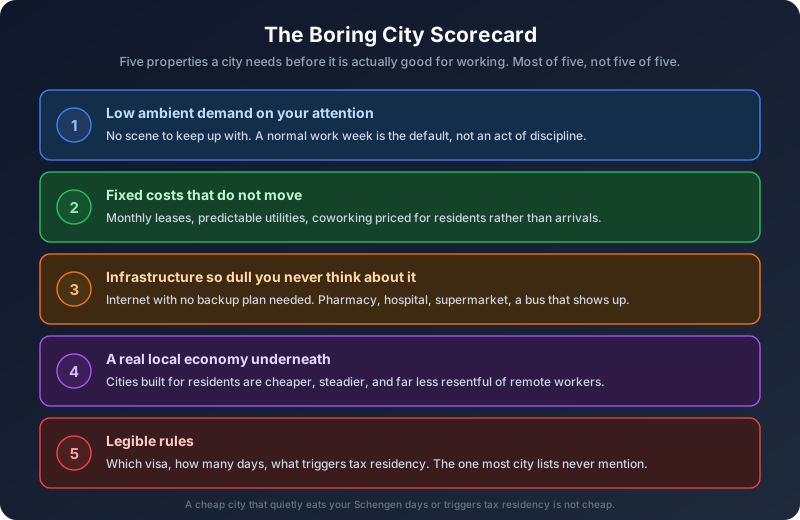
Boring is not an insult in this context. It is a specification. We would define it as five properties, and a city needs most of them to qualify.
Low ambient demand on your attention. No scene you feel obliged to participate in. No rotating cast of people leaving on Thursday. The social gravity is low enough that a normal work week is the default rather than an act of discipline.
Fixed costs that do not move much. Rent negotiated monthly rather than nightly. Utilities that are not a surprise. A coworking membership priced for locals, not for arrivals.
Infrastructure that is genuinely unremarkable. Internet that works without a backup plan. A pharmacy, a decent hospital, a supermarket, a functioning bus. Nothing that requires a workaround.
A real local economy underneath. Cities that exist for their own residents rather than for visitors are more stable, cheaper, and considerably less resentful of you.
Legibility. You can figure out the rules in an afternoon. What visa, how long, what happens if you stay.
That last one is where most "best cities" lists stop being useful, and it is the part we care most about. A cheap city that quietly ticks you toward tax residency or eats your Schengen allowance is not cheap.
Six Cities That Fit the Specification
Plovdiv, Bulgaria
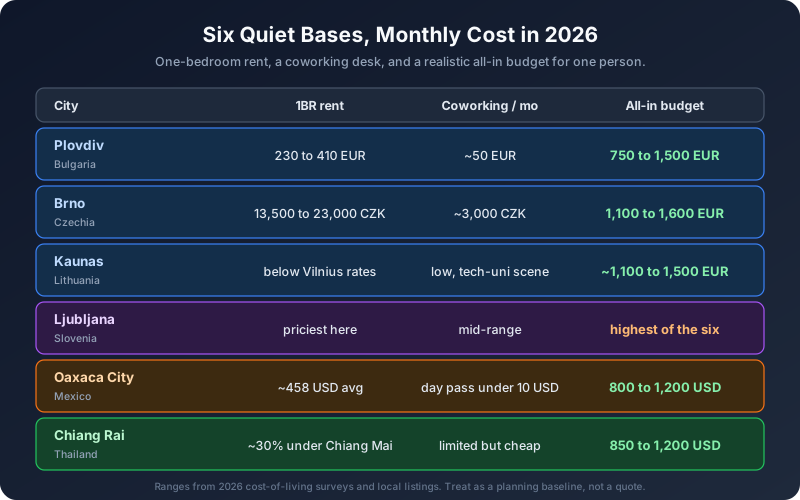
Bulgaria's second city is roughly 20 to 30 percent cheaper than Sofia, which was already cheap. One-bedroom rentals sit in the 230 to 410 EUR range depending on the neighbourhood, utilities and internet run about 50 to 120 EUR a month, and a comfortable total budget lands between 750 and 1,500 EUR. A desk at a local coworking space starts around 99 leva a month, roughly 50 EUR.
The connectivity is the part people underestimate. Bulgaria has some of the fastest internet in Europe, leading the continent on mobile speed at around 289 Mbps, and fibre in Plovdiv comfortably clears what any video-heavy job needs. The old town is walkable, the cafe density is high, and the expat population is small enough that you will not accidentally rebuild your home social life.
The catch, and it is a significant one, is covered further down.
Brno, Czechia
Prague's less famous sibling holds a real university and tech economy, which means the infrastructure is built for residents who work rather than visitors who don't. One-bedroom rents run roughly 13,500 to 23,000 CZK a month, and a full monthly budget typically lands between 1,100 and 1,600 EUR. There are around 45 coworking spaces for a city of under 400,000 people, with memberships from about 3,000 CZK, near 120 EUR.
Brno is the clearest example of the pattern: it is 30 to 40 percent cheaper than the capital while offering the same legal framework, the same healthcare, and the same passport-free movement. You give up nothing structural and keep several hundred euros a month.
For anyone planning to stay properly, Czechia's digital nomad route requires around 69,836 CZK per month, roughly 3,200 USD, set at 1.5 times the national average salary and revised each May. There is also the long-standing trade licence path, the živnostenský list, under which self-employed residents can use the 60/40 flat expense method and end up with one of the lower effective rates in the EU.
Oaxaca City, Mexico
Oaxaca does something unusual: it is culturally rich enough that you never feel deprived, and inconvenient enough to reach that it has not been overrun. Budget-conscious remote workers live comfortably on 800 to 1,200 USD a month. Average rent sits near 458 USD. Meals at a local comedor run 2 to 4 USD. Coworking day passes rarely break 10 USD, and shared coliving starts around 500 USD.
El Centro is walkable and dense with cafes that tolerate a laptop. Internet is reliable for most work, with one real caveat worth planning around: upload speeds above 60 Mbps are not dependably available, so anyone pushing large files or running multi-camera streams should test before committing to a lease.
Chiang Rai, Thailand
Chiang Mai has spent fifteen years as the default Southeast Asian nomad hub and now carries the pricing to match, with a comfortable single-person budget commonly cited between 1,800 and 2,500 USD. Three hours north, Chiang Rai runs roughly 30 percent cheaper, with a comfortable solo budget around 850 to 1,200 USD.
What you trade is community density and workspace choice. What you get is space, quiet, mountains, and a cost base that has not been bid up. The "slomad" pattern of longer stays in calmer places has been pulling people north for two years now, and Chiang Rai is the main beneficiary.
The visa situation changed sharply in September 2026 and is no longer compatible with a casual long stay. More on that below.
Kaunas, Lithuania
Vilnius takes the attention and the price increases. Kaunas, ninety minutes away, has the same Baltic tech-and-university character at a lower base cost, unusually high English proficiency, riverside cycling infrastructure, and cheap budget flights out when the winter gets genuinely dark. It is a good fit for someone who wants EU-grade infrastructure and near-zero distraction, and a poor fit for anyone who needs daylight in January.
Ljubljana, Slovenia
Not the cheapest entry on this list, but possibly the most legible. Slovenia launched a dedicated digital nomad permit on 21 November 2025. It runs up to one year, costs 162 EUR in administrative fees, and requires monthly income around 3,098 EUR, set at twice the Slovenian average net salary and recalculated periodically. All income must come from outside Slovenia, and working for Slovenian clients is explicitly prohibited.
The city itself is small, green, extremely safe, and ringed by mountains and lakes. It is the kind of place where the weekend takes care of itself and the work week does not get eaten.
The Part Every Other List Skips: These Cities Share One Clock
Here is the trap hiding inside a European quiet-city strategy.
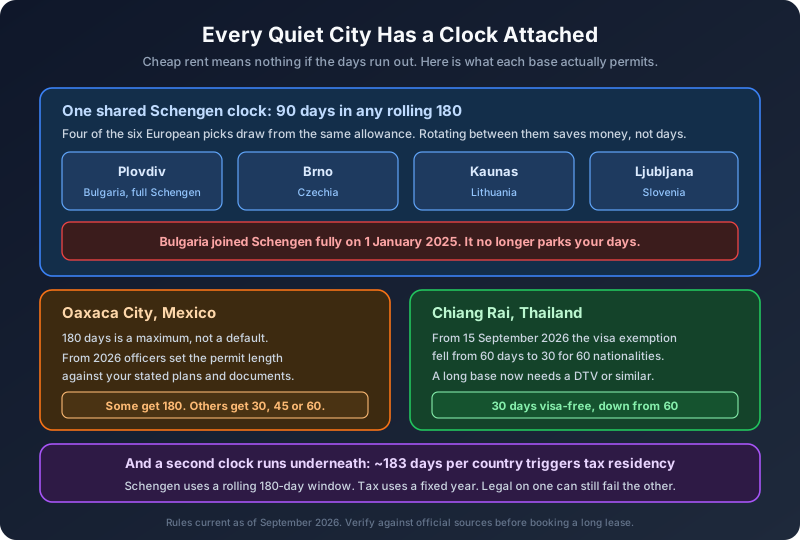
Plovdiv, Brno, Kaunas, and Ljubljana all sit inside the Schengen Area. Bulgaria and Romania became full Schengen members on 1 January 2025, which ended an era in which Bulgaria was used as a parking spot to wait out Schengen days. For a non-EU passport holder, days in Plovdiv now count against the same 90-day allowance as days in Lisbon, Berlin, or Barcelona.
That means a plan like "three months in Brno, then three months in Plovdiv" is not a plan. It is a six-month stay inside a zone that permits 90 days in any rolling 180-day window. The cities are cheap and the countries are different, but the clock is identical and it never stops running. If the rolling window is new to you, our 90/180 rule guide explains why moving between member states changes nothing.
The practical implications:
- Rotating between cheap Schengen cities buys you nothing on the visa side. It saves money, not days.
- Non-Schengen alternatives still exist in the region. Albania, Montenegro, Serbia, North Macedonia, Georgia, Türkiye, and the UK and Ireland sit outside the Schengen count, and several of them have their own quiet, cheap second cities. What those countries actually buy you is time for old days to age out, not a reset, as we explain in the border hopping myth.
- A national long-stay permit changes the arithmetic entirely. Slovenia's nomad permit or Czechia's route takes you out of the 90/180 tourist regime for that country, which is the whole point of applying.
For the two non-European picks, the rules moved recently and in the same direction.
Mexico ended the default 180 days. In 2026 the practice of routinely stamping tourists in for the full 180 days effectively ended. Officers now set the permit length against your stated plans and supporting documents. Some travellers still get 180 days, others receive 30, 45, or 60. The 180-day figure was always a legal maximum rather than an entitlement, and it is now being applied that way. If you need longer, extensions are requested at an INM office inside the country, and you should plan the Oaxaca lease around the days you were actually granted rather than the days you expected.
Thailand cut visa-free stays to 30 days. From 15 September 2026, the 60-day visa exemption that had covered 93 countries was replaced by a tiered system: 30 days for 60 nationalities, 15 days for two, visa on arrival for three, and no visa-free access at all for 21 that previously had it. A Chiang Rai base is still very achievable, but it now requires a DTV or another visa category rather than showing up and getting two months. The full tier list and the extension math are in our breakdown of the September 2026 change.
The Second Clock: Tax Residency
The visa clock governs whether you are allowed to be somewhere. A separate clock governs who taxes you, and quiet cities are where people get caught by it, precisely because they are pleasant enough to stay in.
Most countries apply some version of a 183-day test per tax year. Slovenia is explicit about it: stay beyond 183 days and worldwide income becomes taxable at progressive rates running from 16 to 50 percent. Bulgaria, Czechia, Lithuania, Mexico, and Thailand all have their own versions, with their own definitions of a counted day and their own secondary tests based on where your home, family, and economic interests sit.
The uncomfortable part is that the two clocks run on different calendars. Schengen uses a rolling 180-day window that moves every single day. Tax residency usually uses a fixed calendar year or fiscal year. A stay that is perfectly legal on the immigration side can still push you over a tax threshold, and staying under 90 Schengen days per window says nothing at all about whether you crossed 183 days in one country across a year. Running both counts at the same time is the whole reason we log every day in every country instead of estimating either.
This is the actual reason to count days rather than estimate them. Not paranoia, just two incompatible calendars applied to the same trip.
How to Pick Your Own Quiet Base
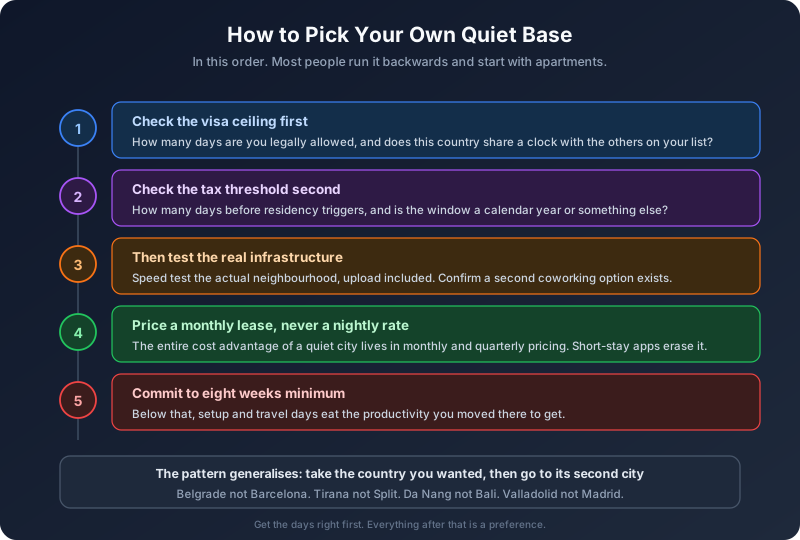
The six cities above are examples of a pattern, not a definitive list. The pattern generalises, and it generalises well: take a country you already wanted to be in, then go to its second or third city instead of its capital.
Belgrade instead of Barcelona. Tirana instead of Split. Da Nang instead of Bali. Valladolid instead of Madrid. The savings are usually 25 to 40 percent and the infrastructure gap is far smaller than the price gap.
A workable filter, in order:
- Check the visa ceiling first, not last. How many days can you legally be there, and does this country share a clock with the others on your list? Answer this before you look at apartments.
- Check the tax threshold second. How many days before residency triggers, and does the country use a calendar year or something else?
- Then test the infrastructure. Run a speed test in the actual neighbourhood, including upload. Confirm there is a second coworking option in case the first one closes.
- Price a monthly lease, not a nightly rate. The entire cost advantage of a quiet city lives in monthly and quarterly pricing. Short-stay platforms erase it.
- Commit to at least eight weeks. Below that, setup costs and travel days consume the productivity you moved there to get, and the whole exercise becomes an expensive way to change your wallpaper.
What You Actually Give Up
It would be dishonest to present this as a free upgrade. Quiet cities cost you things.
Serendipity is the big one. In Lisbon or Canggu you meet three interesting people a week without trying. In Plovdiv in February you may meet three in a month, and you will have to go looking. Nomads who get energy from that churn genuinely do worse in quiet places, and that is a legitimate reason to pay the hype premium.
Flight connectivity is the second. Secondary cities usually mean a connection or a bus to the nearest hub, which makes short trips more expensive and long weekends less spontaneous.
Language is the third. Capitals are cushioned by English in a way second cities are not. Kaunas is an exception with unusually high English proficiency, but Plovdiv, Oaxaca, and Chiang Rai all reward even a small amount of effort with the local language and quietly penalise the absence of it.
And there is a real seasonal risk. A Baltic winter or a Thai hot season in a city with a thin social scene is a different experience from the same season in a city full of people. Plan the calendar, not just the destination.
The Honest Summary
The boring city strategy works because it inverts the usual trade. Instead of paying a premium for a place that constantly offers you something better to do than work, you pay less for a place that offers you very little, and you keep both the money and the hours.
The number that matters is not the daily rate. It is the total: what a month costs, how many of those months you are legally allowed, and whether the sum of them tips you into a tax system you did not plan for. A 400 EUR apartment in a city where you can legally spend ninety days is a different proposition from a 400 EUR apartment in a city where you can stay a year.
Get the days right first. Everything else on the list is a preference.
Know exactly how many days each base costs you.
Nomad Tracker counts your Schengen 90/180 window and your per-country tax days automatically, and Ghost Trips let you simulate a move to a new base before you book it. All on-device, all private. Available on iOS.
Download on the App Store