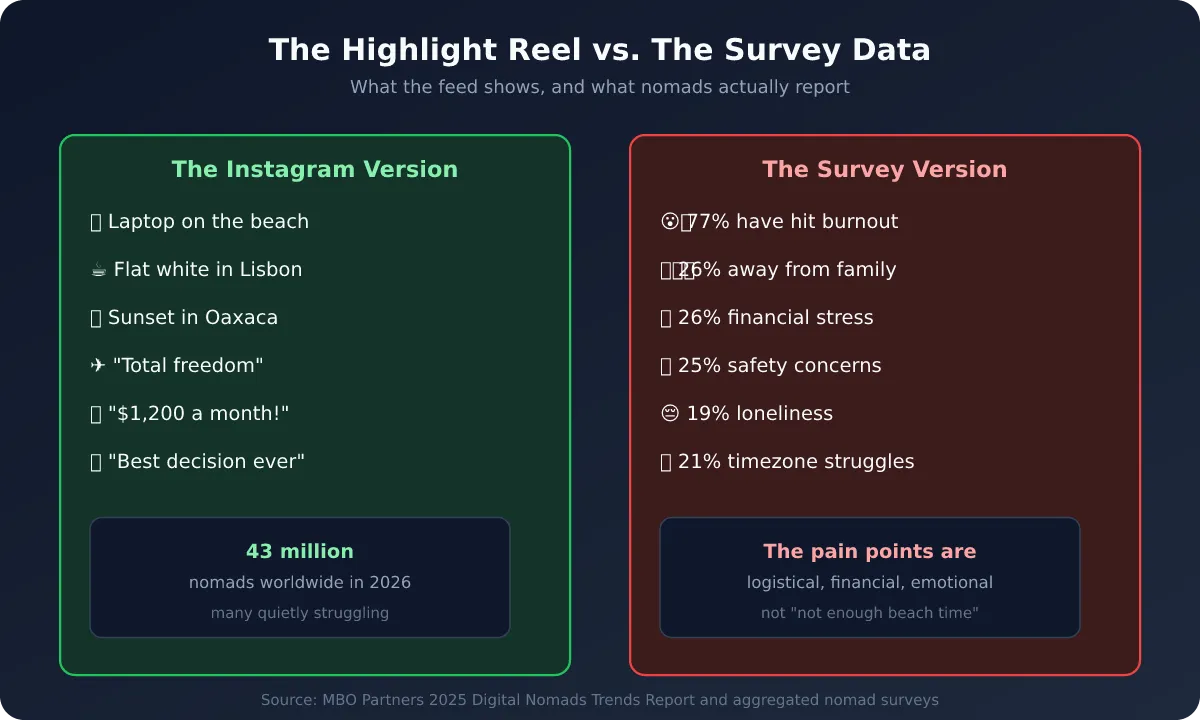
The Instagram version of nomad life is a new skyline every few weeks. The reality, for a lot of people who live this way for more than a year, is a low-grade exhaustion that nobody warned them about. It does not look like classic burnout. There is no dramatic collapse. It is quieter than that: a creeping sense that the novelty has curdled into logistics, that every city has started to feel like an airport, and that the freedom you chased now runs on a calendar you cannot seem to slow down.
This is the burnout the highlight reels skip, and it belongs on the same list as everything else nobody posts about. And the numbers suggest it is far more common than the community likes to admit. Roughly 77 percent of digital nomads report having experienced burnout, according to aggregated 2025 to 2026 surveys. For context, fully remote workers who stay put report burnout at around 61 percent, and hybrid workers at 57 percent. The nomad lifestyle does not cause burnout on its own, but the constant-movement version of it clearly compounds the risk.
Why Constant Movement Wears People Down
The one-month-per-city rhythm looks efficient on a map. In practice it traps you in the worst part of every stay, over and over. A typical month somewhere new follows a predictable arc, and the problem is that you leave right as the good part begins.
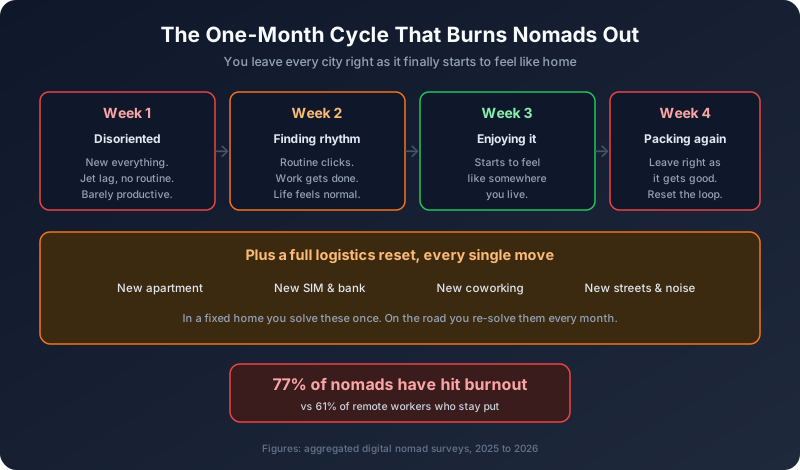
Week one is disorientation. You do not know where the good coffee is, your body is still adjusting to the time zone, and your productivity craters while you rebuild the basics of daily life. Week two you finally find a rhythm. Week three the place starts to feel like somewhere you live rather than somewhere you are passing through. Week four you pack a bag and do it all again. The math is brutal: on a monthly cycle you spend a large share of your life in the disoriented, unproductive phase, and you consistently abandon each city at the exact moment it starts to feel like home.
Underneath that emotional arc sits a logistics tax that resets every single move, which is one reason a smaller, more settled kit is worth more than a clever one. New apartment, new keys, new quirks of a stranger's kitchen. New SIM card or eSIM, new banking friction, new coworking space to evaluate, new grocery stores, new noise outside the window at 2 a.m. In a fixed home you solve these problems once and forget them. On the road you re-solve them monthly, and each individual task is small enough that you never quite let yourself count it as work. It is work. It just never shows up on an invoice.
The Tolls Nobody Puts on the Spreadsheet
Ask a burned-out nomad what is wrong and the first answer is usually "I don't know, I'm just tired." The tiredness is real, but it is rarely one thing. It is the sum of several separate drains that each seem manageable in isolation and become corrosive in combination.
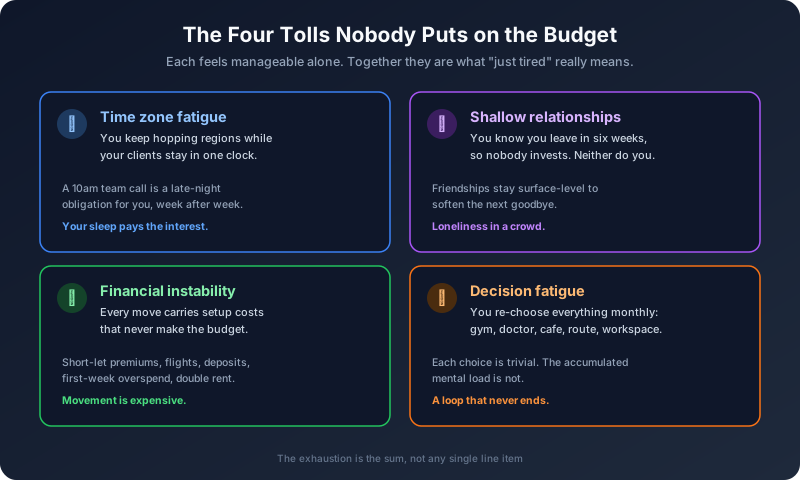
The first is time zone fatigue. If your clients or team sit in one region and you keep hopping across others, you are perpetually negotiating with a clock. A call that is 10 a.m. for your team is a late-night obligation for you, week after week, and your sleep pays the interest.
The second is the relationship problem, and it may be the quietest and most damaging of all. When you know you are leaving in six weeks, you invest accordingly. So do the people you meet. Friendships stay shallow because everyone involved is subconsciously protecting themselves from another goodbye. Over months this produces a specific kind of loneliness that has nothing to do with being alone. You are surrounded by interesting people and connected to almost none of them.
The third is financial. Every move carries setup costs that rarely make it into anyone's budget: short-let premiums over monthly rents, flights, the first-week spending you do simply because you have not found the cheap options yet, deposits, and the occasional double rent when dates do not line up. Constant movement is quietly one of the most expensive ways to travel, which is its own source of stress.
The fourth is decision fatigue. Psychologists have written for years about the mental cost of repeated small choices. The nomad who changes cities monthly re-chooses everything, apartment, workspace, gym, doctor, route to the shop, on a loop that never ends. Each decision is trivial. The accumulated load is not.
What the Shift to Slow Travel Actually Looks Like
The encouraging part of the 2026 data is that the community has started to correct course, and the correction has a name. "Slowmadism," or slow nomadism, describes the growing preference for staying put for three to twelve months rather than churning through a city a month. Average stay lengths have stretched noticeably, with a strong shift toward the three-to-nine-month range by 2025, driven by exactly the pressures this article describes: burnout, rising travel costs, and tighter visa enforcement.
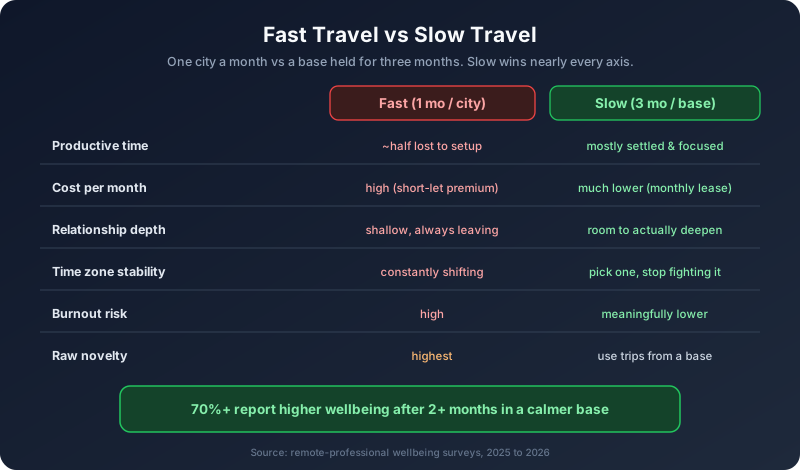
The case for slowing down is not soft or sentimental. It shows up on nearly every axis a nomad cares about. Productivity rises because you spend more of each stay in the effective, settled phase instead of the disoriented setup phase. Cost per month falls, often sharply, because monthly and multi-month leases are dramatically cheaper than short lets, and you stop paying the repeated first-week tax. Relationships get room to deepen, because both you and the people around you can safely assume you will still be there next month. Time zone stress eases when you pick a base that overlaps reasonably with your work and then stop moving relative to it.
The wellbeing evidence backs this up. In surveys of remote professionals, more than 70 percent reported higher wellbeing and lower stress after spending at least two months in a calmer destination rather than racing between hubs. Slower travel also tends to produce the thing people originally left home to find: actual cultural immersion, a few words of the local language, a regular cafe where the staff know your order, a sense of place rather than a sequence of backdrops.
How Slowing Down Actually Changes the Experience
The transition from fast to slow is less a single decision than a set of habit changes, and the difference in day-to-day life is larger than most people expect before they try it.
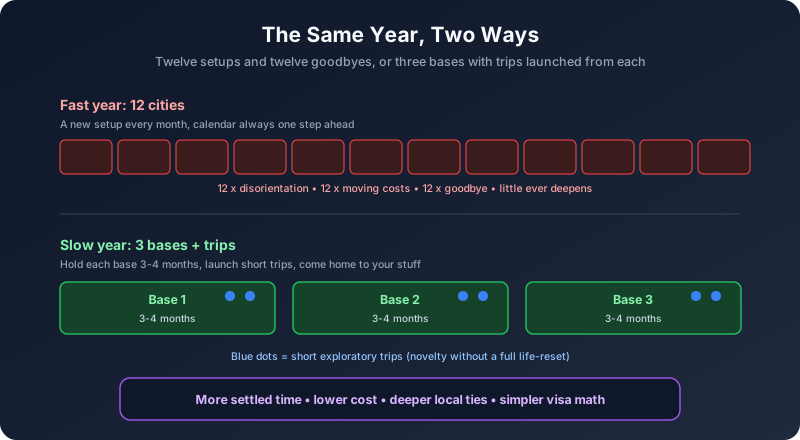
A fast year might be twelve cities, twelve setups, and twelve goodbyes, with the calendar always one step ahead of you. A slow year might be three or four bases, each held for two to four months, with short exploratory trips launched from each. The exploratory trips scratch the novelty itch without triggering a full life-reset, because your apartment, your routine, and your things are waiting when you get back. You still see plenty of the world. You just stop paying the full setup cost every time you do.
Slowing down also interacts directly with the two constraints that define serious nomad life: visas and taxes. Longer stays make visa math simpler, because you have fewer border crossings to track and more predictable entry and exit dates. But they raise the stakes on tax residency. Most countries apply some version of a 183-day rule, and the moment you plant yourself somewhere for months at a time, you need to know precisely how close you are to becoming a tax resident there. Slow travel does not remove the day-counting problem. It changes its shape, from many short stays that threaten a Schengen limit to a few long stays that threaten a fiscal one.
A Practical Framework for Not Burning Out
You do not have to swing from twelve cities a year to becoming a homebody. The sustainable middle is a set of habits, not a rule.
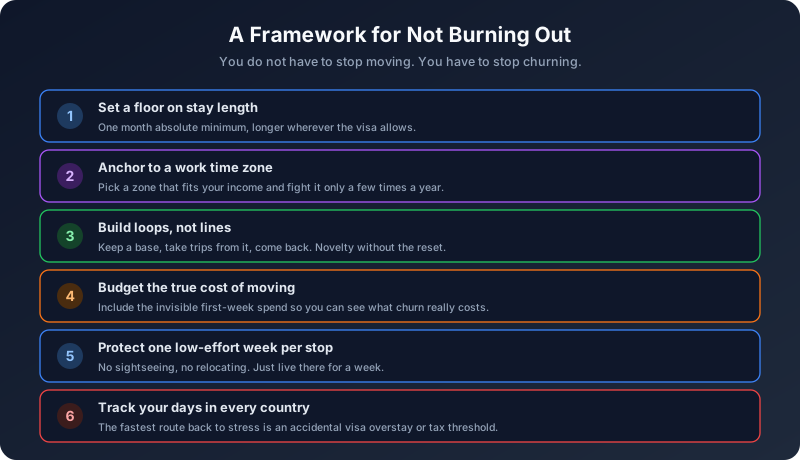
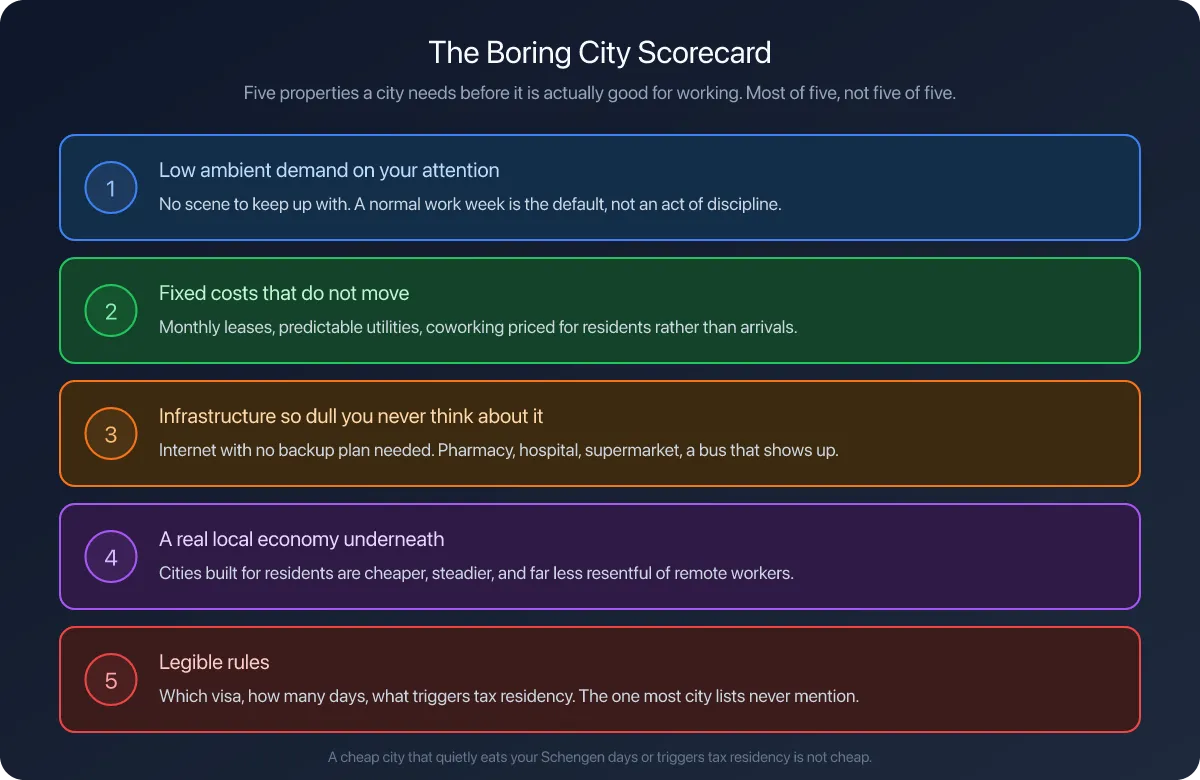
Set a floor on how short a stay can be, and hold the line at a month at the absolute minimum, longer where a visa allows. Choosing a quieter base helps more than choosing a cheaper one, which is the argument behind our list of boring cities for people who want to get work done. Anchor to a time zone that works for your income and try not to fight it more than a few times a year. Build loops instead of lines: keep a base, take trips from it, and come back. Budget the true cost of every move, including the invisible first-week spending, so you can see on paper how much constant motion is actually costing you. Protect at least one genuinely low-effort week in each location where you do not sightsee, do not relocate, and simply live. And keep a clean record of your days in every country, because the fastest route back to stress is discovering you have accidentally overstayed a visa or tripped a tax threshold you were not watching.
That last habit is the one people skip until it bites them, and it is the one that ties the whole lifestyle together. Whether you move monthly or settle into long bases, the days accumulate somewhere, and both immigration limits and tax residency turn on precise counts you cannot reliably keep in your head.
Burnout on the road is not a sign you are bad at this or that the lifestyle is a lie. It is usually a sign that the pace outgrew the person. The people who last are rarely the ones moving fastest. They are the ones who figured out how to keep the freedom while dropping the churn, and who let their day counting run in the background so it stops being one more thing to worry about.
Slow down without losing track.
Nomad Tracker logs your days in every country automatically, so whether you move monthly or settle into long bases, your Schengen and tax residency counts stay accurate. On-device, private, no spreadsheets. Available on iOS.
Download on the App Store