Every piece about dating as a digital nomad covers the same ground. The apps are a numbers game, the goodbyes are hard, and you should "be upfront about your lifestyle." All true, none of it new.
What those pieces skip is the part that actually ends relationships, or quietly creates legal problems: when you date on the road, your love life starts interacting with immigration law and tax law. Two people with different passports run on two different visa clocks. A partner who lives somewhere can turn that somewhere into your tax home. And the classic "I'll just stay a few more weeks" comes up again and again in the overstay cases readers send us.
This is the honest version. Some of it is awkward, a lot of it is arithmetic, and all of it is worth knowing before the third date turns into "so what are we doing in March?"
The Real Problem: Three Clocks That Never Line Up
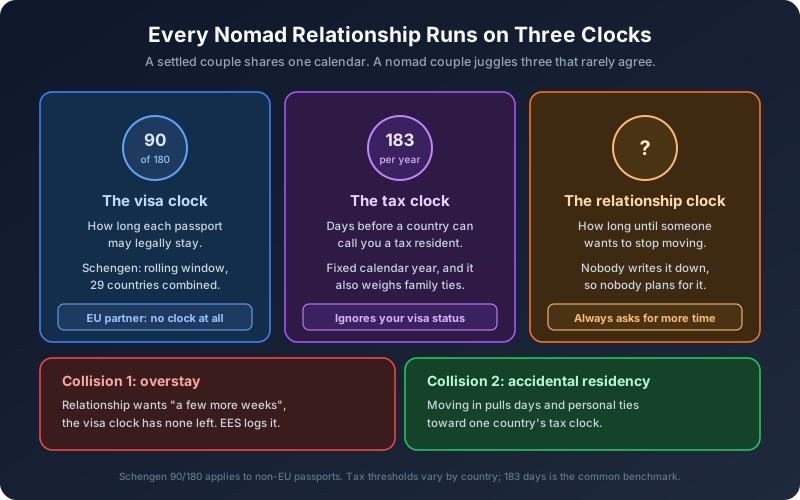
A settled couple shares one calendar. A nomad couple runs at least three clocks at the same time, and they rarely agree.
The visa clock. How long each of you may legally stay in a country or zone. For a US, UK, Canadian or Australian passport in Europe, that is the Schengen 90/180 rule: 90 days in any rolling 180-day window, across all 29 Schengen states combined. For an EU citizen in Europe, there is no clock at all.
The tax clock. How long you can spend somewhere before you become a tax resident. This usually runs on a fixed calendar year, not a rolling window, and it does not care about your visa status. In Spain the headline number is 183 days, but the 183-day rule is far from the whole test.
The relationship clock. The one nobody writes down. How long until one of you wants to stop moving, or wants the other to come home with them for the holidays, or wants to know whether this is a summer thing or a real thing.
The friction appears when the relationship clock asks for more time than the visa clock allows, or when it pulls you toward a country whose tax clock you were not watching.
The Apps: What Actually Works When You Move Every Month
Let us get the lighter part out of the way, because the tooling has changed.
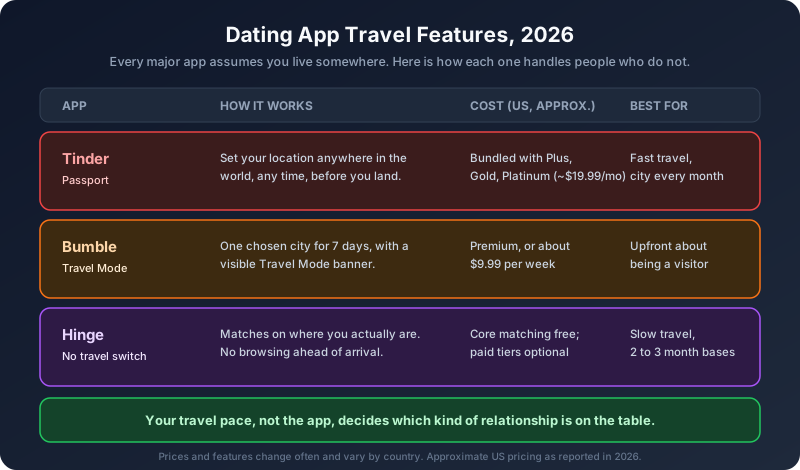
The main dating apps all assume you live somewhere. Their travel features exist to paper over that assumption, and they work differently enough to matter:
- Tinder Passport lets you set your location anywhere in the world before you arrive. It comes bundled with paid tiers such as Tinder Plus, which costs around $19.99 a month in the US, with Gold and Platinum on top.
- Bumble Travel Mode places you virtually in one chosen city for 7 days and shows a visible Travel Mode banner on your profile. It is part of Bumble Premium, or available as a weekly purchase, around $9.99 per week.
- Hinge has no dedicated location-switching feature. It works off where you actually are, which suits slow travelers and frustrates people who change cities monthly.
The practical pattern that experienced nomads describe is consistent: open the location switch about a week before arrival, be explicit in the profile about how long you are in town, and expect the people who reply to be either other travelers or locals who are fine with something short. That banner on Bumble is useful here, because it does the awkward disclosure for you.
The bigger point is not which app. It is that the pace you travel at determines which kind of relationship is even available to you. One month per city is long enough for a fling and short enough to make almost anything else painful. This is one reason so many nomads who end up in long-term relationships are the ones who slowed down to two or three months per base.
Mixed-Passport Couples: The Clock Mismatch Nobody Warns You About
Here is the scenario that generates the most reader questions.
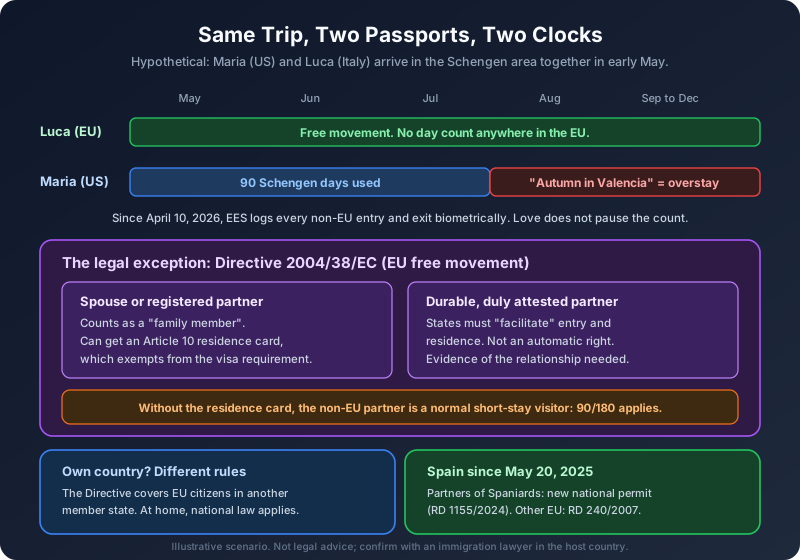
Imagine Maria, a US citizen freelancing from Europe, and Luca, an Italian. They meet in Lisbon in May. Luca can stay in Portugal, Spain, Greece or anywhere else in the EU indefinitely, no counting required. Maria is spending Schengen days with every single night.
By August they have a plan: autumn in Valencia, Christmas with Luca's family in Turin, then "we'll see." Maria checks her count and realises that if she arrived in the Schengen area in early May, her 90 days run out somewhere around early August. Valencia is not "autumn together." It is an overstay waiting to happen.
This mismatch is invisible to the EU partner because they have never had to count. It is common for the EU partner to assume the rules are softer than they are ("they never check," "just say you're with me"), and since the Entry/Exit System went fully live across Schengen on April 10, 2026, every entry and exit of a non-EU traveler is logged biometrically. Being in love with an EU citizen does not pause the count.
When a relationship does change the rules
There is a real legal route, and it is narrower than most couples hope.
EU free movement law, Directive 2004/38/EC, gives rights to third-country family members of an EU citizen who moves to, or travels within, another EU state. "Family member" covers spouses and registered partners where the host state treats registered partnerships as equivalent to marriage. Partners in a "durable relationship, duly attested" are a weaker category: member states must facilitate their entry and residence, which is not the same as an automatic right.
The key document is a residence card for a family member of an EU citizen, issued under Article 10 of the Directive. Holders of that card are exempt from the visa requirement when travelling with or joining the EU citizen. Without it, the third-country partner remains a normal short-stay visitor and the 90/180 limit applies.
Two details trip people up:
- The Directive covers EU citizens who move to another member state. If Luca lives in Italy, Italian national law governs Maria's status there, not the Directive. If the couple moves to Spain, the Directive applies because Luca is an EU citizen exercising free movement in a state that is not his own.
- Spain changed the rules for partners of Spanish citizens. Since the new immigration regulation (Real Decreto 1155/2024) entered into force on May 20, 2025, family members of Spanish nationals living in Spain go through a separate national residence permit rather than the EU family member card. Partners of other EU citizens living in Spain still use the EU route under Real Decreto 240/2007, where a registered pareja de hecho can lead to a 5-year residence card that allows work.
None of this happens on a timeline that rescues an overstay already in progress. Registering a partnership requires shared address registration, documents and, depending on the region, proof of a stable relationship. The residence card application comes after that. Couples who want to stay together in Europe without counting days need to start the paperwork months before the clock runs out, not the week before.
The Tax Side: Your Partner Can Make You a Resident
This is the part almost nobody connects to dating.
Tax residency rules are not only day counts. Most countries also look at where your life is centred, and a partner is one of the strongest signals of that.
Spain spells it out
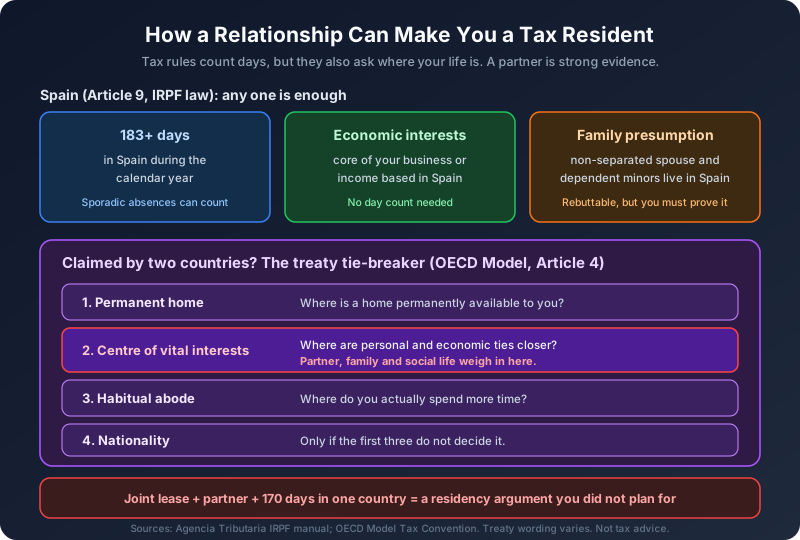
Spanish law (Article 9 of the IRPF law) makes you a tax resident if you spend more than 183 days in Spain in a calendar year, or if Spain is the core of your business or economic interests. On top of that sits a presumption: you are presumed resident, unless you prove otherwise, when your legally non-separated spouse and dependent minor children habitually live in Spain.
Read that carefully. The presumption is about a spouse and minor children, so a new girlfriend in Madrid does not trigger it on her own. But it tells you how the Spanish tax agency thinks: family location is evidence of where you live. A nomad who marries a Spaniard, has a child, and keeps "travelling" from a flat in Valencia is going to struggle to argue that Spain is not home, whatever the day count says.
Treaties weigh personal ties
If two countries both claim you as resident, the tax treaty between them breaks the tie, usually following Article 4 of the OECD Model Convention. The ladder goes:
- Permanent home. Where do you have a home permanently available to you?
- Centre of vital interests. If you have a home in both, where are your personal and economic relations closer?
- Habitual abode. Where do you spend more of your time?
- Nationality. The last resort.
"Personal relations" at step two means family, partner, social life. A nomad with a rented base in Lisbon and a partner they live with in Barcelona has handed the Spanish side a strong argument. We walked through how this plays out in our guide to dual tax residency, and moving in with someone is one of the fastest ways to end up there by accident.
The quiet trigger: moving in
The pattern in reader cases is rarely dramatic. It looks like this: you start splitting time between your own base and your partner's city. Then you keep a toothbrush there. Then you sign a joint lease. Then you notice you spent 170 days in that country this year and your partner, your gym, your doctor and your bank card all point to the same address.
None of these steps feels like a tax event. Together they can be one. If you do not track where you actually slept, you will not see the 183 days coming, and you will have no records to argue the other side if a tax authority asks.
The Awkward Conversations (and When to Have Them)
None of the above is romantic, which is exactly why couples avoid talking about it until it bites. The nomads who handle this well tend to have three conversations earlier than feels natural.
"How many days do you have left?"
Ask it early and ask it literally. If one of you is on a visa-exempt stay, a work permit or a digital nomad visa, the other should know the end date. It turns "should we go to Croatia in October" from a mood into a calculation. Croatia has been in Schengen since 2023, so it is not a break from the count.
"Where do we want to be when it runs out?"
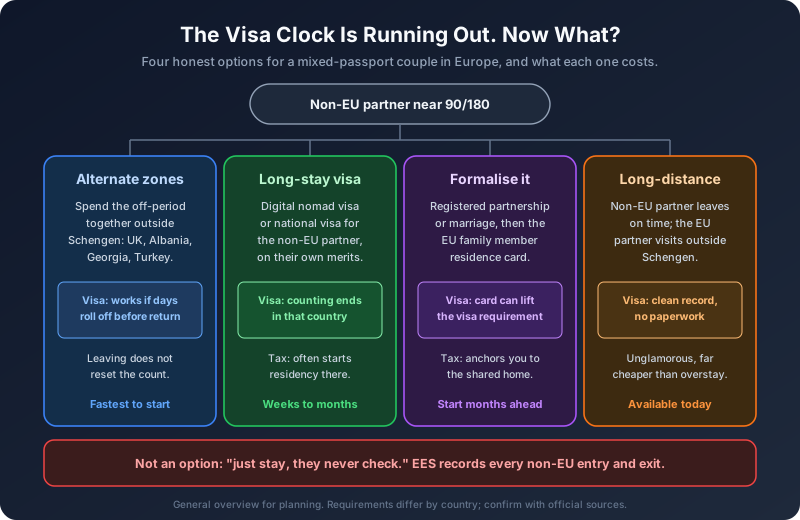
Plan the gap. For a mixed-passport couple in Europe, the honest options are:
- Alternate zones. Spend the non-EU partner's off-period somewhere outside Schengen together: the UK, Albania, Montenegro, Georgia, Turkey. Note that leaving does not reset the count. You still need enough days to roll off the 180-day window before re-entering.
- Get a long-stay status. A digital nomad visa or national visa for the non-EU partner. It ends the counting, but it can also start a tax residency, so check both clocks.
- Formalise the relationship. Registered partnership or marriage, then the family member route described above. Only do it for the right reasons; immigration offices look for genuine relationships, and so should you.
- Go long-distance for a stretch. Unglamorous, but far cheaper than an overstay record.
"Where is home, for tax purposes?"
If you are about to move in together, decide which country is going to be your tax home and make sure your day count, your lease and your paperwork tell the same story. "We'll figure it out later" is how people end up filing in two countries.
What Dating on the Road Actually Teaches You
Strip away the logistics and the honest truth about nomad dating is fairly simple. The lifestyle is good at producing intense, short connections and bad at producing the slow, boring overlap that long relationships are built on. The people who make it work almost always change something: they slow down, they pick a base, or they build a shared plan where both clocks are visible to both people.
The logistics are not the romantic part, but they are the part that can be fixed with information. Every overstay story involving a partner that we have seen has the same root: one person did not know their count, and the other assumed it did not matter. Every accidental tax residency story involving a partner has the same root too: nobody was counting days in the country where the relationship lived.
You cannot schedule chemistry. You can know exactly how many days you have.
Keep Both Clocks Visible
We built Nomad Tracker for exactly this kind of situation, where your plans change faster than you can redo the maths. It logs the country you are in automatically, runs the Schengen 90/180 calculation on the official rolling-window method, and tracks per-country day totals for tax residency in parallel.
When "should we stay through Christmas?" comes up, Ghost Trips lets you simulate the plan before you book it and see the exact date the Schengen count or a 183-day threshold would be crossed. Everything stays on your device, which matters when the data in question is where you have been sleeping.
Know your days before the relationship asks for more.
Nomad Tracker counts Schengen days, tracks per-country tax residency, and lets you simulate future plans with Ghost Trips. All on-device, all private. Available on iOS.
Download on the App Store