Most border crossings take under a minute. An officer looks at your passport, glances at a screen, asks one or two questions, and waves you through. Then, every so often, a traveler gets a follow-up question, then another, and then the words nobody wants to hear: "Can you step over there for a moment, please?"
For digital nomads, that moment rarely comes from doing anything illegal. It comes from a story that does not add up. The answers you give, the documents you carry and the record the officer sees on the screen are supposed to describe the same trip. When they do not, the officer's job is to find out why.
This guide explains what officers are actually checking, what each common question is really testing, the mismatches that most often trigger a closer look, and what happens next in Schengen, the UK and the US. It is not about having the perfect line ready. It is about making sure the truth, your paperwork and your travel record all agree.
What a Border Officer Is Actually Checking
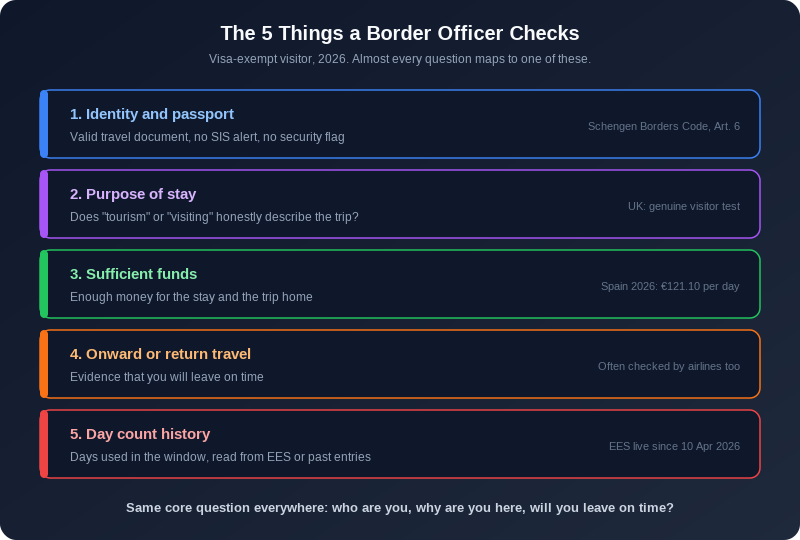
An immigration officer is not trying to catch you out for sport. They work from a short legal checklist, and almost every question maps to one item on it.
In the Schengen Area, the list is Article 6 of the Schengen Borders Code. A visa-exempt visitor must hold a valid travel document, be able to justify the purpose and conditions of the intended stay, have sufficient means of subsistence for the stay and the return, not be flagged in the Schengen Information System, and not be considered a threat. On top of that sits the 90/180 limit, which the officer can now check instantly because the Entry/Exit System (EES) has been fully operational at every Schengen external border since 10 April 2026.
The UK asks a broader question: are you a genuine visitor? Under Appendix Visitor, that means you will leave at the end of your visit, you are not trying to live in the UK through frequent or successive visits, and you will only do permitted activities. The US asks something similar of Visa Waiver travelers: is this a temporary visit for business or pleasure, and is there any reason you are inadmissible?
Different wording, same core idea. The officer wants to confirm three things: who you are, why you are here, and that you will leave on time.
The Questions, and What Each One Is Really Asking
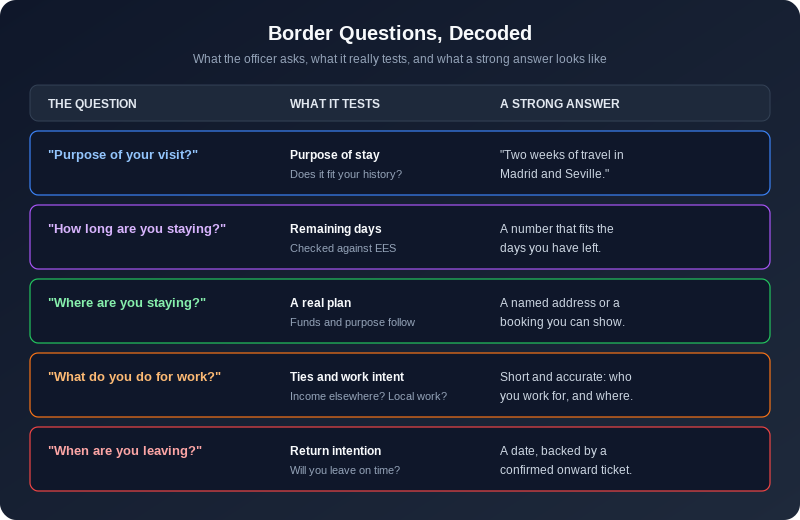
Border questions sound casual. They are not random. Each one tests a specific entry condition, and the officer is listening for whether your answer fits everything else they can see.
"What is the purpose of your visit?"
This tests purpose of stay. "Tourism" is a fine answer for a two-week holiday. It is a weaker answer when the screen shows you have spent 80 of the last 180 days in the Schengen Area and you are carrying a laptop, two monitors' worth of cables and a one-way ticket. The question is not whether you are allowed to open your laptop. It is whether "tourism" honestly describes your trip.
"How long are you staying?"
This checks your answer against the days you have left. Since EES replaced passport stamps with a biometric record of every entry and exit, the officer does not need to count stamps. If you say "three weeks" and you only have ten days left in your window, the conversation changes immediately.
"Where are you staying?"
This tests whether there is a real plan. A named address or booking is a complete answer. "I'll figure it out" or "a friend's place, not sure where" invites follow-ups about funds and purpose.
"What do you do for work?"
This is the question nomads worry about most, and it is really two questions in one. The officer wants to know whether you have a stable life and income elsewhere, which supports that you will leave and can afford the stay. They also want to know whether you plan to work in their country, which may fall outside visitor permissions.
"When are you leaving, and do you have a ticket?"
This tests return intention. A confirmed onward or return ticket is the single strongest document a short-stay traveler can carry. In Thailand, airlines frequently enforce the onward ticket at check-in before immigration ever sees you.
Where Stories Stop Adding Up
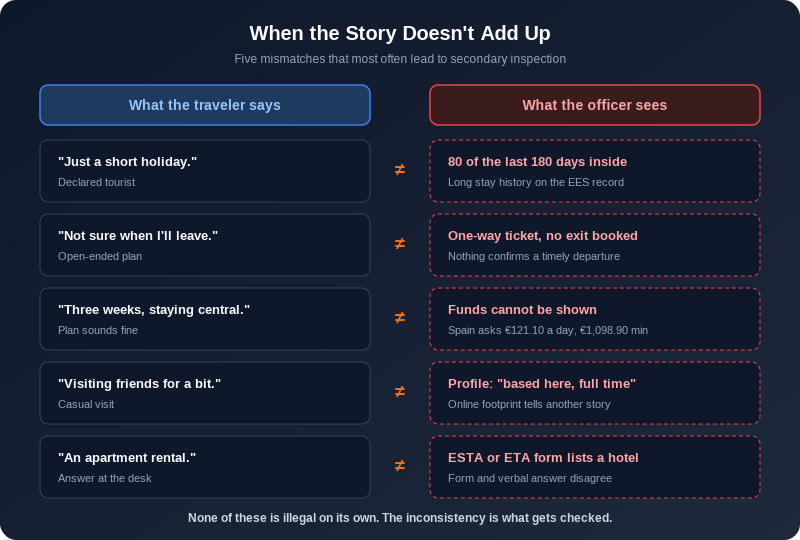
Officers are trained to notice inconsistency, not lifestyle. Being a nomad is not a red flag in itself. These are the mismatches that most often turn a 30-second crossing into a 30-minute one.
The tourist who has been here for months
The classic pattern: a traveler declares a holiday, but their entry history shows repeated long stays. The UK is explicit about this. Its visitor guidance tells officers to consider whether someone is effectively living in the UK through successive visits, even if each stay is under six months. Schengen has a hard ceiling instead, and EES makes it visible in seconds.
The one-way ticket and the open-ended plan
"I'm not sure when I'll leave" is an honest answer for many nomads. It is also the answer that most directly undermines a short-stay entry, because it gives the officer nothing to confirm you will leave on time.
Funds that cannot be shown
Most countries set a minimum. Spain, for example, requires visitors to be able to show €121.10 per person per day for 2026, with a minimum of €1,098.90 regardless of trip length. Thailand's tourism authority reminded visitors in July 2026 that officers may ask for proof of funds, with figures between 10,000 and 20,000 baht per person depending on entry category. Few travelers are actually asked, but those who are need an answer that matches their story.
A digital footprint that tells a different story
If your answers say "short holiday" and your public profile says "based in Lisbon, working remotely full time," the two can collide. This matters more in the US, where CBP searched a record of roughly 55000 electronic devices in fiscal year 2025, and where a proposal to ask ESTA applicants for five years of social media history was still being reworked in 2026. Nobody should scrub their life for a border crossing, but your answers should be consistent with what is publicly true.
Answers that contradict the form
What you wrote on an ETA, ESTA or arrival card is often in front of the officer. Imagine a traveler who listed a hotel on an online form weeks ago and then names an apartment rental at the desk. Both can be true, plans change, but the mismatch now has to be explained.
What Happens Next: Secondary Inspection and Beyond
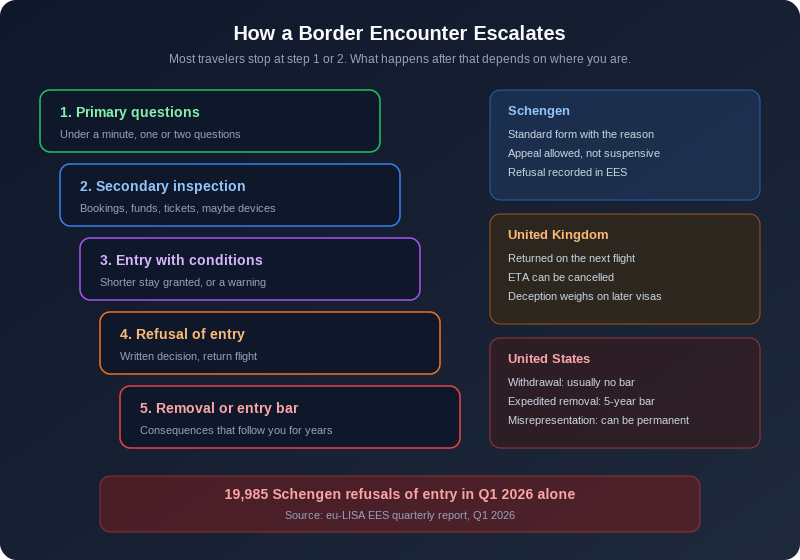
If the officer is not satisfied at the first desk, you are referred for a closer look. What follows depends heavily on where you are.
Secondary inspection
This is usually a separate room or desk where a more senior officer asks more detailed questions. They may ask to see bookings, bank statements, a return ticket, an employment letter or proof of accommodation. In the US they can inspect your phone and laptop. Most secondary inspections end with entry being granted, often with a shorter stay than requested or a warning.
Refusal in the Schengen Area
If a Schengen officer decides you do not meet the entry conditions, the refusal must be given on a standard form that states the precise reason, such as no documents justifying the purpose of stay, having already stayed 90 days within 180, or lacking sufficient means. You sign to acknowledge receipt. Under Article 14 of the Schengen Borders Code you have the right to appeal under national law, but the appeal does not suspend the refusal: you still leave. EES now records refusals, and eu-LISA's first quarterly report counted 19,985 refusals of entry in the first three months of 2026 alone.
Refusal in the UK
A UK refusal at the border usually means being returned on the next available flight. It also matters later: the refusal becomes part of your record, an ETA can be cancelled, and future trips may require a full visitor visa instead of an ETA. A refusal for using deception carries much heavier consequences in later applications than a refusal for an incomplete plan.
Refusal in the US
US officers have more options, and the stakes are higher. A traveler may be allowed to withdraw their application for admission and fly home, which generally carries no formal bar. Expedited removal, by contrast, carries a five-year bar on returning. A finding of willful misrepresentation can make someone permanently inadmissible. Visa Waiver travelers also waive the right to appeal an admissibility decision, so there is no review process once you are at the desk.
How to Make Sure Your Story Adds Up
The goal is not to memorize a script. Scripts sound like scripts. The goal is to make sure that the true version of your trip is easy to explain and easy to prove.
Never lie, and never improvise a "safer" answer
The worst outcome at any border comes from a false statement, not an awkward truth. A refused entry for an unclear plan is recoverable. A deception or misrepresentation finding can follow you for years, and in the US it can be permanent. If a truthful answer feels risky, that is a sign the trip itself needs rethinking, not the answer.
Answer the question that was asked
Short, accurate, specific. "Two weeks in Madrid and Seville, then I fly to Istanbul on the 9th" beats a five-minute explanation of your lifestyle. Volunteering a complicated backstory creates more questions, not fewer.
Be accurate about work
If you work remotely for a company or clients abroad, say so plainly when asked. Whether that is permitted varies by country. The UK, for example, has explicitly allowed visitors to do remote work for an overseas employer since January 2024, as long as it is not the main purpose of the visit. Other countries are silent or stricter, which is exactly why a dedicated digital nomad visa exists in many of them. Our piece on working on tourist visas goes through where the lines fall.
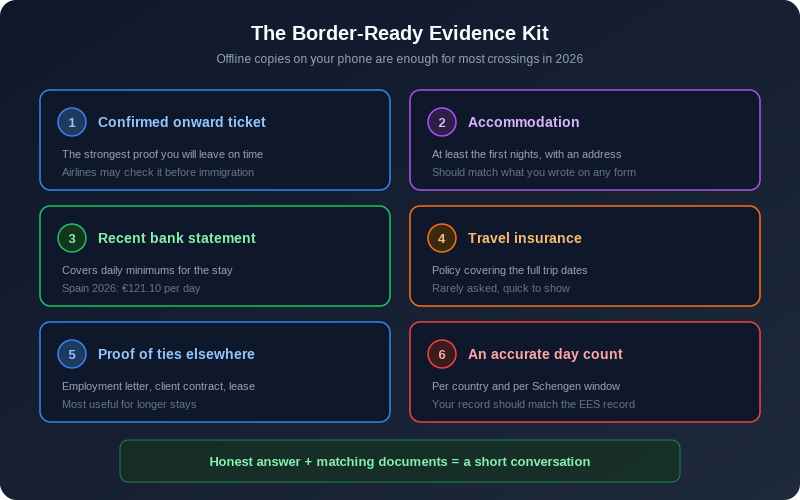
Carry a small, boring evidence folder
Offline copies on your phone are enough for most crossings: onward ticket, accommodation for at least the first nights, a recent bank statement, travel insurance, and for longer stays something that shows ties elsewhere, such as an employment letter or lease. You will rarely need it. When you do, it ends the conversation quickly.
Know your numbers before the officer does
This is where most mismatches start. If you cannot say how many days you have used in the current Schengen window, or how long you have spent in the UK this year, you are relying on the officer's screen to tell you. With EES in full operation, and with ETIAS now expected no earlier than 2027 after the EU dropped its late-2026 target, your entry and exit history is already digital. Your own record should be at least as accurate as theirs.
A Short Pre-Crossing Checklist
Before any border where you have been spending a lot of time, run through this:
- Count your days. Schengen rolling window, UK days this year, and the country you are entering.
- Match your purpose to your history. If your entry record shows months of presence, "a short holiday" is not an accurate summary.
- Have an exit. A confirmed onward ticket, not a plan to buy one later.
- Check the form. What you put on the ETA, ESTA or arrival card should match what you will say.
- Know the funds rule. Daily minimums like Spain's €121.10 exist, and officers may ask.
The Bottom Line
Border officers are not looking for nomads. They are looking for inconsistency. A trip that is legal, well documented and accurately described almost always ends with a stamp, or in the EES era, a green light on a screen. The trouble starts when your words, your papers and your travel record each tell a slightly different story.
The fix is unglamorous: keep an accurate record of where you have been, answer honestly and briefly, and carry the two or three documents that prove it.
Keep Your Record Straight
We built Nomad Tracker so the most important number at any border, how many days you have used, is never a guess. It logs your country changes automatically, runs the Schengen calculator on the official rolling window, and tracks per-country totals for tax residency. Before a trip, Ghost Trips lets you simulate an itinerary and see exactly how many days you will have left at each crossing, so "how long are you staying?" always has an answer that matches the screen.
Know your days before the officer does.
Nomad Tracker automates Schengen day counting, per-country tracking and trip planning with Ghost Trips, all on-device and private. Available on iOS.
Download on the App Store