Nobody becomes a tax resident by accident on day 184. They become one on a quiet Tuesday in October, when a two-week stay turns into five because the apartment was cheap and the coworking space was good, and nobody looked at the number until the following spring.
A day counter does not prevent that. A counter only warns the people who open the app, and the weeks when a threshold slips past are precisely the weeks you are not thinking about it. An alert is the version of the counter that comes to you.
This guide covers how to set fiscal alerts in Nomad Tracker so they actually buy you time: which number each country should be measured against, where to put the warning and the deadline, and the places where a simple day count and the law disagree. Examples are hypothetical, but every rule cited is current as of October 2026.
Why a Threshold Needs Two Warnings, Not One
The classic advice is "set an alert at 150, 170 and 180 days." The instinct is right: one alert at the line is a notification that you already have a problem. What you want is notice early enough to change a flight.
Think about what each warning is for:
- The first alert is a planning trigger. It should arrive while you still have a month or more of room, enough to decide where the next stretch happens.
- The second alert is a deadline. It should arrive while leaving is still easy, not after the last affordable flight has gone.
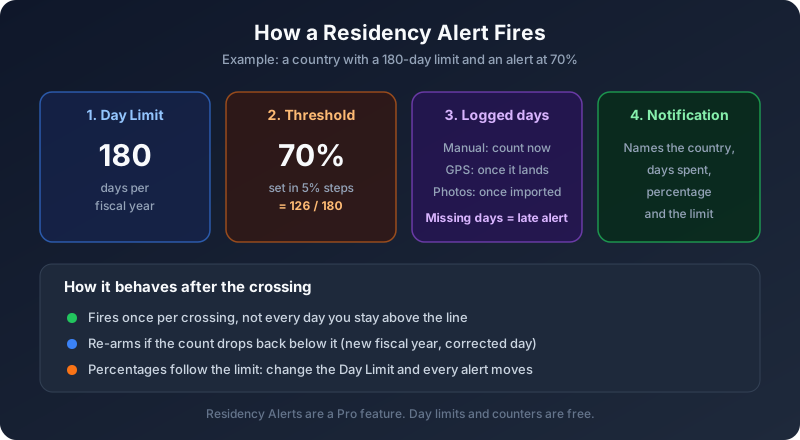
In Nomad Tracker, alerts are set as a percentage of the country's Day Limit, in 5% steps, and the sheet converts the percentage into days as you drag: at 70% of a 180-day limit it reads 126 / 180. Percentages are a deliberate choice. If you later change a country's limit, every alert on it moves with it instead of pointing at a number that no longer means anything.
When a threshold is crossed, the notification names the country, the days spent, the percentage and the limit. Each alert fires once per crossing, not every day you stay above it, and it re-arms if your count drops back under the line, for example when a new fiscal year starts or you correct a mislogged day.
Step 1: Get the Number Right Before You Set Any Alert
An alert is only as good as the limit it measures. Nomad Tracker starts most countries at 183 days because many jurisdictions draw the line at roughly half a year, and it already carries a few exceptions, such as Thailand at 180 and Malaysia at 182. For every other country, 183 is a default, not a decision, and a warning measured against the wrong number is worse than no warning at all.
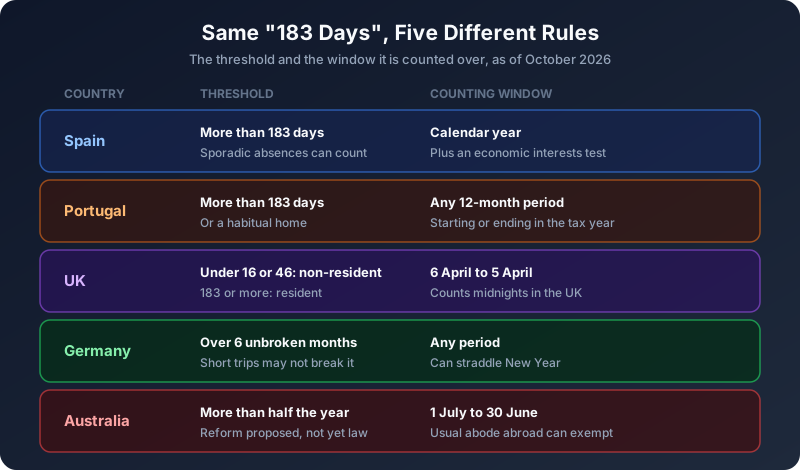
Here is what the rule actually says in some of the countries nomads most often get wrong.
Spain: more than 183 days in the calendar year
Spain treats you as resident if you spend more than 183 days in Spanish territory during the calendar year, and the tax agency can count sporadic absences toward your Spanish days unless you can prove tax residence in another country. That means a weekend in Lisbon does not necessarily take a day off your Spanish total. There is also a separate test based on where your main economic interests sit, which no day count can settle. Our guide to the 183-day rule in Spain covers both.
Portugal: any 12-month period, not the calendar year
Portugal's day test is one of the most misunderstood. According to PwC's tax summary, last reviewed in January 2026, you are resident if you spend more than 183 days, consecutive or not, in any 12-month period that starts or ends in the tax year concerned. A day counts if you sleep in Portugal. Residency can also arise with fewer days if you have a home there that suggests you intend to keep it as your habitual residence.
United Kingdom: 16 or 46 days can matter more than 183
The UK's Statutory Residence Test runs on the tax year from 6 April to 5 April and counts days in which you are in the UK at midnight. Spending 183 days or more makes you resident automatically. But the more useful numbers for nomads sit at the other end. If you were not UK resident in any of the previous three tax years, fewer than 46 days makes you automatically non-resident. If you were resident in at least one of them, the safe harbor shrinks to fewer than 16 days. Above those lines you are not automatically resident, but you fall into the sufficient ties test, where family, accommodation and work decide the answer.
Germany: six months, even across New Year
Germany looks at habitual abode, generally an unbroken stay of more than six months. PwC notes this can be met by a consecutive six-month period over a year-end, and short trips away do not necessarily break it. A stay from October to April can qualify even though neither calendar year holds six months of it.
Australia: 183 days in the July to June income year
Australia's 183-day test counts days over its income year, 1 July to 30 June, and the ATO still describes the existing test with its "usual place of abode" escape. A simpler primary 183-day rule has been proposed for years, but as of this writing it has not replaced the current law. Treat it as a rule in flux.
Setting the limit and the fiscal year
Both live on the country's screen under Settings, Countries & Regions. Day Limit is the number counted against; Fiscal Year Start is the window it is counted over. The app already knows the common non-calendar years: the UK starts on 6 April and Australia on 1 July. Check both rows before you add any alert, because an alert at 80% of the wrong number over the wrong year is two errors stacked.
Day limits and their counters are free. The alerts on the same screen are part of Pro.
Step 2: Set Your Own Line Below the Legal One
Here is the move most people miss: the Day Limit does not have to be the legal figure. It is a warning line, not a verdict, and setting it below the law is a legitimate use of it.
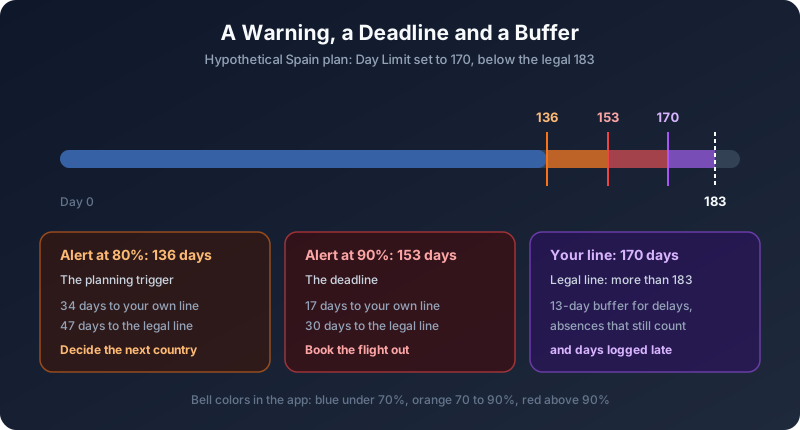
Take a hypothetical case. Lucía is a freelancer whose tax residence is outside Spain, and she wants to spend a long stretch of 2027 in Valencia without becoming Spanish resident. The legal line is more than 183 days. She sets Spain's Day Limit to 170, then adds two residency alerts:
- 80%: 136 days. The planning trigger. At this point she still has 34 days before her own line and 47 before the legal one.
- 90%: 153 days. The deadline. Seventeen days to her line, thirty to the law.
Her own line at 170 leaves a 13-day buffer below 183 for everything she cannot control: a delayed flight, a family emergency, a day the app counts that she forgot about. That buffer is the point. A sporadic-absence argument from the tax agency, a weekend that turns out to count, a GPS gap you fill in later: each of these eats margin, and the margin should exist before you need it.
The bells in each alert row are tinted by how close the threshold sits to the limit: blue below 70%, orange from 70 to 90%, red above. Two orange-to-red bells per country is a sensible default. Setting the deadline alert at 95% or higher usually defeats its purpose, because it arrives after the flight you would have needed to book.
Step 3: Know Where a Day Count and the Law Disagree
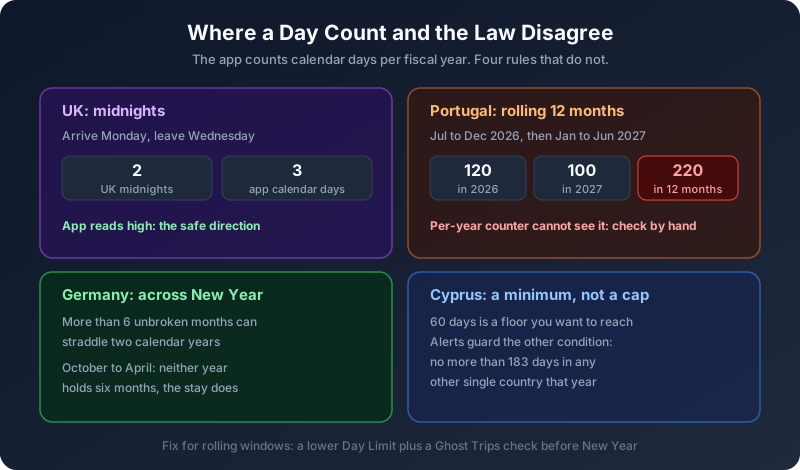
Nomad Tracker counts calendar days over each country's fiscal year, including arrival and departure days. That is a clean, conservative model, and for many countries it maps closely onto the rule. For some, it does not, and you should know where before you trust a silent phone.
Midnight counts read lower than calendar days
The UK counts midnights. A Monday arrival and Wednesday departure is two UK days under the test and three calendar days in the app. The app reads high, which is the safe direction for an error. If you want the alert to track the 46-day test closely, a Day Limit of 45 with alerts at 70% and 90% works, knowing the real midnight count will usually be a little lower.
Rolling windows can hide inside two fiscal years
Portugal is the one to handle by hand. Imagine someone who spends 120 days in Porto between July and December 2026, then 100 more between January and June 2027. Each calendar year shows a comfortable number, but the 12-month window from July 2026 to June 2027 holds 220 days, well over the line. A counter per fiscal year cannot see that window.
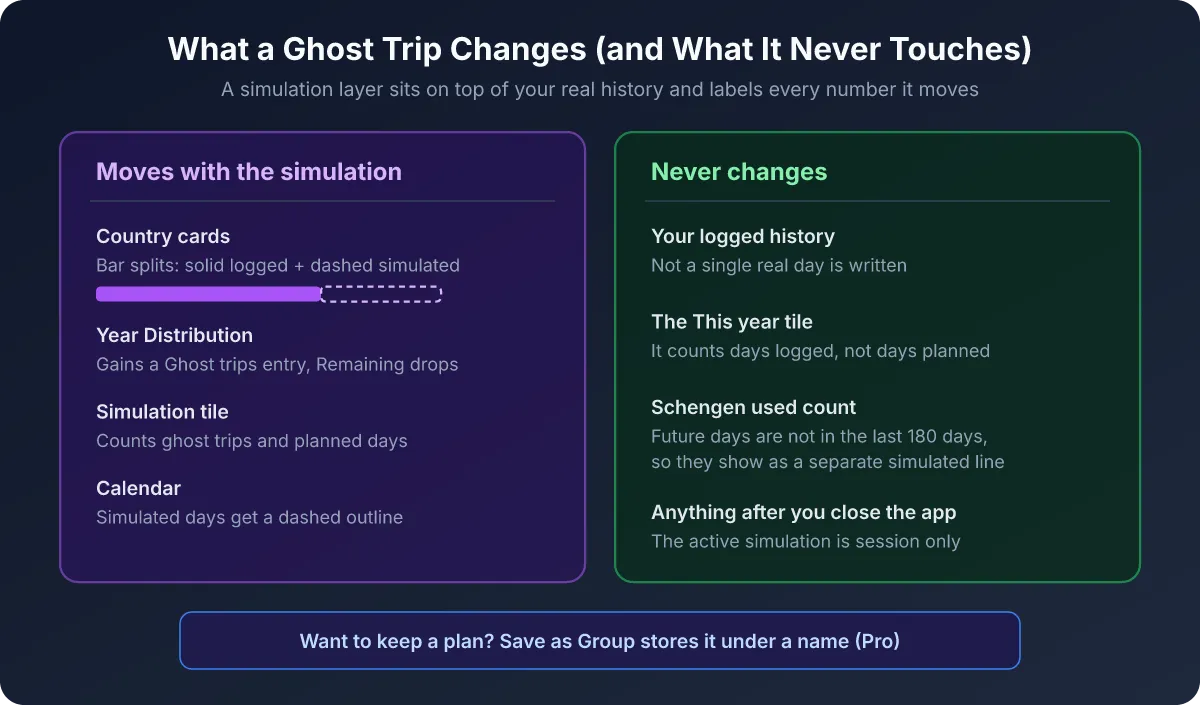
Two ways to protect yourself. Set Portugal's Day Limit much lower, so that the alert fires early in each calendar year and prompts you to add up the previous months yourself. And before any long Portugal stay that crosses New Year, simulate it with Ghost Trips and add the months on either side of the boundary manually. The same logic applies to Germany's six months across a year-end.
Minimums are not thresholds
Cyprus's 60-day rule works in the opposite direction: you want to reach it, not avoid it. Since 1 January 2026, Cyprus no longer requires that you not be tax resident anywhere else, but you still need at least 60 days in Cyprus, a home there, Cypriot work or business ties, and no more than 183 days in any other single country in the same calendar year. A residency alert cannot tell you that you have not done enough. It can, however, guard that last condition: an alert on each country where you spend long stretches keeps the "no more than 183 days elsewhere" condition visible. The amendment also makes dual tax residency more likely, which is exactly what those alerts help you avoid.
Step 4: Make Sure the Alert Can Actually Reach You
The most common reason an alert never arrives is not a bug. It is one of three settings.
Permission. Under Countries & Regions, an orange Notifications Disabled row means iOS refused permission at some point, and the app cannot ask again. Tap it to jump to iOS Settings and turn notifications on. If there is no orange row and no Enable Notifications button, permission is already granted.
An alert that exists. Alerts are per country, and every country starts with none. An empty Residency Alerts section sends nothing, however loudly iOS is allowed to speak. The summary line for each country in Countries & Regions ends with its number of alerts, so a quick scan shows which countries are watched.
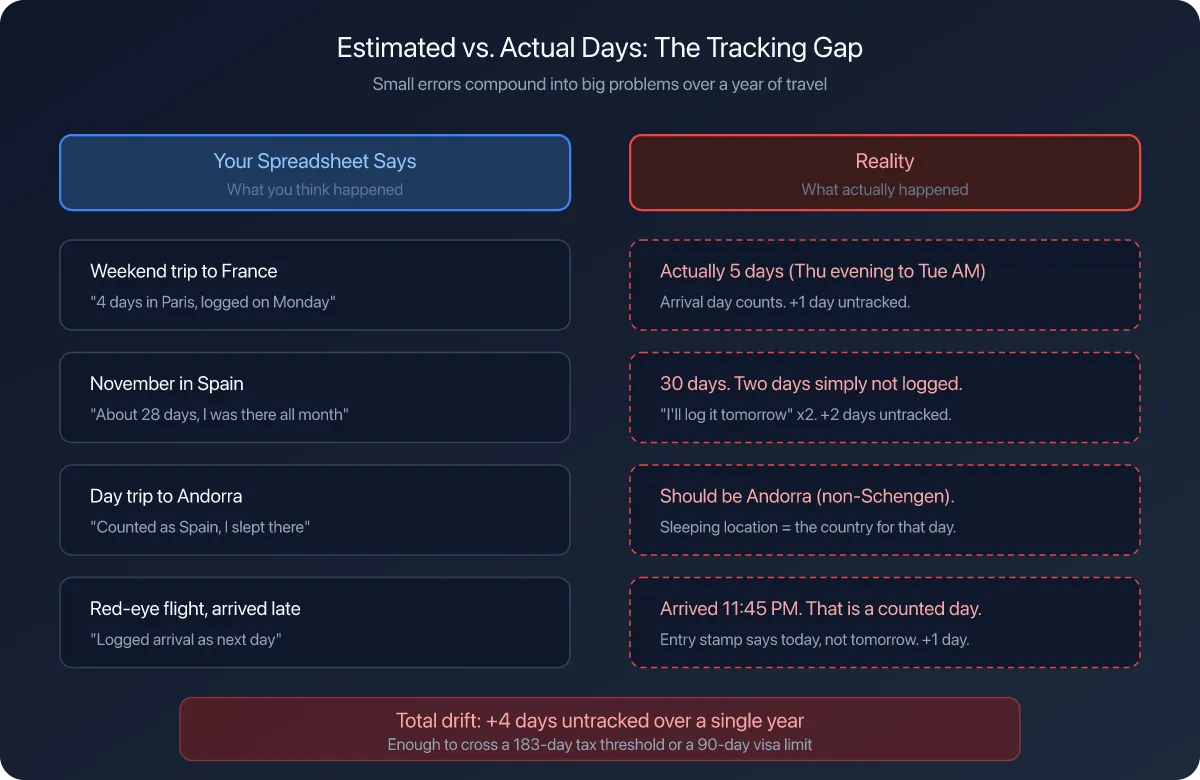
Days that have landed. Alerts are evaluated against logged days. Days you enter by hand count immediately; days that arrive from GPS or a photo import count once they are in. If automatic tracking had a gap, the alert is counting a smaller number than reality. A weekly glance at the calendar for missing days is the habit that keeps the alert honest.
Tax alerts and visa alerts are different things
The section below Residency Alerts is Visa Alerts, and it watches a different number: how long the country lets you stay, not how long before it taxes you. Schengen alerts live on a third screen, Schengen Area under Regional, measured against the 90-day limit across all member states at once. A country can let you stay six months and tax you after 46 days, or tax you at 183 and throw you out at 90. Set both kinds where both apply.
A Setup That Works for Most Nomads
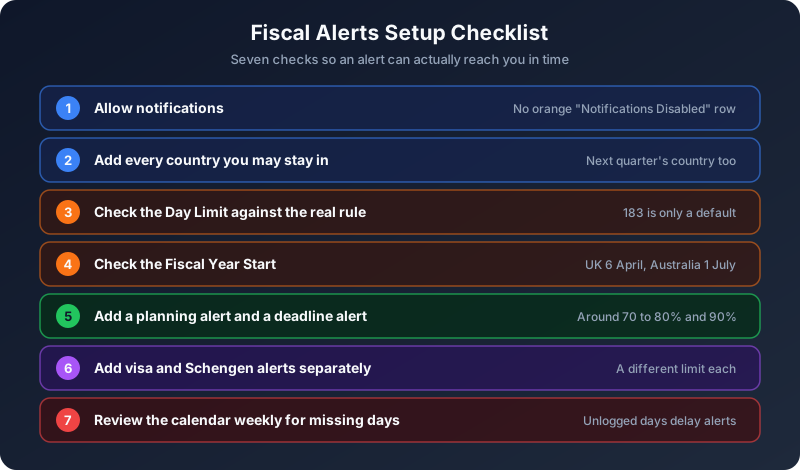
If you want a starting point rather than a framework, this covers most situations:
- Every country where you might spend more than a month gets alerts, not only the one you are in now. Next quarter's country is the one you forget.
- Day Limit at your own line, 10 to 15 days below the legal figure for half-year rules, and at the safe harbor (45 or 15) for the UK if it applies to you.
- Two residency alerts per country: one around 70 to 80% as the planning trigger, one around 90% as the deadline.
- Fiscal Year Start checked for the UK, Australia and any country you have set as your tax residence.
- Rolling-window countries handled by hand at the start of each year and before any stay that crosses New Year.
None of this decides whether you are tax resident anywhere. Residency also depends on ties, intent and treaties, and the app is explicit that it measures days, not legal status. For a close case, talk to an adviser in the country concerned. What alerts do is make sure that conversation happens in September, with options on the table, instead of in April, with a filing deadline.
Get warned before the threshold, not after it.
Nomad Tracker counts your days per country over each country's fiscal year, with residency alerts, visa and Schengen alerts, automatic day tracking and Ghost Trips to test a stay before you book it. All on-device and private. Available on iOS.
Download on the App Store