Thailand's Long-Term Resident visa is usually discussed as a tax product. That framing skips the harder question, which is whether you can get one at all. The LTR is not one visa with one bar. It is four separate qualification tests run by the Board of Investment (BOI), each built for a different kind of person, and most applicants who get refused do not fail on the money. They fail because they picked a category whose logic does not match their situation.
This guide is about that matching problem: what each of the four categories actually tests, what changed in the 2025 relaxation and the 2026 industry update, what you need on top of the headline numbers, and how the BOI process runs from first upload to stamp. If you want the tax side, we covered it separately in Thailand's LTR Visa Tax Benefits: A Brutally Honest Breakdown, and we will not repeat it here.
First, Who the LTR Is Really Being Granted To
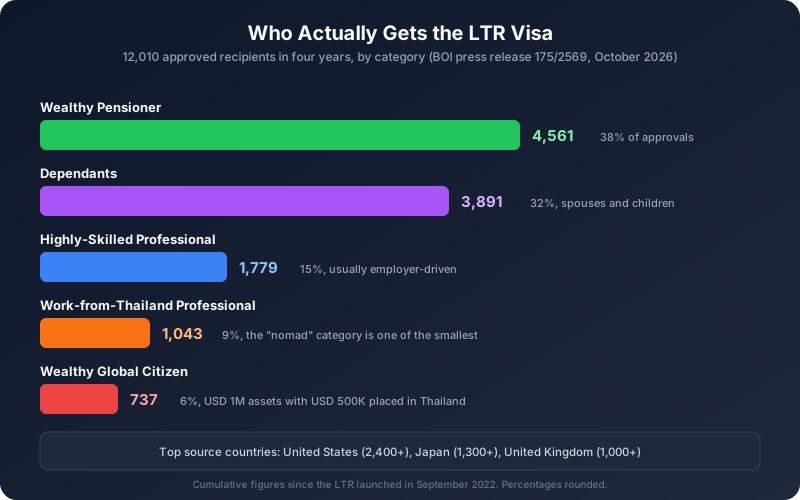
Before the criteria, look at who is actually getting through. In October 2026 the BOI published a four-year tally (press release 175/2569) of 12,010 approved LTR recipients. The split is revealing:
- Wealthy Pensioner: 4,561
- Dependants: 3,891
- Highly-Skilled Professional: 1,779
- Work-from-Thailand Professional: 1,043
- Wealthy Global Citizen: 737
The BOI also reported the United States as the largest source country with more than 2,400 approvals, followed by Japan and the United Kingdom.
Two things stand out. Retirees are by far the biggest group, which tells you the pension route is the most straightforward to evidence. And the category that sounds like it was designed for digital nomads, Work-from-Thailand Professional, is one of the smallest. That is not an accident, and the reason sits in its employer test, which we will get to.
The Four Categories, Read as Qualification Tests
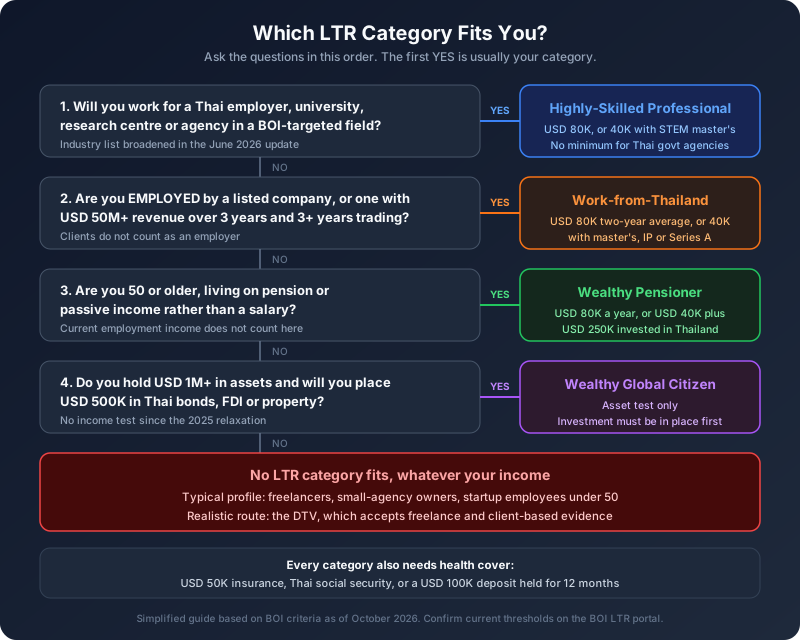
Each category answers a different question. Read them that way and the right one usually becomes obvious.
Wealthy Global Citizen: "Do you have money, and will you put some of it in Thailand?"
This is an asset test, and since 2025 it is almost purely an asset test.
- At least USD 1 million in assets.
- At least USD 500,000 of that placed in Thailand, through Thai government bonds, foreign direct investment in a Thai company, or Thai real estate.
- Health cover (see below).
The big change: the old requirement of USD 80,000 in annual personal income over the previous two years was removed under BOI Announcement Por. 3/2568 in early 2025. That reopened the category to people with large portfolios but little declared income.
What still trips people up is the Thai investment half. The USD 500,000 has to be in qualifying Thai assets, and guidance published alongside the 2025 revision clarified which asset classes do not count. Applicants holding wealth mostly in a home-country brokerage account should expect to move a large sum into Thailand before endorsement, not after.
Wealthy Pensioner: "Are you 50 or older with reliable passive income?"
- Aged 50 or over.
- USD 80,000 a year in pension or passive income, or
- USD 40,000 a year in pension or passive income plus USD 250,000 invested in Thai government bonds, Thai FDI or Thai property.
- Health cover.
This is the cleanest category to evidence because pension statements and dividend records are stable documents. It is also why it dominates the approval figures. Note what does not count: salary from a job you are still doing. If you are 52 and still employed, your earnings belong in a different category, not this one.
Work-from-Thailand Professional: "Does an established foreign company employ you?"
This is the category nomads look at first, and the one most of them fail.
- Personal income of USD 80,000 a year averaged over the past two years, or
- USD 40,000 to 80,000 a year if you hold a master's degree or higher, own intellectual property, or have received Series A funding (guides commonly cite at least USD 1 million).
- Employment with a company that is listed on a stock exchange, or a private company that has operated for at least three years with combined revenue of at least USD 50 million over the last three years.
- Health cover.
The income bar gets the attention. The employer bar is what actually decides it. Before 2025 the private-company threshold was USD 150 million, which effectively limited the category to employees of large multinationals. The 2025 relaxation cut it to USD 50 million, and sources report that wholly owned subsidiaries of listed companies can also qualify. That is a meaningful opening, but it still excludes most of the remote economy: startups below that revenue, small agencies and, crucially, freelancers.
A freelancer billing ten clients is not "employed by an established foreign company", however healthy the combined income looks. This is the structural reason the category sits at around 1,000 approvals after four years, and why the DTV, which accepts freelance and client-based evidence, is where most remote workers end up. If that describes you, our DTV guide is the more realistic route.
Highly-Skilled Professional: "Are you working in or for Thailand in a targeted field?"
- USD 80,000 a year over the past two years, or USD 40,000 to 80,000 with a master's degree in science or technology or specialised expertise relevant to the role.
- No income minimum if you work for a Thai government agency.
- Work for a business in a BOI-targeted industry, or a Thai higher-education institution, research centre, specialised training institution or government agency.
- Health cover.
This is the only category built around working in Thailand rather than bringing outside money or an outside job with you. It is the one an employer usually drives, and it comes with the digital work permit as a central feature rather than an optional extra.
The 2026 update matters here. In June 2026 KPMG reported that the BOI had revised the targeted industry list for this category with broader, more inclusive definitions, reaching into non-STEM fields such as development and sustainability and disaster and risk management. Roles that would have failed the industry test a year ago may now pass. Because the reclassification is recent, check the current BOI list against your employer's activity before assuming either way.
What the 2025 and 2026 Changes Actually Moved
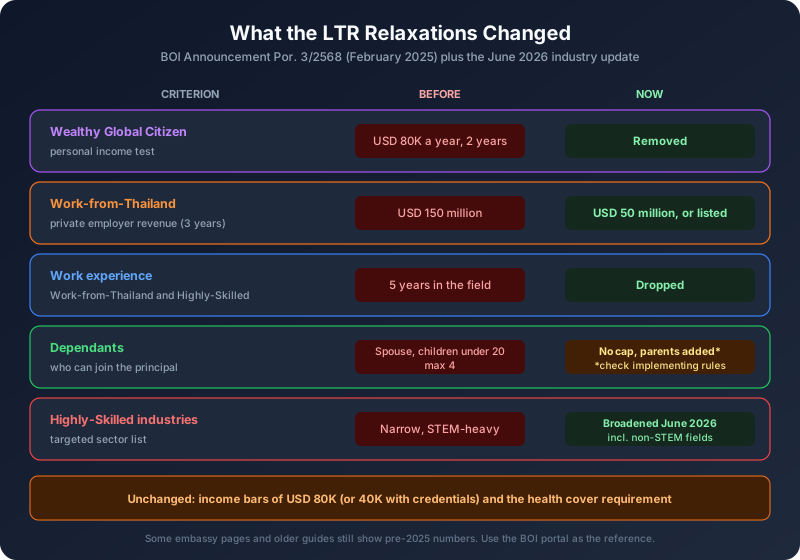
The LTR launched in September 2022 with criteria that were widely criticised as too narrow. The 2025 relaxation, issued as BOI Announcement Por. 3/2568 and reported by law firms such as Tilleke & Gibbins as taking effect on issuance in February 2025, was the response. In summary:
| Item | Before 2025 | After the 2025 relaxation |
|---|---|---|
| Wealthy Global Citizen income test | USD 80,000 a year over two years | Removed, asset test only |
| Work-from-Thailand employer revenue | USD 150 million over three years | USD 50 million over three years, listed companies qualify |
| Work experience (Work-from-Thailand, Highly-Skilled) | Five years in the relevant field | Requirement dropped |
| Dependants | Spouse and children under 20, capped at four | Cap removed, parents added (see caveat) |
| Highly-Skilled industry list | Narrow, STEM-heavy | Broadened again in the 2026 update |
Two caveats are worth taking seriously. First, some commercial guides and even some embassy pages still publish the pre-2025 numbers, so if a checklist you are reading mentions five years of experience or USD 150 million, it is out of date. Second, the dependant changes were announced before every supporting regulation was in place. Several legal sources reported that adding parents required a further Ministry of Interior announcement, and that some aspects, such as same-sex spouses, were still awaiting implementing rules. As of October 2026 you should confirm current dependant eligibility directly on the BOI portal before filing a family application.
The Requirement Every Category Shares: Health Cover
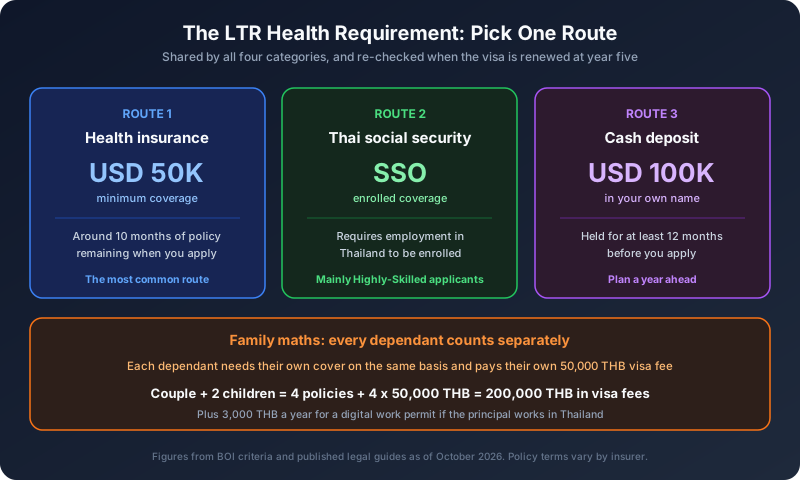
All four categories carry the same baseline, and it is easy to underestimate. You need one of:
- Health insurance with at least USD 50,000 of coverage, with guides commonly specifying at least ten months of the policy remaining at the time you apply.
- Thai social security coverage, which in practice only applies to people already employed in Thailand, so mainly Highly-Skilled applicants.
- A deposit of at least USD 100,000 held in your own name for at least twelve months, as an alternative to insurance.
The deposit route suits wealthy applicants who would rather not buy a policy, but the twelve-month holding period means it has to be planned a year ahead. The insurance route is the common one, and the coverage has to be maintained, not just shown once. The LTR is issued in two five-year blocks, and the renewal at year five re-checks that you still meet your category's conditions, insurance included.
Each dependant needs their own coverage on the same basis, and each pays their own visa fee. For a couple with two children, that is four policies and four fees, which changes the cost picture considerably.
A Few Worked Examples
These are hypotheticals built to show how the tests interact. They are illustrations, not assessments of anyone's real file.
Daniel, 41, US software engineer. Employed for four years by a NASDAQ-listed company, earning USD 135,000, approved to work remotely from Thailand. He meets the income test and the employer is listed, so the revenue question never arises. Category: Work-from-Thailand Professional, a strong fit.
Aiko, 34, Japanese product designer. Employed by a 60-person Singapore startup, earning USD 72,000, with a master's degree. Her income works with the master's degree route. Her employer does not: it is unlisted and nowhere near USD 50 million in three-year revenue. She does not qualify for Work-from-Thailand, and she has no Thai employer for Highly-Skilled. Realistic route: DTV, unless the startup is a wholly owned subsidiary of a listed group, which it is not.
Graham, 63, retired UK teacher. Defined-benefit pension equivalent to USD 46,000 a year, plus savings. He falls short of USD 80,000, so he needs the second route: USD 40,000 in pension plus USD 250,000 in Thai bonds or property. If he is willing to place USD 250,000 in Thailand, he qualifies as a Wealthy Pensioner. If not, he is looking at a Non-O or O-A retirement visa instead, which we will cover later in this series.
Sofia, 45, sold her company. USD 2.4 million in assets, almost no salary. Pre-2025 she would have failed the Wealthy Global Citizen income test. Today she qualifies, provided she places USD 500,000 in qualifying Thai assets. Category: Wealthy Global Citizen.
Marco, 38, freelance consultant. Billing EUR 110,000 a year across eight European clients. His income is well above the bar, yet he fits no category: no employer, no Thai role, under 50, nowhere near USD 1 million in assets. This is the most common profile among nomads asking about the LTR, and the answer is almost always the DTV.
How the BOI Process Runs
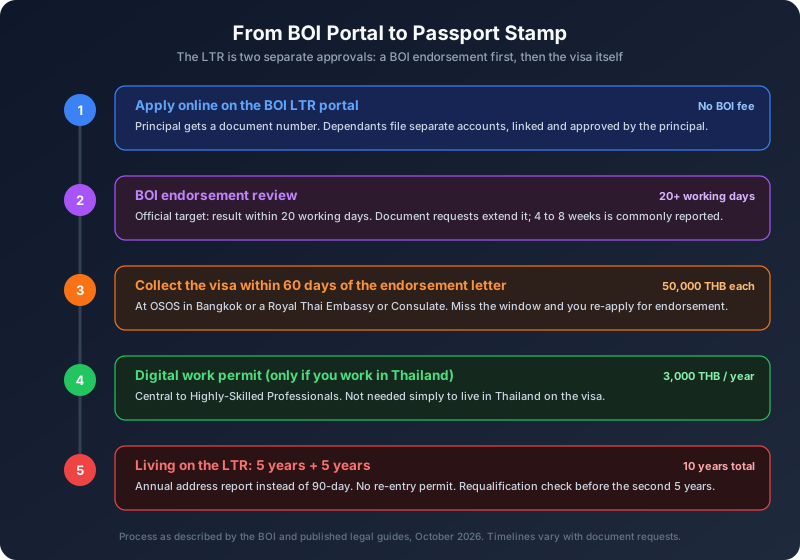
The LTR has a two-stage structure that confuses people because the first stage is not a visa at all.
Stage 1: BOI endorsement. You create an account on the BOI's LTR portal (ltr.boi.go.th), upload the documents for your category and submit. The BOI says it notifies applicants of the result within 20 working days, with the clock extending if it asks for more documents. In practice, applicant reports and agents commonly describe four to eight weeks once document requests are included. The BOI does not charge a fee for endorsement. Agents do, if you use one.
Dependants file their own applications under separate accounts, linked to the principal's application by a document number, and the principal has to log in and approve each link. They can apply at the same time as the principal or later.
Stage 2: visa issuance. Once endorsed, you have 60 days from the date of the endorsement letter to apply for the visa itself, either at the One Start One Stop Investment Center (OSOS) in Bangkok, at a Royal Thai Embassy or Consulate abroad, or at another designated agency. Miss the 60 days and you have to seek endorsement again. The visa fee is 50,000 THB per person, paid once, at issuance.
Stage 3: work permit, if relevant. If your category involves working in Thailand, you can apply for the digital work permit, which carries a fee of 3,000 THB per year.
After issuance. The visa is issued for an initial five years and extended for another five once you show you still qualify. Holders report their address to Immigration once a year instead of every 90 days, do not need a separate re-entry permit, and get access to fast-track lanes at participating international airports.
Where Applications Go Wrong
Across agent reports, legal commentary and community threads, the same failure patterns repeat:
- Wrong category. A self-employed applicant files as Work-from-Thailand. A 52-year-old still drawing a salary files as a Pensioner. The category logic, not the amount, sinks the file.
- Income that cannot be evidenced as a two-year average. The income tests look back over two years. A big jump last year with a thin year before can drag the average under the line.
- Employer documents that do not prove the revenue test. For a private employer, the USD 50 million needs third-party evidence such as audited statements. An HR letter stating the company is large is not enough.
- The Thai investment not yet in place. For Wealthy Global Citizen and the lower Pensioner route, the investment is part of the qualification, not a promise to make one later.
The LTR and Your Day Count
The LTR solves the immigration side of a long stay in Thailand more completely than any other visa: ten years, annual reporting, no re-entry permit. What it does not change is the 180-day tax residency line. Spend 180 days or more in Thailand in a calendar year and you are a Thai tax resident, LTR or not. What happens after that depends on your category, which is exactly what the LTR tax breakdown and our wider guide to Thailand's remittance rules cover.
Many applicants also prepare their file from inside Thailand on a DTV or exemption entry, and those months count toward the same calendar-year total. Know where you stand on that count before the move, not after.
Know your Thailand day count before the BOI asks.
Nomad Tracker logs your days in every country automatically, alerts you at 150, 170 and 180 days so the Thai tax residency line never surprises you, and lets you model future stays with Ghost Trips before you book. The Schengen calculator runs alongside it. All on-device and private. Available on iOS.
Download on the App Store