For a non-EU digital nomad, almost every hard constraint in life traces back to one document. The Schengen 90/180 rule, the visa runs, the income thresholds on nomad visas, the border questions about onward tickets: all of it depends on the passport in your pocket. Change the passport and a large part of that admin simply disappears. An Irish, Italian or Polish passport ends Schengen day counting for good, because EU citizens have freedom of movement across the whole bloc.
That is why "second passport" is one of the most searched topics in the nomad community, and also why it attracts so much bad advice. The glossy version involves a six-figure cheque to a Caribbean government. The realistic version, for most people, involves a grandparent's birth certificate or a few years of genuine residence somewhere. Both realistic routes changed a lot between 2025 and 2026, and some of the most popular ones (Italy by descent, Portugal by naturalization) are now much narrower than the guides written two years ago claim.
This guide covers the paths that are still open on a nomad budget, what changed, and the part almost nobody mentions: most of these routes are won or lost on day counts.
The Three Realistic Routes (And the One We Are Skipping)
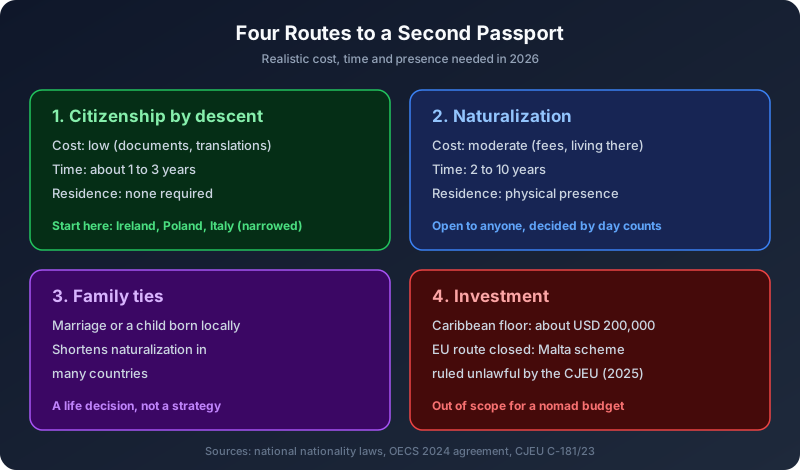
There are four ways to acquire a second citizenship:
- Descent. You are already a citizen through a parent or grandparent, and you ask the state to recognise it. Cheapest and fastest when you qualify.
- Naturalization through residence. You live somewhere legally for a set number of years, then apply. Open to anyone, but it costs years of genuine presence.
- Family ties. Marriage to a citizen or having a child born in the country shortens naturalization in many places. This is a life decision, not a strategy, so we only mention it where it changes the timeline.
- Investment. You pay. The Caribbean programmes (Dominica, St Kitts and Nevis, Grenada, Antigua and Barbuda, Saint Lucia) moved to a shared floor of roughly USD 200,000 after a 2024 regional agreement, with several programmes priced above that. Inside the EU, the Court of Justice ruled in April 2025 that Malta's citizenship-for-investment scheme breached EU law, which effectively closed the idea of buying an EU passport.
That last route is out of scope for this article. If you have USD 200,000 to spend on a passport, you also have a lawyer. Everyone else should start with descent.
Citizenship by Descent: Check Your Family Tree First
Descent routes are attractive because you are not "earning" anything. Under the law of the country concerned, you were a citizen from birth. The application is paperwork that proves it: birth, marriage and naturalization records for every link in the chain, often apostilled and translated.
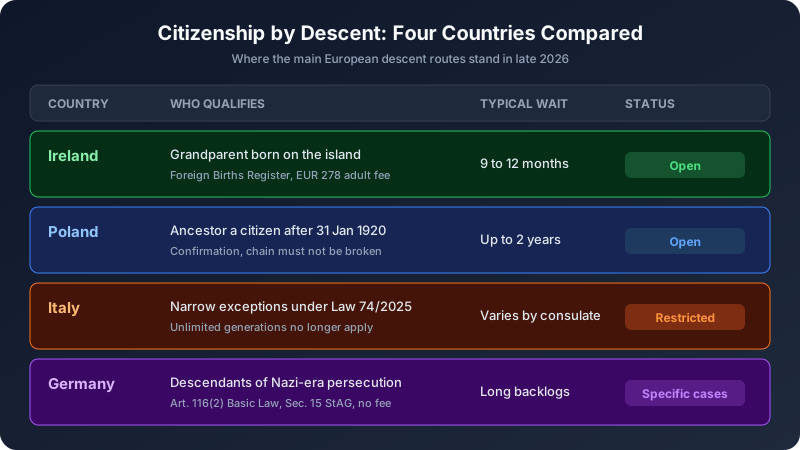
The four countries nomads ask about most:
Ireland: the grandparent route still works
If one of your grandparents was born on the island of Ireland, you can register on the Foreign Births Register (FBR). Registration makes you an Irish citizen from that date, and Ireland allows dual citizenship.
The practical details:
- Fee: EUR 278 for an adult, EUR 153 for a minor, according to Department of Foreign Affairs figures reported by several law firms.
- Processing: roughly 9 to 12 months once all original documents are received, longer if anything needs clarification.
- The catch: if you claim through a grandparent and your parent was not born in Ireland, your parent must have been registered before your birth for you to pass it on to your own children later. Families often register the parent and child in sequence.
Ireland is the cleanest descent route in Europe right now: no language test, no residence requirement, and no recent restriction.
Italy: the route that changed the most
For decades, Italy was the default answer. Citizenship passed down the bloodline with no generation limit, so a great-great-grandparent who emigrated in 1890 could be enough. That ended with the Tajani Decree (Decree-Law 36/2025, converted into Law 74/2025 in May 2025).
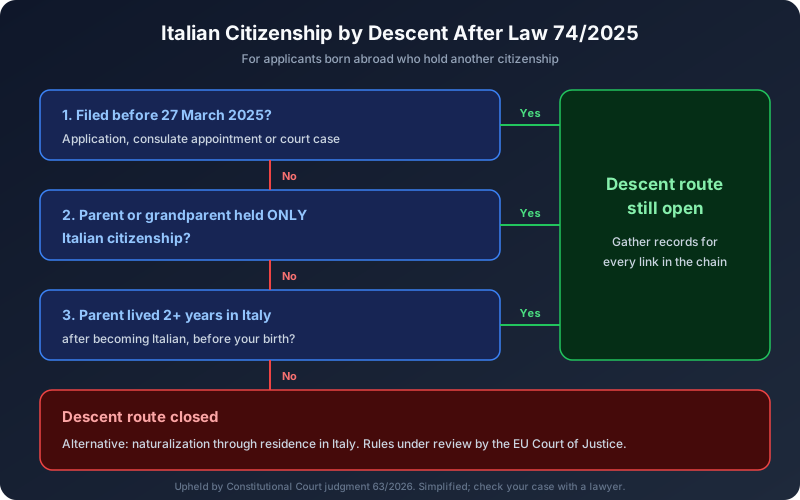
Under the new rules, a person born abroad who holds another citizenship is treated as never having acquired Italian citizenship by descent, unless one of a few exceptions applies:
- a parent or grandparent held only Italian citizenship (at the time of death, or still today), or
- a parent lived legally in Italy for at least two consecutive years after becoming Italian and before your birth, or
- your application, appointment or court case was filed before 27 March 2025.
The Italian Constitutional Court upheld the reform in judgment 63/2026 (filed 30 April 2026). In July 2026 the Court then referred questions about its retroactive effect to the Court of Justice of the EU, so the situation of people born before March 2025 is still technically open. This rule is in flux, but nobody should plan around the old law coming back.
What that means in practice: a typical Argentine, Brazilian or US applicant whose Italian ancestor naturalized abroad, and whose parents never lived in Italy, no longer qualifies. Those with an Italian-born grandparent who never took another nationality still might.
Poland: confirmation, not application
Poland frames descent as confirmation of citizenship you already hold. The key date is 31 January 1920, when Poland's first citizenship law took effect. Broadly, your ancestor needs to have been a Polish citizen after that date and must not have lost it before passing it on. Common loss events include naturalizing abroad, and voluntary service in a foreign army between 1920 and 1951.
Polish claims are document-heavy, since archives from the interwar period are scattered, and families report waits of up to two years for a decision. The upside: no residence, no language test, and a full EU passport at the end.
Germany: mainly for descendants of the persecuted
Germany's ordinary descent rules rarely help someone whose family left generations ago. The important exception is restoration of citizenship under Article 116(2) of the Basic Law and Section 15 of the Nationality Act, for descendants of people who lost or were denied German citizenship through Nazi-era persecution. Applications are free, and since the 2024 reform Germany generally allows dual citizenship.
Spain: the window that just closed
Spain's Democratic Memory Law gave descendants of Spanish exiles a special route to citizenship, but its application window closed in October 2025 after an extension. Anyone who filed in time is still being processed; new applicants are out of luck.
A Closer Look at Italy After 2025
Because Italy was the default answer in so many nomad forums, it is worth walking through the new logic step by step. The question is no longer "did any ancestor emigrate from Italy?" but "does your case fit one of the narrow exceptions?"
Take a hypothetical applicant, Lucia, a Brazilian designer born in 1994. Her great-grandfather was born in Veneto and emigrated to São Paulo in 1902.
- Under the old law, Lucia would have needed his birth record, proof he did not naturalize in Brazil before her grandfather's birth, and the Brazilian records for each generation. A consulate or an Italian court would then recognise her.
- Under Law 74/2025, she was born abroad and holds Brazilian citizenship. Her great-grandfather is not a parent or grandparent, her parents never lived in Italy, and she had not filed before 27 March 2025. She does not qualify.
Now compare Marco, a US software engineer whose grandmother was born in Sicily and kept only Italian citizenship until her death. Marco still fits the exclusive-citizenship exception. His case is stronger than it would have been as a simple bloodline claim, and his file is a lot smaller.
If you sit in Lucia's position, the alternative is residence. Italy's ordinary naturalization period is 10 years for most foreigners, and the 2025 reform added a shortened residence path for people with an Italian-born parent or grandparent. Either way, it now involves actually living in Italy.
Naturalization: Where Years of Residence Pay Off
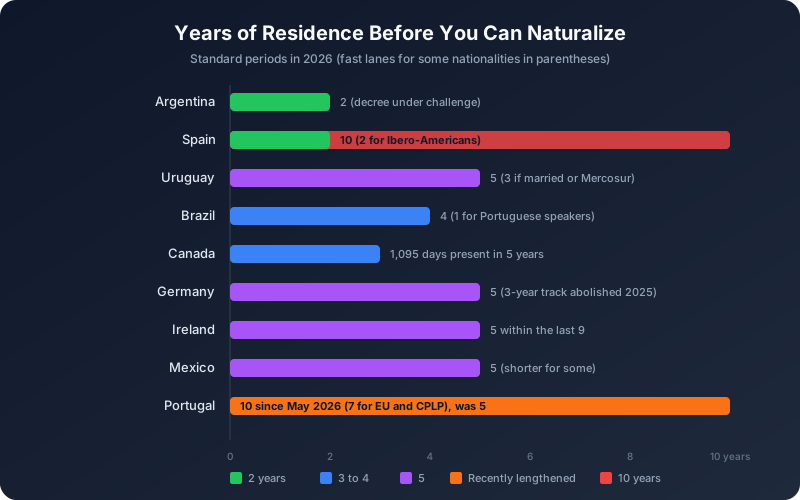
If descent is closed to you, naturalization is the route that works for anyone. The variable is time, and it varies enormously by country:
- Argentina: 2 years. Decree 366/2025 now requires two years of continuous legal residence, with the applicant not leaving the country during that period, and moved processing from the courts to the National Migration Directorate. The decree's constitutionality is being challenged in court, so treat this one as in flux.
- Spain: 2 years for nationals of Ibero-American countries, Andorra, the Philippines, Equatorial Guinea and Portugal; 10 years for everyone else. Nationals of those countries can usually keep their original citizenship; most others must formally renounce it.
- Uruguay: 3 years if married or for Mercosur citizens, 5 years if single. Dual citizenship is allowed, but you are expected to be physically in Uruguay a substantial part of each year.
- Brazil: 4 years of residence as standard, 1 year for nationals of Portuguese-speaking countries.
- Mexico: 5 years as standard, with shorter periods for certain nationalities and family situations.
- Germany: 5 years. The three-year "turbo" track for highly integrated residents was abolished in October 2025. Dual citizenship is allowed.
- Ireland: 5 years of reckonable residence within the last 9, including a final continuous year.
- Portugal: now 10 years (7 for EU and CPLP nationals). The revised nationality law (Organic Law 1/2026) took effect in May 2026, replacing the old 5-year rule and closing the Sephardic route. It is still frequently quoted as 5 years in older guides.
- Canada: 1,095 days of physical presence in the 5 years before applying.
The Latin American options are the most interesting for nomads on a budget. Argentina, Uruguay and Brazil all allow dual citizenship, their passports carry visa-free Schengen access, and living costs are moderate. Spain's two-year track is effectively a fast lane into the EU, but only for the nationalities listed.
The Nomad Catch: Naturalization Is a Day-Counting Exercise
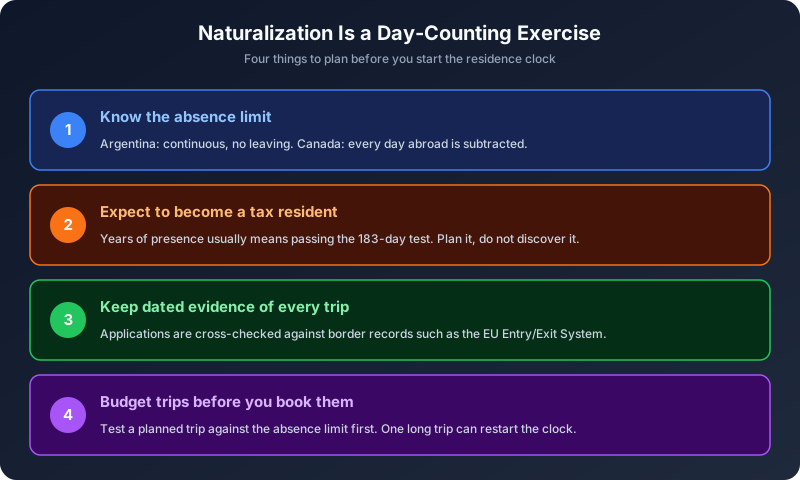
Here is the part that most second-passport content skips. Naturalization does not reward holding a residence card. It rewards being physically present for most of the qualifying period, and you prove it with dates.
Every country above counts differently:
- Argentina's decree speaks of continuous residence without leaving the country.
- Canada counts exact days, and each day abroad is subtracted.
- Ireland's final year must be continuous, with only limited absences tolerated.
- Uruguay's authorities expect you to spend a substantial part of each year in the country, and long absences can restart the clock.
- Spain and Portugal look at legal residence periods, but long absences can break continuity and are checked against entry and exit records.
For someone used to moving every few months, this is a real lifestyle trade-off. A naturalization plan usually means one base country for years, with travel carefully budgeted around the absence limit.
There is a second consequence. Spending the time required for naturalization almost always makes you a tax resident of that country. Living in Argentina or Spain for two years without leaving means passing the 183-day test twice. That is not a reason to avoid naturalization, but it should be planned rather than discovered when the tax office writes to you. Our guide to dual tax residency covers what happens when two countries claim you at once.
Finally, the evidence. Immigration offices increasingly cross-check applications against digital border records, including the EU's Entry/Exit System for non-EU nationals in Schengen. If your own count of days abroad is off by a few weeks, an application can be delayed or refused. Many Nomad Tracker users keep their day log precisely for this: a dated record of where they were, exported when a form asks for a list of absences.
How to Pick Your Route
A simple order of operations works for most people:
- Map your family tree first. Go back to your great-grandparents and note where each was born and whether they naturalized elsewhere. Ireland (grandparent born on the island) and Poland (ancestor a citizen after 1920) are the strongest current descent routes. Italy now only works in the narrow cases above.
- If descent fails, match your nationality to a fast lane. Ibero-Americans have Spain at two years. Lusophone nationals have Brazil at one year. Mercosur nationals have Uruguay at three.
- Otherwise, choose a base you would genuinely live in. Argentina's two years is the shortest standard period on the list, but it is also the least settled legally. Germany and Ireland at five years are slower and more stable.
- Check dual citizenship rules on both sides. Some countries, including several in Asia, make you lose your original nationality when you acquire another. Confirm before you apply, not after.
- Budget for documents, not just fees. Apostilles, sworn translations and archive searches often cost more than the government fee itself, especially on descent claims.
And regardless of route: do not stop counting days until the new passport is in your hand. Until it is, the old rules still apply to you, including the Schengen 90/180 rule. Our complete 90/180 guide explains how the rolling window works while you wait.
Track the Days That Decide Your Application
Whether you are waiting on an Irish registration, sitting out a two-year residence period in Buenos Aires or keeping under Canada's absence limit, the outcome often comes down to an accurate count of where you were and when.
Nomad Tracker logs country changes automatically with on-device GPS, so your history of entries and exits builds itself. The Schengen calculator keeps the 90/180 window honest until your EU passport arrives, fiscal residency alerts warn you as you approach 183 days in a country, and Ghost Trips let you test a planned trip against your absence budget before you book it.
Your citizenship timeline runs on days. Count them properly.
Nomad Tracker logs every border crossing automatically, tracks Schengen and tax residency limits, and exports a dated travel history for any application. All on-device, all private. Available on iOS.
Download on the App Store