Most Thai long-stay visas ask what you do: remote work, Muay Thai, retirement, a job. The Non-Immigrant O visa based on marriage asks who you are married to. If your spouse is a Thai national, it is the most direct route to living in Thailand year after year, it has a lower financial bar than retirement, and it is the only family route that can eventually lead to permanent residence on the strength of the relationship itself.
It is also the route with the most paperwork outside your control: your spouse's house registration, district office certificates, photos of your home, and an officer who may turn up at your door. This guide covers how it works in 2026: the money test, the annual extension cycle, work permits, children, and how it compares to the DTV. Local offices apply these rules with real discretion, so treat every number as the published baseline.
The Route in Two Stages
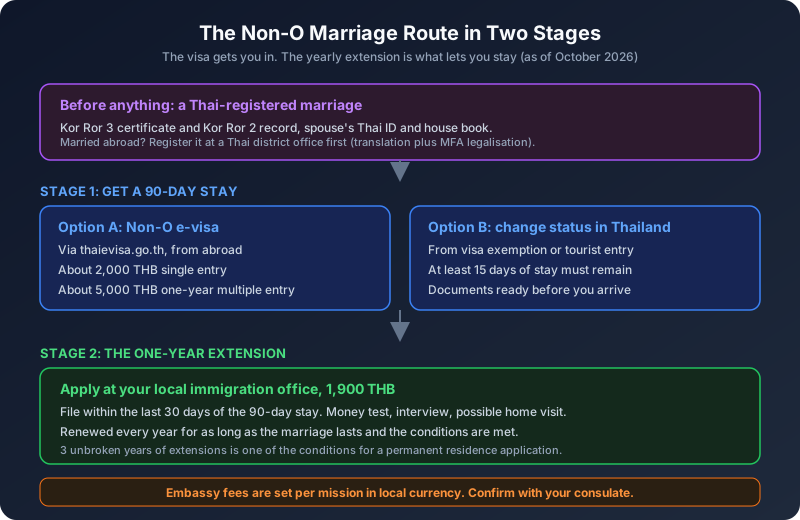
The phrase "marriage visa" is a little misleading, because the visa itself is only the entry ticket. The long-term permission comes from a separate step taken inside Thailand.
Stage 1: the Non-O entry visa. You apply through the Thai e-visa portal (thaievisa.go.th) or, in some cases, convert your status inside Thailand. The visa gives you a stay of up to 90 days from arrival. Embassy fee schedules commonly list about 2,000 THB for a single-entry visa valid for 90 days and about 5,000 THB for a one-year multiple-entry version, but each mission sets its own figure in local currency. The Royal Thai Embassy in Singapore, for example, asks applicants to file at least 21 working days before travel.
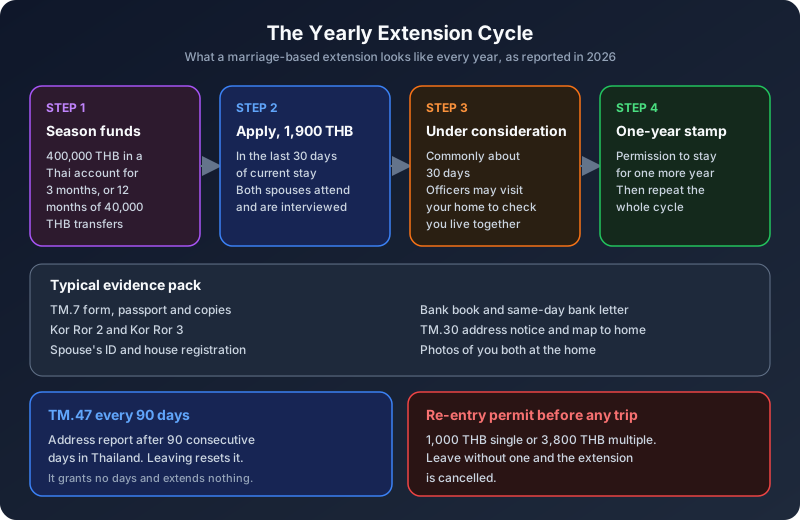
Stage 2: the one-year extension of stay. Within the last 30 days of your 90-day stay, you apply at your local immigration office for a one-year extension based on marriage. This is where the financial test, the interview and the home visit happen. The fee is 1,900 THB. You then repeat this extension every year for as long as the marriage subsists and you keep meeting the conditions.
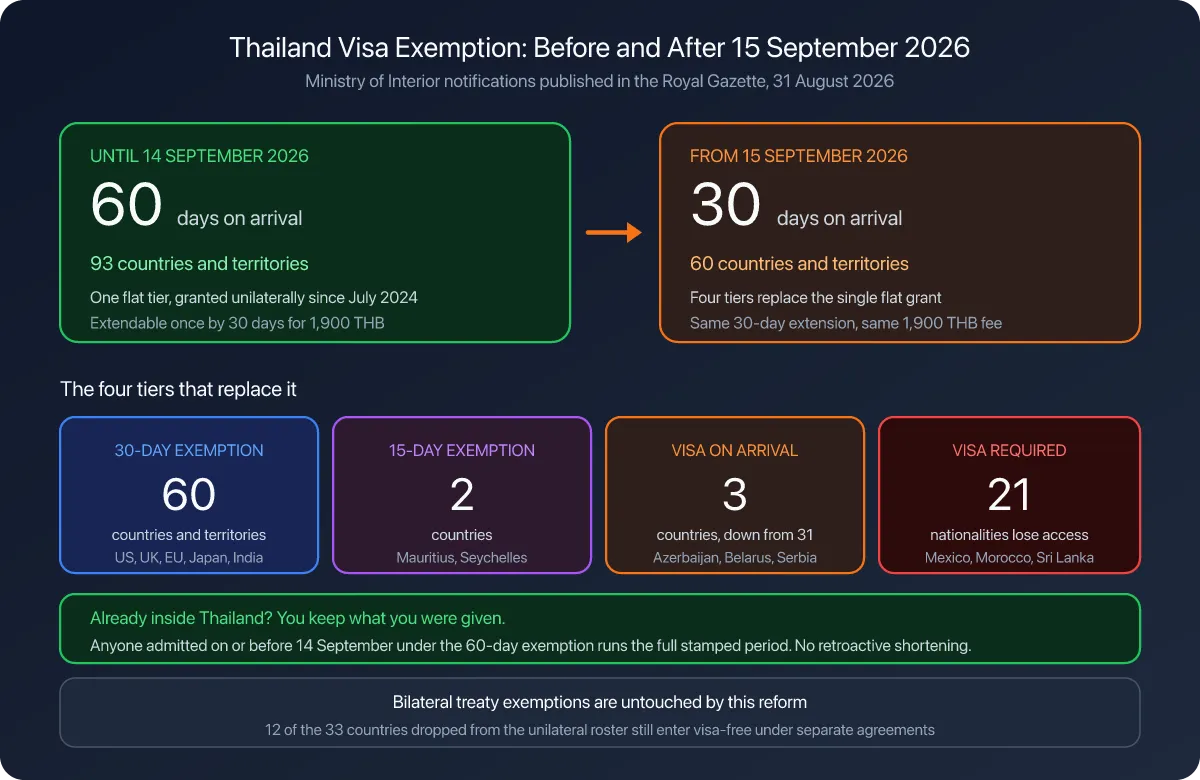
There is also an in-country shortcut. Thai legal guides report that someone on a visa exemption or tourist entry can change status to Non-O at immigration if at least 15 days of stay remain. With the exemption cut to 30 days for most Western passports from 15 September 2026 (full details here), arrive with your documents ready, not with a plan to gather them.
The marriage has to be Thai-registered
The extension is built around Thai civil documents. For a marriage registered at a Thai district office (amphoe), immigration expects the marriage certificate (Kor Ror 3) and the marriage registration record (Kor Ror 2), plus your spouse's Thai ID card and house registration book. Some offices want a freshly issued Kor Ror 2, with 2026 reports ranging from "no older than 30 days" to "no older than a year" depending on the office.
If you married abroad, you generally need to register that marriage at a Thai district office first, with a Thai translation legalised by the Ministry of Foreign Affairs. Plan for weeks.
Since 23 January 2025, Thailand's Marriage Equality Act has opened civil marriage to same-sex couples, and Thai law firms report that a same-sex foreign spouse of a Thai national now applies on the same basis as any other spouse. Early 2025 analysis flagged that immigration regulations might still need amending, so if this applies to you, confirm with the office before filing.
The Money Test: Three Ways to Pass
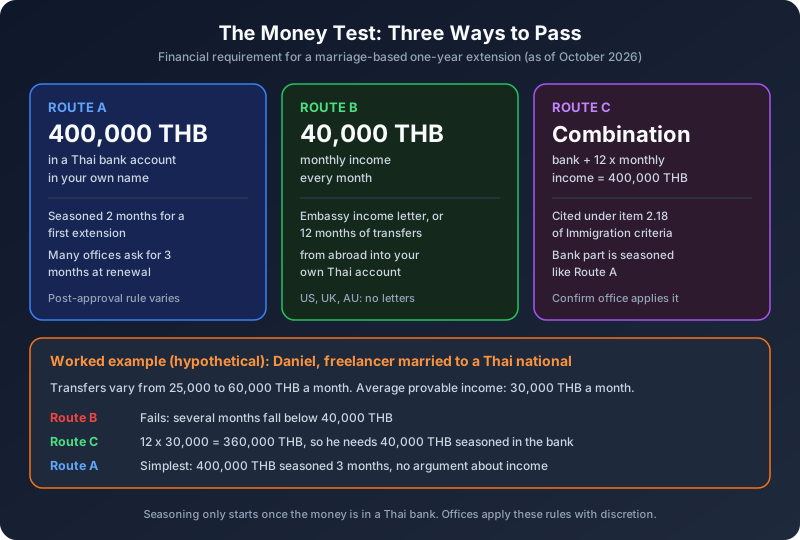
The financial requirement for a marriage-based extension is half the retirement figure, and it can be met in three ways.
Route A: 400,000 THB in a Thai bank
A deposit of at least 400,000 THB in a Thai bank account in your own name. The account has to be Thai, and the money has to be "seasoned", meaning it sat there for a period before you apply. The published baseline for a first extension is two months. At renewal, many offices ask to see three months of history, so the safe planning assumption is three months before every application.
After approval, some offices reportedly require the balance to stay put for a period (one Thai legal guide cites three months), while others do not check. Ask before you move the money. And note a mistake Thai lawyers flag often: the seasoning clock only starts once the money lands in a Thai bank, not while it sits abroad.
Route B: 40,000 THB a month in income
Income of at least 40,000 THB a month. Historically this was proven with an income letter from your own embassy. Several embassies, including those of the United States, the United Kingdom and Australia, have stopped issuing these letters, so applicants from those countries typically prove income instead with twelve months of transfers of at least 40,000 THB each, sent from abroad into their own Thai account. Community reports are consistent that the transfers should go into the applicant's account, not the Thai spouse's, and that services that do not show as international transfers may be rejected.
Route C: the combination
Thai law firms and visa services describe a combination route in which the bank balance plus twelve times the monthly income must total at least 400,000 THB. The legal basis cited is item 2.18 of the Immigration Bureau criteria, and some sources point to a 2025 Immigration Bureau order as writing the combination in expressly. Not every office applies it the same way, so it is the route most worth confirming in advance.
Worked example
Imagine Daniel, a hypothetical Canadian freelance designer married to Ploy, a Thai national, living in Chiang Mai. His income is real but uneven: some months he transfers 60,000 THB into his Thai account, some months 25,000 THB.
- Route B fails. Several months are below 40,000 THB, so twelve months of qualifying transfers is not available.
- Route C works. His average provable income is 30,000 THB a month, or 360,000 THB a year. He needs a Thai bank balance of at least 40,000 THB on top, seasoned like any other deposit, to reach 400,000 THB.
- Route A is the simplest. If Daniel can park 400,000 THB (roughly 12,000 USD; check the rate on the day) in a Thai account three months before each renewal, he never has to argue about his income at all, which is why many couples default to it.
The Annual Extension, Step by Step
Once you are on the one-year cycle, every year looks roughly the same. Reported practice in 2026:
- File in the last 30 days of your current permission to stay. Not earlier, and never after it lapses.
- Bring your spouse. Both of you attend. Expect questions about how you met, how long you have lived together, and daily life.
- Bring the evidence pack: TM.7 application form, passport and copies, Kor Ror 2 and Kor Ror 3, your spouse's ID and house registration, bank book and a bank letter dated the same day, a TM.30 residence notification for your address, a hand-drawn or printed map to your home, and photographs of the two of you together at the home, often including the house number and the inside of the property.
- Pay 1,900 THB. You are usually given an "under consideration" stamp, commonly about 30 days, while the file is reviewed.
- Expect a possible home visit. Officers may come to check that you actually live together at the address you declared. Thai sources describe this as possible rather than guaranteed, and some offices do it far more than others.
- Return for the final stamp granting the year.
Around the extension sit the same reporting duties every long-stay foreigner has. If you stay 90 consecutive days you file a TM.47 90-day address report; leaving the country resets that clock (our DTV day-math guide explains TM.47 and TM.30 in detail). And because the extension is a permission to stay rather than a visa, leaving Thailand without a re-entry permit cancels it. A re-entry permit costs 1,000 THB for a single trip or 3,800 THB for multiple trips, and the BOI's own FAQ lists the same figures. Forgetting it is the classic way to lose a year's extension at the airport.
The Work Question
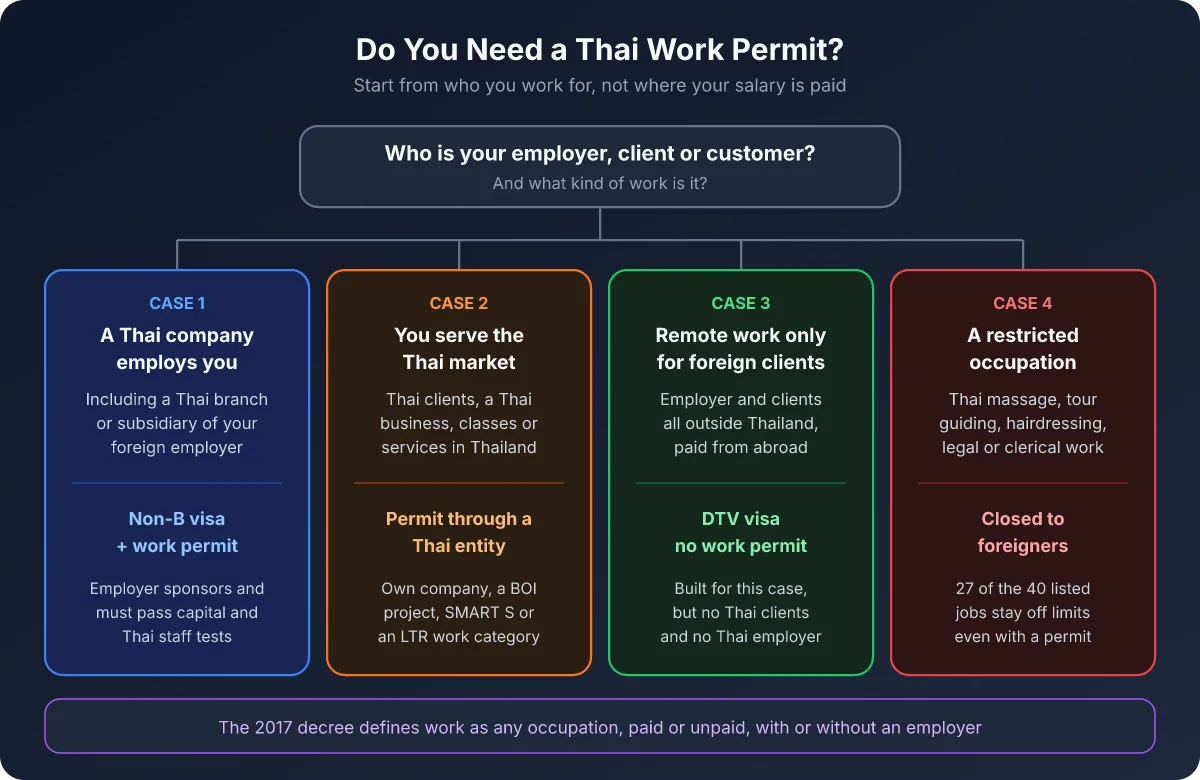
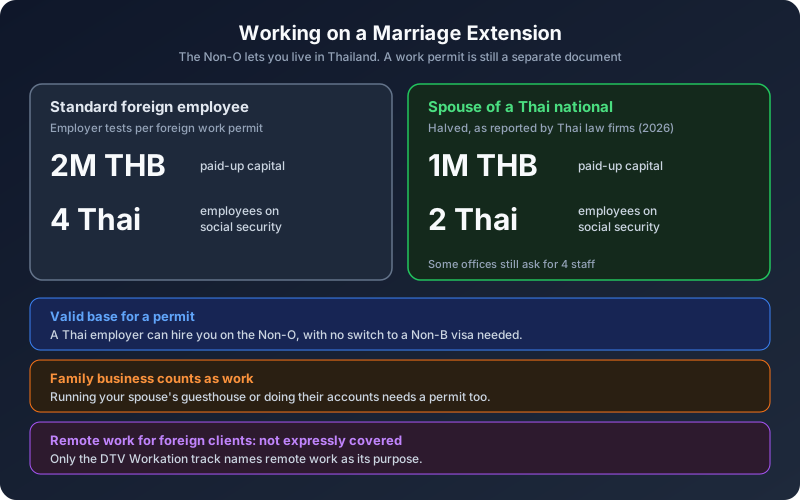
The Non-O marriage extension lets you live in Thailand. It does not let you work there. As with every other status, the right to work comes from a work permit issued by the Department of Employment, and Thai law defines work broadly enough to cover unpaid activity. Our Non-B and work permit guide covers the system in full; here are the parts that change for spouses.
You can hold a work permit on a Non-O. Unlike a tourist entry, the marriage-based status is a valid base for a work permit, so a Thai employer can hire you without you switching to a Non-B.
The employer tests are lighter. A standard work permit expects 2 million THB of paid-up capital and four Thai employees per foreign permit. For a foreigner married to a Thai national, Thai law firms, including one guide updated in September 2026, report that both requirements are halved: 1 million THB of capital and two Thai employees for that spouse's permit. Some community reports describe offices still asking for four staff, so treat the concession as the published rule that a given office may apply with discretion.
Helping in the family business is work. Managing your spouse's guesthouse or doing their company's accounts needs a permit, which is why many couples structure the business to sponsor one under the reduced thresholds.
Remote work for foreign clients is not expressly covered. Unlike the DTV Workation track, the marriage extension creates no remote-work right, so a spouse working for a company abroad sits in the same grey zone as on any non-DTV status.
Children and the Wider Family
The Non-O is the umbrella for several family relationships, not only marriage.
Children of a Thai national. A foreign parent of a Thai child can use the Non-O route and extend on that basis, with the same 400,000 THB or 40,000 THB a month financial test reported for the marriage route. For unmarried fathers, the paperwork is the hard part: 2026 community reports and at least one Thai embassy page point to a child legitimation order from a Thai family court, or registration of parental rights at the district office, as the basis immigration wants to see.
Foreign children. A non-Thai child living with a foreign parent on a long-stay status can generally get a dependant Non-O tied to the parent's. A child with a Thai parent is usually entitled to Thai nationality and needs no visa at all.
Permanent residence. This is the long game that only the family route offers. Thai PR applications based on marriage are reported to require at least three consecutive years of extensions immediately before applying, combined income of around 30,000 THB a month, and a slot in an annual quota of 100 places per nationality, with the window usually opening late in the year. Spouses of Thai nationals pay a reduced permit fee of 95,700 THB rather than 191,400 THB, plus a 7,600 THB application fee. Sources disagree on whether a minimum marriage duration applies, so confirm the current criteria with the Immigration Bureau when the quota is announced.
If the marriage ends, the basis for the extension falls away, and you need another route (retirement, DTV, Non-B, or a child-based Non-O) before your permission runs out. Talk to immigration or a Thai lawyer early.
Non-O Marriage vs DTV Dependant
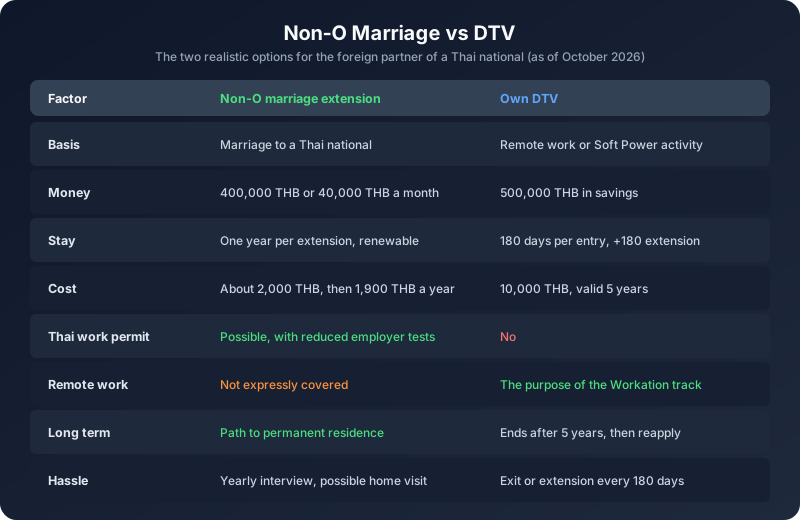
Since 2024 couples have had a second option: the DTV. A DTV dependant must be the spouse or unmarried child under 20 of a DTV holder, and a Thai national cannot be a DTV principal, so for a Thai-foreign couple the real comparison is the Non-O against the foreign partner getting their own DTV.
| Non-O marriage | Own DTV (or DTV dependant) | |
|---|---|---|
| Basis | Marriage to a Thai national | Remote work or Soft Power activity (dependant: married to a DTV holder) |
| Money | 400,000 THB in a Thai bank, or 40,000 THB a month | 500,000 THB, held by the principal |
| Stay | One year per extension, renewed annually | 180 days per entry, extendable once by 180 days |
| Visa cost | About 2,000 THB, then 1,900 THB a year | 10,000 THB per person, valid 5 years |
| Work | Work permit possible, reduced employer tests | No Thai work permit; remote work for foreign clients only |
| Remote work | Not expressly covered | Expressly the purpose of the Workation track |
| Long-term path | Can lead to permanent residence | Ends at 5 years, then reapply |
| Hassle | Annual interview, photos, possible home visit | Border runs or extensions every 180 days |
The DTV suits a couple with remote income who move in and out of Thailand often. The Non-O marriage route suits a couple who want to settle: a full year per stamp, a work permit within reach, and a path to permanent residence. See our complete DTV guide for the other side.
The Line Nobody Mentions at the Interview
A marriage extension is built for people who live in Thailand, and people who live in Thailand cross 180 days in a calendar year. At that point you are a Thai tax resident, and foreign income you bring in can become taxable under the remittance rules in force since 1 January 2024.
Route B, twelve months of 40,000 THB transfers into a Thai account, is literally a record of remitting foreign income. That does not automatically mean tax is due (the source of the money, when it was earned and any tax treaty all matter), but a Thai tax adviser should look at it before you set it up. Our Thailand tax guide for nomads walks through the 180-day test, the remittance rules and the planning options in detail.
All figures here come from Thai embassy pages, Immigration Bureau criteria as reported by Thai law firms, the BOI and 2026 community reports, as of October 2026. Offices interpret the marriage rules with considerable discretion, so confirm with the office that will process your extension, and with a Thai tax adviser on anything involving remittances.
Living in Thailand with your partner? Know your day count.
Nomad Tracker logs your days in every country automatically and alerts you at 150, 170 and 180 days, so the Thai tax residency line never catches you by surprise. Plan trips home and DTV entries with Ghost Trips before you book, and keep the Schengen calculator running for Europe. All on-device and private. Available on iOS.
Download on the App Store