Most of what gets written about Thai visas for nomads is about staying. The DTV, the LTR, the exemption: they answer the question "how long can I be here?" This article answers a different one: "who am I allowed to work for while I am here?" For anyone whose employer, clients or customers are in Thailand, there is essentially one answer. You need a work permit, and for most people that means a Non-Immigrant B visa sponsored by a Thai employer.
The two documents are separate and they are not interchangeable. The visa lets you enter and stay. The work permit, issued by the Department of Employment under the Ministry of Labour, lets you work. Holding one without the other is the most common way foreigners end up on the wrong side of the law, and in 2026 the government is checking more than it ever has.
Below we cover when a permit is legally required, how the Non-B and work permit process runs, what your employer has to prove, which jobs stay closed to foreigners even with a permit, the BOI and SMART S alternatives, and why remote workers on a DTV sit outside this whole system.
When Thailand Requires a Work Permit
The governing law is the Emergency Decree on Foreigners' Working Management B.E. 2560 (2017), amended in 2018. Its definition of "work" is broad: performing any occupation, with or without an employer, paid or not. It does not depend on where the salary lands or which country's payroll you are on.
In practice, three situations clearly need a permit:
- You are employed by a Thai company, including a Thai subsidiary of your foreign employer. This is the textbook Non-B case.
- You serve the Thai market yourself: freelancing for Thai clients, running a Thai business, teaching classes in Thailand, selling services to people in Thailand.
- You do something on the restricted list, which no permit can cover at all (more on that below).
Then there is the zone everyone actually asks about: working remotely, from a laptop in Chiang Mai, for an employer or clients entirely outside Thailand. The 2017 decree does not carve this out. What changed the picture is the Destination Thailand Visa, which the Ministry of Foreign Affairs designed explicitly for remote work for foreign employers and foreign clients. That is the government's way of saying "this activity is acceptable, on this visa". It is also why the DTV comes with a hard boundary: no Thai employer, no Thai clients, and no access to a Thai work permit. We covered that boundary in our complete DTV guide.
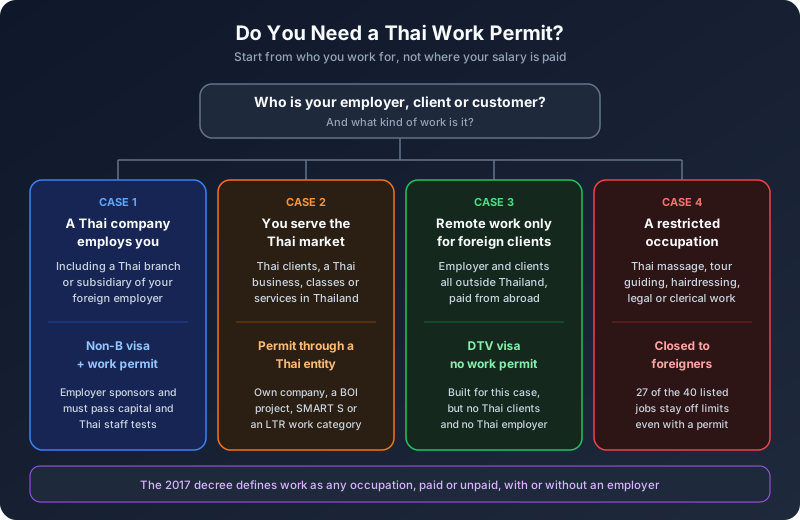
The practical rule follows from that design. If the money and the client are outside Thailand, the DTV is the route the government built for you. The moment the employer, the client or the customer is in Thailand, you are in work permit territory.
How the Non-B and Work Permit Process Works
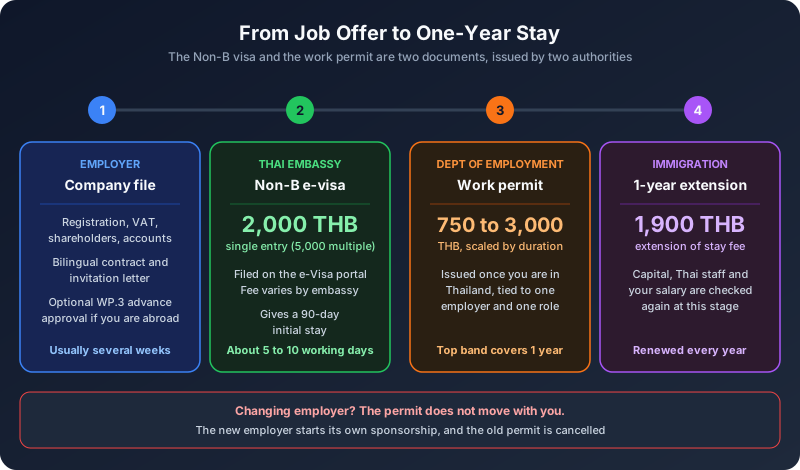
The Non-Immigrant B is the "business and employment" visa. On its own it lets you enter Thailand to take up a job, but it is only the first piece. The sequence that most employers and agents describe looks like this:
Step 1: The employer secures the job and the paperwork
The Thai employer prepares its side of the file: company registration, shareholder list, VAT registration, recent financial statements, a list of current foreign staff, a bilingual employment contract and an invitation letter stating your position, salary and contract length. For a hire who is still abroad, the employer can apply to the Department of Employment for advance approval (the WP.3 route), which produces an approval letter you then use at the embassy.
Step 2: You apply for the Non-B visa
Applications run through the official Thai e-Visa portal, with every supporting document uploaded electronically. Embassy guides typically quote 2,000 THB for single entry and 5,000 THB for multiple entry, though the exact fee is set per embassy and charged in local currency. Processing is usually quoted at 5 to 10 working days, longer if the officer asks for more documents. A single-entry Non-B gives you an initial 90-day stay.
Step 3: The work permit is issued in Thailand
Once you arrive, the work permit is issued by the Department of Employment. Fees under the ministerial regulation scale with duration, in a range of roughly 750 to 3,000 THB, with the top band covering a permit of up to one year. Agencies and law firms widely report that the permit is now handled through an electronic system, and a 2025 Cabinet-approved draft moved toward letting workers collect permits through a representative, by post or online instead of in person.
Step 4: The one-year extension of stay
With the permit in hand, you apply at Immigration to extend your 90 days into a one-year stay. This is where most of the hard tests sit: the employer's capital, its Thai headcount and your salary are checked again. The standard extension of stay fee is 1,900 THB. Every year after that, the permit and the extension are renewed together. If you change employer, the permit does not travel with you: the new employer starts its own process.
What Your Employer Has to Prove
This is the part that surprises people moving from countries where a job offer is most of the battle. In Thailand, the employer has to qualify for the right to hire you, and it keeps having to qualify every year.
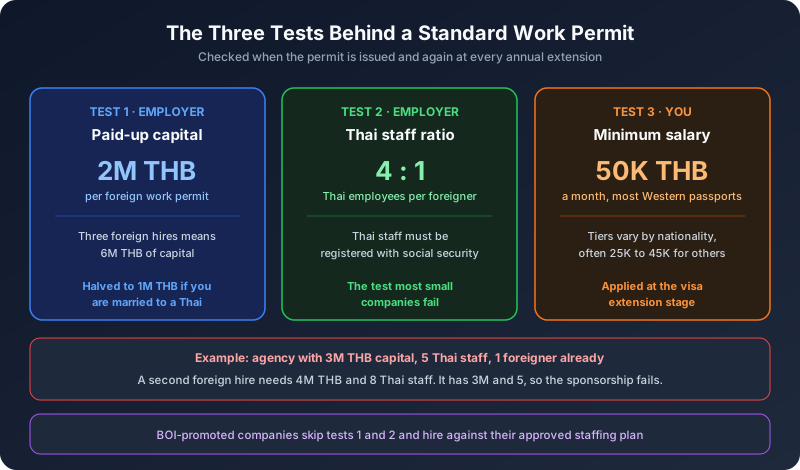
The capital test
A standard Thai company is generally expected to have 2 million THB of registered, paid-up capital per foreign work permit. A company that wants to sponsor three foreigners needs 6 million THB. If the foreign employee is legally married to a Thai national, law firms including Forvis Mazars report the capital requirement drops by half, to 1 million THB per permit.
The 4:1 Thai staff ratio
Alongside the capital, the company typically needs four Thai employees, registered with social security, for each foreign work permit. This is the test that kills most small-company sponsorships. A two-person startup cannot sponsor its foreign co-founder through the standard route, however well funded it is.
Your salary
For the annual extension, Immigration applies minimum monthly salaries that vary by nationality. The figure most commonly cited for nationals of Europe, the UK, Australia and North America is 50,000 THB a month, with some agents quoting 60,000 THB for US, Canadian and Japanese nationals and lower tiers (often 45,000, 35,000 and 25,000 THB) for many Asian and African nationalities. Sources disagree on which country sits in which tier, so this is something to confirm with the employer's immigration lawyer for your passport specifically. A BOI FAQ notes a useful nuance: the salary condition attaches to the visa extension, not the work permit itself. Since losing the extension means losing the right to stay, the effect is the same.
A worked example
Imagine Lena, a German marketing manager, is offered a job by a Bangkok agency with 3 million THB in paid-up capital and five Thai staff on social security. The agency already sponsors one foreigner. To add Lena, it would need 4 million THB of capital and eight Thai employees under the standard tests. It has 3 million and five. Unless it injects another million in capital and hires three more Thai staff, the sponsorship fails, and Lena's job offer, however genuine, cannot legally start.
Jobs Foreigners Cannot Do, Even With a Permit
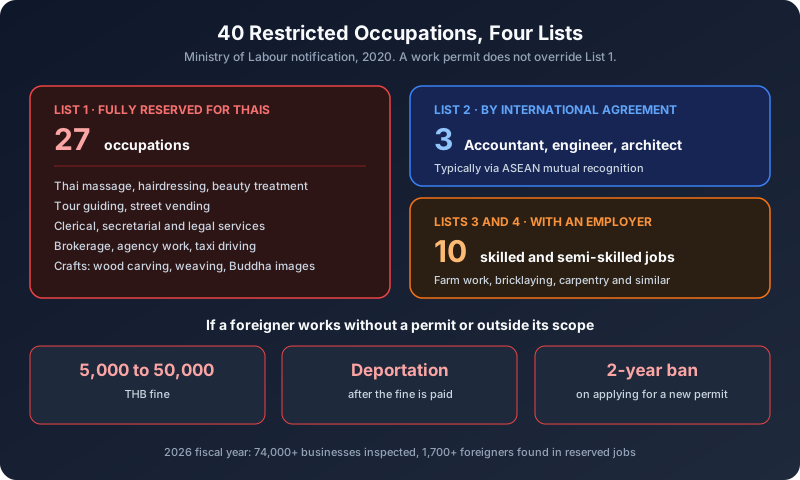
A work permit is not a blank cheque. Under the Ministry of Labour's 2020 notification, 40 occupations are restricted for foreigners, split into four lists:
- List 1: 27 occupations fully reserved for Thais. Examples reported by Khaosod English and the Ministry include Thai massage, hairdressing and beauty treatment, tour guiding, street vending, clerical and secretarial work, legal services, brokerage and agency work, driving taxis and similar vehicles, and traditional crafts such as wood carving, hand weaving, Thai musical instruments and Buddha images.
- List 2: 3 professions open only under international agreements: accountant, engineer and architect, typically through ASEAN mutual recognition arrangements.
- Lists 3 and 4: 10 skilled and semi-skilled occupations (for example agricultural work, bricklaying and carpentry) that foreigners can only do when employed by an employer, and in some cases only under bilateral labour agreements.
These lists are being enforced. In May 2026, after a raid on a childcare facility on Koh Phangan led to nine arrests, the Labour Minister ordered nationwide permit checks and said the grace period was over. The Thaiger reported that during the 2026 fiscal year officials inspected more than 74,000 businesses employing foreigners and found over 1,700 foreign workers in occupations reserved for Thais. In October 2026, DSI and Immigration ran coordinated raids at three Bangkok locations.
The penalties after the 2018 amendment: a foreigner working without a permit, or outside the scope of the permit they hold, faces a fine of 5,000 to 50,000 THB, deportation, and a two-year ban on applying for a new permit. Employers face fines per foreign worker, with higher penalties and a hiring ban for repeat offences.
The Alternatives: BOI, SMART S and the LTR
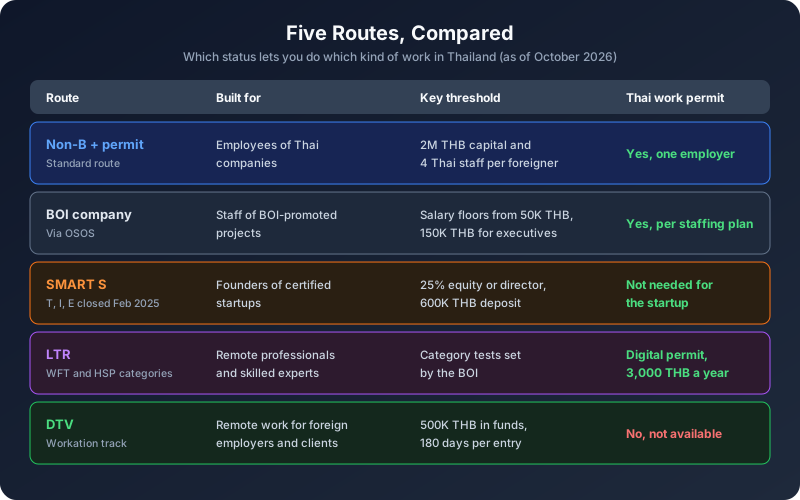
If the standard Non-B tests rule you out, three government programmes offer a different path. They are not loopholes, they are routes designed for companies and people Thailand actively wants.
BOI-promoted companies
Companies promoted by the Board of Investment do not hire under the standard capital and ratio tests. They hire against the staffing plan approved in their BOI promotion, and their foreign staff get visas and work permits through the One Start One Stop Investment Center (OSOS) in Bangkok. That freedom now comes with its own floors. Under BOI Announcement Por. 8/2568, in force from 1 October 2025 for newly promoted projects and from 1 January 2026 for older certificates, executives must earn at least 150,000 THB a month, with skilled roles such as engineers, researchers and IT specialists at 50,000 to 75,000 THB depending on degree and experience. Manufacturers with more than 100 employees must keep at least 70% Thai staff.
SMART S: the founder route
The SMART visa used to have five categories. That changed on 18 February 2025: under BOI Announcements 5/2568 and Por. 6/2568, the Talent (T), Investor (I) and Executive (E) categories were discontinued for new applications. Many guides still list all five, so check the date on anything you read. Today only two remain:
- SMART S, for founders of a startup certified in one of Thailand's targeted industries by an agency such as NIA or DEPA. Commonly cited requirements are at least 25% of the registered capital or a director role, a deposit of 600,000 THB held for at least three months, and health insurance for the full stay. The key benefit: no separate work permit is needed for work inside the certified startup.
- SMART O, for the founder's spouse and children, with an extra deposit commonly cited at 180,000 THB per dependant.
Former Talent, Investor and Executive applicants are now pointed at the LTR.
The LTR and its digital work permit
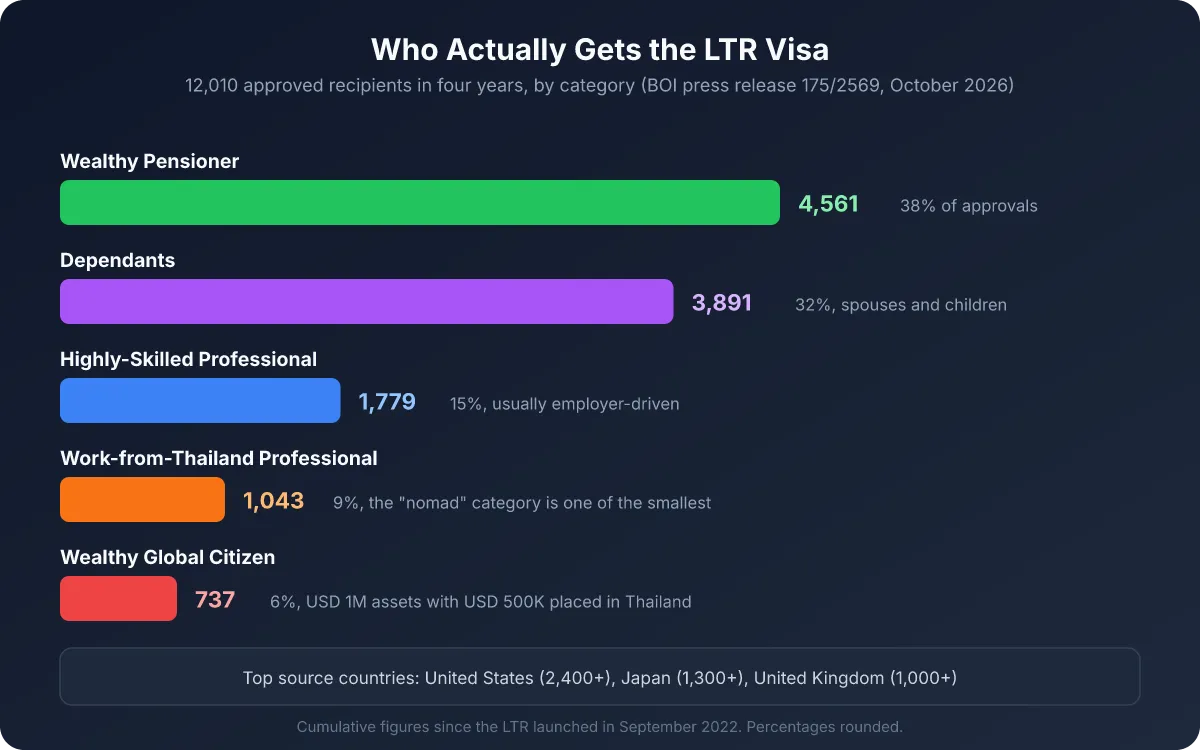
The Long-Term Resident visa's Work-from-Thailand Professional and Highly-Skilled Professional categories come with a digital work permit at 3,000 THB a year. That is a real work authorisation, but only for the role the LTR was granted on. We cover who qualifies in our LTR category guide and the tax treatment in our LTR tax breakdown, so we will not repeat either here.
Why DTV and Tourist Status Sit Outside This System
The DTV and the work permit system are deliberately separate. The DTV lets you work remotely for foreign employers and clients for up to 180 days per entry. It does not let you take a Thai job, invoice a Thai client, or apply for a Thai work permit, and it does not convert into one. If a Thai company wants to hire you, the path starts again from Step 1 above with a Non-B.
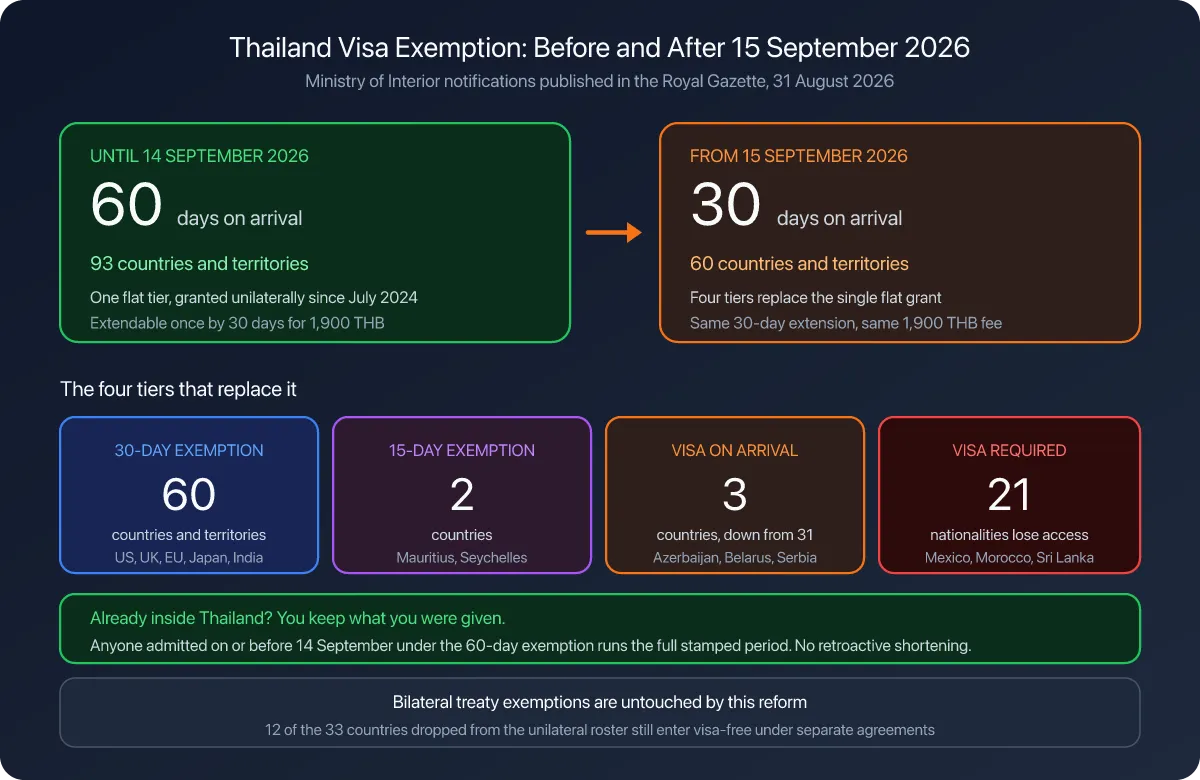
Tourist status is weaker still. Visa-exempt and tourist entries were never designed for any kind of work, and remote work on them remains a legal grey area we will cover separately in this series. With the visa exemption cut from 60 to 30 days for 60 nationalities from 15 September 2026 (details here), it is also becoming a less practical base.
There is one more line that runs through all of these routes, and no visa or permit changes it. Spend 180 days or more in Thailand in a calendar year and you are a Thai tax resident. A Non-B employee is taxed on Thai salary through payroll from day one, and foreign income remitted into Thailand while resident is taxable on top, under the rules we unpacked in our guide to Thailand's remittance rules. A remote worker on a DTV who stretches to a second 180-day stay in the same year hits the same line without ever touching the work permit system.
The Short Version
- Working for a Thai employer, Thai clients or the Thai market means a work permit. For most people that means a Non-B visa sponsored by a qualifying employer.
- The employer must pass the tests: 2 million THB paid-up capital and four Thai employees per foreigner, plus your nationality-based salary floor.
- 40 occupations are restricted, 27 of them completely, and 2026 enforcement is real.
- BOI-promoted companies, SMART S founders and LTR professionals have dedicated routes, each with its own floors.
- Remote work for foreign employers is what the DTV is for, and the DTV gives no access to a Thai work permit.
All figures here come from Thai government publications, the BOI, embassy guidance and law-firm summaries as of October 2026. Thresholds and enforcement are moving, so confirm the current numbers with the employer's immigration lawyer or the Department of Employment before you sign anything.
Whatever visa you hold, know your Thailand day count.
Nomad Tracker logs your days in every country automatically and alerts you at 150, 170 and 180 days, so the Thai tax residency line never surprises you. Plan future DTV entries or a job move with Ghost Trips before you book, and keep the Schengen calculator running alongside. All on-device and private. Available on iOS.
Download on the App Store