There is a version of the digital nomad story that gets repeated on podcasts and in Telegram groups: keep moving, never spend 183 days anywhere, and you become a tax resident of nowhere. No tax return, no tax bill, no country with a claim on you. It is the purest expression of what the offshore world calls flag theory, and for a stretch of the 2010s it genuinely worked for a small number of people who were careful and lucky.
In 2026 it is a much worse plan than its reputation suggests. Not because anyone passed a law banning it, but because three separate things changed at once: countries got stickier about letting residents go, banks stopped accepting "nowhere" as an answer, and the automatic exchange of financial data got wide enough that being invisible is no longer an option.
We built the day tracking in Nomad Tracker because this exact problem, knowing precisely where you were and for how long, is the load-bearing input for every one of these rules. So this is a piece written from inside that problem, not a sales pitch for any particular jurisdiction.
What the strategy actually claims
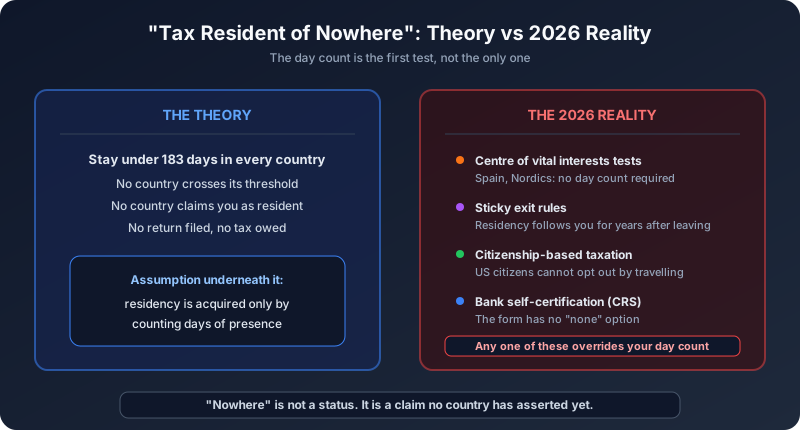
The perpetual traveler pitch rests on one assumption: that tax residency is a positive status you acquire by crossing a day threshold, and that if you never cross the threshold anywhere, you acquire nothing.
That assumption is only half true. The 183-day rule exists in most tax codes, and physical presence is the cleanest way to become a tax resident. But almost no country's residency test stops at day counting. Spend enough time reading actual statutes and a pattern shows up: the day count is the first test, and then there are three or four backup tests that catch you anyway.
Spain, for example, treats you as resident if you spend more than 183 days in the calendar year, or if the main base of your economic activities or interests is in Spain, regardless of days. There is also a rebuttable presumption of Spanish residency if your non-separated spouse and minor children habitually live in Spain. Nothing in that second and third test requires you to set foot in the country. Spain's three routes to residency are worth reading in full if you keep any ties there.
Problem one: residency is sticky on the way out
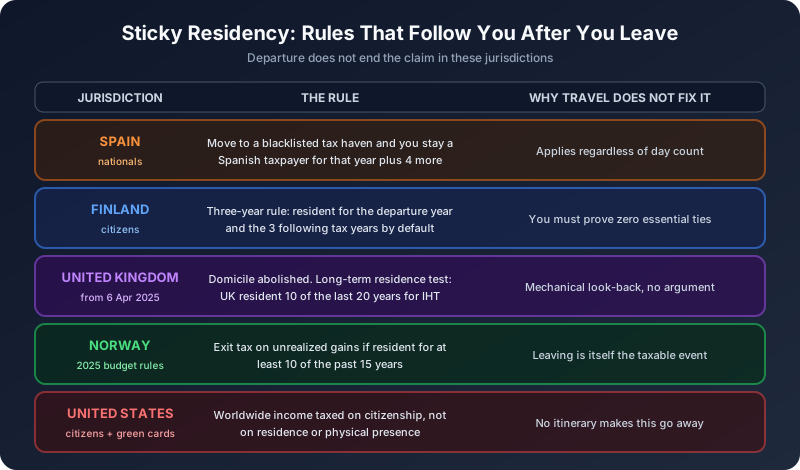
The strategy assumes leaving is symmetrical with arriving. It is not. Several countries have written rules specifically designed to keep taxing people who claim to have moved to nowhere in particular.
Spain's tax haven rule
If you are a Spanish national and you move your tax residence to a jurisdiction Spain classifies as a tax haven, you remain a Spanish personal income tax payer for the year of the move plus the following four years. Day counts do not save you. Spain also reserves the right to demand documentary proof that you were physically present in that destination for 183 days in the calendar year, which is a nasty catch for someone whose whole plan is not being anywhere for 183 days.
Finland's three-year rule
Finnish citizens who leave Finland normally stay Finnish tax residents for the year of departure and the three following tax years. Breaking out of it requires an affirmative request plus evidence that you retain no essential economic or social ties: no permanent home available, no Finnish spouse or minor children in Finland, no actively managed Finnish business or investment interests. The default is that you are still resident, and the burden of proof sits with you.
The UK's shift to long-term residence
The UK abolished the domicile concept from 6 April 2025, replacing it with a residence-based framework and a four-year foreign income and gains regime for new arrivals who were non-resident for the previous ten years. For inheritance tax, non-UK assets now fall in scope if you have been UK tax resident for at least ten of the previous twenty years. The old game of leaving while keeping a domicile argument alive got replaced by a mechanical look-back that nomadic travel does nothing to shorten.
Norway's exit tax
Norway has tightened its exit tax framework repeatedly, most recently through the 2025 national budget. It triggers for people who have been Norwegian residents for at least ten of the past fifteen years and applies to unrealized gains on substantial shareholdings. Leaving is the taxable event. Having no new residence does not make the event disappear.
US citizenship
The obvious one, and still the most consequential. US citizens and green card holders are taxed on worldwide income regardless of where they live or how many countries they touch. The Foreign Earned Income Exclusion helps, but it is a benefit you claim on a return you still have to file. A US citizen cannot be a tax resident of nowhere. They can only be a US tax resident with a complicated travel schedule.
Problem two: the bank will not let you say nowhere
This is where the strategy fails most often in practice, and it has nothing to do with tax authorities knocking on doors.
Under the Common Reporting Standard, adopted by more than a hundred jurisdictions, financial institutions are required to identify the tax residence of every account holder and collect a tax identification number. This is the self-certification form you fill in when you open an account. It has a field for country of tax residence, and it does not have a checkbox for "none."
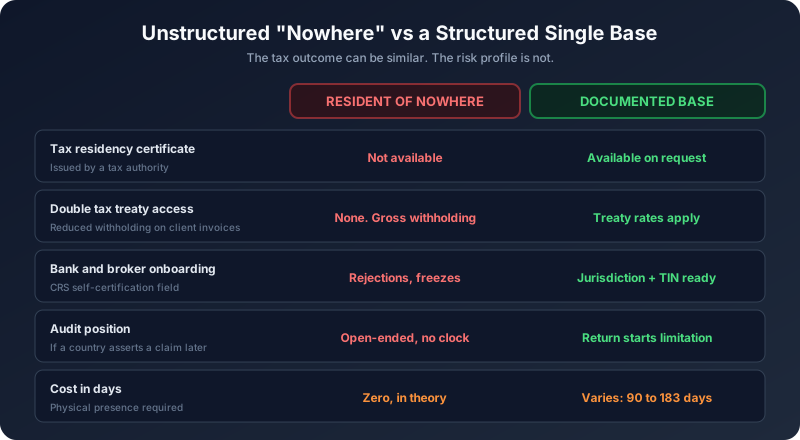
The practical consequences when you cannot produce a jurisdiction and a TIN are mundane and painful: applications rejected, existing accounts flagged for remediation, transactions held, and in some cases accounts closed. Compliance departments are not interested in your theory of statutory residency. They need a field populated, and the fallback is usually your country of citizenship or your last known address.
There is a second-order problem too. Double tax treaties are available to residents of a contracting state. If you are a resident of no state, you cannot obtain a tax residency certificate, and without one you cannot claim reduced withholding rates. A nomad invoicing clients in countries with withholding tax on services can end up paying gross withholding they would have avoided with a boring residency in a boring country.
The 2026 data layer
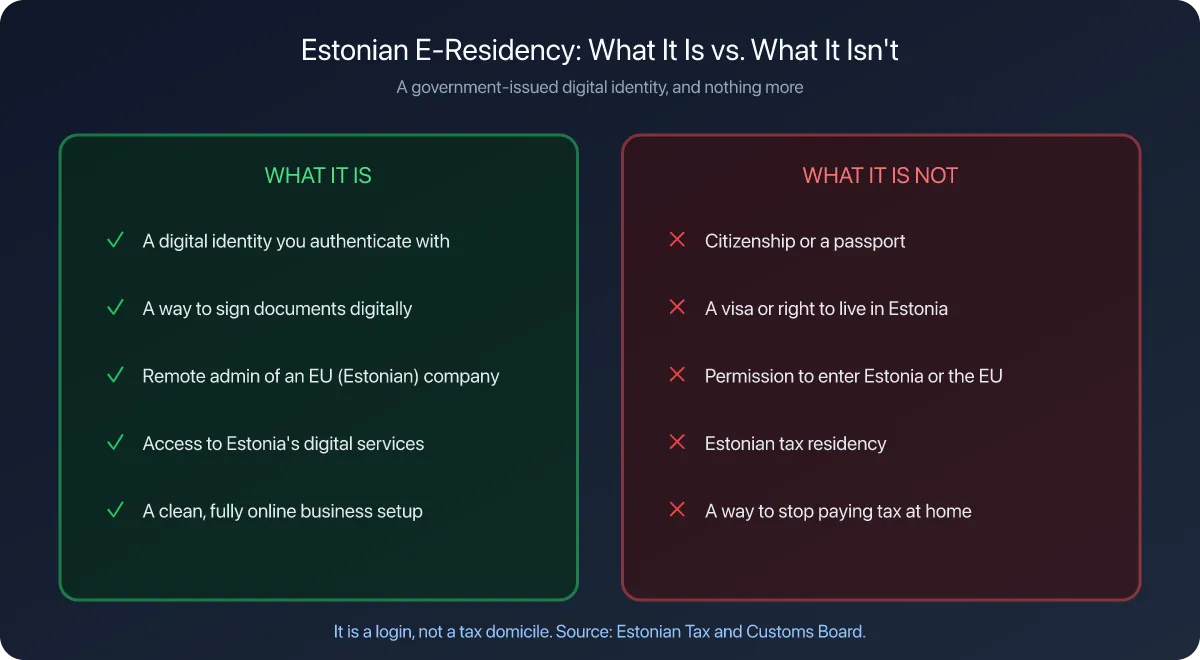
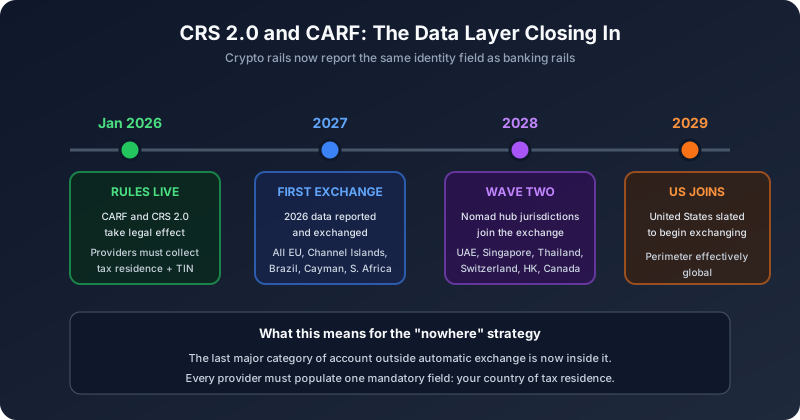
The reporting perimeter also got wider. The OECD's Crypto-Asset Reporting Framework and the expanded CRS 2.0 rules took legal effect on 1 January 2026 across participating jurisdictions. Crypto-asset service providers must now collect user tax residences and TINs and report transaction data to their domestic authority, with the first exchanges of 2026 data happening during 2027. The initial exchange group includes all EU countries plus jurisdictions such as the Channel Islands, Brazil, the Cayman Islands and South Africa, with a further wave including Australia, Canada, Hong Kong, Singapore, Switzerland, Thailand and the UAE, and the US scheduled later still.
The relevant point for nomads is not that crypto became taxable. It always was. The point is that the last significant category of financial account that sat outside automatic exchange has been pulled inside it, and the identity field those providers must fill in is, again, your country of tax residence.
Problem three: nowhere is not a defensible position, it is an unresolved one
The deepest issue is conceptual. "Tax resident of nowhere" is not a status any tax administration recognizes. It is a description of a situation in which no country has yet asserted a claim. That is a very different thing from a country having examined your facts and agreed you owe nothing.
Nobody issues you a certificate. Nothing is time-barred until a country opens an assessment and the clock starts. If Spain, Finland, Germany or Australia decides three years from now that your centre of vital interests was on their territory, the argument happens then, on their evidentiary terms, in their language, with penalties and interest attached to whatever they conclude. You will be trying to reconstruct where you slept in 2026 from boarding passes and card transactions.
Compare that to the position of someone who spent 2026 as an ordinary tax resident of Georgia, Cyprus, the UAE, Panama or any other jurisdiction with a light touch on foreign income. They have a certificate. They have a treaty. They have a return that started a limitation period. Their tax outcome might be identical, or close to it, but their risk profile is not remotely the same.
The version of this that still works
None of the above means geographic flexibility is dead. It means the unstructured version of it is. The structured version, which the offshore advisory world has quietly converged on, looks like this.
Pick a real base and make it real. One jurisdiction where you hold residency, file something, and can obtain a tax residency certificate. Low tax is fine. Zero substance is not. The UAE illustrates the gap neatly: its domestic 90-day route to residency is genuinely available to permit holders with a home or business there, but a treaty-purpose certificate from the Federal Tax Authority requires 183 days of physical presence in the relevant twelve-month period. Domestic residency and treaty-usable residency are different products with different price tags in days. Our full look at Dubai goes through what that actually costs in rent, insurance and time on the ground.
Sever the old ties deliberately, not passively. Deregistration where it exists, closing or reassigning the permanent home available to you, moving the economic centre, updating the self-certification at every bank and broker. Sticky-exit countries look at ties, not intentions.
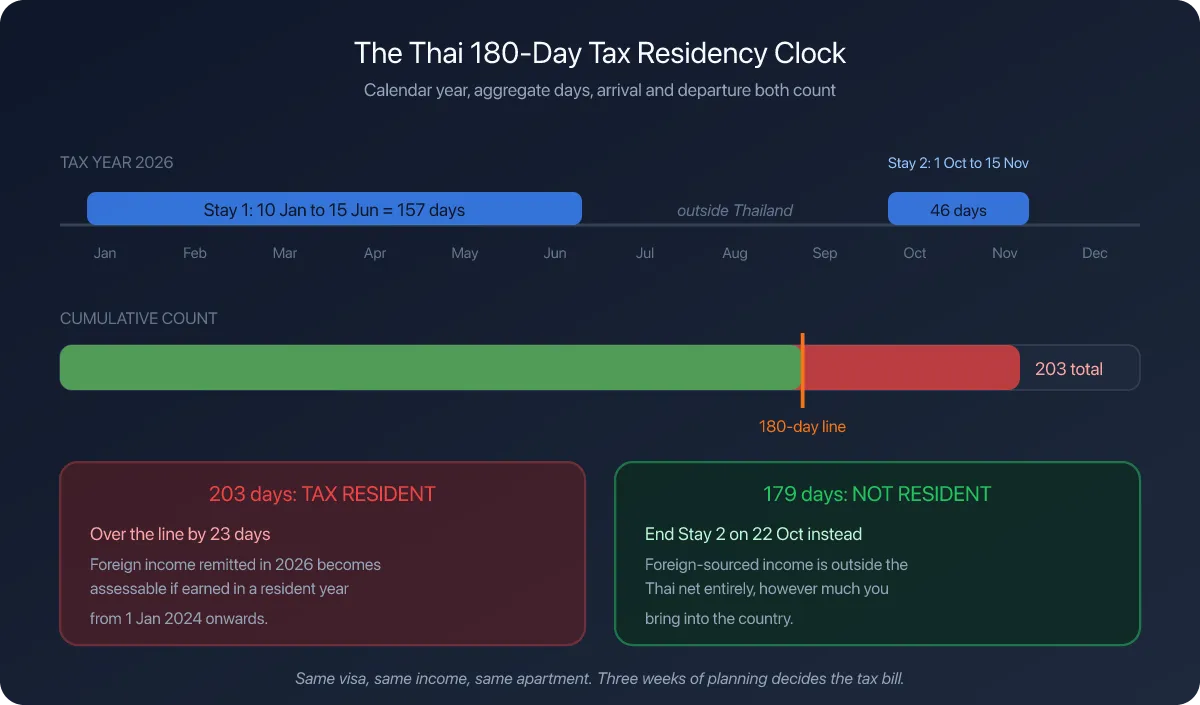
Stay under the thresholds everywhere else, and be able to prove it. This is the part people underestimate. The 183-day test is the easy one. Ireland has a look-back test across two years. Several countries count part-days as full days. Australia's tests reach well beyond day counts. The evidentiary burden in a residency dispute almost always sits with the taxpayer, and the evidence required is a day-by-day location history you cannot reconstruct after the fact.
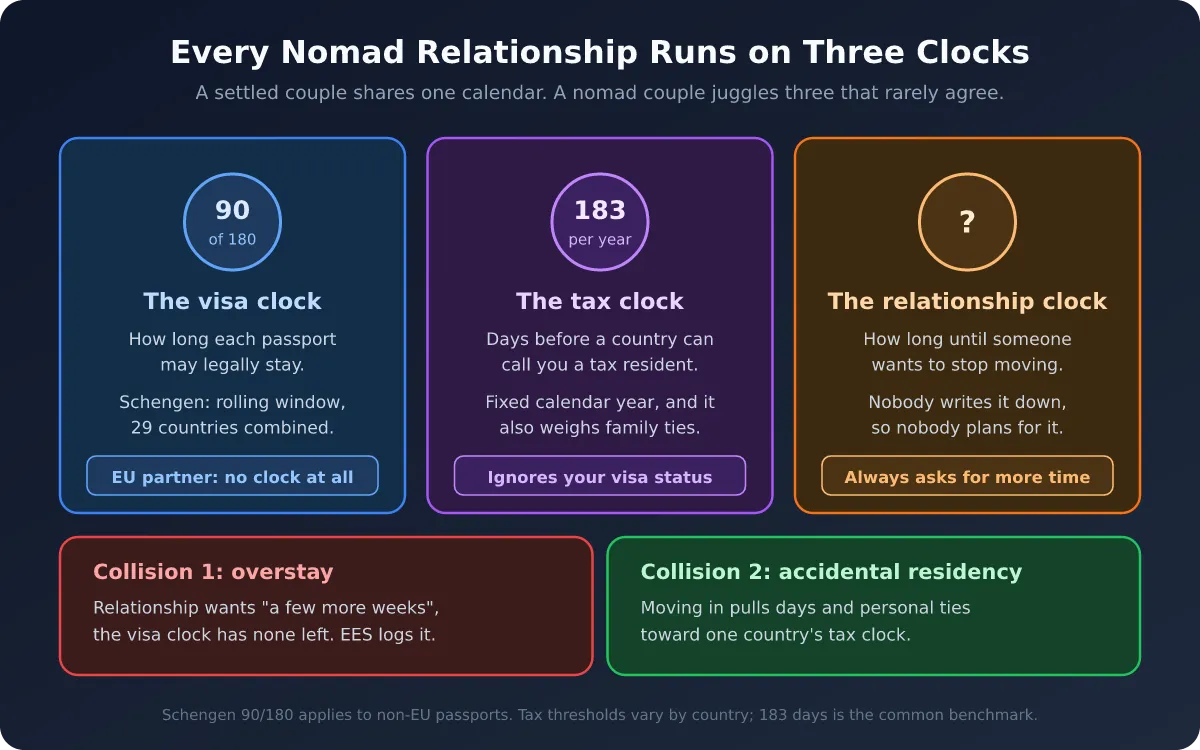
Track immigration and tax days separately. They are different calculations with different windows. Schengen runs on a rolling 180-day window. Tax residency mostly runs on calendar or fiscal years. A nomad who is fine on one can be in trouble on the other, and conflating the two is one of the most common errors we see.
What to do if you have been running the nowhere strategy
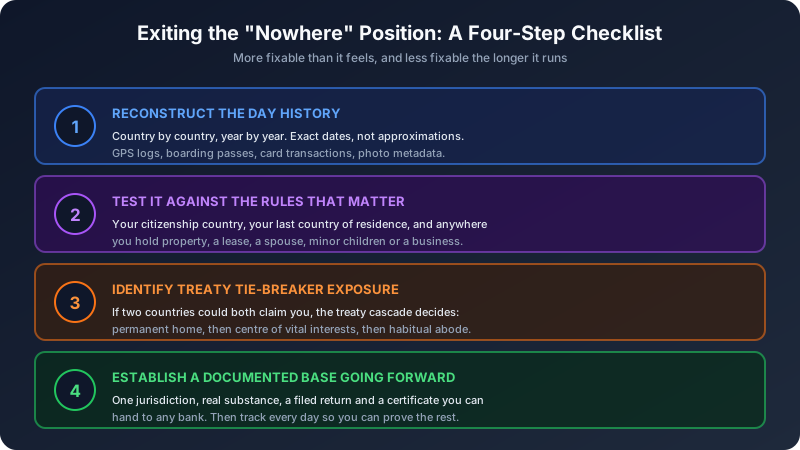
If this describes your last few years, the situation is usually more fixable than it feels, and it gets less fixable the longer it runs.
Start by reconstructing your actual day history as accurately as you can, country by country, year by year. Not approximations. Dates. Then check that history against the residency tests of your citizenship country, your last country of residence, and any country where you spent a meaningful block of time or hold property, a lease, a spouse or a business.
The output of that exercise is one of three things: you are clean and simply need to formalize a base going forward, you have a specific exposure in a specific year that a local adviser can quantify, or you have a tie-breaker situation under a treaty that needs resolving. All three are manageable. What is not manageable is discovering which one applies to you during an audit, without records.
The honest summary
Flag theory was never wrong about the underlying insight, which is that residency, citizenship, banking and business registration are separable and can be optimized independently. That remains true and remains useful.
What has changed is that the "no flag" variant, the one where you plant nothing anywhere and rely on falling through the cracks, depended on cracks that automatic information exchange has largely closed. The countries that mattered wrote sticky exit rules. The banks that mattered were handed a mandatory form with no null option. And from January 2026 the crypto rails got the same treatment as the banking rails.
The nomads doing this well in 2026 are not the ones with the cleverest structure. They are the ones with the cleanest records.
Track the days that decide this
Every rule in this article turns on the same input: exactly which country you were in, on exactly which dates. Nomad Tracker logs that automatically using your phone's GPS, entirely on-device, with per-country tax residency counters running alongside the Schengen rolling window so you can watch both at once. Fiscal alerts fire well before you approach a 183-day threshold, and Ghost Trips let you simulate a planned itinerary to see which countries it would push you into before you book anything.
Your day history is your only defense.
Nomad Tracker automates per-country day counting, fiscal residency alerts, and Schengen tracking -- all on-device, all private. Available on iOS.
Download on the App Store