For about fifteen years the Thai education visa had a second, unofficial job. Officially it was for students. Unofficially it was the cheapest way for a remote worker to stay in Thailand for a year: enrol at a language school, pay a package fee, show up when you felt like it, and extend every 90 days. Whole Chiang Mai neighbourhoods ran on that arrangement.
Two things ended it. In 2024 the Destination Thailand Visa (DTV) gave remote workers a legitimate long-stay option of their own. And through 2025 and 2026, immigration and the Ministry of Education started checking whether ED students actually study. This guide covers the Non-Immigrant ED visa as it works in late 2026: the routes it covers, the attendance rules, the costs, the extension cycle, and an honest answer to whether it still makes sense for a nomad.
A note on sourcing before we start. Thailand publishes very little about ED visas in one place. Fees and documents come from Thai embassy pages, which vary by mission. Attendance thresholds and enforcement figures come mostly from visa agencies, school guidance and community reports, and they do not always agree. Where a number is reported rather than official, we say so.
What the ED Visa Is (and What It Is Not)
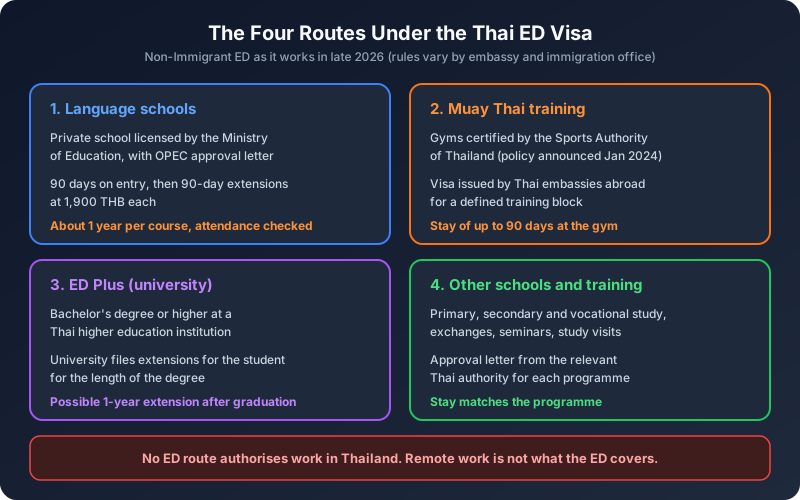
The Non-Immigrant ED is Thailand's visa for people whose reason for being in the country is study or training. It is not a single product. In practice it covers four distinct routes:
Language schools. Thai (and in principle other languages) at a private school licensed by the Ministry of Education. This is the route most nomads mean when they say "ED visa," and it is the one that has been tightened the most.
Muay Thai and other training. Since a January 2024 policy announcement, Thai embassies can issue a Non-ED visa for training at Muay Thai gyms certified by the Sports Authority of Thailand, with a stay of up to 90 days at the gym. Some embassies list Muay Thai alongside seminars, workshops and study visits under the same ED heading.
University degrees: ED Plus. Thai embassy pages now describe a separate "ED Plus" for students on a bachelor's degree or higher at a Thai higher education institution. The university files extensions on the student's behalf, and embassy pages describe a possible one-year extension after graduation to look for work or travel.
Other schools and programmes. Primary, secondary and vocational study, exchange programmes, and some professional training, each with its own approval letter from the relevant Thai authority.
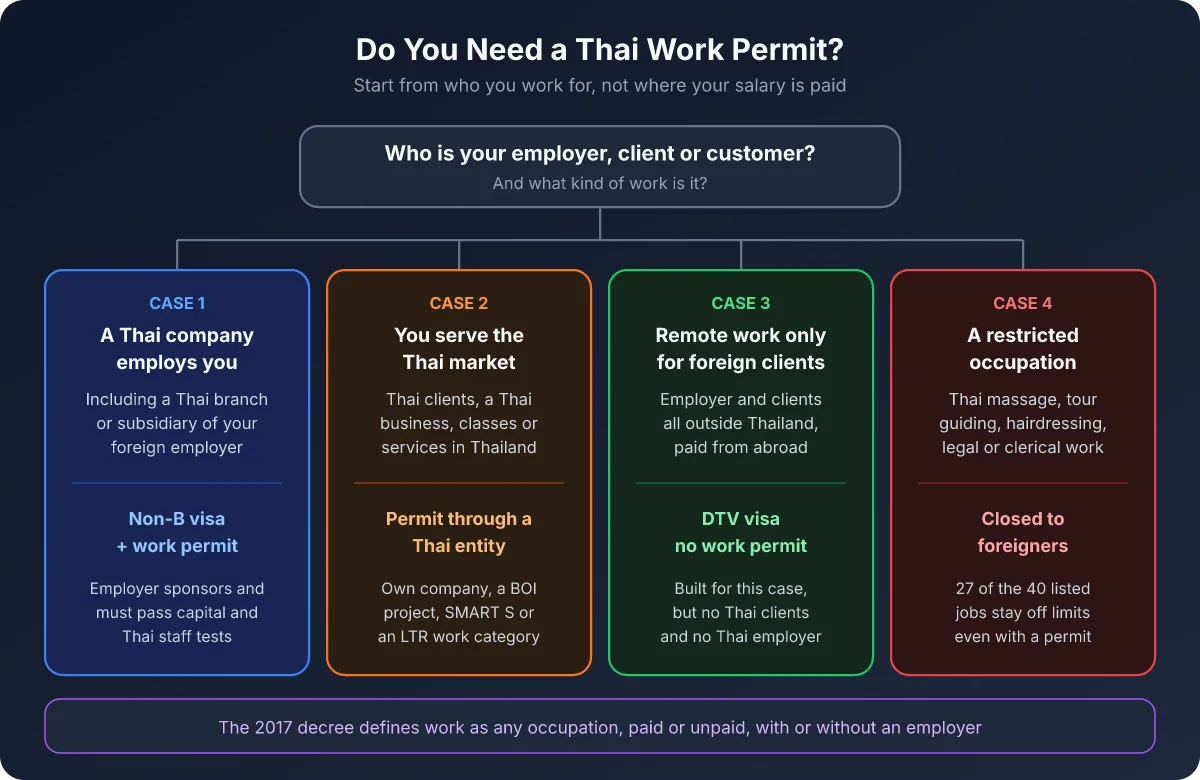
What the ED is not: a work visa. No ED route on its own authorises work in Thailand, and remote work for foreign clients is not something the ED was designed to cover. Reports on whether ED Plus allows limited part-time work for degree students conflict, and universities themselves tell students to check before taking any job. If you need to work for a Thai employer, the route is a Non-B visa and work permit, covered in our Non-B and work permit guide.
Applying: Documents, Money and Fees
You apply through the Thai e-visa portal (thaievisa.go.th) or the embassy that covers your country of residence. As with every Thai long-stay visa, what each mission asks for differs, so read the page of the specific embassy you will apply through.
The common core for a language-school ED:
- Letter of acceptance on the school's letterhead, signed by an authorised person and stamped with the school seal, stating the course, its length and the hours.
- A copy of the school's licence or registration, and for private schools a letter from the Office of the Private Education Commission (part of the Ministry of Education) approving the student's enrolment.
- Proof of tuition payment for the course.
- Financial evidence. Requirements vary widely. The Royal Thai Consulate in Los Angeles, for example, asks short Thai or English course applicants for a bank statement with a balance of at least 1,000 USD. Other missions ask for more, or for proof of full tuition payment instead.
- Passport, photo and application form, with documents not in Thai or English translated and certified.
Fees. The most consistently reported embassy fees are 2,000 THB for a single-entry ED visa and 5,000 THB for a multiple-entry version, charged in local currency at the mission's own rate. In-country extensions cost 1,900 THB each.
Compare that financial bar with the DTV's 500,000 THB. For someone who genuinely wants to learn Thai and does not have half a million baht sitting in an account, this is the single biggest reason the ED still exists as an option.
The Language School Year: How the Clock Works
Here is the cycle as language schools and immigration offices describe it in 2026.
Day 1 to 90: the visa stay. You enter on the ED visa and receive 90 days.
Extensions every 90 days. Before each 90-day period ends, you apply at your local immigration office for a further extension of stay, typically up to 90 days, with a TM.7 form, a 1,900 THB fee, your passport and photos, and a fresh letter from the school confirming enrolment and attendance. The school prepares that letter, and it is where attendance problems surface.
The ceiling: about one year per course. For language and other non-degree study, reports consistently describe the total stay as capped at about one year from the date of entry for a given course. Continuing beyond that generally means enrolling in a different course level and, in most cases, applying for a new ED visa from outside Thailand. Whether there is a lifetime cap on consecutive years of language study is not stated clearly anywhere official. Forum reports range from "no limit" to two or three years at one school, and repeated applications draw scrutiny either way.
A worked example
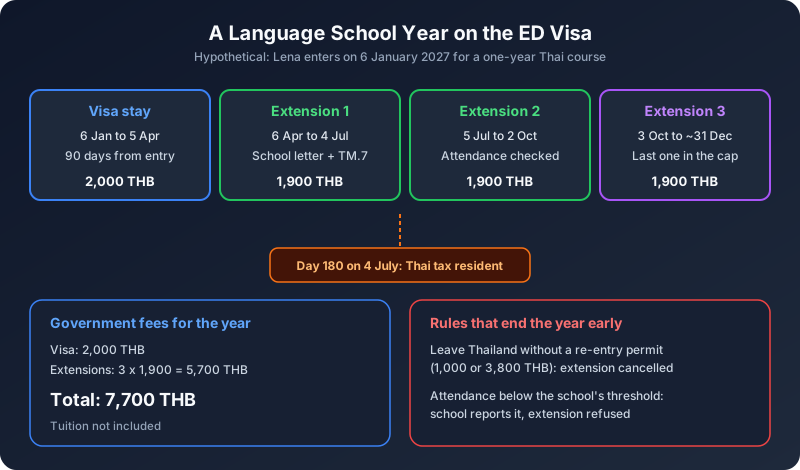
Imagine Lena, a German citizen, who enrols for a year of Thai at a licensed Chiang Mai school and enters on 6 January 2027.
| Period | Dates (approx.) | What happens | Fee |
|---|---|---|---|
| Visa stay | 6 Jan to 5 Apr | 90 days from entry | 2,000 THB visa |
| Extension 1 | 6 Apr to 4 Jul | School letter, TM.7, attendance checked | 1,900 THB |
| Extension 2 | 5 Jul to 2 Oct | Same again | 1,900 THB |
| Extension 3 | 3 Oct to about 31 Dec | Final extension inside the one-year cap | 1,900 THB |
Government fees for the year: 2,000 + (3 × 1,900) = 7,700 THB, before tuition. Each extension also resets her 90-day reporting clock, since she is at immigration anyway.
Two traps in that year. First, if Lena flies to Bali in May without buying a re-entry permit (1,000 THB single, 3,800 THB multiple), leaving Thailand cancels her extension and she cannot come back on it. Second, by early July she has passed 180 days in Thailand for 2027, which makes her a Thai tax resident for that year. More on that below.
The Crackdown on Visa-Mill Schools
The old model was simple: some schools sold "visa packages" where the course existed on paper and attendance was optional. A one-year ED "all included" was widely quoted on forums at around 40,000 THB. The student got the visa, the school got the fee, and nobody sat in a classroom.
That model has been squeezed from several directions:
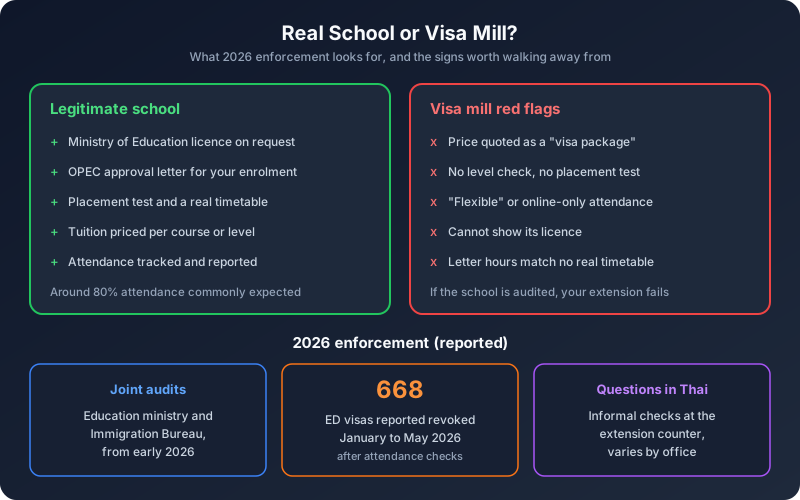
Attendance is reported, not assumed. Schools are expected to report students who fall below the attendance requirement, and an extension can be refused or the permission revoked when that happens. Many agencies and schools cite roughly 80% attendance as the working threshold, with figures of around four hours of class per week quoted for language courses. Neither number appears in a single official document we could find, so treat them as the practical expectation, not a statute.
Coordinated audits. Visa trackers report that the Ministry of Education and the Immigration Bureau began joint audits of language schools and training centres sponsoring ED visas in early 2026. One report puts the number of ED visas revoked between January and May 2026, after attendance records were checked with schools, at 668. Other sites quote far larger totals that we could not reconcile with any primary source.
Officers test the story. Community reports through 2025 and 2026 describe immigration officers asking ED students simple questions in Thai at the extension counter. Older reports of formal Ministry of Education exams are contradicted by later ones, so this appears to be informal and office-dependent. The practical point holds anyway: six months into a Thai course, an officer expects you to manage a basic exchange.
The DTV door closed. Thai language schools were removed from the DTV Soft Power list in 2025, as our DTV guide explains. That pushed language students back onto the ED at the same time the ED was being policed.
Signs a school is a visa mill
- The price is quoted as a "visa package" rather than tuition for a course.
- Nobody asks about your level, and there is no placement test.
- You are told attendance is "flexible" or that you can study online from anywhere.
- The school cannot show its Ministry of Education licence.
- Class hours on the acceptance letter do not match any real timetable.
A school like that is not just poor value. If the school is audited, your extension is the one that fails.
What It Actually Costs
Tuition at private language schools is reported in a range of roughly 20,000 to 50,000 THB a year, with some schools charging per level (25,000 to 30,000 THB a term is a common quote) and group classes at major Bangkok schools running a few thousand baht a month. One 2026 guide puts the all-in annual cost of a Thai language or Muay Thai track, school plus visa fees, at 35,000 to 80,000 THB. Confirm prices directly with each school, since none of the large schools publish a single comparable figure.
Muay Thai is the expensive end. Serious gym programmes charge by the month and include multiple daily sessions, so a 90-day ED training block costs far more than a language course with a few hours of class a week.
ED vs DTV over one year
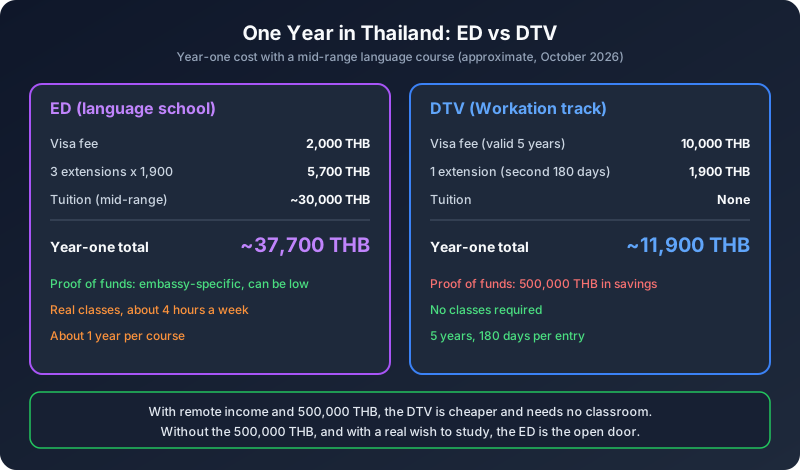
Here is the honest comparison for a single year in Thailand, using a mid-range language course for the ED and the standard DTV figures.
| ED (language school) | DTV | |
|---|---|---|
| Visa fee | 2,000 THB | 10,000 THB (valid 5 years) |
| Extensions | 3 × 1,900 = 5,700 THB | 1 × 1,900 THB for a second 180 days |
| Tuition | about 30,000 THB | none on the Workation track |
| Money shown | varies by embassy, can be low | 500,000 THB |
| Year-one total | about 37,700 THB | about 11,900 THB |
| Time commitment | real classes, about 4 hours a week | none |
| Years covered | about 1 per course | 5 |
For someone with remote income and the 500,000 THB, the DTV is cheaper, needs no classroom time, and lasts five years. That is why most nomads who once lived on ED visas have moved across. Our DTV extensions and re-entry guide covers how the 180-day blocks work in practice.
Who the ED Still Makes Sense For
The ED is no longer the default nomad visa, but it has not become pointless. It fits a smaller, clearer group:
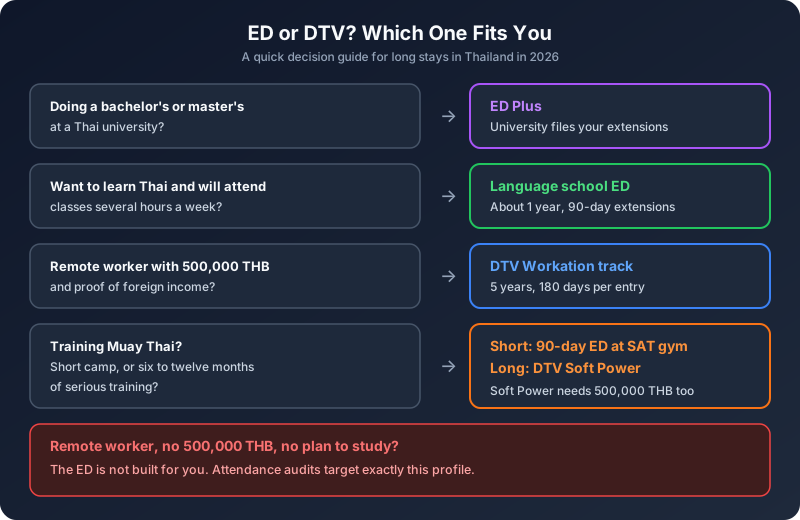
People who actually want to learn Thai. A year of structured classes, a visa built around them, and an immigration officer who is satisfied rather than suspicious when you answer in Thai.
People without 500,000 THB. Students, career changers and younger travellers who cannot meet the DTV's financial requirement, and who will genuinely attend.
Degree students. ED Plus is the correct route for a bachelor's or master's at a Thai university, and the post-graduation extension, where granted, gives time to find a job and switch to a Non-B.
Serious fighters on a short block. A 90-day Muay Thai ED at an SAT-certified gym suits a defined training camp. For six to twelve months of training, the DTV Soft Power track is usually the better fit, with five-year validity and 180 days per entry.
It does not fit someone who wants a year in Chiang Mai to work remotely and has no intention of studying. That person is exactly who the audits are looking for, and remote work is not something the ED covers. With the visa exemption cut to 30 days for most Western passports from 15 September 2026 (details here), the fallback of stacking tourist entries has shrunk too.
The Tax Line a Student Year Crosses
A year on an ED visa is a year living in Thailand, and anyone in Thailand for 180 days or more in a calendar year is a Thai tax resident for that year. Lena in the example above crosses that line in early July.
Being a student does not change the test. What changes is the question of what money you bring in. Since 1 January 2024, foreign income remitted to Thailand by a tax resident can be taxable, which matters if you are living on current earnings rather than savings built up before 2024. Tuition, rent and daily spending paid from a foreign account or card are all remittances in principle. Our Thailand tax guide for nomads explains the 180-day count, the remittance rules and the legitimate planning options. If your year will be funded from current income, it is worth having a Thai tax adviser look at it before you arrive.
All figures in this article come from Thai embassy and consulate pages, the January 2024 Muay Thai visa announcement, visa trackers, school guidance and community reports, as of October 2026. ED rules are applied with real discretion by individual embassies and immigration offices, and several enforcement figures circulating online could not be confirmed against a primary source. Check with the embassy you will apply through and with your school before you commit.
Studying in Thailand for a year? Know your day count.
Nomad Tracker logs your days in every country automatically and alerts you at 150, 170 and 180 days, so the Thai tax residency line never catches you by surprise. Map out extension dates and trips home with Ghost Trips, plan DTV entries if you switch visas, and keep the Schengen calculator running for Europe. All on-device and private. Available on iOS.
Download on the App Store