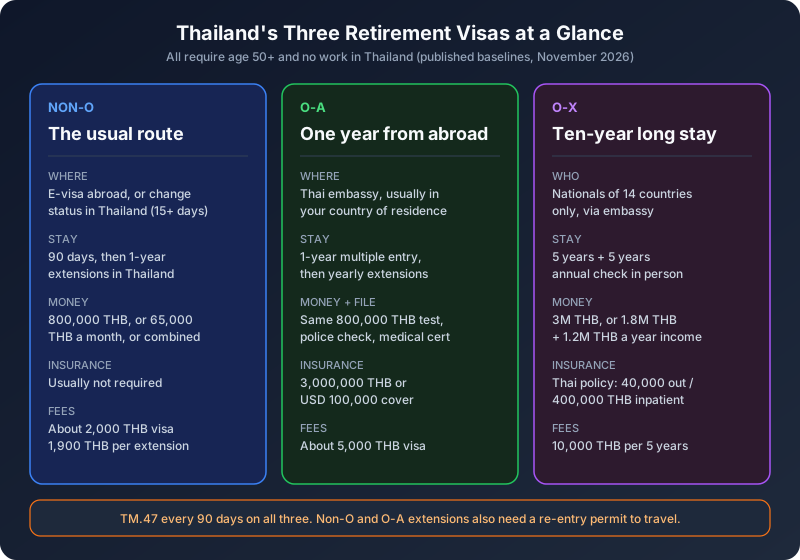
Thailand has three visas that people loosely call "the retirement visa", and they are not interchangeable. The Non-O is the cheap, flexible route most retirees actually use. The O-A is the one-year version obtained from abroad, with a police check, a medical certificate and mandatory health insurance. The O-X is the ten-year option that only fourteen nationalities can apply for.
All three start from the same place: you must be 50 or older and able to support yourself without working. They differ on where you apply, what you prove, how often you see immigration, and how much money sits in a Thai bank. This guide covers each as the rules stand in November 2026, then compares them with the LTR Wealthy Pensioner category, which beats all three for some retirees.
The figures come from Thai embassy pages, Ministry of Foreign Affairs guidance and the Thai government portal, cross-checked against 2026 legal guides and community reports. Local offices apply the retirement rules with real discretion, especially on seasoning and insurance, so treat every number as the published baseline.
The Common Ground: Age 50 and the Money Test
For the Non-O and the O-A, the financial test is 800,000 THB, met in one of three ways:
- Deposit: at least 800,000 THB in a Thai bank account in your own name.
- Income: at least 65,000 THB a month, typically a pension.
- Combination: a Thai bank balance plus twelve months of income totalling at least 800,000 THB.
2026 legal guides report that, as of late October 2026, no announcement, draft or Cabinet decision to change the 800,000 THB, the 65,000 THB or the age-50 threshold had been published, despite recurring rumours. The O-X has its own, much higher test.
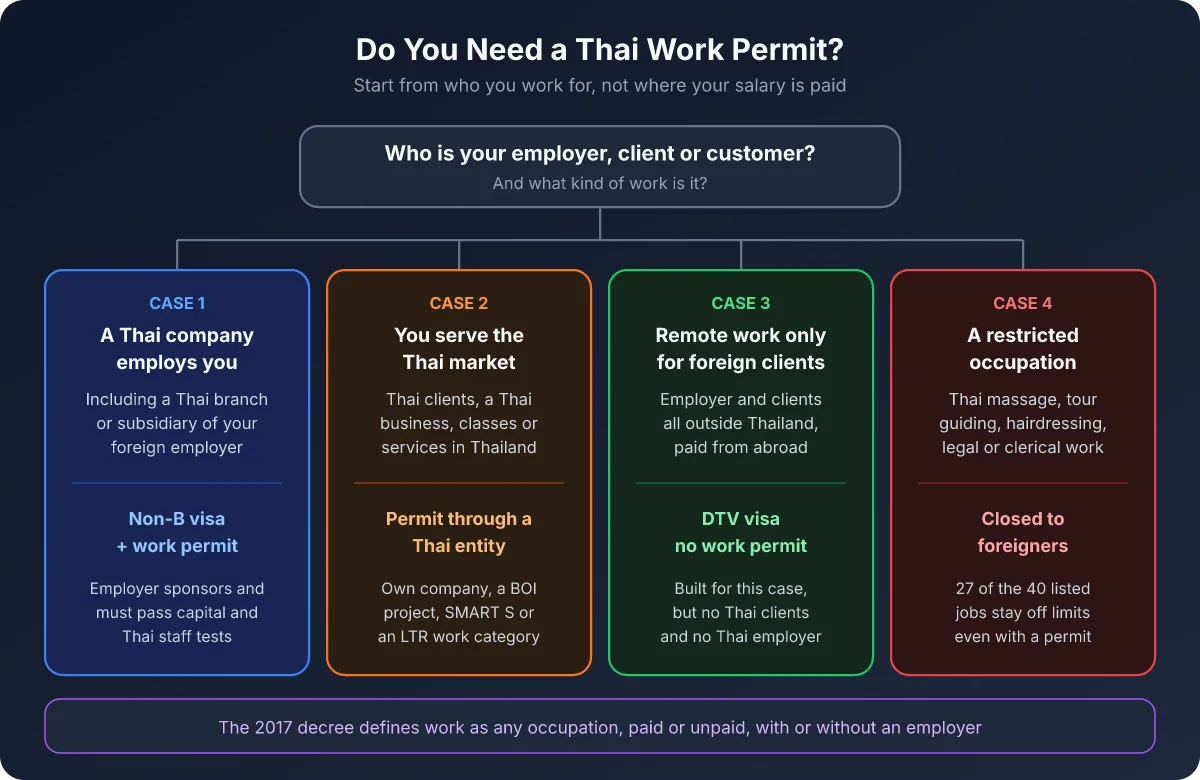
None of the retirement visas allows work, paid or unpaid. A retiree who starts helping at a friend's bar or consulting for a Thai company needs a different status, which our Non-B and work permit guide explains.
The Non-O: The Route Most Retirees Use
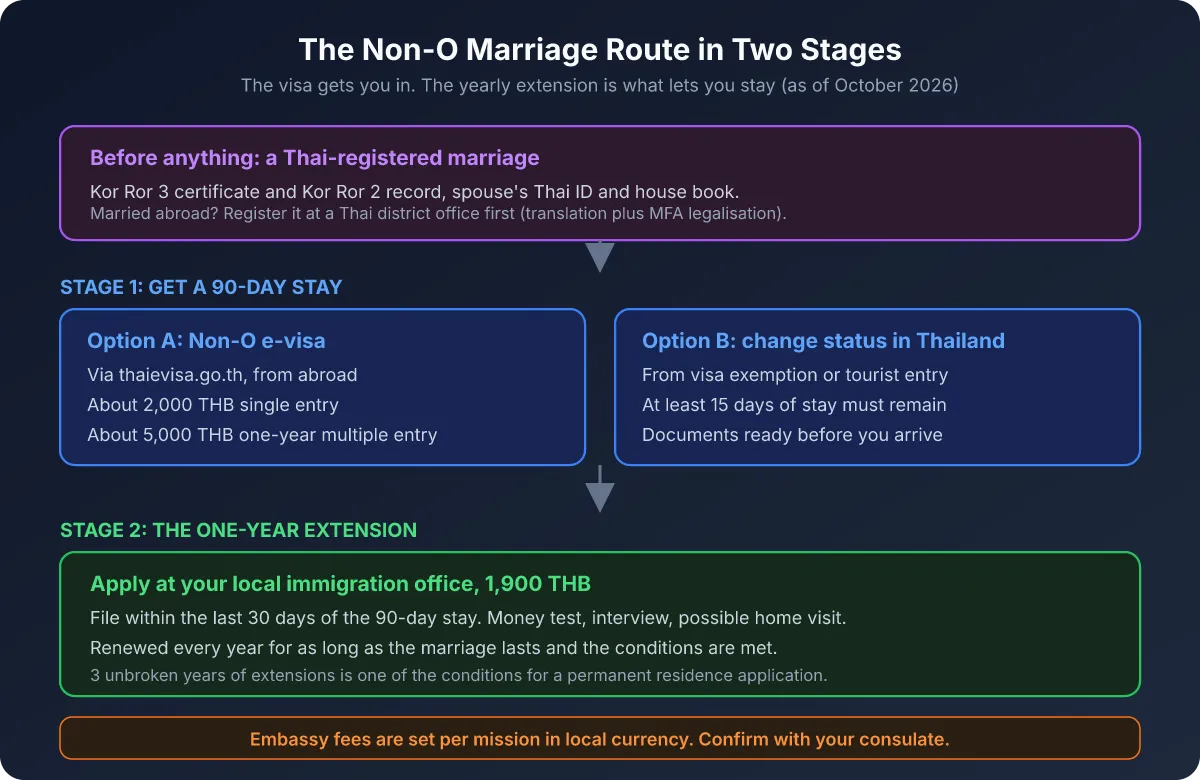
The Non-O retirement route has two steps, like the Non-O marriage route: a short entry visa, then a one-year permission to stay granted inside Thailand.
Step 1: the 90-day Non-O. You apply through the Thai e-visa portal before travelling, for a fee commonly cited as 2,000 THB (each embassy sets its own figure in local currency), with proof of age and of funds or pension income. Legal guides also describe an in-country change of status from a tourist entry or visa exemption, provided at least 15 days remain on your stay. With the exemption cut to 30 days for most Western passports from 15 September 2026 (details here), that margin comes quickly, so have your documents ready before you land.
Step 2: the one-year extension. In the last 30 days of your 90-day stay, you apply at your local immigration office and pay 1,900 THB. You then repeat this every year for as long as you meet the conditions, with no limit on the number of renewals.
In most offices, the Non-O extension does not require health insurance. 2026 guides agree there is no national insurance condition for it, though at least one reports some offices asking anyway. Ask your office in advance.
The extension pack
Reported 2026 practice: the TM.7 form, passport, copies and a photo; your Thai bank book updated on the day plus a bank letter confirming the balance; for the income route, an embassy income letter or twelve months of international transfers; a TM.30 residence notification; and the fee. Many offices give an "under consideration" stamp before the final year.
Around the extension sit the usual duties: a TM.47 report every 90 days in Thailand, and a re-entry permit (1,000 THB single, 3,800 THB multiple) before every trip abroad. Leaving without one cancels the extension. Our DTV day-math guide covers TM.47 and TM.30 in detail.
Seasoning: The Rule That Catches People Out
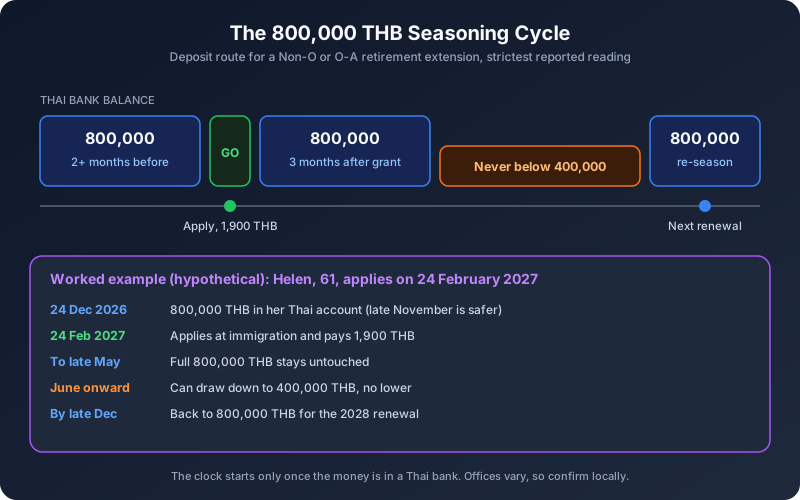
The 800,000 THB is not a balance you flash on the day. It has to be "seasoned", under rules that trace back to a 2019 Immigration Bureau order. As reported across 2026 guides and community sources:
- Before applying: the full 800,000 THB sits in your Thai account for at least 2 months. Some offices want three months of history at renewal.
- After approval: it stays there for 3 months.
- For the rest of the year: the balance can fall, but never below 400,000 THB.
- Before the next renewal: it is back up to 800,000 THB in time to season again.
Some guides omit the 400,000 THB floor and some offices ask for a full year of statements. The safe assumption is the strictest one: the 800,000 THB is untouchable for about five months a year, and 400,000 THB is untouchable all year.
Worked example
Imagine Helen, a hypothetical 61-year-old retired nurse from Ireland in Hua Hin, whose extension expires on 20 March 2027. She plans to apply on 24 February 2027.
- By 24 December 2026: 800,000 THB in her Thai account (late November is safer, for three months of history).
- 24 February 2027: she applies and pays 1,900 THB.
- Until late May 2027: the 800,000 THB stays untouched.
- June 2027 onward: she can draw down to 400,000 THB, no lower.
- By late December 2027: back to 800,000 THB for the next cycle.
The clock only starts once the money lands in a Thai bank. A foreign balance does not count, a mistake Thai lawyers flag often.
Income and Combination Routes
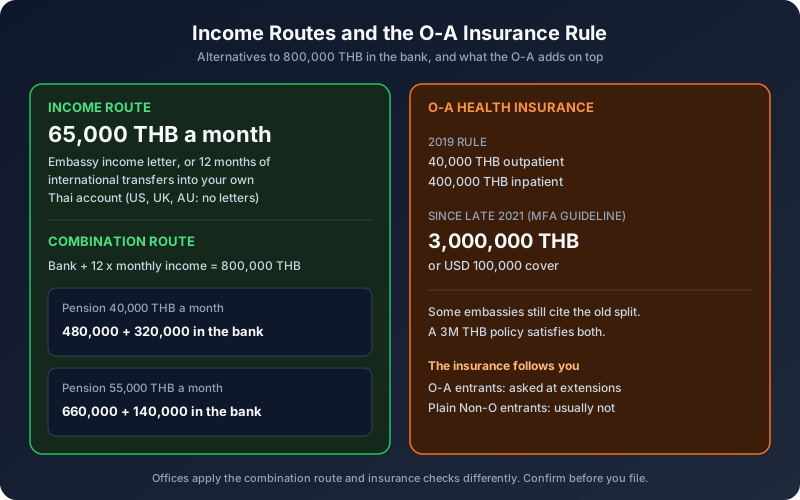
65,000 THB a month. This used to be proven with an embassy income letter. Several embassies, including those of the United States, the United Kingdom and Australia, no longer issue them, so applicants from those countries typically show twelve months of transfers of at least 65,000 THB each, sent from abroad into their own Thai account. Community reports say transfers that do not appear as international transfers on a Thai statement may be rejected.
The combination. Bank balance plus twelve times monthly income must reach 800,000 THB. A hypothetical retiree with a pension of 40,000 THB a month has 480,000 THB a year, so needs at least 320,000 THB seasoned in the bank. At 55,000 THB a month, the bank part drops to 140,000 THB. Offices do not all apply the combination identically, so confirm it in advance.
The O-A: One Year From Abroad, With Insurance
The O-A is issued by a Thai embassy or consulate, usually in your country of nationality or residence, as a one-year multiple-entry visa, with a fee commonly listed at 5,000 THB or the local equivalent. The money test is the same, but the file is heavier: a police clearance, a medical certificate and health insurance for the whole stay.
The original 2019 rule asked for 40,000 THB outpatient and 400,000 THB inpatient cover. Since late 2021, the Ministry of Foreign Affairs guideline and embassy pages such as Madrid's set a minimum of 3,000,000 THB or USD 100,000. Some embassies still cite the old split, so check yours; a policy at the higher level satisfies both.
The appeal is a full year on arrival rather than 90 days and an immigration visit. Community reports add that each entry while the visa is valid is commonly stamped for up to a year, so a last entry just before expiry can stretch the first period well beyond twelve months. After that, you extend in Thailand on the same 1,900 THB cycle.
The catch is that the insurance follows you. Agency and community reports say offices ask holders whose stay began on an O-A to keep showing compliant insurance at each extension, while retirees who entered on a plain Non-O usually are not asked. For a 70-year-old, that policy can cost more each year than every visa fee combined, which is why many retirees deliberately choose the Non-O.
The O-X: Ten Years, Fourteen Nationalities
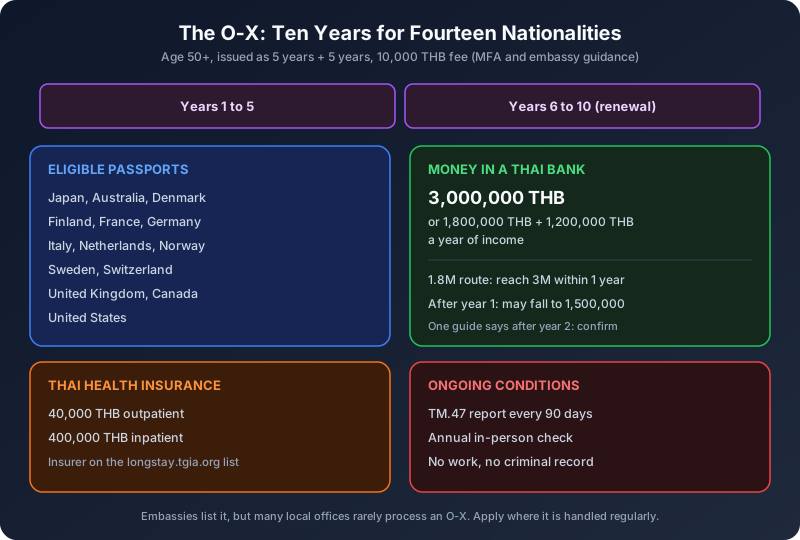
The Ministry of Foreign Affairs describes the O-X as allowing nationals of 14 countries to stay up to 10 years, issued as five years plus five.
- Who: aged 50 or over, from Japan, Australia, Denmark, Finland, France, Germany, Italy, the Netherlands, Norway, Sweden, Switzerland, the United Kingdom, Canada or the United States.
- Money: 3,000,000 THB in a Thai bank, or 1,800,000 THB plus annual income of 1,200,000 THB. MFA-hosted guidance says the 1.8 million route must reach 3 million THB within a year of entry. After the first year the balance may reportedly fall to 1,500,000 THB, though one guide places that after the second year, so confirm with the embassy.
- Insurance: a Thai policy for the whole stay with at least 40,000 THB outpatient and 400,000 THB inpatient cover, from an insurer on the list at longstay.tgia.org.
- Other: no criminal record, a medical certificate, a 10,000 THB fee, TM.47 every 90 days and an annual in-person check at immigration.
The O-X trades a far bigger deposit for far less paperwork: no annual extension application, one fee per five years. The reality check is that a Pattaya Mail review of Thai retirement options described the scheme as largely neglected, with no updates from the Immigration Bureau or Cabinet since launch. Embassy pages still list it. If you are eligible, apply through an embassy that processes it regularly and expect to explain it at your local office.
Ten Years, Side by Side
Government fees for a hypothetical ten-year stay, excluding re-entry permits, translations and agents:
| Non-O | O-A | O-X | |
|---|---|---|---|
| Visa fee | About 2,000 THB once | About 5,000 THB once | 10,000 THB per 5 years |
| Extensions | 1,900 THB x 10 | 1,900 THB x about 9 | None |
| Total fees, 10 years | About 21,000 THB | About 22,000 THB | About 20,000 THB |
| Money in a Thai bank | 800,000 THB, less with income | Same as Non-O | 3,000,000 THB, then 1,500,000 THB |
| Insurance | Usually not required | 3,000,000 THB cover | Thai policy required |
On fees the three are nearly identical. The real choice is between locking up a large deposit (O-X), buying a high-cover policy (O-A), or accepting a yearly trip to immigration (Non-O).
Where the LTR Wealthy Pensioner Beats All Three
For retirees with a substantial foreign pension, the BOI's Long-Term Resident visa has a Wealthy Pensioner category. Our LTR qualification guide covers the process; the headlines:
- Aged 50 or over
- USD 80,000 a year in pension or passive income, or USD 40,000 plus USD 250,000 in Thai bonds, FDI or property
- Health insurance of at least USD 50,000, Thai social security, or a USD 100,000 deposit
- A 50,000 THB fee for ten years, issued as five plus five
- Annual address reporting instead of every 90 days, and no re-entry permit
No seasoned 800,000 THB, no annual extension, no quarterly TM.47. Wealthy Pensioners were the largest category in the BOI's October 2026 approval figures, covered in our LTR guide. The category also carries a statutory exemption on remitted foreign income, which no retirement visa offers; the LTR tax breakdown explains where it helps and where it does not.
Two hypothetical cases show where the line falls:
- Margaret, 66, retired US executive, with USD 95,000 a year in pension and dividends. She clears the LTR test, pays 50,000 THB once, reports yearly and never seasons a baht.
- Tom, 58, retired UK electrician, with a pension of about 55,000 THB a month. He cannot reach USD 40,000. The Non-O combination route (660,000 THB of income plus at least 140,000 THB seasoned) is his path.
The Tax Line Nobody Mentions at the Counter
A retirement visa is built for people who live in Thailand, and people who live in Thailand cross 180 days in a calendar year. At that point you are a Thai tax resident, and foreign income you bring in, pensions included, can become taxable under the remittance rules in force since 1 January 2024.
The income route, twelve months of 65,000 THB transfers, is a documented record of remitting foreign income. Whether tax is due depends on the source of the money, when it was earned and your country's treaty with Thailand. Under the standard treaty model, government service pensions are often taxable only in the paying country, while private pensions are often taxable where you live, but each treaty differs. The draft exemption for income remitted in the year it is earned or the year after was still not law as of late October 2026, according to 2026 guides.
None of this is tax advice. It is the reason a Thai tax adviser should look at how you fund your visa before you set up a transfer pattern you will repeat for a decade. Our Thailand tax guide for nomads covers the 180-day test, the remittance rules and the legal planning options.
Which One Fits
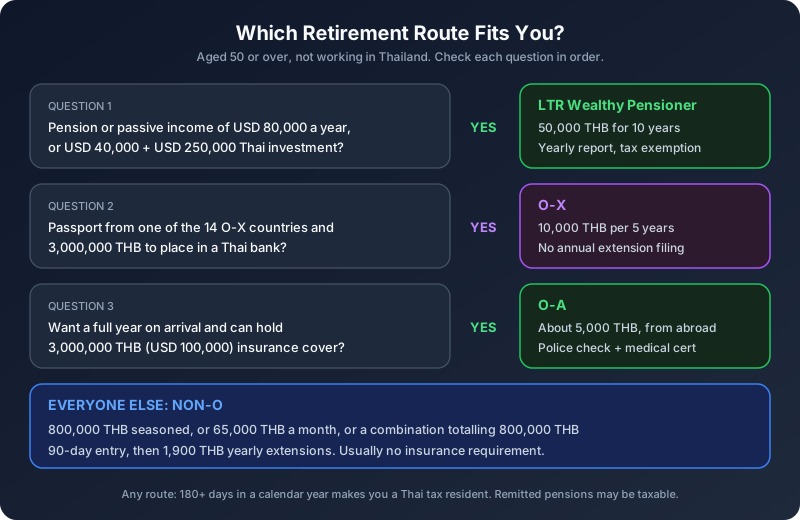
The Non-O suits most retirees: cheapest, flexible, usually no insurance, one immigration visit a year. The O-A suits those who want a full year on arrival and can carry 3,000,000 THB of cover. The O-X suits eligible nationals who can place 3 million THB in a Thai bank and want five years per stamp. And if your pension reaches USD 80,000, or USD 40,000 with a Thai investment, the LTR Wealthy Pensioner beats all three on hassle and tax.
Figures are as of November 2026. Seasoning and insurance practice varies by office and has shifted before, so confirm with the immigration office or embassy that will handle your application.
Retiring to Thailand? Keep your day count in view.
Nomad Tracker logs your days in every country automatically and alerts you at 150, 170 and 180 days, so the Thai tax residency line never surprises you. Plan trips home with Ghost Trips before you book, and keep the Schengen calculator running for Europe. All on-device and private. Available on iOS.
Download on the App Store