For about a decade, a certain kind of Thailand year ran on autopilot: arrive on a visa exemption, extend, hop to a neighbouring country, come back, repeat. In 2026 that stopped working, and not because of a single rule. Three separate pieces moved at roughly the same time: the visa exemption was cut to 30 days from 15 September, immigration began screening repeat visa-exempt arrivals far more aggressively from November 2025, and the exemption notifications now say in writing that they cover tourism only.
We already covered the exemption cut in detail, including the full country lists, in our guide to the 30-day visa exemption. This article picks up where that one stops. It covers the tools that are left for anyone who wants to stay in Thailand as a tourist for longer than a month: the TR tourist visa, the in-country extension, the Thailand Digital Arrival Card, how serial entries get flagged, and why working on your laptop during any of this remains legally grey.
All figures below were checked against embassy pages, Immigration Bureau statements and reporting available in early November 2026. Thai entry rules are moving quickly, so treat every number as dated to that point.
The Three Tourist Routes Left in 2026
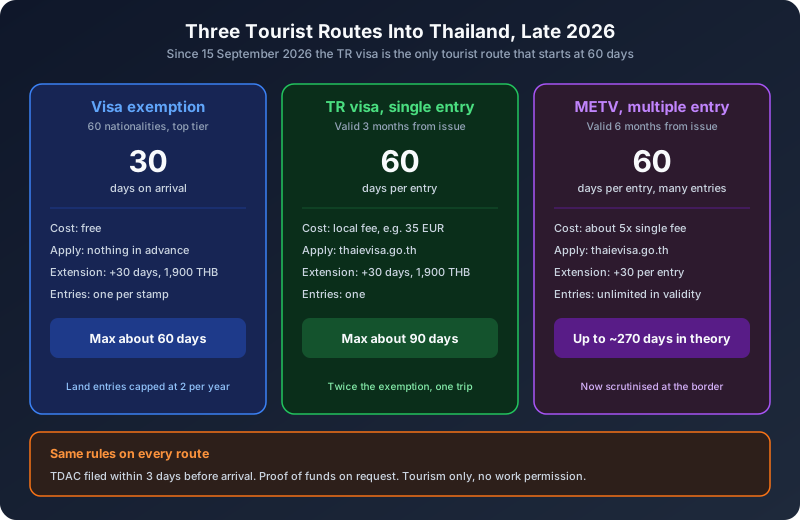
Once you strip away the long-stay visas (DTV, LTR, retirement, education, marriage and work), a tourist arriving in Thailand has three ways in.
Visa exemption. For the 60 nationalities in the top tier, 30 days on arrival, free, extendable once by 30 days. This is the default for most Western passport holders.
TR tourist visa, single entry. Applied for in advance through the official e-Visa portal at thaievisa.go.th. It grants up to 60 days per entry, and embassy pages describe it as valid for three months from issue, meaning you have to enter within that window.
METV, the multiple-entry tourist visa. Same 60 days per entry, but valid for six months and usable as many times as you like inside that period.
Visa on arrival (15 days, 2,000 THB) now covers only Azerbaijan, Belarus and Serbia, so we leave it aside.
The headline change: before September 2026 the exemption and the TR visa were both 60 days, so the visa made little sense for Western passports. Today the TR visa gives twice what the exemption does.
The TR Visa: How It Works Now
Cost
There is no single baht price for the TR visa. Consular fees are set in the local currency of the embassy that handles your application, and they differ by country. Some reference points from official embassy pages:
- Frankfurt: 35 EUR for a single-entry tourist visa.
- Ho Chi Minh City: 40 USD single entry (3 months validity), 200 USD multiple entry (6 months validity).
- New Delhi: 3,000 INR single entry and 13,500 INR multiple entry, under a fee schedule effective 27 April 2026.
The pattern holds across most embassies: the METV costs roughly five times the single-entry visa. Fees are non-refundable if you are refused.
Where you can apply
The e-Visa portal handles almost all tourist applications now, but you do not choose your embassy freely. Applications are routed to the mission covering the country you are applying from, and Thai missions have long required that you either be a citizen of that country or hold legal residence there. Third-party guides updated in 2026 also list proof of current location among the supporting documents.
The old habit of picking up the next tourist visa in Vientiane or Penang depended on missions accepting non-resident applicants. Assume instead that you will apply from home or from a country where you hold a residence permit, and check that mission's page before booking.
The money and the onward ticket
The Tourism Authority of Thailand issued a reminder in July 2026 that the proof-of-funds rule, which dates back to 1980 with amounts set in 2000, still applies. For tourist and non-immigrant visa holders the figure is 20,000 THB per person or 40,000 THB per family. Certain visa-exempt and transit cases sit at 10,000 THB per person. Children under 12 are excluded.
Most travellers are never asked, but TAT was explicit that failing to show funds can feed into a refusal, and that holding a visa does not guarantee admission. A confirmed onward ticket works the same way.
Extensions: The 1,900 THB Morning
Both the visa exemption and the TR visa can be extended once inside Thailand, for up to 30 days, at a fee of 1,900 THB. The legal basis that guides and immigration offices cite is Immigration Bureau Order 327/2557. You file form TM7 at the immigration office covering where you are staying, with your passport, a photo, proof of address and the fee in cash.
Three practical points tend to trip people up.
One extension per entry, not per year. You can extend each time you enter, but you cannot extend twice on the same stamp. Once the extended date arrives, you leave.
File before the stamp expires. An extension extends an existing permission. If you turn up the day after your stamp expires, you are on overstay, and the overstay fine is 500 THB per day. Offices differ on how early they will accept an application, so check with yours rather than leaving it to the final afternoon.
It is not automatic. Officers can ask for evidence of where you are staying. If your accommodation has not filed the TM.30 notification of your address, some offices will send you away to sort that out first. We explain the TM.30 mechanics in our DTV day-math guide, and they apply equally to tourists.
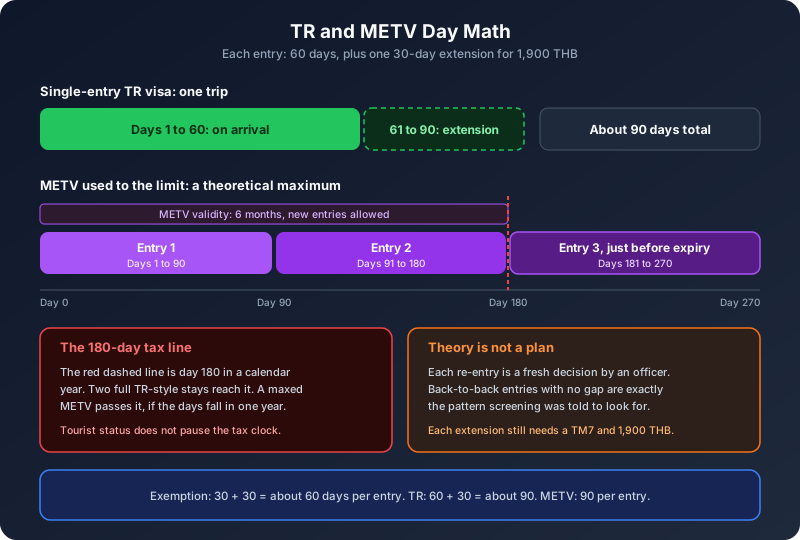
Worked example: what each route actually buys
Here is the arithmetic, using a hypothetical traveller we will call Tom, a UK citizen who wants to spend as much of the cold season in Thailand as the rules comfortably allow.
On the exemption: 30 days, plus a 30-day extension, gives 60 days per entry for 1,900 THB. Four entries a year means four extension fees (7,600 THB) and four exits.
On a single-entry TR visa: 60 days, plus a 30-day extension, gives 90 days for the visa fee plus 1,900 THB. One trip, one exit.
On a METV: the visa is valid for six months, and each entry gives 60 days that can be extended by 30. If Tom enters on day 1, extends, leaves around day 90, comes straight back in, and makes his last entry shortly before the visa expires at month six, that final entry still gives him 60 days plus 30. In theory, the total permission from a single METV approaches 270 days, roughly nine months.
That theoretical number is exactly what recent enforcement was designed to make uncomfortable.
The TDAC: Your Entries Are Now Data
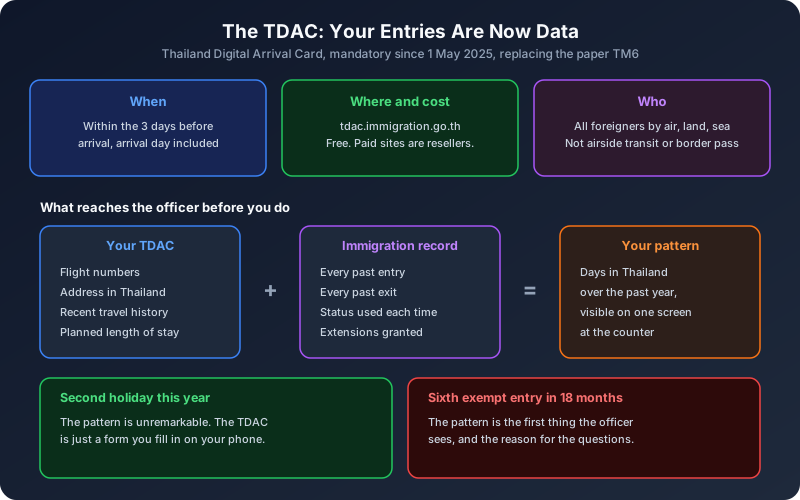
Since 1 May 2025, every foreign national entering Thailand by air, land or sea has to file the Thailand Digital Arrival Card, which replaced the paper TM6 form. Thai embassy guidance says it must be submitted within the three days before arrival, counting the arrival date. It is free on the official site at tdac.immigration.go.th, and any site charging a fee is a reseller or a scam.
Two exemptions are commonly listed: travellers who transit without passing through immigration control, and those entering on a border pass. If you change flights or accommodation after submitting, you can update the card through the official site.
The form itself is trivial. What changed is the record: your address, flights, travel history and planned stay arrive at the border in structured form, linked to your passport and to the database of every past entry and exit. On a second holiday of the year, that is invisible. On a sixth exempt entry in eighteen months, it is why the conversation at the counter takes longer.
How Serial Entries Get Flagged
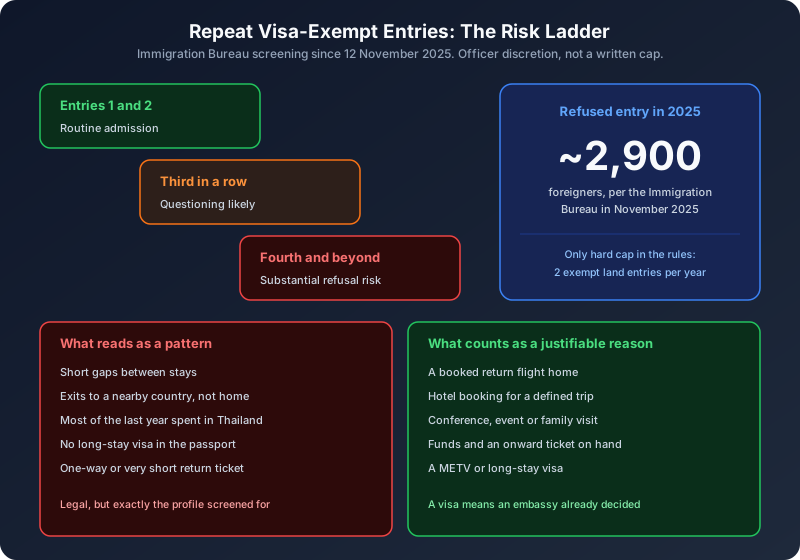
On 12 November 2025, the Immigration Bureau announced tighter screening of visa-exempt arrivals. Spokespeople framed it as a response to foreigners "disguising themselves as tourists" while running illegal operations, and said about 2,900 foreigners had already been refused entry in 2025 under the standards being applied.
The core of the measure, as widely reported, is that officers may refuse entry to people who have used visa-exempt entries more than twice in a row without a justifiable reason. It is worth being precise about what that is and what it is not.
It is not a statute. No Royal Gazette notification caps visa-exempt air entries at two. A fact-check published by a Thai-focused outlet found that the primary sources do not establish a hard numerical limit. The only hard numerical cap in the 2026 framework is the two visa-exempt land entries per calendar year covered in our exemption article.
It is discretion with a clear direction. Officers have always had the power to refuse entry. What changed is that they were told, publicly, to use it on repeat exempt arrivals. Commercial visa advisers now describe a third consecutive exempt entry as an increased risk of questioning, and anything beyond that as a substantial risk of refusal at the border.
What reads as a pattern. Based on community reports and adviser guidance, the profiles that attract questions share a few features: short gaps between stays, the exit being to a nearby country rather than home, most of the past year spent inside Thailand, no long-stay visa in the passport, and arrival on a one-way or very short return ticket.
What reads as a justifiable reason. A booked return home, a hotel booking for a defined trip, a conference or event, a family connection, or simply a visa. That last point is the important one. Advisers consistently recommend a METV or a long-stay visa for anyone expecting more than two consecutive entries, because a visa shows the decision was already made by an embassy, not left to the counter.
Hypothetically, consider Ana, a Canadian freelancer who spent 2025 on four 60-day exempt stays with short trips to Kuala Lumpur in between. In late 2026, arriving on her fifth exempt stamp in a little over a year, her TDAC shows a one-way flight and an Airbnb, and the immigration screen shows roughly 240 of the last 365 days in Thailand. Nothing she did was illegal, but it is exactly the profile the November 2025 instruction describes, and the officer may refuse entry if her answer does not convince.
The Remote-Work Grey Zone
What the law says
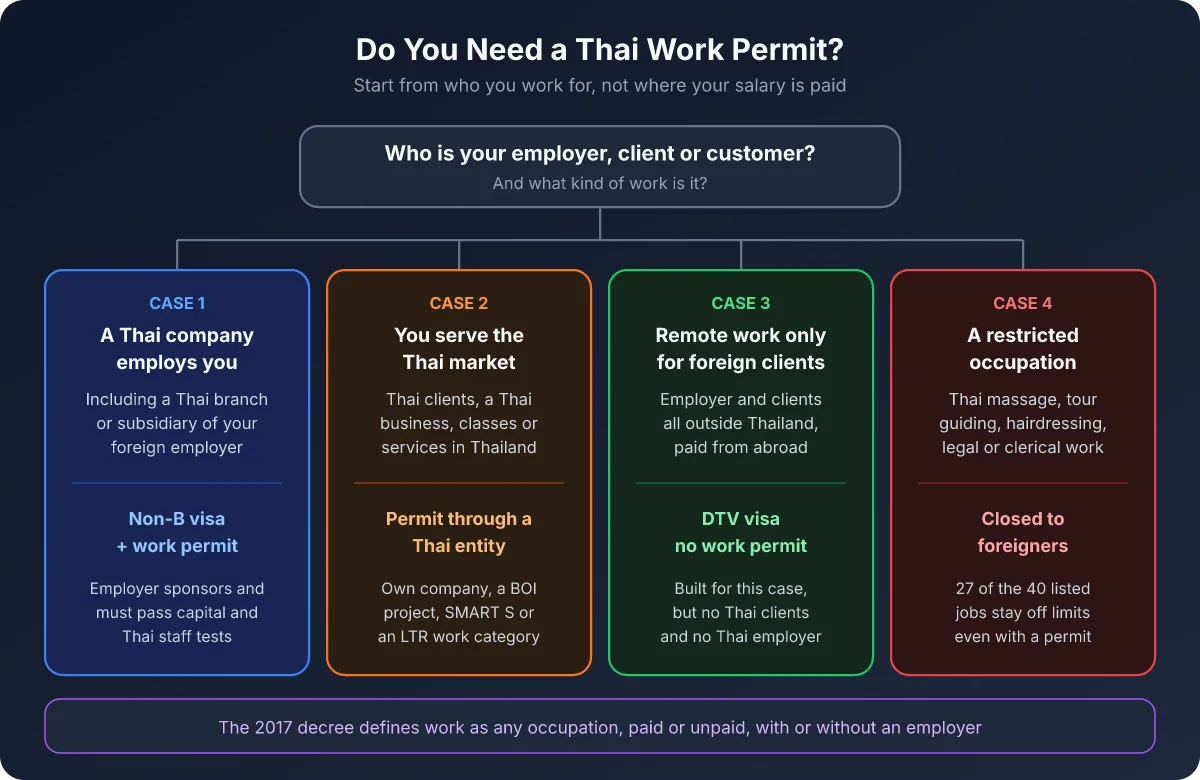
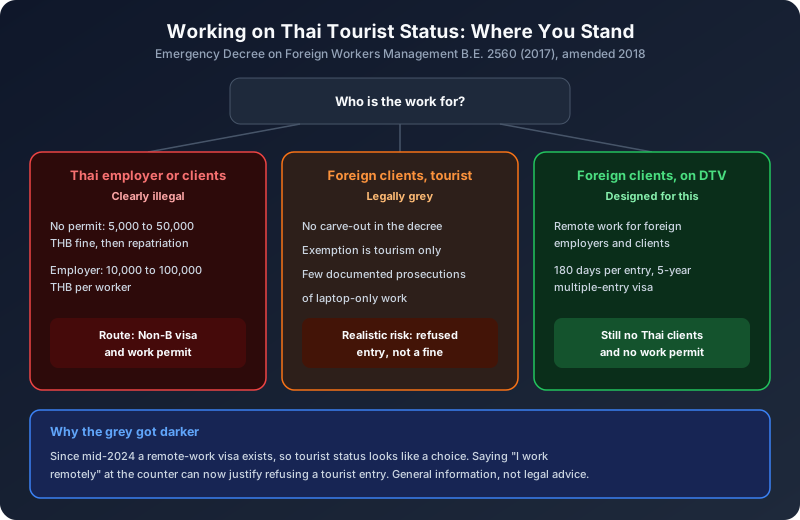
Thailand's main work law is the Emergency Decree on Foreign Workers Management B.E. 2560 (2017), as amended in 2018. It defines work broadly, and a foreigner who works without a permit faces a fine of 5,000 to 50,000 THB, followed by repatriation. Employers who hire someone without a permit face separate fines of 10,000 to 100,000 THB per worker. Nothing in the decree carves out laptop work for a foreign client.
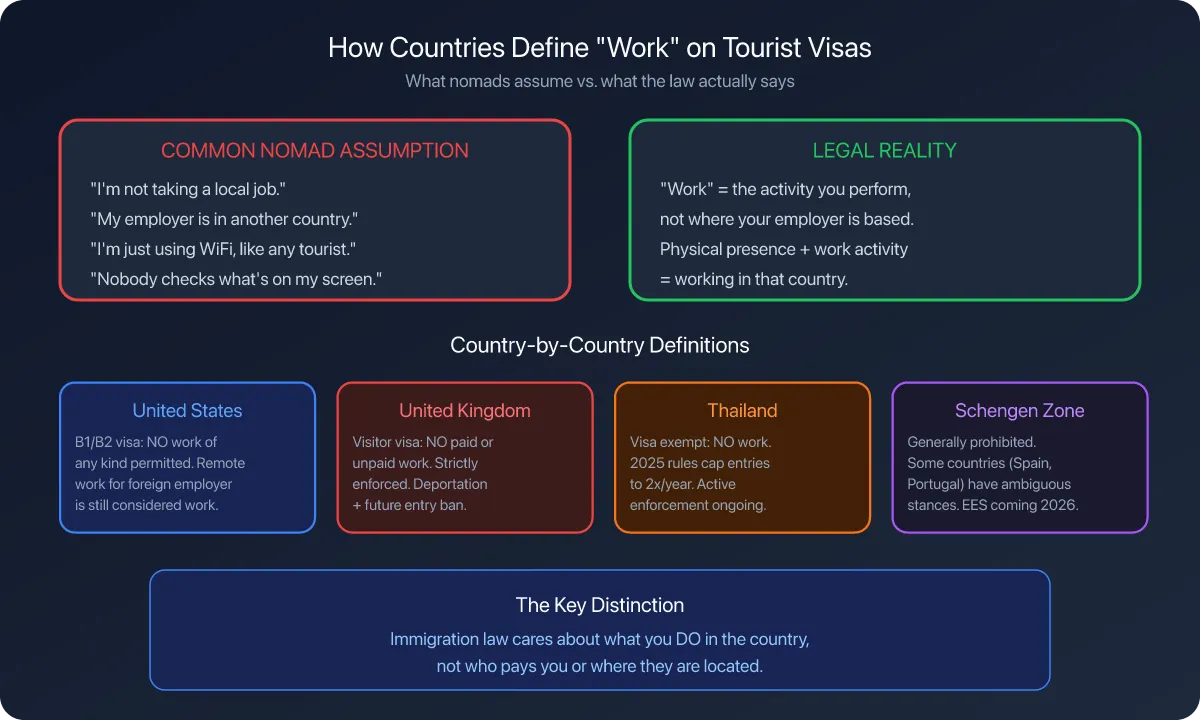
From 15 September 2026, the visa-exemption notifications also state explicitly that the exemption is for tourism. The TR visa, by name, is a tourist visa. Neither status includes any permission to work.
What happens in practice
Several legal and relocation guides note that there are no widely documented cases of a remote worker being prosecuted simply for answering emails for an overseas employer from a Thai café. Enforcement has historically targeted foreigners doing work that Thais could do: teaching without a permit, running a local business, guiding tours, or selling to the Thai market.
That is why it is a grey zone rather than a safe one: the legal text points one way, the enforcement record the other.
Why the grey just got darker
Two things shifted in the last two years.
First, since mid-2024 Thailand has had the DTV, a visa built for remote workers serving foreign businesses. Choosing tourist status instead now looks like a choice.
Second, the questions at the border have changed. If an officer asks a serial visitor what they do in Thailand all year and the honest answer is "I work remotely", that answer can now be used to justify refusal of a tourist entry, entirely separate from any prosecution under the work decree. The practical risk is not a fine. It is being sent home from the airport.
For a remote worker who wants more than a holiday, the DTV is the route that matches what they are actually doing. If the DTV application is the obstacle, our rejections guide explains what tends to sink an application. And if you will work for a Thai company or Thai clients, none of the tourist or DTV routes cover you; you need a Non-B visa and work permit.
The Day Count That Keeps Running
There is one more clock that tourist status does not pause. Thailand's tax residency test is 180 days in a calendar year, counted across every entry, every stamp and every visa type. The METV arithmetic above, roughly nine months from one visa, puts you well past that line. A traveller doing three 60-day stays on the old exemption, or two 90-day TR stays today, lands exactly on it.
Being a tourist for immigration purposes does not make you a non-resident for tax purposes. If you cross 180 days, foreign income you bring into Thailand in that year falls under the remittance rules we break down in our Thailand tax guide. This is general information, not tax advice, and a Thai tax adviser is the person to confirm how it applies to your case.
A Short Checklist for Tourist Stays in 2027
- More than 30 days? The TR visa is now worth the fee. Several entries over six months? The METV.
- Apply from where you live, and budget 1,900 THB per extension, filed before the stamp expires.
- File the TDAC free on the official site within three days of arrival.
- Carry 20,000 THB in funds and an onward ticket. Rarely checked, decisive when it is.
- Keep consecutive exempt entries to two. After that, have a visa or a clear reason.
- Working remotely most of the year? Look at the DTV.
- Count every day toward 180, whichever stamp it came from.
One Year, Several Clocks
A tourist year in Thailand now runs on several counters at once: the per-entry clock (30, 60 or 90 days), one extension per entry, six months of METV validity, the pattern an officer reads on screen, and the annual 180-day tax line that ignores all the others. None is hard alone. Keeping them all straight across a dozen flights is where people lose track, usually in December, usually by a week.
See every Thai entry and every day in one place.
Nomad Tracker logs each stay, counts your days toward Thailand's 180-day tax line with alerts at 150, 170 and 180 days, and lets you plan the next entry with Ghost Trips before you book it. It also runs the Schengen 90/180 calculator for the European side of your year. All on-device, all private.
Download on the App Store