For about fifteen years, the visa run was the quiet engine of the nomad economy. Your tourist stamp is about to expire, so you take a bus to the nearest border, have lunch on the other side, walk back in and collect a fresh stamp. Repeat every one to three months. Whole communities in Chiang Mai, Playa del Carmen, Medellín and Canggu were built on that loop.
In 2026 the loop is breaking almost everywhere at once. Not through one dramatic law, but through three quieter changes: limits that count days across a whole window instead of per entry, mandatory gaps before you can come back, and border officers who now see your entire travel history on a screen and have been told to use their discretion.
This guide walks through how each of those mechanics works, which countries have adopted them, and what actually replaces the border run if you want to spend long periods somewhere without a residence permit.
Why the Visa Run Worked, and Why It Stops Working
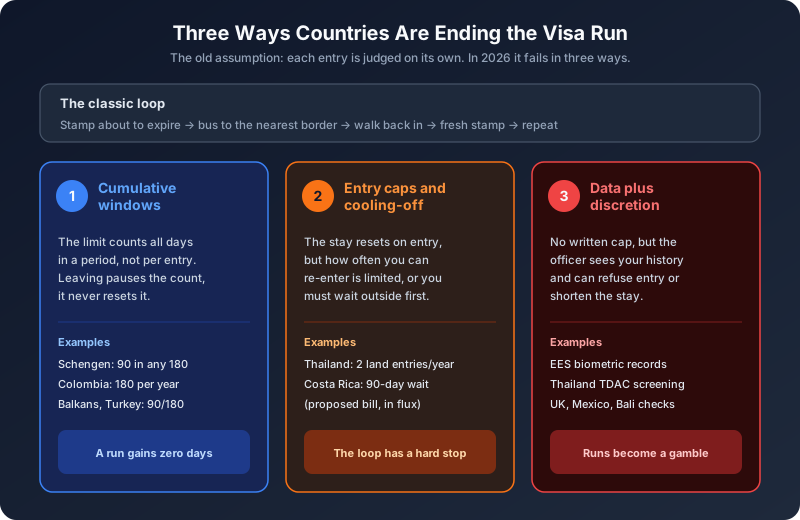
A classic visa run relies on one assumption: that each entry is judged on its own. Leave, come back, and the clock starts again from zero. Countries kill that assumption in three different ways.
1. Cumulative windows. The limit applies to the total days in a period, not to a single stay. Schengen's 90 days in any rolling 180-day window is the best known example. Colombia caps tourists at 180 days per calendar year. Under a cumulative rule, a trip out of the country pauses your count but never resets it. You can fly out and back as often as you like and the arithmetic stays the same.
2. Cooling-off periods and entry caps. Some countries let your stay reset on re-entry but limit how often you can do it. Thailand allows only two visa-exempt entries by land per calendar year. Costa Rica has a bill on the table that would make tourists wait 90 days outside the country before re-entering on the same status.
3. Data plus discretion. This is the one that catches most people. Even where no written rule caps your entries, the officer at the counter can refuse entry or shorten your stay if your pattern suggests you are living in the country as a tourist. What changed is that the pattern is now obvious: biometric entry systems, digital arrival cards and shared databases put a full history on the screen in seconds.
The practical effect is that the visa run has gone from a reliable routine to a gamble. It might still work at a given border on a given day. You just can no longer plan a year around it.
Europe: The Region Where Border Runs Never Really Worked
Schengen
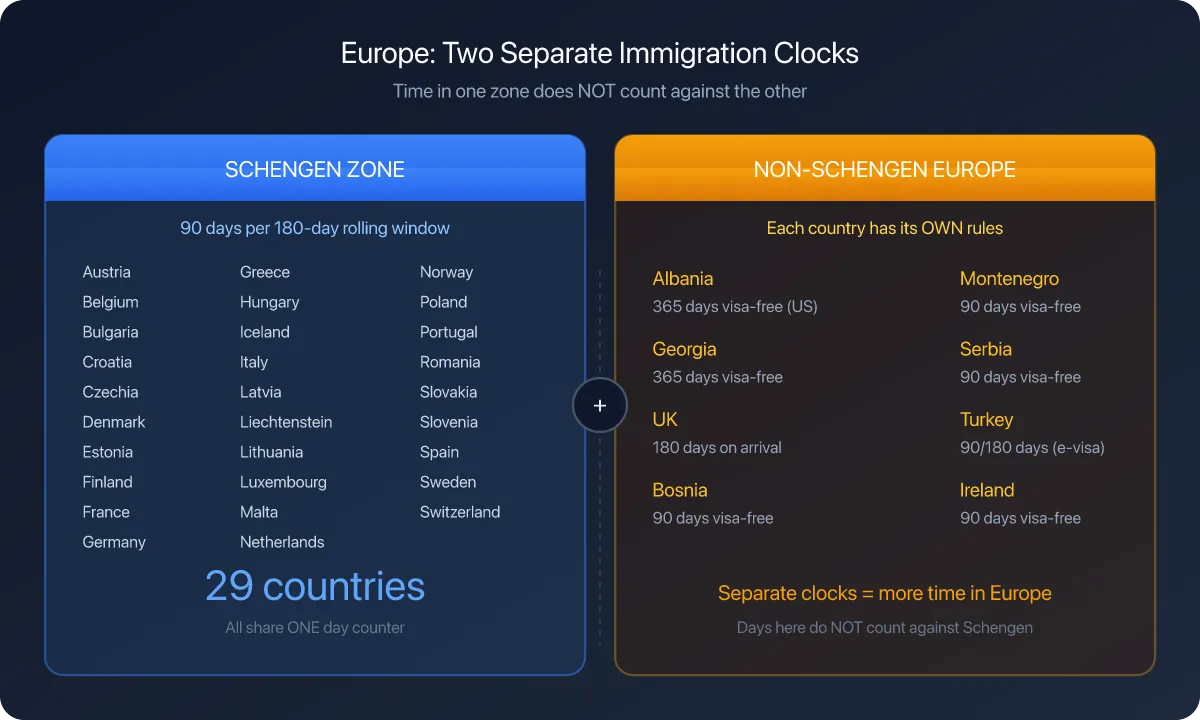
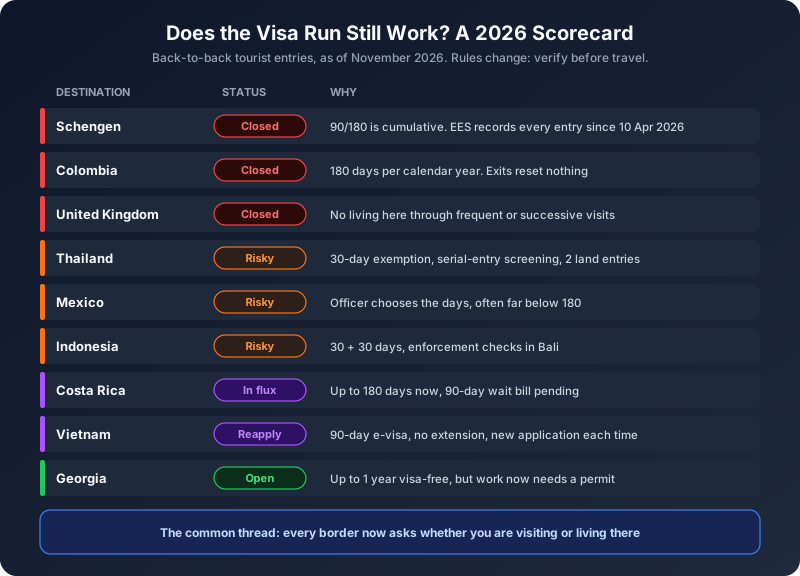
Schengen deserves its place at the top of this list because it is where the visa run myth does the most damage. The 90/180 rule has always been cumulative. A weekend in Albania or a month in Turkey does not reset anything; it simply stops the counter while you are outside. We covered the math in detail in our piece on why border hopping does not reset your Schengen days.
What changed in 2026 is enforcement. The EU Entry/Exit System (EES) has been fully operational at Schengen external borders since 10 April 2026. It records every entry and exit biometrically and calculates your remaining days automatically. The old era of a guard failing to add up smudged stamps is over. ETIAS, the travel authorization for visa-exempt travellers, is scheduled to follow in the last quarter of 2026, adding a pre-travel screening layer on top. ETIAS does not give you more days. It just means the system knows about you before you board.
Non-Schengen Europe (Albania, Montenegro, Serbia, Turkey and others) is still a legitimate way to spend time outside the zone while your Schengen window recovers. But those countries have their own limits, often a 90/180 rule of their own, so they are rotation stops, not reset buttons.
United Kingdom
The UK lets most visa-exempt visitors stay up to six months per visit, which sounds generous enough to make runs unnecessary. The catch is a line in the Immigration Rules: visitors must not live in the UK through frequent or successive visits, even if each individual visit stays within the six-month maximum.
There is no number attached to that rule. Home Office guidance tells officers to look at your travel history and the overall pattern of your stays. Spending five months in London, two weeks in Lisbon and then returning for another five months is exactly the pattern immigration lawyers warn about. Since 25 February 2026, the UK also enforces its Electronic Travel Authorisation on a "no permission, no travel" basis for eligible nationalities, and an ETA explicitly does not give anyone the right to live in the UK through repeat visits.
Southeast Asia: The Visa Run Heartland Tightens Up
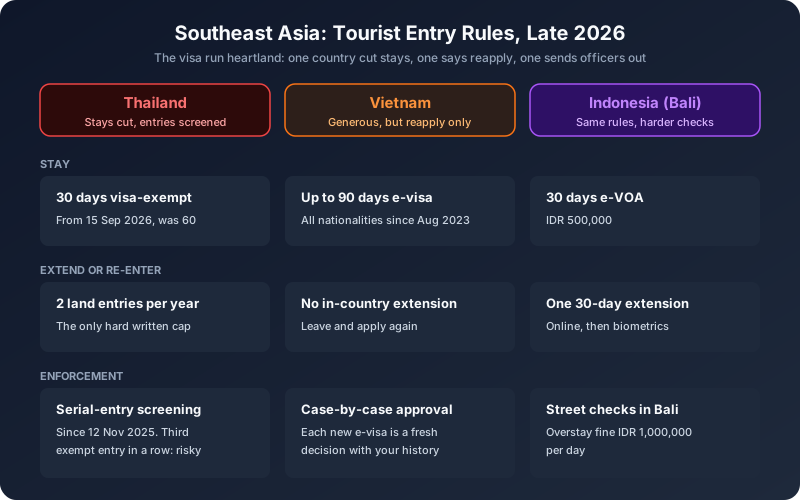
Thailand
Thailand is where the decline is most visible. On 15 September 2026, the 60-day visa exemption that covered 93 countries was replaced by a tiered system, with 30 days for most Western passports, including the US, UK, Canada, Australia and every EU member state. We broke down the full change in our article on Thailand's new 30-day exemption.
The border-run side changed even earlier. On 12 November 2025, the Immigration Bureau announced tighter screening of visa-exempt arrivals, and officers were told to scrutinize people with repeated exempt entries and no justifiable reason. Advisers widely describe a third consecutive exempt entry as a likely trigger for questioning, though no Royal Gazette notification sets a hard number for air arrivals. The only hard cap is the limit of two visa-exempt land entries per calendar year. Thai outlets reported tens of thousands of refusals at the border in the first months of 2026 as the screening campaign ran.
The details of how serial entries get flagged, including the TDAC digital arrival card that now logs every arrival, are in our Thailand tourist entries guide.
Vietnam
Vietnam went in the opposite direction on paper. Since August 2023, its e-visa has been available to every nationality for stays of up to 90 days, single or multiple entry. That is more generous than the old 30-day e-visa, and it removed much of the reason for monthly runs.
What Vietnam does not allow is extending that e-visa from inside the country. If you want to stay longer, you leave and apply again from abroad, and each new application is a fresh decision by the immigration department, which sees your previous stays. Some nationalities also have a 45-day visa exemption, which is a separate status with its own rules. Treat any claim of a guaranteed re-entry gap or approval with caution and check the official portal (evisa.gov.vn) before you build a plan around it.
Indonesia (Bali)
Indonesia's tourist framework has not changed much on paper: the e-VOA costs IDR 500,000, gives 30 days and can be extended once for another 30 days through the official eVisa site, followed by an appointment for biometrics at an immigration office. Overstays are fined IDR 1,000,000 per day.
The change is in enforcement. Immigration officers began street checks in Bali in late 2025, working with village heads and accommodation providers, and in July 2026 Indonesia announced tighter enforcement of tourist visa rules aimed squarely at digital nomads and influencers working on tourist status. Repeated 60-day loops with a hop to Singapore or Kuala Lumpur in between are exactly the profile those checks are designed to surface.
The Americas: Discretion Replaces the Default
Mexico
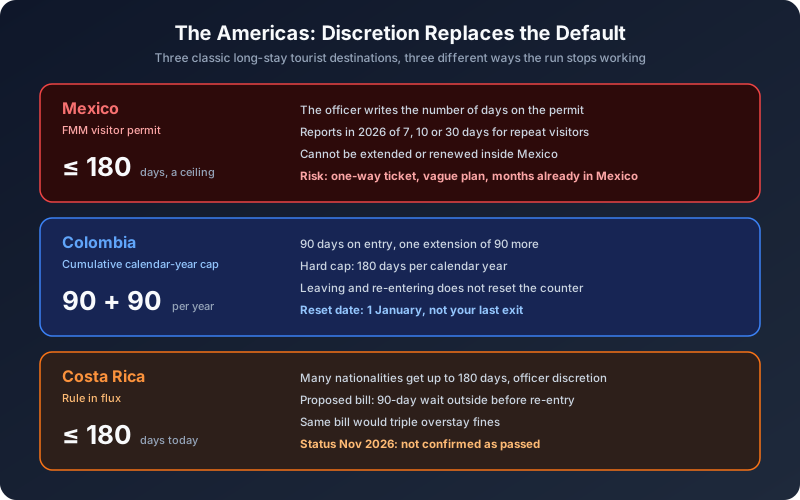
For years, Mexico was the easiest long-stay tourist destination in the world: arrive, receive 180 days almost automatically, leave for a weekend in Guatemala or the US, come back for another 180. That default is gone.
The FMM visitor permit is still valid for up to 180 days, but the 180 is a ceiling, not an entitlement. Officers have always had discretion over the number written on the permit, and since 2022 they have been using it. Mexico News Daily reported a growing number of visitors receiving 30 days or less, and travel reports in 2026 describe stays of 7, 10 or 30 days for people whose itinerary is vague or whose history suggests they live in Mexico. The permit cannot be extended or renewed from inside the country, so whatever number the officer writes is your limit. The FMM fee in 2026 is reported at MXN 983, roughly USD 54.
Colombia
Colombia is a clean example of a cumulative rule. Tourists from most visa-exempt countries get 90 days on entry and can extend once for another 90, but the total is capped at 180 days per calendar year. Leaving and coming back does not reset anything: the counter only clears on 1 January. A December arrival can therefore be a trap, because those days count toward the year they fall in, and a new 180 opens on 1 January.
Costa Rica
Costa Rica is the country to watch. Many nationalities can currently receive up to 180 days on entry, at the officer's discretion, and border runs to Panama or Nicaragua still happen. But a bill in the Legislative Assembly proposes that tourists whose permitted stay ends must wait 90 days outside the country before re-entering as tourists, and would triple overstay fines. As of November 2026 we could not confirm that it has passed, so treat it as a rule in flux. Proof of onward travel is already commonly requested at airports.
The outlier: Georgia
Not everything is closing. Georgia still offers a visa-free stay of up to one year to citizens of roughly 95 countries, and there is no evidence that this was shortened in 2026. What changed, according to several relocation guides, is that working while on that stay now falls under a work permit framework that took effect on 1 March 2026. The long stay survives; the assumption that you can quietly work on it does not.
What a "Pattern" Looks Like From the Other Side of the Counter
Every one of the discretion-based systems above asks the same question: is this person visiting, or living here? Officers do not need a written cap to answer it. They look at a handful of signals:
- Ratio of days inside versus outside over the last year. Spending 270 of 365 days in one country on tourist entries reads as residence, whatever the stamps say.
- Length and destination of the gaps. A three-day trip to the nearest neighbouring country right before your stay expires is the textbook visa run.
- The ticket. A one-way arrival with no onward booking invites questions everywhere.
- The story. "Tourism" after eight consecutive months in the same city is hard to defend, and saying you are working remotely can be an admission that you are breaking tourist conditions.
Consider a hypothetical case. Daniel, a US citizen, spent most of 2025 in Playa del Carmen on 180-day FMMs, crossing to Belize twice. In 2026 he arrives at Cancún on a one-way ticket and tells the officer he is on holiday. The screen shows roughly 330 days in Mexico in the previous 365. Nothing he did was illegal. He still leaves the counter with 14 days written on his permit instead of 180, and his plans for the year collapse on the spot.
The key point is that discretion is not random. It is pattern recognition, and the data to recognize patterns is now in front of every officer.
What Works Instead of the Visa Run
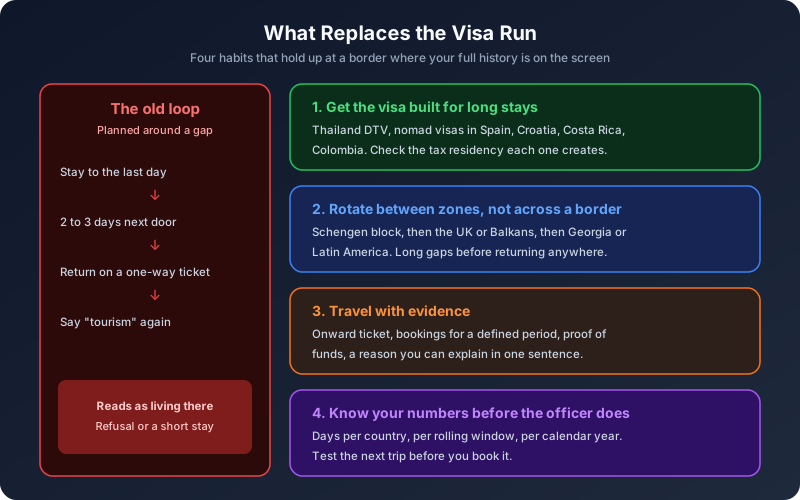
If back-to-back tourist entries are fading, the alternatives are not complicated. They just require deciding where you actually want to spend your time.
Get the right visa for long stays. If you want six months or more in one country, use the status built for it. Thailand's DTV, the digital nomad visas in Spain, Portugal, Croatia, Costa Rica, Colombia or Mexico's temporary residence all exist precisely for people who would otherwise loop through tourist entries. Be aware that many of these create tax residency, which is the subject of our unpopular opinion piece on nomad visas.
Rotate between zones, not across a border. Instead of hopping out and back, plan a genuine rotation: a Schengen block, a block in the UK or the Balkans, a block in Georgia or Latin America. Each stop stays well inside its own limit and the gaps between visits to the same country are long.
Travel with evidence. An onward ticket, accommodation bookings for a defined period, proof of funds and a plausible reason for the trip turn a borderline interview into a routine one.
Know your numbers before the officer does. Since the border systems now count your days in real time, you need the same count, per country and per window, before you book anything.
A Short Checklist Before Your Next "Quick Exit"
- Is the limit per entry or per window? If it is per window (Schengen, Colombia), leaving resets nothing.
- Is there a cap on entries? Thailand's land limit is the clearest example, and Costa Rica may add a cooling-off period.
- What does your last year look like? Count your days in that country over the past 365. If the number is high, expect questions.
- Can you explain the trip in one sentence? If not, an officer will draw their own conclusion.
- Is there a visa that fits your plan better? If you keep needing runs, the answer is usually yes.
The End of an Era, and Not a Bad One
The visa run was always a workaround: technically legal in many places, but built on the assumption that nobody was counting. Now someone is always counting, whether it is EES in Europe, the TDAC in Thailand or an officer in Cancún looking at your history.
The upside is that the rules are becoming more predictable for people who plan. If you know exactly how many days you have used in each country and each window, you can design a year that never needs a nervous border crossing. That is the whole reason we built Nomad Tracker.
Know your days before the border does.
Nomad Tracker counts your days per country and per rolling window automatically, runs the Schengen 90/180 calculator in real time, and lets you test future itineraries with Ghost Trips before you book. All on-device and private.
Download on the App Store