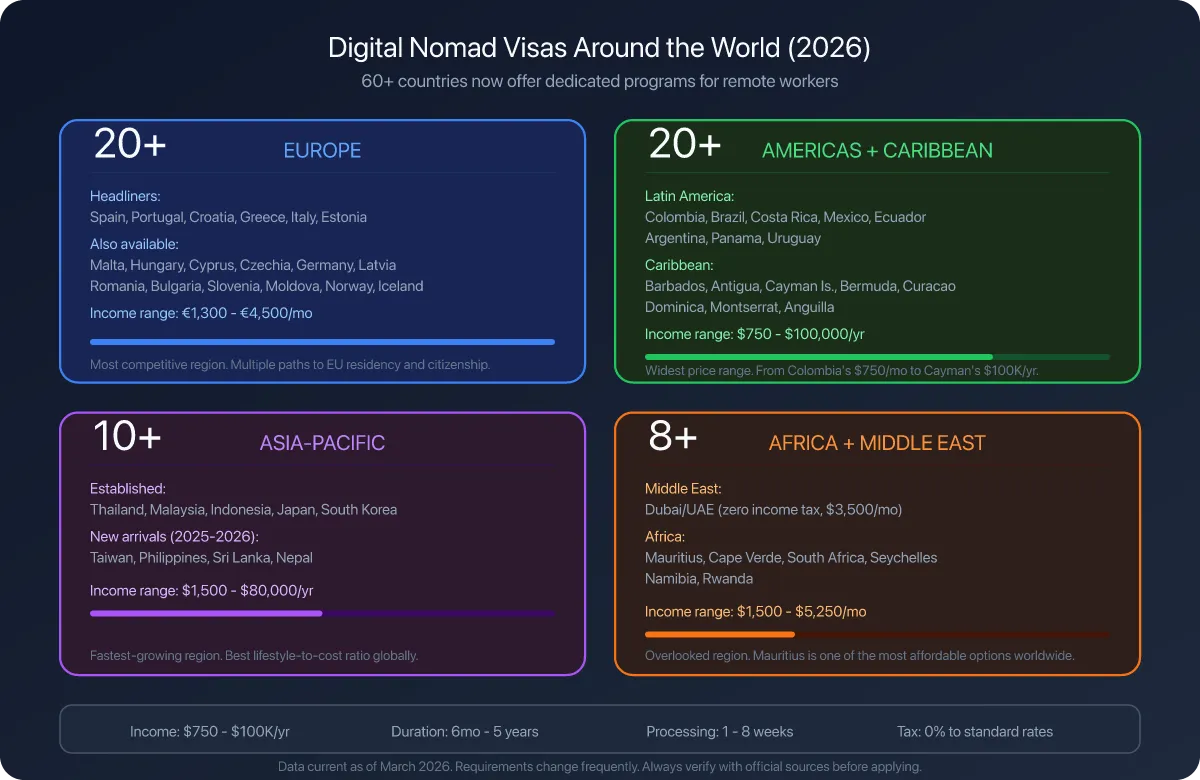
Every few weeks another country announces a digital nomad visa, and the announcement gets shared as if it were a gift. Over 55 programs now exist. The marketing is always the same: sunshine, laptops on terraces, "live and work legally in paradise."
Here is the unpopular part. For a large share of the people applying, a digital nomad visa is a bad deal. Not because the programs are scams, but because most applicants misunderstand what they are buying. A digital nomad visa is not a premium tourist visa. In most countries it is a residence permit, and residence permits are precisely the thing tax authorities look for when they decide whether you owe them money on your worldwide income.
This article is the counterweight to the hype. We cover what these visas actually give you, where the tax trap sits, what they really cost compared with a plain tourist entry, and the specific profiles for whom they are genuinely worth it. If you want the full country-by-country table first, our digital nomad visa comparison for 2026 has every active program.
A Nomad Visa Is a Residence Permit, Not a Travel Upgrade
The core misconception is about category. People compare a nomad visa with a tourist stay and assume it is the same thing, just longer and more legal. Legally, the two live in different worlds.
A tourist entry (visa-free or a short-stay visa) says you are visiting. You have no address on file, no residence card, no registration with local authorities. A digital nomad visa, in most European programs, is a national residence permit. Spain's version leads to a residence card (TIE) and a foreigner number. Portugal's D8 is processed into a residence permit by AIMA. Greece issues a residence permit after the initial visa. You become, on paper, someone who lives there.
That paper matters. When a tax office asks "where is this person resident?", it looks at days of physical presence, but it also looks at your permanent home, your registered address, your center of economic and personal interests. A residence permit plus a long-term lease is close to a confession.
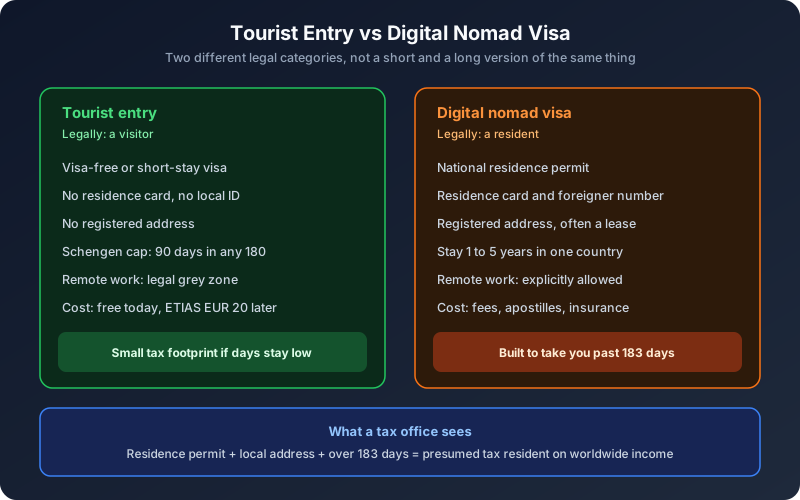
The Tax Trap: Residence Permit Plus 183 Days
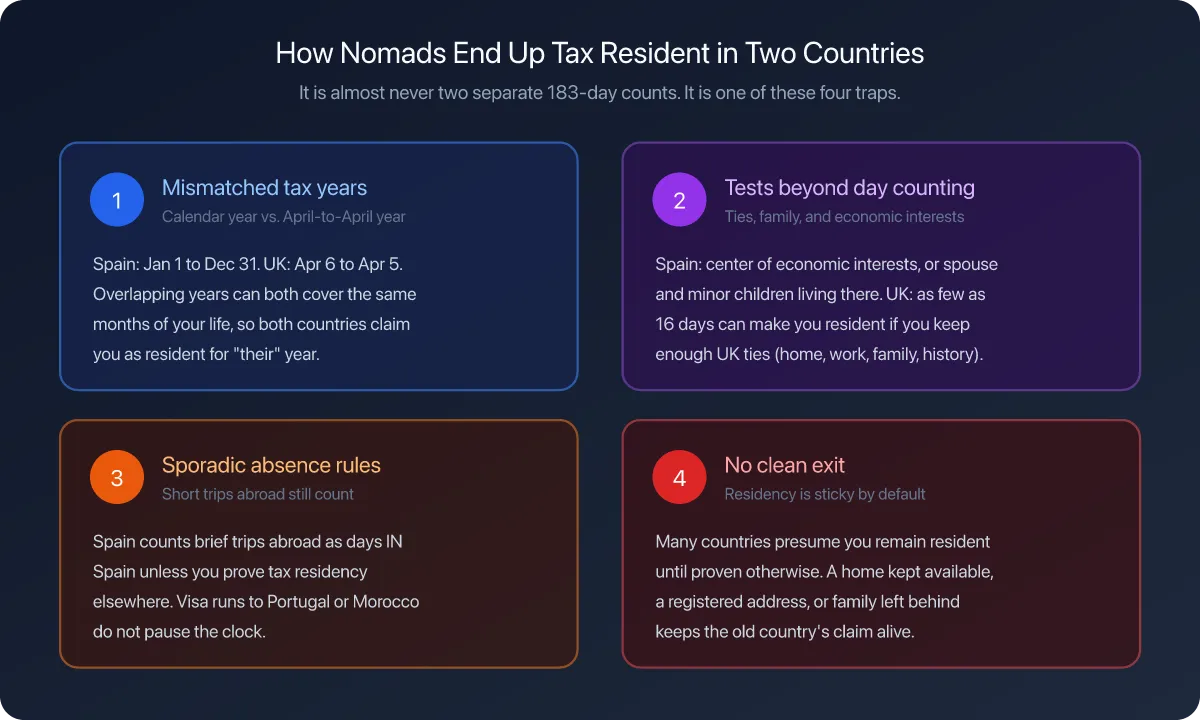
Almost every country that offers a nomad visa also applies some version of the 183-day rule. Stay more than half the year and you are presumed tax resident. The nomad visa is literally designed to let you stay longer than that. Put those two facts together and the default outcome is obvious: if you actually use the visa as intended, you become a tax resident of the country that issued it.
Tax residency usually means you are taxed on your worldwide income at local progressive rates, not just on money earned locally. Here is how that plays out in the most popular European programs in 2026.
Spain: worldwide income, with an exception that mostly helps employees
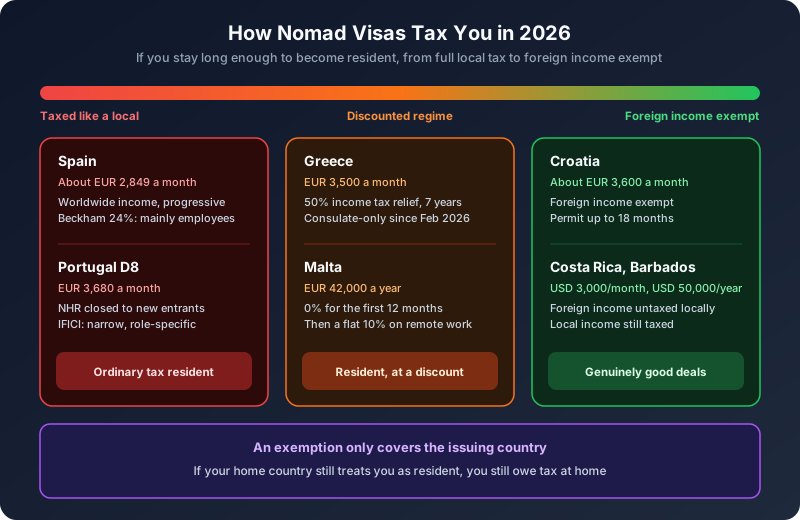
Spain's digital nomad visa requires around €2,849 per month for a single applicant in 2026 (200% of the minimum wage, which rose to €1,221 in 14 payments this year), with at least 80% of income from non-Spanish sources. Spend more than 183 days in Spain in a calendar year, or have your center of economic interests there, and you are a Spanish tax resident taxed on worldwide income at progressive rates that reach the mid-to-high 40s depending on the region. Our guide to the 183-day rule in Spain explains why the day count is only half of the test.
The escape hatch people cite is the Beckham Law, a flat 24% rate on income up to €600,000. Since the 2023 Startup Act, nomad visa holders can apply. But eligibility is strongest for remote employees. Freelancers and self-employed applicants face a much narrower interpretation from the Spanish tax agency, and the application window is short and unforgiving. "Nomad visa equals Beckham" is not a safe assumption.
Portugal: the D8 without the old NHR cushion
The Portugal D8 now asks for €3,680 per month, four times the 2026 minimum wage of €920. Under the old NHR regime, many nomads paid little or nothing on foreign income. That regime is closed to new applicants, and its replacement, IFICI, is narrow and tied to specific roles and entities. As we covered in our post on Portugal's NHR replacement, most freelancers on a D8 who stay over 183 days simply become ordinary Portuguese tax residents.
Greece and Malta: real discounts, still residency
Greece asks for €3,500 per month and offers a 50% income tax reduction for up to seven years to qualifying new tax residents. That is a genuine benefit, but notice the wording: it is a discount for people who become Greek tax residents, not an exemption. Since February 2026, under Law 5275/2026, applications also have to be filed at a consulate before you travel.
Malta's Nomad Residence Permit (€42,000 a year) is one of the few programs with an explicit tax deal: 0% on the authorized remote work income for the first 12 months, then a flat 10%. For the right person that is excellent. For someone who planned to spend four months in Malta and eight elsewhere, it adds paperwork without changing much.
The exceptions that prove the rule
A minority of programs do exempt foreign income. Croatia's digital nomad permit exempts foreign-source income from Croatian income tax for the length of the permit (up to 18 months), with an income bar of roughly €3,600 per month in 2026. Costa Rica's visa (US$3,000 per month) treats foreign income as untaxed locally. Barbados' Welcome Stamp holders are exempt from Barbadian income tax on foreign income under the Remote Employment Act.
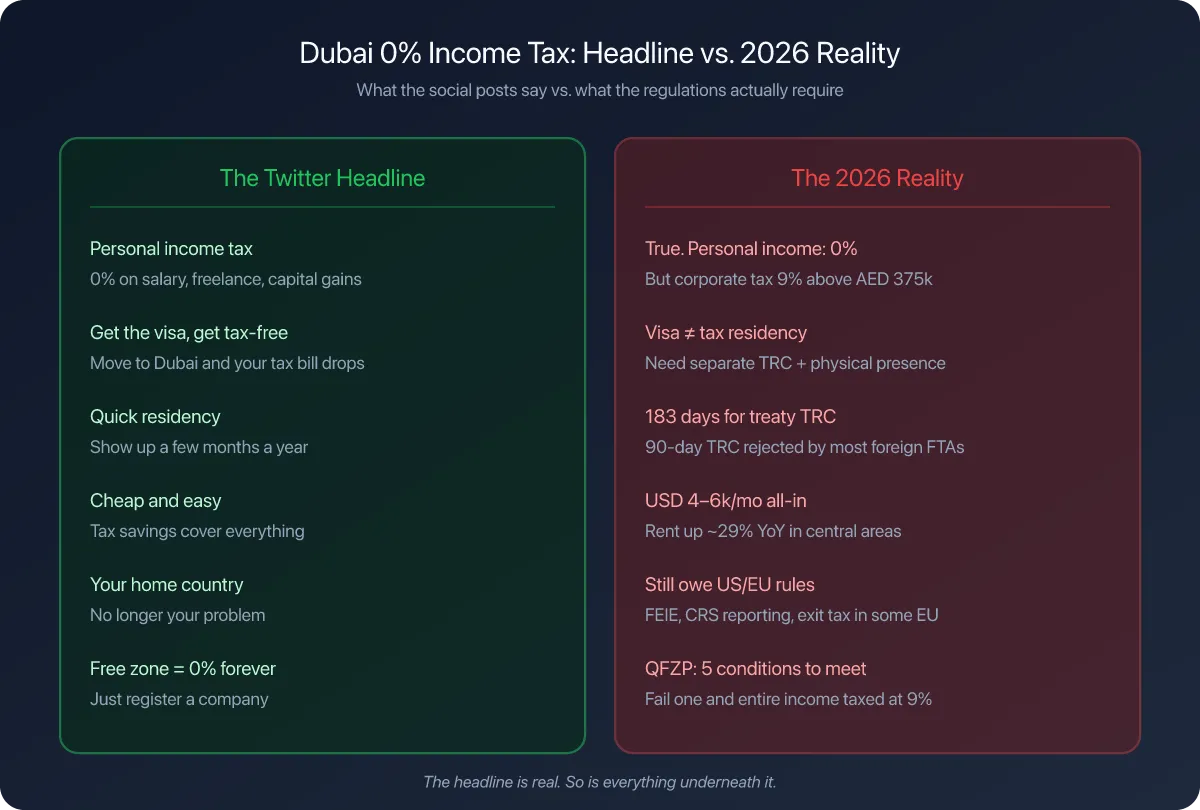
These are the good deals. But even here, the exemption only covers the country that issued the visa. It does not make you tax resident nowhere. If your home country still considers you resident (and many do, especially if you keep a home, family or business there), you still owe tax at home. A nomad visa cannot cancel another country's claim on you.
What It Actually Costs Compared With a Tourist Entry
The second problem is cost. A tourist entry into most of the countries nomads love is cheap or free. A nomad visa is a project.
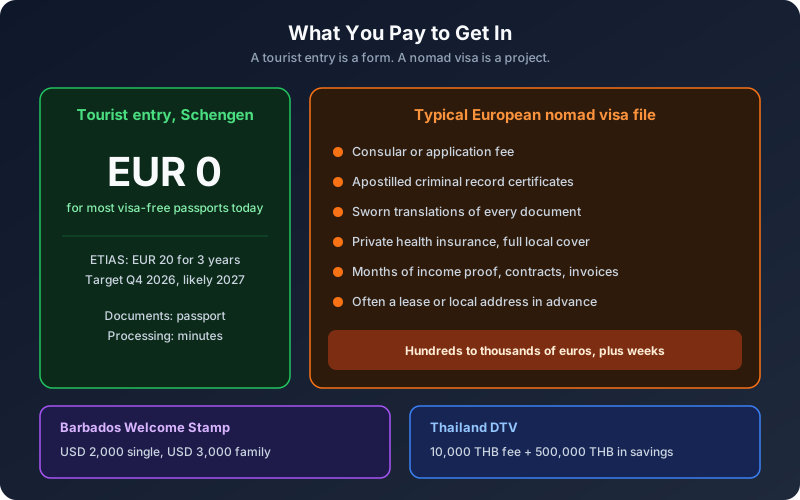
For a typical European program, the bill includes the consular fee, apostilled criminal record certificates from every country you lived in recently, sworn translations, private health insurance with full local coverage and no copays (Spain insists on this), proof of income for several months, sometimes a local bank account and a lease before you arrive. Outside Europe, Barbados charges US$2,000 for an individual and US$3,000 for a family. Thailand's DTV costs 10,000 THB and requires 500,000 THB in savings.
Compare that with what most passport holders pay to visit Schengen today: nothing. When ETIAS finally starts, the fee will be €20 for three years. The European Commission still lists the last quarter of 2026 as the target, but recent reports point to a slip into 2027, so check our ETIAS and EES update before you plan around a date.
Then there is time. Processing, appointments and renewals eat weeks. Income thresholds also move every year, so the number you met in January can be wrong by renewal time. Spain's threshold has risen with the minimum wage for several years running.
What You Do Get in Return
To be fair, nomad visas solve real problems, and pretending otherwise would make this a hit piece rather than an analysis.
The legal right to work. This is the big one. Working remotely on a tourist entry sits in a grey zone in most countries, as we explain in our article on the tourist visa problem. A nomad visa closes that gap for the issuing country.
Time beyond 90 days. If you want six or twelve months in one Schengen country, a national residence permit is the only clean way to do it. Tourist time is capped at 90 days in any 180 across the whole zone.
Normal life admin. A residence card makes it far easier to sign a long lease, open a local bank account, get a phone contract or register with a doctor.
A path to permanence. In Spain, five years of legal residence can lead to long-term residence. For people who want to settle eventually, a nomad visa is a front door.
But read the list again. Every one of those benefits matters most to someone who wants to live in one country, which is the opposite of what most people mean by nomad. If you rotate countries every two or three months, you pay for residence rights you barely use, and you take on the tax exposure anyway if the days add up.
There are also limits people miss. Croatia's permit does not give you residence or work rights in the other Schengen countries. A residence permit from one Schengen state generally lets you travel to the others for 90 days in any 180, but it does not let you live or work there.
A Worked Example: Two Ways to Spend a Year
Consider a hypothetical case. Daniel is a Canadian freelance developer, self-employed, earning around €70,000 a year from clients in North America.
Option A: Spanish nomad visa. He moves to Valencia for twelve months. He clears the €2,849 income bar easily, gathers his apostilles, buys local health insurance, signs a lease. Because he is self-employed, Beckham Law is unlikely to help. He spends 300 days in Spain, becomes a Spanish tax resident, and his worldwide freelance income is taxed at Spanish progressive rates, plus he enters the Spanish social security system as a self-employed worker. He has, in effect, emigrated.
Option B: tourist rotation. He spends 85 days in Spain and Portugal, 90 days in non-Schengen countries such as Albania, Georgia and the UK, another 85 days in Schengen later in the year, and the rest at home. He never approaches 183 days anywhere abroad, keeps his tax residency where it already was, and pays a few euros in entry fees. The catch: he has to count every day precisely, because Schengen time is a rolling window and the margin is small.
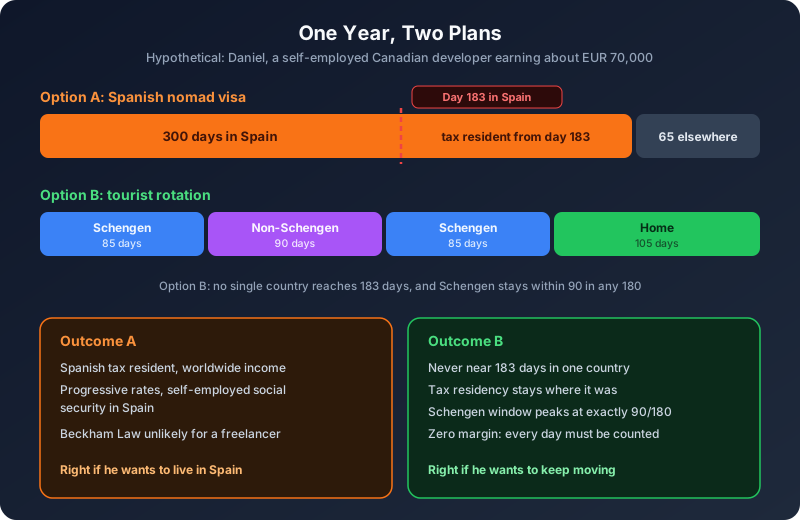
Neither option is wrong. Option A is right for Daniel if he wants a base, a community and eventually a Spanish life. Option B is right if he wants to stay a traveler. What is wrong is choosing Option A while believing you are getting Option B with a nicer stamp. That is the trap, and it is the most common nomad visa mistake people describe after the fact.
For more combinations of Schengen and non-Schengen time, see how to legally spend six months in Europe.
Who Nomad Visas Are Actually Good For
Strip away the marketing and the profile is clear. A nomad visa is probably worth it if:
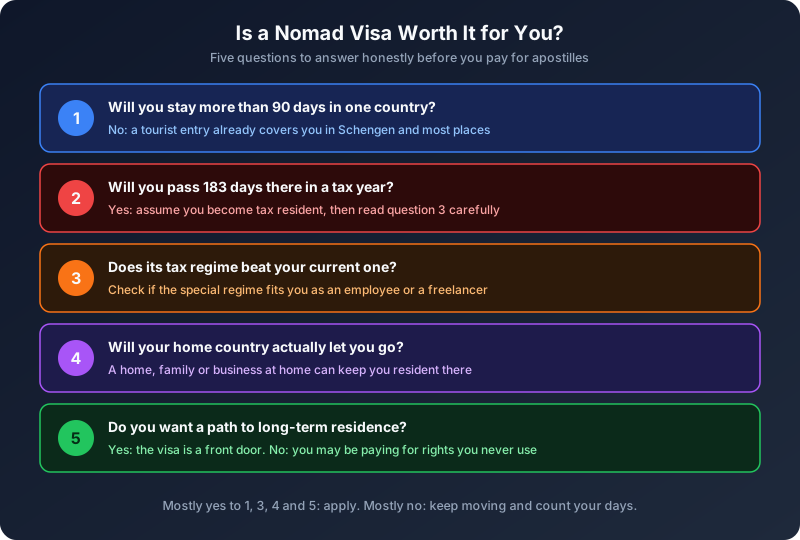
- You want to stay in one country longer than 90 days and the country is in Schengen or otherwise caps tourist stays.
- The program's tax treatment beats your current situation. Croatia, Costa Rica, Barbados and Malta's first year can genuinely save money, but only if your home country lets go of you.
- You are leaving a high-tax home on purpose and want a legal landing spot with a defined regime, such as Greece's 50% relief or Beckham Law as an employee.
- You want a path to residency or citizenship and the visa counts toward it.
- Your work or clients require you to be demonstrably legal where you physically sit, for compliance or insurance reasons.
It is probably a bad deal if you move every one to three months, you are self-employed in a country where the special regime only favors employees, your home country would keep taxing you anyway, or you mainly want "permission" for something a tourist entry already covers.
The Real Question Is Days, Not Visas
Here is the thread running through all of this. Whether a nomad visa is a great deal or an expensive mistake comes down, almost every time, to how many days you will physically spend where. Under 90 days in Schengen, a tourist entry covers you. Over 183 days in one country, you are probably tax resident there, visa or no visa. Between those lines is where planning matters.
Most people who regret a nomad visa did not misread the visa rules. They misjudged their own calendar. They thought they would travel more than they did, or they forgot that a summer at the "base" plus a winter return already crossed the threshold.
That is why we built Nomad Tracker around the day count rather than the paperwork. The app logs which country you are in each day, runs the Schengen 90/180 calculation continuously, and tracks per-country totals against the 183-day tax line. Fiscal alerts warn you as you approach residency thresholds, and Ghost Trips let you simulate a year (Option A, Option B, or anything in between) before you commit to a lease or a visa application.
Know your numbers before you apply.
Nomad Tracker counts your Schengen days, tracks per-country totals against the 183-day line, and lets you simulate future trips with Ghost Trips. All on-device, all private. Available on iOS.
Download on the App Store