The Thailand Elite visa had a simple pitch for twenty years: pay a large one-off fee, skip the paperwork, and live in Thailand for years without ever thinking about visa runs again. In 2023 it was rebranded as Thailand Privilege, repriced, and restructured into tiers. In 2026 the cheapest tier is on its way out and the screening is tighter than it has ever been.
It is also the most misunderstood long-stay route in the country. People buy it expecting a work permit, a tax break or a path to residency, and it gives them none of those. What it does give is real, and for a specific kind of person it is worth every baht. This guide covers what the membership costs, what it actually includes, what it leaves out, and how to decide whether it beats the cheaper alternatives.
What Thailand Privilege Actually Is
Thailand Privilege is not a normal visa category that you apply for at an embassy on your own merits. It is a membership sold by Thailand Privilege Card Co., Ltd., a company owned by the Tourism Authority of Thailand. The membership comes bundled with a long-validity, multiple-entry visa called the Privilege Entry visa, plus a package of concierge services and, on most tiers, annual "privilege points" you can spend on perks.
That structure explains almost everything about it. There is no income test, no savings requirement, no age requirement and no employment requirement. You do not have to prove you are retired, studying, married, investing or working remotely. You pay the fee and you pass a background check. That is the whole qualification.
The trade-off is that you are buying convenience, not status. The membership does not change your legal position in Thailand beyond the right to stay.
The 2026 Tiers and Prices
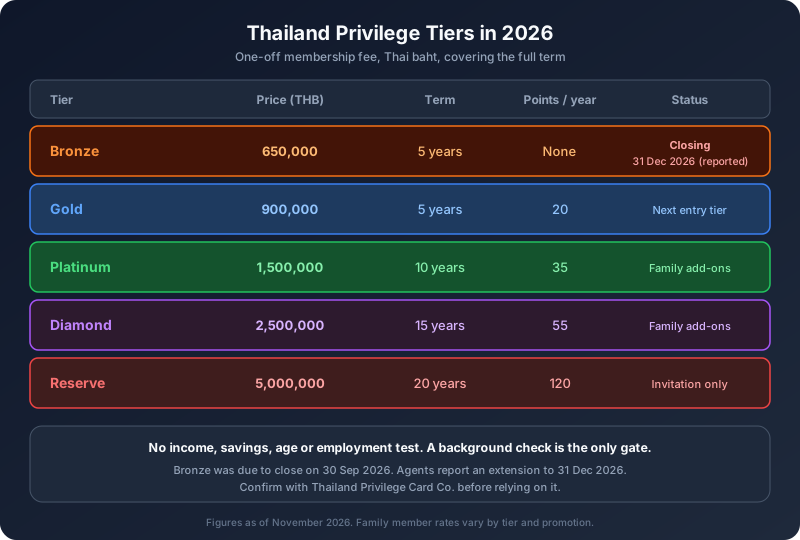
As of November 2026, five tiers are listed. Prices are one-off fees in Thai baht, covering the full term of the membership:
| Tier | Price (THB) | Term | Annual points | Notes |
|---|---|---|---|---|
| Bronze | 650,000 | 5 years | None | Being withdrawn, see below |
| Gold | 900,000 | 5 years | 20 | De facto entry tier once Bronze closes |
| Platinum | 1,500,000 | 10 years | 35 | Family members can be added |
| Diamond | 2,500,000 | 15 years | 55 | Family members can be added |
| Reserve | 5,000,000 | 20 years | 120 | Invitation only |
At recent exchange rates, Bronze works out at roughly 18,000 to 20,000 USD and Gold at roughly 25,000 to 28,000 USD. The old "is it worth 15K?" question from the Elite days no longer matches any tier on sale.
Bronze is in flux. The company announced that the 650,000 THB Bronze tier would stop accepting new applications on 30 September 2026. Several authorised agents have since reported that the deadline was extended to 31 December 2026, together with the reduced "next member" family rate on the higher tiers. We could not confirm the extension on an official channel, and nothing has been said about what happens after December. If Bronze is the tier you want, treat the end of 2026 as a hard deadline and confirm directly with the company before you plan around it. Existing Bronze memberships keep running for their full five years either way.
Family add-ons are priced separately and vary by tier and by whatever promotion is running. Agents have quoted figures from 750,000 THB per additional member under promotions up to 1,000,000 to 2,000,000 THB at standard rates, so get a written quote.
The Real Cost Per Year
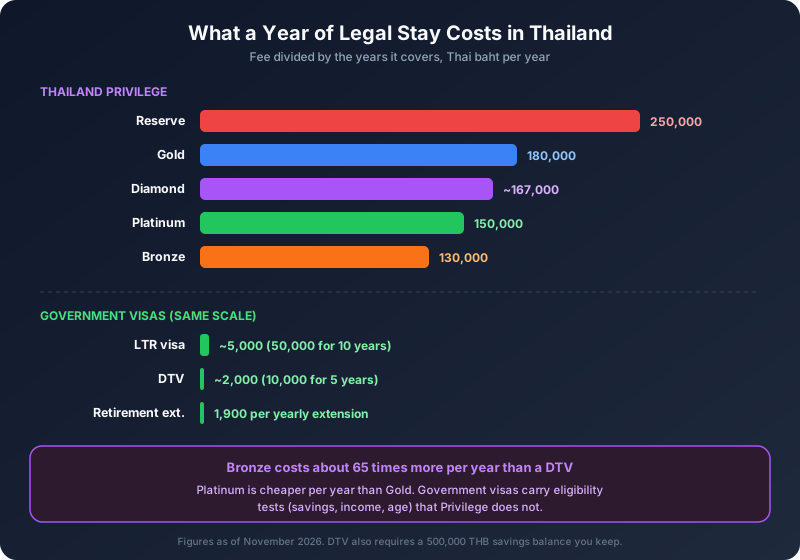
Headline prices hide the useful number, which is the cost per year of legal stay. Divide each fee by its term:
- Bronze: 130,000 THB per year
- Gold: 180,000 THB per year
- Platinum: 150,000 THB per year
- Diamond: about 167,000 THB per year
- Reserve: 250,000 THB per year
Two things stand out. First, Platinum is cheaper per year than Gold, so if you are confident you will want Thailand for a decade, the longer membership is the better deal. Second, every tier is in a completely different price band from the government visas that overlap with it.
Compare the alternatives on the same basis:
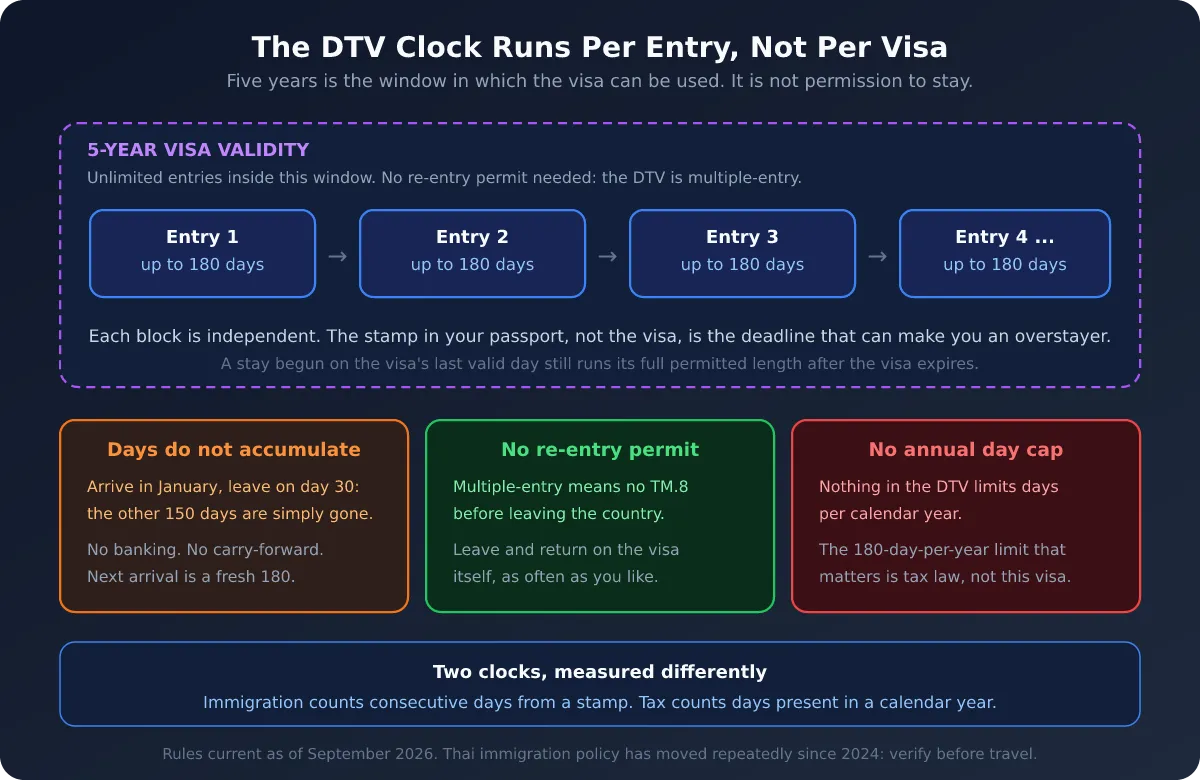
- Destination Thailand Visa (DTV): 10,000 THB for a five-year multiple-entry visa, so about 2,000 THB per year, plus a 500,000 THB savings balance you keep. Our complete DTV guide covers the details.
- Long-Term Resident (LTR) visa: 50,000 THB for ten years, about 5,000 THB per year, but with steep income or asset thresholds. See which LTR category you qualify for.
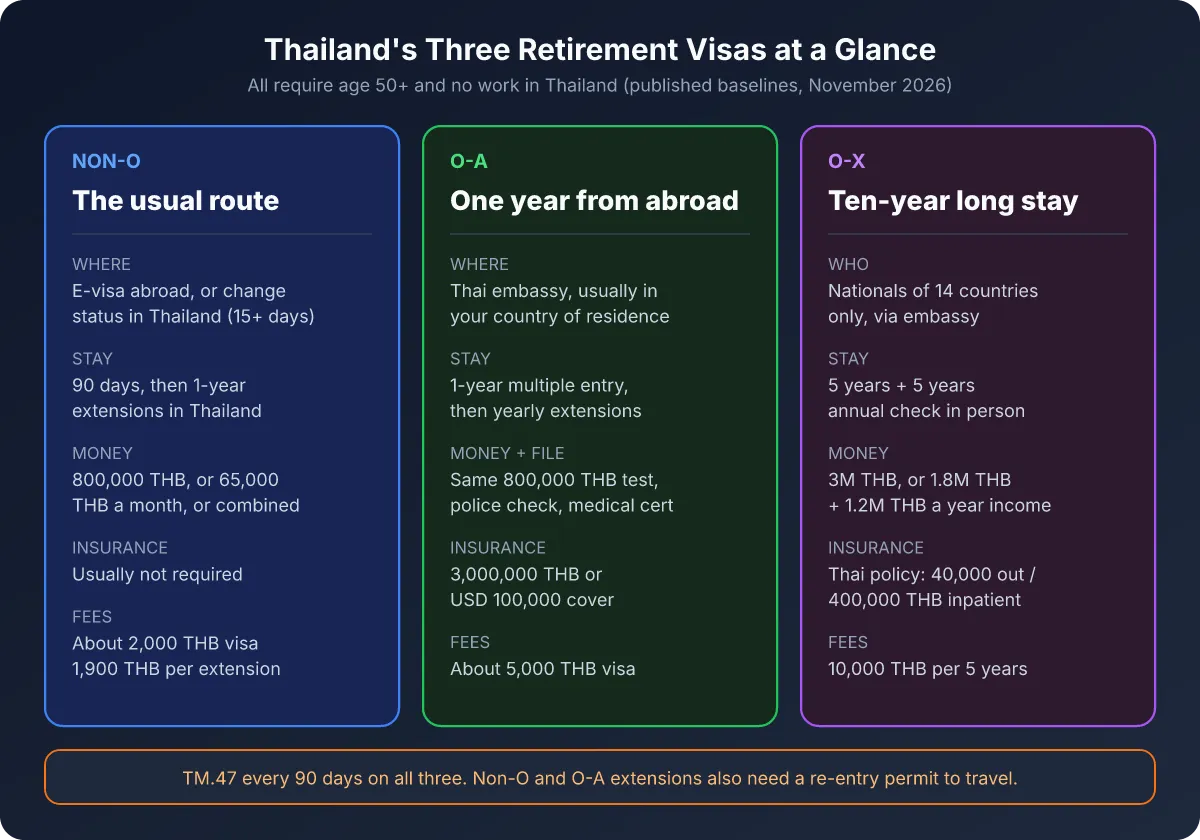
- Retirement extension (Non-O based): 1,900 THB per year at immigration, for people aged 50 or over who meet the financial test. Our retirement visa comparison breaks down the options.
Put bluntly, a Bronze member pays about 65 times more per year than a DTV holder for the right to stay. That premium only makes sense if the cheaper routes are closed to you, or if the things the membership does include are worth that much to you personally.
What the Membership Includes
A long, flexible visa
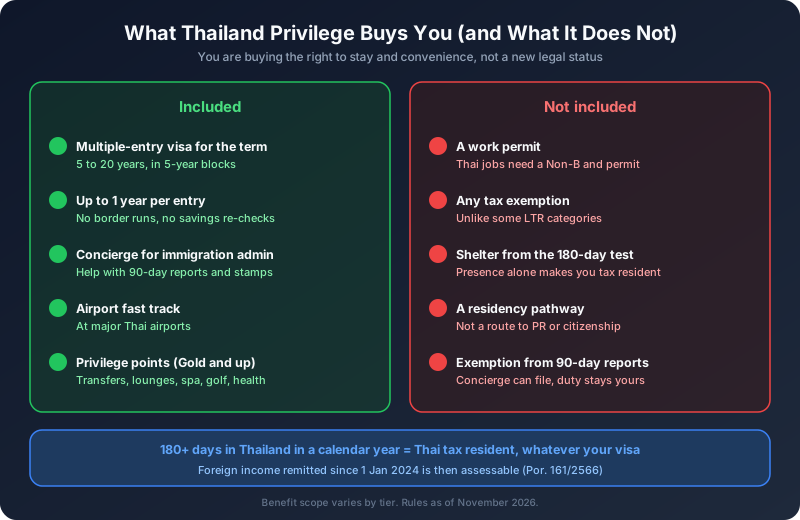
The Privilege Entry visa is multiple-entry and valid for the length of the membership, issued in five-year blocks on the longer tiers. Each entry gives permission to stay for up to one year. Agents disagree on the details of continuous stays beyond a year: some say members simply exit and re-enter, others say an extension of stay at a local immigration office is needed. Either way, it is administratively far lighter than anything else in Thailand's visa system.
What you avoid is the treadmill: no embassy interviews every few years, no border runs, no proving a savings balance at each renewal, no tourist-entry scrutiny at the airport.
Concierge and airport services
Memberships come with an Elite Personal Assistant service that handles much of the immigration admin on your behalf, plus fast-track service at major airports. The exact scope varies by tier, so check the benefits sheet for the one you are buying. On the tiers with points, you spend them on extras such as airport limousine transfers, lounge access, spa treatments, golf, hotel dining and health checks. Points are use-it-or-lose-it perks, and they lapse with the membership. Bronze has no points at all.
Certainty
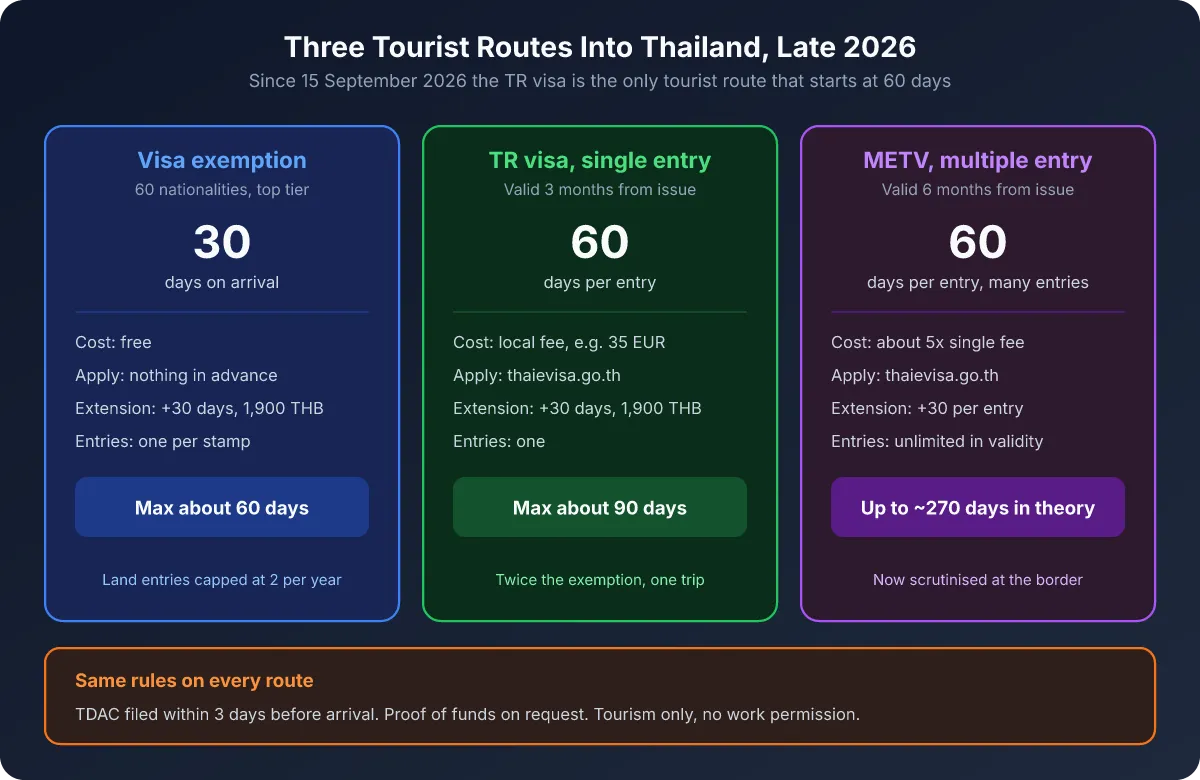
This is the underrated part. Thailand's visa rules have moved a lot recently. The visa-exemption stay for most nationalities was cut, DTV requirements have tightened, and border runs on tourist entries now get questioned. A Privilege visa holder is largely insulated from those swings for the life of the membership. For someone who has already built a life in Thailand and wants to stop thinking about it, that predictability is the actual product.
What It Does Not Include
This is where most buyers get it wrong.
No work permit
The membership grants the right to stay, not the right to work. It does not include a work permit, and it is not a remote-work visa. If you are employed by or invoicing foreign clients from Thailand, the DTV is the visa that explicitly covers working remotely for foreign employers. On a Privilege visa you are in the same grey zone as a tourist working on a laptop, which we cover in the tourist visa work problem. If you want to work for a Thai company, you need a Non-B visa and work permit, not a membership.
No tax treatment of any kind
This is the most expensive misunderstanding. A Privilege membership does nothing to your Thai tax position. Thai tax residency is triggered by physical presence: 180 days or more in Thailand in a calendar year. Your visa type does not enter into it.
Once you are resident, the ordinary rules apply. Since 1 January 2024, foreign income that a resident brings into Thailand is assessable whenever it is remitted, under Departmental Instruction Por. 161/2566, with pre-2024 income protected by Por. 162/2566. The proposed relaxation that would exempt income remitted in the year it is earned or the following year was still a draft as of the latest reporting we could find, not law. Our guide to Thailand's 180-day and remittance rules walks through the full test.
Contrast that with the LTR, where certain categories get a statutory exemption on remitted foreign income under Royal Decree 743. If tax is the reason you are looking at long-stay options, the LTR is the visa built for it. The LTR tax breakdown explains where that exemption applies.
A Privilege visa is genuinely good at one thing that matters for tax: it lets you leave and come back without friction. That makes it easy to manage your calendar-year count deliberately. It does not manage it for you.
No residency pathway or reporting exemption
Time on a Privilege visa is not a route to permanent residence or citizenship on its own. And you still file 90-day address reports like any other long-stay foreigner. The concierge service can handle them for you, but the obligation remains yours.
Screening Got Stricter in 2026
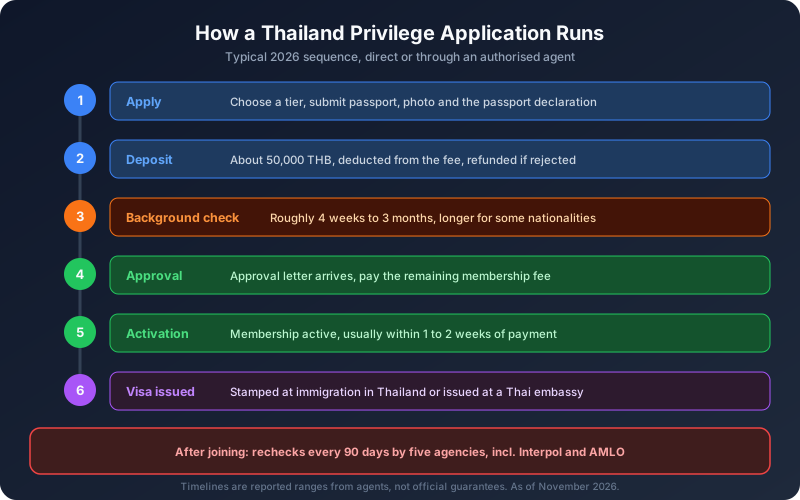
Because there is no income or employment test, the background check is the only gate, and it has been tightened twice. Enhanced screening and a mandatory passport declaration took effect on 17 December 2025, following cases in which membership holders were linked to scam networks. In September 2026 the company said it had widened checks to five agencies, adding Interpol, Thailand's Central Investigation Bureau and the Anti-Money Laundering Office, with members rechecked every 90 days and immediate suspension when irregularities appear. The company puts the share of members involved in offences at under 0.1% of a base of about 40,000.
For a law-abiding applicant this mostly means a slower, more document-heavy process. It also means the membership is no longer a soft option for anyone with a complicated history.
How the Application Works
The process is the same whether you apply directly or through one of the company's authorised agents:
- Choose a tier and submit the application with a passport copy, photo and the required declarations. Applications can be made from inside or outside Thailand.
- Pay the deposit. Agents commonly cite 50,000 THB, deducted from the final fee and refunded if the background check fails.
- Background check. Reported timelines range from about four weeks to three months, and longer for some nationalities.
- Approval and full payment. You receive an approval letter and pay the balance.
- Membership activation, usually within one to two weeks of payment.
- Visa issuance, stamped in Thailand at immigration or issued at a Thai embassy, depending on where you are.
Be wary of anyone who promises a guaranteed approval. Agents can prepare the file and chase the paperwork, but the background check is run by the company and the agencies behind it, and no intermediary can buy you past it.
Who It Actually Makes Sense For
Take three hypothetical profiles.
Anna, 38, US citizen, fully remote software engineer. She has a foreign employer, a salary, and well over 500,000 THB in savings. The DTV covers her for five years at a tiny fraction of the cost and explicitly fits her remote work. Privilege would be paying 130,000 to 180,000 THB a year for airport perks. Not worth it.
Tom, 45, UK citizen, sold a business and lives on investment returns. He has no employer, is too young for the retirement route, and does not fit the DTV's work or "soft power" activity categories comfortably. His assets might reach the LTR wealthy categories, but if they do not, Privilege is one of the few clean multi-year options. For him the membership is buying legal stability that nothing cheaper provides. Plausibly worth it.
Li and Mei, a couple in their 50s with a teenager. They want ten years in Chiang Mai with no admin and occasional trips home. On Platinum with family members added, the per-person cost is high but spread over a decade, and the concierge handles the family's reporting. Worth it if the budget is comfortable and tax has been planned separately.
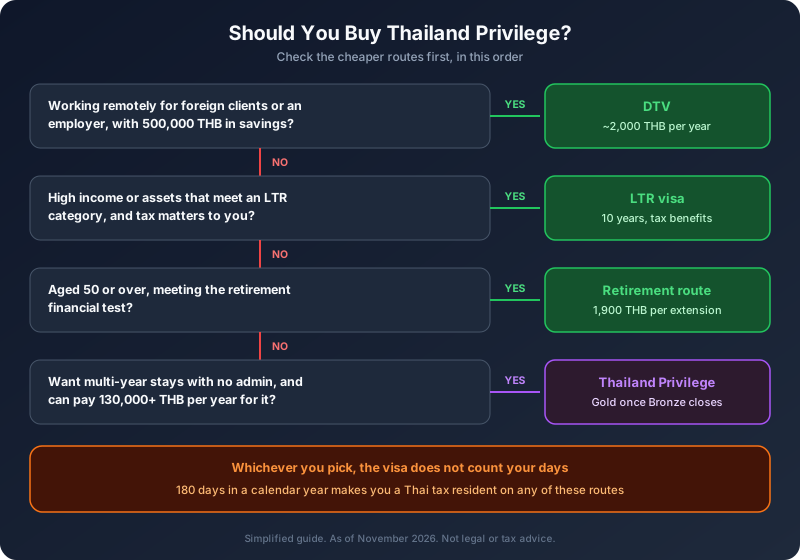
The pattern: Privilege makes sense when the cheaper routes are closed, awkward or unstable for you, and when you value never having to think about Thai immigration again. It makes little sense for a working nomad who qualifies for the DTV, and none at all for someone chasing a tax benefit.
A quick checklist before you buy
- Have you ruled out the DTV, the LTR and, if you are 50 or over, the retirement route?
- Do you plan to stay long enough that the per-year cost is acceptable, ideally five years or more?
- Do you understand that you cannot legally take Thai employment on it?
- Have you modelled your Thai tax position, especially if you will spend 180 days or more there in any calendar year?
- If you want Bronze, can you apply before the end of 2026?
The Bottom Line
Thailand Privilege is a premium convenience product with a visa attached. It is expensive per year, it gives no right to work, and it has zero effect on your tax. It is also the simplest way for someone without an employer, a pension or LTR-level income to live in Thailand legally for a decade, and it shields you from the rule changes that keep catching DTV and tourist-entry holders off guard.
If you buy it, the one thing the membership will never do is count your days. A member who settles in Thailand full time will cross the 180-day tax line in the first calendar year without noticing, and that line, not the visa, decides what you owe.
Your visa covers the stay. Your day count decides the tax.
Nomad Tracker logs your days in Thailand and every other country automatically, alerts you at 150, 170 and 180 days so the Thai tax residency line never surprises you, and lets you test future trips with Ghost Trips before you book. The Schengen calculator runs alongside it for your European time. All on-device and private. Available on iOS.
Download on the App Store